In the winter of 1888, the American frontier became a world reduced to white and silence. Wyoming Territory lay beneath a sky that seemed to have forgotten mercy, and the prairie, usually so vast and open that it could make a man feel small in the best of ways, turned into something else entirely. It became a trap. The cold did not merely arrive. It descended, absolute and punishing, driving itself into log walls, through wool coats, beneath skin, into marrow. Cabins that had once stood as proof of human stubbornness on a difficult land became, in a matter of hours, elegant little coffins rimmed with frost. The winter would later be remembered for the blizzard that took children from schoolhouses and livestock from fields and whole families from homes that had seemed solid enough the night before. But before the storm was named, before it was measured, before it had entered anyone’s memory as history, it was only a possibility riding the air.
Margaret Thorne smelled it coming long before most others did.
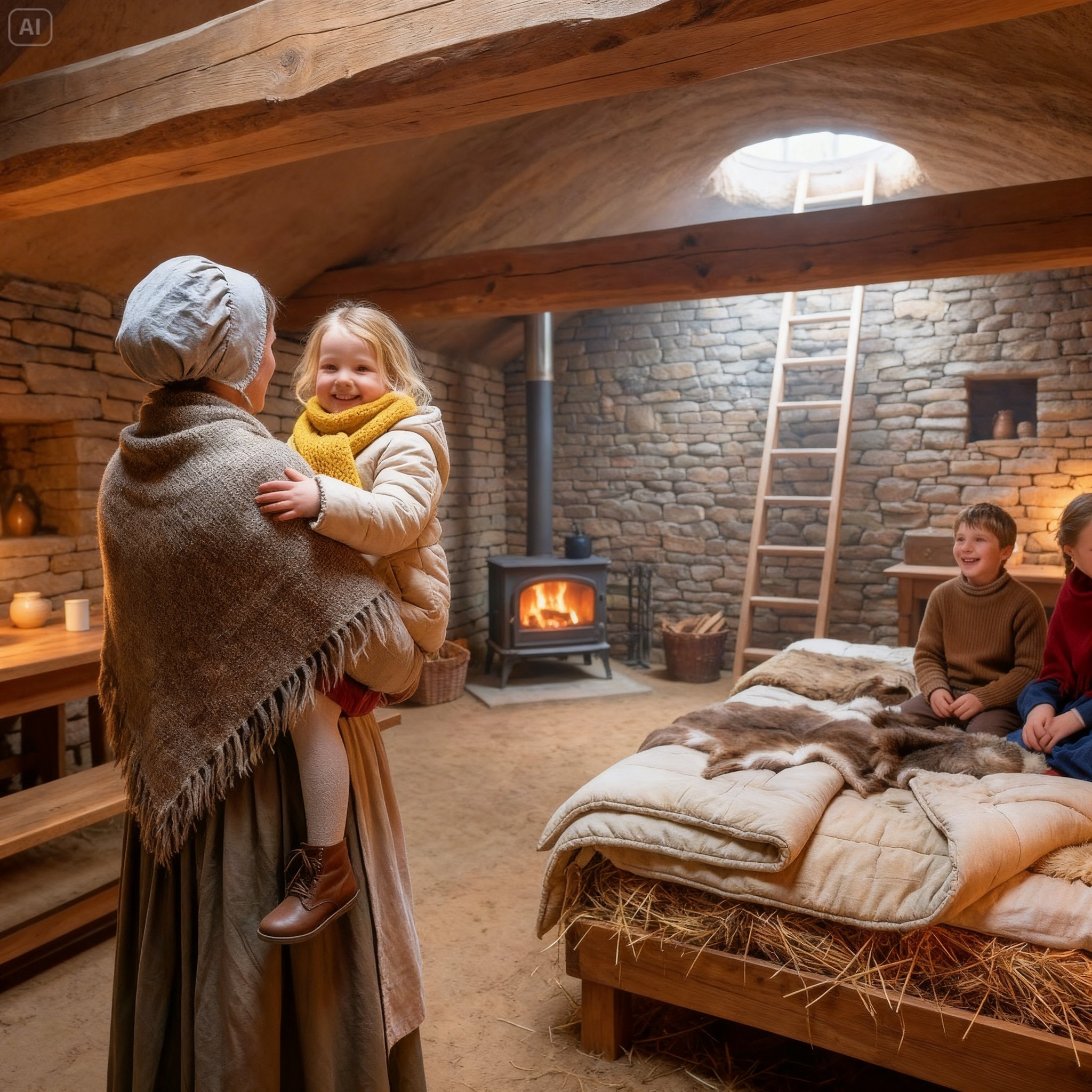
In October 1888, inside a weathered barn that measured 18 by 20 feet, Margaret was not tending hay or currying horses or doing any of the ordinary work a widow was expected to do in a place like that. She was measuring the earth. At 34, she had already learned that expectation rarely kept anyone warm. With a rusted iron spade, a length of twine, and an attention so exact it might have been mistaken for prayer, she marked a rectangular perimeter beneath the center joists of the barn floor. Her 3 children watched from the shadows of the loft—Beth, 10 years old and already old enough to understand fear; James, 8, restless and sharp-eyed; and Clara, 5, who still believed every adult action concealed some secret magic.
To anyone riding past, it might have looked like Margaret was digging a grave.
In a sense, she was. Not for her family, but for every idea the valley held about how survival ought to look.
The work began in silence and continued that way for days. Margaret removed the soil in uniform buckets, digging until she reached a depth of 7 feet. The labor was punishing. Wyoming earth did not surrender easily, and each spadeful demanded effort from shoulders and hands already worn thin by widowhood, harvest, and the endless negotiations of poverty. But Margaret worked methodically because desperation had not made her frantic. It had made her precise.
The year before, she had watched her husband Thomas burn through 3 cords of wood trying to keep the drafty cabin warm while the cold still climbed the inside walls like frostbitten fingers. Firewood vanished. Heat vanished. Then Thomas vanished too, taken by fever while the wind needled its way through every seam of the house. Since then, Margaret had come to understand a truth no one around her seemed willing to admit: a log cabin was only a brave idea until the weather turned against it. Then it was a sieve. Fireplace heat rose and escaped. Wind found cracks. Walls shrank and shifted. Warmth had to be fed constantly like an animal with a bottomless appetite.
Earth, however, did not behave like that.
The deeper she dug, the more convinced Margaret became that the answer was not above the ground but beneath it. The soil held its own temperature, stable and indifferent to the swings of weather. The barn above, with its horses and cow, offered another form of heat no cabin could replicate. Animals breathed, shifted, radiated warmth continuously, and if their heat could be trapped and guided rather than wasted, perhaps it could become part of something stronger than mere shelter. Not a house in the ordinary sense. A system.
Beth climbed down from the loft one afternoon and stood beside the pit, looking into it with the grave suspicion of a child who had begun to understand when her mother was attempting something larger than daily life.
“Why aren’t we fixing the roof on the house, Mama?” she asked.
Margaret straightened and wiped dirt from her forehead with the back of one wrist. She pointed upward to the floorboards above them, where the horses shifted in their stalls and the milk cow exhaled into the cooling air.
“A cabin is a sieve, Beth,” she said. “But the earth is a blanket. Up there, those animals make heat all day and all night. Their bodies, their breath. It goes nowhere useful in the cabin. Down here, with enough soil and stone around us, the heat stays.”
Beth frowned, trying to picture what her mother meant.
Margaret knelt and touched the edge of the excavation. “The wind can steal what is loose. It can’t steal what is buried.”
She began lining the chamber with white quartz gathered from the dry creek bed, stacking each piece without mortar, fitting the jagged stones together by balance and angle alone. The walls leaned slightly inward, designed so the earth pressing around them would tighten the whole structure rather than break it apart. It was dry-stack work, careful and intelligent, and over time a room began to emerge from the hole. A chamber 12 feet long and 8 feet wide. Stone. Soil. Purpose.
Then Isaac Miller came.
He arrived with the easy confidence of a man who had long mistaken status for wisdom. His horse’s approach sounded first, a steady thud on the dirt road outside, then his shadow stretched into the doorway of the barn. Isaac Miller was the valley’s wealthiest landowner, a man whose opinions passed too easily for law among the people of Buffalo. He stood above the pit in his heavy coat and expensive boots, looking down at Margaret with the sort of practiced pity that always carried an insult inside it.
“Still digging in the dirt, Margaret?” he asked. “Folks in Buffalo are talking. They say a woman who lives like a badger isn’t fit to raise children in Christian territory.”
Margaret did not climb out of the pit to answer him. She stood where she was, her hands stained dark by soil, and looked up…..
“The talk in Buffalo won’t keep my children warm in January, Mr. Miller. This stone will.”
Miller’s expression hardened.
“The law requires a proper dwelling to hold this claim. If there isn’t a house fit for human habitation standing here by November 1st, I’ll have the marshal sign the deed over. A widow who can’t build a chimney has no business keeping prime grazing land.”
Then he rode away, taking his certainty with him. The sound of his departure faded into a gust of sharp air that cut through the doorway and changed the temperature of the barn in seconds. The sky beyond the opening had turned a bruised gray. The scent of snow entered behind him, metallic and absolute.
The valley’s grace period had ended.
By the second week of October, the excavation reached its full depth. Margaret turned to what mattered next: air.
A room under the ground could keep heat beautifully. It could also kill with equal efficiency if it could not breathe. Margaret had acquired a set of 8-inch clay drainage tiles and laid them in a trench from the chamber ceiling beneath the barn foundation and outward toward a natural fissure in a limestone bluff nearby. The vent had to be hidden. Anything that looked like a chimney would draw questions, and Margaret had already learned that men like Isaac Miller considered a widow’s ingenuity less acceptable than her suffering. So the flue became a secret. It would carry stale air and stove smoke out through stone where no one could see it.
The town noticed her anyway.
When Margaret went 3 miles into Buffalo for supplies, people made room for her without kindness. Widowhood had a way of becoming a superstition in hard places. Some people seemed to believe a woman who had lost her husband had somehow courted misfortune and might carry it with her like illness. At the general store, Margaret pointed to a stack of fire-hardened bricks she needed to line the chamber’s small corner hearth, and the clerk looked at her as if he regretted having to conduct business at all.
“I can’t carry you on credit, Mrs. Thorne,” he said. “Folks say you’re pouring everything into a hole in the ground instead of building a proper roof. That’s a poor risk.”
Margaret did not argue. She reached up, unclasped the chain at her throat, and slid off the plain gold band hanging there. Thomas’s wedding ring. The last of him she could sell.
She laid it on the counter.
The bricks came home with her.
That evening, she stuffed raw sheep’s wool and compressed straw into the gaps between the barn floorboards overhead, sealing them in layers. The insulation would trap warmth from the animals above while blocking the drafts that moved through the barn itself. It was dirty, itchy work, but she did it carefully, understanding that survival often depended on the things no one thought worth admiring.
Outside, the weather changed personality. What had been a whistle became a howl. Wind no longer moved around the buildings as weather. It moved like intention. Looking for seams. Testing weak points. The first true Arctic bite came before the month was out.
“Mama,” James asked one evening as Margaret worked on the trap door, “Billy says people only go underground when they’re finished. Are we going to die in here?
She Hid Her Children’s Bedroom Under the Barn — Then the Blizzard Made It Their Only Shelter