In the Montana Territory in 1872, the land had a way of sorting people long before society finished trying to name them.
The smooth ones slipped easily toward towns, toward churches with painted trim, toward dining rooms where conversation followed rules and parlors where chairs were made for narrower bodies and gentler manners. They moved with the current of other lives, carried along by the great human agreement about what was ordinary, desirable, civilized, and appropriately sized. They found companionship more readily because the world had already built itself to fit them. They were stones the river took without protest.
The rough ones stayed where they had fallen.
They lodged in creek beds and mountain cuts. They held fast where the current could not smooth them enough to make them welcome downstream. They were too broad in shoulder or too blunt in speech, too loud in laughter or too heavy in silence, too scarred, too awkward, too much of some quality the world preferred in smaller portions. They learned early what it meant to be measured and found excessive.
Callum Brek was one of those people.
At 43, he lived alone on a ridge above the Flathead Valley in a cabin he had built over 16 years out of labor, weather, and the stubborn belief that a man might yet make a home sturdy enough to hold a life larger than the one he had been given. The cabin was not elegant, but it was substantial. Three rooms. A broad stone fireplace large enough to heat the whole structure in winter. A porch facing the valley where each evening the sunset unfurled itself in a display so extravagant it seemed almost indecent for one man to witness alone.
He was, by any ordinary measure, an imposing figure.
He stood so tall that most doorways required negotiation rather than passage. He was broad enough through the shoulders and chest that furniture seemed to take his arrival as a personal insult. His hands were enormous, roughened and scarred across every knuckle by years of chopping, hauling, shoeing, lifting, planing, building, and losing small arguments with tools sharp enough to leave records. He looked assembled the way mountains looked assembled: from whatever materials were at hand, without consultation, without concern for symmetry, and with no intention of apologizing afterward.
His face did little to soften the effect.
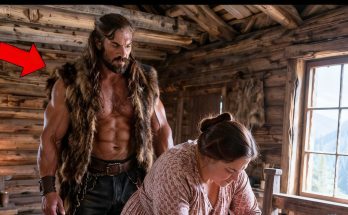
A scar cut through his left eyebrow, pale against weathered skin. His nose had once belonged to a different arrangement before a horse objected to being saddled and settled the dispute with force. His jaw was wide and unyielding, most of it hidden beneath a beard that had long since moved beyond grooming into something like habitat. He had the kind of countenance that made children pause mid-step, dogs reconsider their trust, and women in towns lower their eyes and drift to the other side of a street before they had even fully registered why.
The trouble was that his eyes ruined the rest of him.
They were warm brown. Not merely brown, but rich and deep, the color of wet earth after rain, of turned soil in spring, of something living and generous and kind. Everything else about him suggested danger, severity, rough edges, hardness. Then a person met his gaze and found gentleness there so plain and unguarded it almost felt like a mistake in creation. It was as though God, having finished the rest of Callum Brek’s alarming frame, had reached into the wrong drawer for the eyes and decided to leave the contradiction in place just to see what it might do to a man’s life.
What it did was make him lonely in a very specific, punishing way.
Cruel men were feared and sometimes desired. Handsome men were forgiven in advance. Quiet men with agreeable features found wives because people liked the look of them across a supper table. But a man built like Callum, with a face that warned strangers away and eyes that betrayed every decent impulse he had ever possessed, became something harder for other people to categorize. He frightened before he reassured. By the time reassurance arrived, many people had already retreated.
So he lived mostly with horses.
They listened well. They had no opinion about scars. They asked little beyond hay, weather, routine, and fair handling. But horses, for all their virtues, were poor companions for a man who wanted a wife. Not a servant. Not merely someone to cook and wash and mend. A wife. A partner. Someone to sit beside on the porch while the last light poured over the valley in copper and purple and aching gold. Someone to whom he might speak a thought aloud and hear a human voice answer back. Someone before whom silence would not feel like evidence of a life gone partially unwitnessed.
The mail-order correspondence service had been his idea.
That was the practical side of him, the part built as solidly as the cabin. Within any sensible riding distance of his ridge there were no unmarried women likely to come his way willingly. Within the wider territory there were few enough, and those who had already seen his face had given no sign of wanting a second look. Mathematics, if not optimism, required him to expand the search.
So he placed an advertisement.
He did not write anything clever. Callum was not a clever writer, only an honest one. He described himself plainly enough, stated that he had land, a cabin, livestock, means enough for a modest but stable life, and an intention to marry if a suitable woman could be found who understood the realities of frontier living. He did not embellish himself. He could not have, even if he wished to. No sentence could have adequately disguised either the remoteness of the mountain or the fact of Callum Brek.
Still, letters came.
The first bride arrived in April.
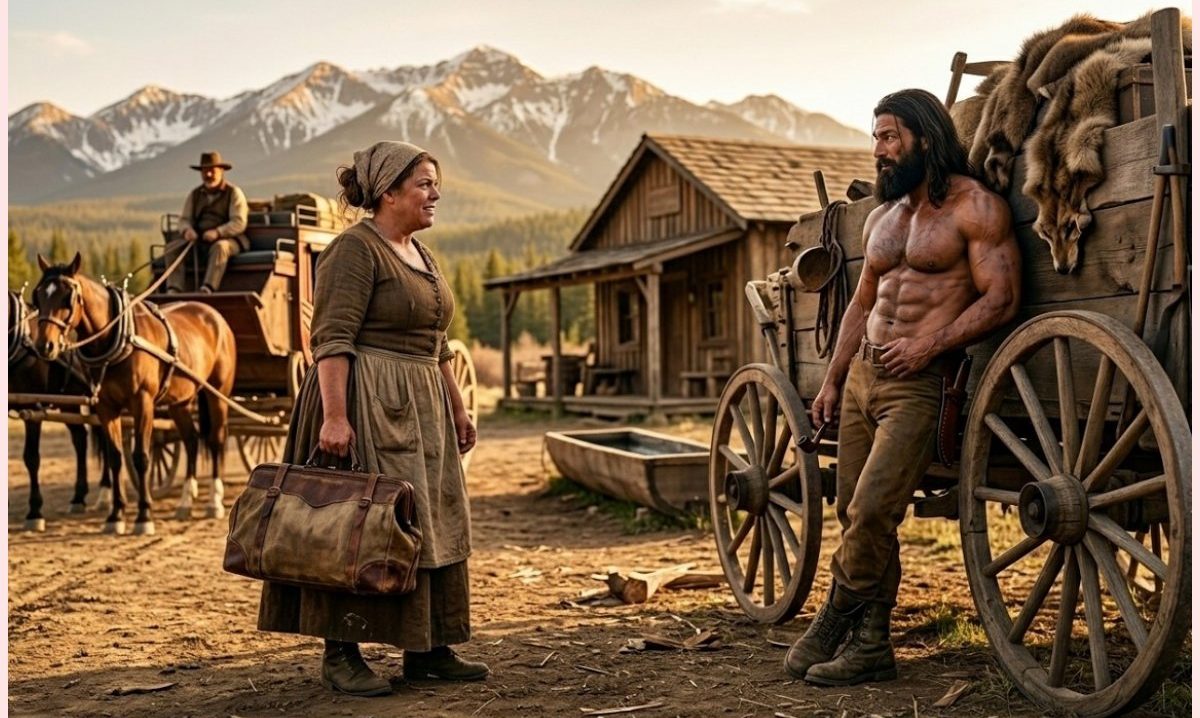
Her name was Helen, and she came from Ohio with a hat too fine for the mountain wind and a look in her eyes that shifted by the mile from nervous curiosity to despair. Callum met her at the stage and drove her up to the ridge in a wagon that had already carried enough freight to know the road by memory. She tried, at first, to remain polite. But the mountain was too high for her comfort, the cabin too remote, the valley too empty of neighbors, the silence too complete once evening came down around the ridge. She took one long look at the house, one longer look at Callum, and said very little after that. She lasted 4 days. By Thursday she was on the southbound stage again, heading back toward smaller skies and more familiar arrangements.
The second bride came in June.
Margaret was from Pennsylvania, slimmer and more composed than Helen had been, but the silence of the mountain worked on her differently. At night she said it felt as though the world had ended and left only the cabin behind. No voices. No wagon wheels in the distance. No church bells. No human movement except the man across the table from her, eating in near-silence with hands the size of plates. She cried each evening and each morning. On the third day she asked when the next stage left. On the third morning the answer happened to be today. She took it.
The third arrived in August.
Dorothy, from Virginia, stayed 6 days, which made her the record holder for a time and would have been almost funny to Callum if it had not felt like a cruel method of keeping score on his own unfitness. She was tougher than the first 2. She could cook. She could sweep and mend and manage a house. The mountain itself did not trouble her. What troubled her was Callum. The way he ate. The way he walked. The way he filled a room so completely that it seemed impossible for another person to exist inside it without being crowded by his mere being. She finally said, in language memorable enough to survive his shame, that living with him felt like living inside a bear. She left on a Saturday.
The fourth bride arrived in September.
Catherine came from New York and did not even properly begin. She stood in the cabin doorway, stared at the interior with its rough-hewn furniture and the broad hearth and the view through the far window to the immense valley beyond, and broke into tears so suddenly and completely that Callum understood almost at once there would be no salvaging the visit. She said she wanted to go home. He drove her back to town in a silence unlike his usual one. His ordinary silence belonged to habit. This one belonged to something more painful. By then he had begun to suspect that the common factor in all these failures was not the mountain, or the distance, or the weather, or the women.
The common factor was him.
The fifth bride arrived in October.
Sarah was from Massachusetts, and she lasted less than a day. She stepped off the stage, looked at him directly, and said with a kind of hard honesty that under other circumstances he might have admired, “I cannot do this.”
She did not even see the cabin.
She boarded the same stage again and disappeared back into the world of gentler proportions.
Five women. Five departures. Five fresh confirmations of what Callum had suspected in one form or another since childhood: that he was too much. Too large. Too rough. Too remote. Too far from whatever the world recognized as normal or desirable or safe. The correspondence service had not corrected the problem. It had only measured it more systematically.
By winter he stopped writing letters.
He put away the correspondence papers in a drawer he did not open again. Snow sealed the ridge. The road became unreliable, then nearly impassable. The world shrank to the cabin, the barn, the stock, the woodpile, the valley below, and his own company. None of it improved his opinion of himself. A man could get through many things if he believed them temporary, but repeated failure had a way of settling into the bones. It became less an event than an atmosphere.
Winter on the mountain was long.
The snow piled high against the cabin walls. The mornings began in blue cold and stayed there until the stove took command of the room. Callum moved through his chores in the same practiced rhythm he always had, feeding, chopping, hauling, patching, checking, repairing, speaking when necessary to the horses and almost never to himself. The sunsets still came. They still performed their extravagant evening miracles across the valley. Sometimes he stood on the porch and watched them until the light drained away. More often he stayed inside, because beauty endured alone could begin to feel like mockery.
Then, in March of 1873, when winter had started to loosen but had not yet truly surrendered, the trading post owner sent word up the mountain with a timber hauler.
A letter had arrived.
Callum almost ignored it.
He had written to no one. He expected nothing. Hope, once repeatedly embarrassed, becomes a thing a man learns to leave unattended. But curiosity was stubborn in him, and perhaps some smaller, less acknowledged part of him still twitched when the world unexpectedly produced a sealed envelope bearing his name.
The letter was from a woman named Ruth Fairchild of Iowa.
He sat at his table near the window and read it once through. Then he read it again. Then a third time, slower.
It was unlike any letter he had received before.
The earlier ones had all contained a certain polish, as though the women writing them were presenting carefully arranged versions of themselves for approval. Some mentioned domestic skills. Some mentioned family values. Some described themselves in terms designed to suggest sweetness, delicacy, refinement, piety, patience, and all the other virtues commonly listed when a woman wished to be chosen.
Ruth Fairchild did none of that.
Her letter contained facts. Unvarnished, blunt, almost startlingly free of performance. She wrote that she was 37 years old. She wrote that she was not beautiful. She did not circle the fact with modesty or false self-deprecation. She stated it the way a sensible person states the weather. She wrote that she was large—not tall, but large. Wide. Solid. Visible. She used the very word other people used about her when they believed she could not hear them or when they simply did not care whether she did.
She wrote that she had spent 37 years being the woman no one chose first. The woman not noticed at dances except by mothers who worried their sons might be forced by politeness to ask her. The woman whose own mother had stopped mentioning marriage in that particular hopeful tone parents reserve for futures they can still imagine. The woman who occupied too much space in rooms designed by and for people who believed women should be graceful by taking up almost none.
There was no bitterness in the writing, or none that curdled it. Only clarity.
She wrote that she was an excellent cook.
Not decent. Not capable. Excellent. She said she could make a meal from almost nothing and a feast from almost anything. She could bake bread that would make a man forget his own name. She knew how to preserve, pickle, smoke, salt, and cure food. She could run a kitchen the way a general ran a campaign, by order, timing, resourcefulness, and unshakable authority.
She wrote that she was strong. Truly strong. She could carry water, chop wood, manage long days, walk hard miles, and do the kind of practical labor other people often assumed a woman of her size could not do, mistaking softness of outline for softness of function. She corrected the misunderstanding without fuss. Her size, she said in effect, was not weakness. It was fuel. It was foundation. It was the physical architecture of someone built for endurance.
She wrote that she did not expect romance.
She did not expect compliments. She did not expect serenades, courtship flourishes, or a man whose first instinct would be to praise her eyes while silently wishing her waist were smaller. She expected work, shelter, usefulness, and the basic dignity of being treated as a human being instead of a disappointment in a dress.
Then she ended with a line that caused Callum to go back and read the whole letter a fourth time.
“I understand you have difficulty keeping wives. I have difficulty being wanted. Perhaps our difficulties are compatible.”
Callum did not hesitate.
He took out paper. He sharpened a pencil with his knife. He wrote the shortest letter he had ever sent to anyone in his life.
“Come.”
That was all.
She arrived on a Tuesday in April.
He met the stage at the trading post in the valley just as he had for the other 5 women, but he made fewer preparations this time. He had not cleaned the cabin 3 times over. He had not borrowed a better coat. He had not polished his boots or trimmed his beard or attempted to rearrange himself into something less alarming. Experience had cured him of ceremony. If the outcome was going to be disappointment, there was no point exhausting himself by decorating the approach to it.
The stage rolled in under a pale spring sky with mud still clinging to its wheels from lower roads. Callum stood by the hitching rail and watched as passengers descended, each one momentarily obscured by the shifting door and the driver’s bulk until finally a woman in a plain brown dress stepped down carrying one bag.
Ruth Fairchild was exactly what her letter had promised.
She was large. Not tall. Not delicate. Not trying. She had a broad body that occupied space with the solidity of furniture built to last, not furniture made to impress a guest and fail under actual use. Her face was round and wind-reddened, framed by brown hair pinned back with the practical indifference of a woman who regarded hair chiefly as an obstacle to be managed. Her eyes were hazel-green with flecks of gold, sharp and observant. They were the eyes of someone who had spent years on the margins of other people’s attention and had learned, in compensation, to notice nearly everything.
She stood on the platform and looked at Callum the way a carpenter might look at an empty lot: assessing not whether it was attractive, but what might be possible on it.
He looked at her.
She looked at him.
For a moment nothing happened except recognition of a very unusual kind. Two people long judged excessive by the world found themselves standing face to face at last.
“You are bigger than I expected,” she said.
“So are you,” he answered.
The words left his mouth before his mind had a chance to catch them. Almost immediately he wished he could reach into the air and grab them back. He had not meant insult. He had meant, perhaps, surprise mingled with relief, but surprise is dangerous when spoken aloud to a stranger already accustomed to being measured.
Ruth stared at him for one long second.
Then she laughed.
It was not a ladylike sound. It did not arrive in little careful notes meant to reassure others. It was a real laugh, deep and generous and magnificently unconcerned with whether anyone nearby considered it too loud. It rolled out of her with such fullness that Callum felt, absurdly, as if the mountains themselves had joined in.
“Well,” she said, still laughing, “at least we will not have to worry about fitting through doorways together.”
That was the first thing she gave him: relief without pity.
He loaded her bag into the wagon, and they started up the mountain.
For the first mile she said almost nothing. He assumed she was tiring from the ride or considering her odds of escape. But now and then he caught her looking not back toward town, but outward. At the pines. At the valley. At the blue distance. At the way the afternoon light fell over the slopes as though the whole country had been painted by a hand showing off.
At last she said, “It is beautiful.”
“It is remote,” he answered, because that had always been the next necessary truth. “The nearest town is 2 hours. The snow closes the road for months. You will hear nothing but wind and animals and me, and I do not talk much.”
Ruth rested her forearms on her bag and looked ahead. “I have been surrounded by people my entire life,” she said. “People who look through me as if I were a window. Silence sounds like an improvement.”
He had no answer to that. Or rather, he had an answer in the form of understanding, which was rarer and heavier than speech.
By the time they reached the cabin, the light had begun to soften. Ruth climbed down from the wagon and stood in the yard looking at the house just as the other women had done. Callum braced himself for the familiar sequence: the pause, the dismay, the calculation of retreat.
Instead she said, “The chimney draws well?”
“Yes.”
“The root cellar is dry?”
“Mostly.”
“You have a proper stove?”
“Cast iron.”
She nodded once, as though a series of private requirements had been satisfactorily met, and walked straight into the house without waiting for invitation.
Callum followed, ducking through the doorway as he always did.
He found her in the kitchen with one hand resting on the cast-iron stove. There was reverence in the gesture. A musician might have touched a good instrument that way. A blacksmith might have touched excellent steel.
“This will do,” she said.
He blinked. “Will do?”
“The cabin needs work,” she continued, glancing around with brisk assessment. “The kitchen needs organization. The pantry needs a system. And you need a proper meal. When did you last eat something that was not burned or raw?”
He considered the question with more honesty than dignity. “I do not remember.”
“Sit down.”
He did.
He sat in his own kitchen at his own table while a woman who had been in the house for perhaps 4 minutes began taking command of the room as if she had been waiting years for the chance.
Part 2
Ruth moved through the kitchen with the calm authority of someone stepping into her natural element.
She opened cupboards and examined their contents with swift, unsentimental efficiency. She lifted lids, sniffed jars, checked the flour, found beans, salt, a heel of bacon, potatoes, onions, a half-forgotten bundle of dried herbs Callum had never once thought to use, and several edible things growing wild near the side of the cabin that he had spent 16 years walking past without suspecting they were of any culinary value at all. She handled every ingredient like a person accustomed to coaxing order from scarcity and abundance alike.
The first sounds she brought into the room were not conversation, but competence: the clink of iron against the stove, the scrape of a knife, the splash of water, the soft authoritative thud of cupboards closing under new judgments. The first smell was onion hitting fat in a hot pan, then something deeper, warmer, richer, until the whole kitchen began filling with an aroma so astonishing that Callum had the disorienting sensation of realizing his own house had always possessed more possibilities than he knew.
By the time she set a bowl before him, even the horses in the barn seemed alert to the miracle.
He took a bite.
Then he stopped.
Not because the food was bad, but because it was the best thing he had ever tasted in his life and his mouth required a moment to understand that such a thing could be produced from ingredients he had previously considered little more than survival material. The stew was dense, fragrant, layered, alive with a kind of intelligence he had never before associated with dinner. Heat, salt, sweetness, earth, herb, smoke—everything seemed to have arrived in the bowl on purpose.
“This is acceptable?” Ruth asked.
Her face remained composed, but her eyes had sharpened with amusement. She already knew the answer. She had likely seen this exact look on people before: the stunned silence of someone discovering that food could aspire to more than merely not killing them.
“It is acceptable,” Callum managed.
That was enough. She smiled, not coyly, not with the practiced modesty of someone pretending surprise at praise, but with the quiet satisfaction of a craftswoman who has arrived where her work belongs.
She did not leave the next day.
Nor the day after that.
The first week passed without the usual signs of collapse. Ruth did not ask when the stage ran. She did not cry at the silence. She did not look at the mountain with resentment. Instead the days found their shape around her presence the way water found its shape around stone—naturally, decisively, and in patterns that soon seemed as though they had always been waiting there.
She organized the kitchen first.
No military quartermaster ever brought more ruthless order to supplies. Within 2 days the shelves had been rearranged, the spices and dried goods sorted, the good knives separated from the useless ones, the root cellar inventoried, the cracked crock replaced, the hanging hooks repurposed, and the entire notion of where things belonged corrected according to a logic so obvious once she implemented it that Callum felt slightly ashamed of having lived otherwise.
Then she set about the rest of the cabin.
Not because it was filthy. Callum kept things passably clean. But there is a difference between a place not actively dirty and a place actually lived in with care. Ruth saw that difference immediately. She shook out rugs. She scrubbed the table. She aired bedding. She hung herbs from the ceiling where they swayed gently in the warmer air and scented the room with rosemary, thyme, and things Callum could identify only after she explained them. She cleaned not for show, but for function. A chair was moved because it belonged where evening light would fall on a book or mending. A jar was shifted because its contents would keep better there. A blanket appeared on the porch because spring evenings still held a bite once the sun dropped.
The cabin became, under her hands, not merely habitable but welcoming.
Bread was often part of the transformation.
She baked with a consistency bordering on benevolence. Loaves appeared golden and fragrant, their crusts snapping softly when broken, their interiors warm and tender enough to make any meal seem not just sufficient but fortunate. The first time Callum tore into one fresh from the oven he had to set it down and stare at it for a second, as if bread itself had changed species.
He watched this metamorphosis with a kind of reverent caution. The more the house altered around Ruth’s presence, the more he felt he ought to move carefully, speak carefully, perhaps even breathe carefully in case any sudden disturbance caused the spell to break. Extraordinary things, in his experience, did not last.
He tried to help.
She redirected him.
Not cruelly. Not even sharply, most of the time. But with the absolute certainty of a woman who knew her own domain and saw no reason to surrender command of it to a man whose chief culinary achievement thus far had been producing bread dense enough to wedge under a door.
“You can help outside,” she told him one morning when he reached, uninvited, for a dish towel. “Inside is mine.”
He withdrew his hand at once. Partly because she was right. Partly because there was no arguing with her on matters she had already decided. Arguing with Ruth, he was beginning to learn, resembled arguing with weather. It could be attempted in theory. In practice it achieved little and wasted energy.
Outside, she proved no less formidable.
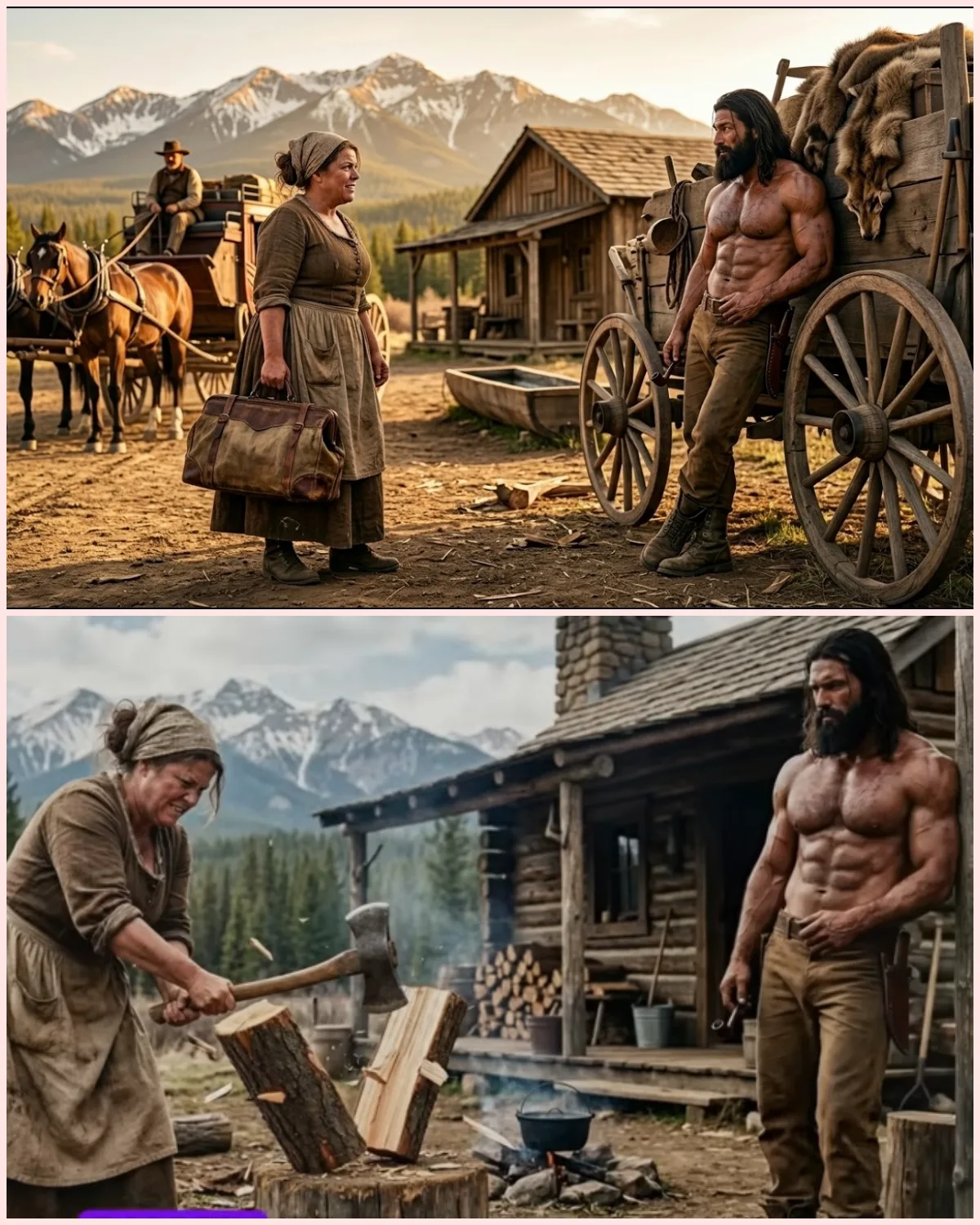
Ruth was strong exactly as she had claimed to be. Not in the decorative frontier-story sense where women lifted improbable things for a single moment of admiration, but in the real enduring sense that comes from years of using one’s body as a tool without apology. She carried water from the creek in full buckets. She split kindling cleanly. She hauled baskets of laundry, sacks of potatoes, bundles of brush, and lengths of wood without making performance of any of it. She walked the mountain paths without complaint, her breath steady where smaller women had faltered after the first incline.
She did not seem to regard her size as an obstacle at all. She used it as fact, as leverage, as capacity.
It unsettled Callum at first, not because he disliked it but because he had never seen it before in a woman who was also meant to be his wife. The world had taught him that women were supposed to be light, decorative, careful, grateful for help, and occupied with seeming smaller than they were. Ruth appeared to have received none of those instructions or else to have burned them unread.
One evening, perhaps 2 weeks after her arrival, he found her on the back steps with a basket of clean laundry balanced on one knee, glaring at the sky.
“What’s wrong?” he asked.
“The shirts,” she said.
He looked up, as though the sky itself might be responsible for his shirts.
“They are too large for the line I have,” Ruth continued. “And the line I have is the line you built, which means the fault is yours, though indirectly.”
He considered this. “I can put up a longer line.”
“You can. And you will.”
So he did.
That was how many things went. Ruth discovered a problem or a deficiency, and Callum built or adjusted accordingly. The cabin expanded in her mind before a single board was cut, because she could see what it ought to become faster than he could imagine it. Yet there was nothing fragile about the arrangement. It did not make him smaller. It made him useful in new directions.
He built shelves because Ruth needed shelves. He widened storage because Ruth had opinions about the relationship between flour, rodents, and good sense. He repaired hinges more promptly because Ruth noticed every squeak and considered them moral failings. He found himself, to his own surprise, enjoying the certainty of being expected.
For Ruth, the mountain seemed not to diminish life but to make it legible. There was work, weather, food, order, fatigue, rest, and beauty. None of it needed polishing for company. None of it required pretending. She looked out at the valley from the porch in the evenings with the steady appreciation of someone who had not come there expecting ease, only space.
It was that word, though unspoken at first, that hovered around her.
Space.
Space on the land. Space in the rooms. Space in the day. Space inside silence. Space in which a person might exist at full size without constant correction.
One evening she found Callum on the porch watching the sunset.
The chairs creaked under both their weights when she sat beside him. He had once been embarrassed by the sounds furniture made beneath him. Ruth was not embarrassed by them at all. Chairs creaked. Floors groaned. Doors objected. Matter answered mass. There was no point blushing about physics.
For a while they sat in quiet, the valley opening below them under a sky going copper, violet, and gold.
At last Ruth said, “You are staring at the sunset like it owes you money.”
Callum kept his eyes on the horizon. “I like the sunset.”
“You like it alone,” she said. “That is different from liking it.”
He turned and looked at her then.
She was not watching the valley. She was watching him watching it. Her expression held no mockery. No pity. What it held was stranger and steadier: recognition. The warmth of a person who sees another person clearly, perhaps for the first time in a long while, and does not find them defective so much as waiting.
“The other women left,” he said.
He said it in the tone of a man naming weather damage or livestock count. Not bitterly. Bitterness required more outward heat than he usually allowed. But the fact sat heavily enough between them that it had to be acknowledged.
“I know,” Ruth said. “The trading post owner told me. Five brides. Five departures. He said you were the territory’s worst investment in matrimonial correspondence.”
“That is accurate.”
“Do you know why they left?”
He gave the answer he had already carved into himself. “Because I am too big, too rough, too remote, too much.”
Ruth was quiet for several moments. The sunset deepened over the valley and the air cooled. Somewhere below, a horse shifted in the pasture.
Then she said, “They left because they were looking for something you are not.”
He said nothing.
“They were looking,” she continued, “for a version of life that requires a different setting. A smaller house. A nearer town. A man who fits inside the world they already understand.” She rested her hands in her lap and looked out toward the enormous darkening spread of mountain and sky. “I was never looking for that.”
He waited.
“I have been too much my entire life,” she said. “Too large, too loud, too present, too visible in a world that prefers women who disappear. I was not looking for somewhere that would make me smaller. I was looking for a place where being too much was not a problem.”
The wind moved lightly across the porch.
Ruth looked at the mountains, at the valley, at the opening night above them.
“There is enough room here,” she said quietly. “For both of us. For all of us, however much of us there is.”
Four words in the center of it struck him so deeply he almost felt them like a physical blow.
Enough room.
It was the opposite of what the world had taught them. The opposite of every crowded dance, every parlor glance, every chair too narrow, every expectation shaped for smaller lives and smaller selves. He turned and looked at her fully then, this woman who had arrived with 1 bag and no illusions, who had reorganized his kitchen, taken command of his house, filled it with bread and order and laughter, and now named, with casual precision, the thing he had needed all his life without ever having known how to ask for it.
“You are not going to leave,” he said.
It was not really a question by the time the words came out. More a dawning recognition.
Ruth leaned back in her chair, which complained but held.
“I am not going to leave,” she said. “Your cabin needs too much work and your diet is a humanitarian crisis. Leaving now would be irresponsible.”
Callum laughed.
It startled him.
The sound came up from some forgotten place so deep in his chest it felt like discovering a room in his own house that had been boarded shut for years. It was a real laugh, rough and rusty and entirely involuntary. Ruth smiled without triumph, as though she had expected something like this all along.
From then on, the shape of their life settled with increasing certainty.
They were not romantic in the manner of novels or songs. He did not recite poetry. She did not sigh into the dusk. Yet a kind of intimacy grew between them stronger than ornament would have been. It lived in labor shared and understood. In the way she filled his plate without asking because she knew how much work he had done that day. In the way he brought in extra wood before a storm because he knew she hated damp kindling. In the way silence between them gradually ceased to mean emptiness and became its own form of company.
She began teaching him to cook.
Not well, because Callum would never be a natural, but adequately. Ruth believed basic competence was a moral expectation. A man could no longer claim ignorance after he had been shown the proper ratio of flour to liquid, the correct heat for fat in a pan, and the alarming difference between edible bread and the sort he used to produce.
“You do not stir as if you resent the pot,” she told him once. “The stew has done nothing to you.”
“It resists.”
“It does not resist. You attack.”
Still, under her instruction he improved from catastrophic to useful. Ruth considered this a victory.
He, in turn, taught her the mountain.
How to read weather by wind movement along the ridge. How clouds over certain peaks meant trouble by morning. How to track elk across rocky ground. How to listen for the shift in the forest that precedes a storm. How to move immediately when the wind changed in a certain direction because that gave exactly enough time to secure the barn before the rain hit, provided one did not waste precious minutes standing around being philosophical about it.
They argued.
Regularly. Loudly. With the full-bodied commitment of 2 large people who had both spent most of their lives learning not to yield their judgment cheaply.
They argued about fence placement, shelf height, storage arrangements, how much salt belonged in beans, whether Callum’s boots ought to be allowed past the back threshold in wet weather, whether Ruth’s preserving jars were too numerous or not nearly enough, and once, memorably, about the correct method for hanging cured meat in early summer. The arguments could shake the cabin walls. But they were never cruel. Neither reached for the tenderest weakness of the other as a weapon. They fought the point at hand, fiercely and honestly, and then, once the point was either settled or set aside, they ate supper together as if the continued existence of stew, bread, and appetite overruled every lesser disagreement.
By May they married.
The ceremony took place on the porch.
The trading post owner came up the mountain to serve as witness and, perhaps even more importantly, as the man who would carry back to town the astonishing news that Callum Brek had finally found a bride who stayed. The preacher read scripture in a solemn voice that occasionally had to compete with the mountain wind. Ruth wore the same brown dress she had arrived in because it was her best dress and because she saw no reason to counterfeit delicacy on the very day she was promising to remain unmistakably herself forever.
Callum placed a ring on her finger that he had made himself from a piece of copper wire, polished until it caught and held the light.
It was not elegant. It was not the sort of ring a jeweler would have claimed. But it fit.
Ruth looked down at it and said, “It fits.”
“It does,” Callum answered.
They both understood that neither of them was talking only about the copper.
Part 3
Marriage did not soften them. It joined them.
The seasons turned over the ridge and across the valley, each one altering the mountain’s color and temper, and the life inside the cabin expanded to meet them. Ruth had ideas about storage, pantry space, and efficient household flow that soon exceeded the dimensions of the original structure. Callum, who had spent years assuming the house complete because he had built it, discovered that a house could also be corrected.
So the cabin grew.
An addition went on because Ruth insisted that if a home was to support proper food storage, laundry drying, extra shelving, and future contingencies, it required more square footage than any bachelor would ever have voluntarily imagined. She designed with the authority of a strategist and the specificity of a person who knew exactly how many jars a decent pantry ought to hold through a hard winter. Callum built what she described. She revised what he built. He adjusted. She approved or sent him back out with new dimensions. The work proceeded as all their work did: directly, efficiently, with loud disagreement at intervals and deep mutual trust underneath it.
The result was not a graceful house by town standards, but it became a remarkably serviceable one.
The kitchen gained wider shelves, improved hooks, more organized work surfaces, and room enough for the orderly campaigns Ruth liked to run during preserving season. The pantry became an object lesson in disciplined abundance. The porch received structural reinforcement, because 2 large adults, a child someday perhaps, and regular sunset observation required the boards to be honest about what they could bear. Every expansion carried within it a quiet declaration: this place was not temporary. It was being built for staying.
Ruth’s presence changed not just the interior of the cabin, but its emotional climate.
Before her arrival, the house had been sturdy and lonely. Afterward it became alive in ways Callum had not realized were possible. It smelled of yeast, broth, herbs drying overhead, coffee in the mornings, meat smoking properly, and laundry steam in bad weather. It developed routine sounds—a spoon against a bowl, Ruth singing half a tune while working, the scrape of her chair on the floor, the occasional muttered criticism aimed at his habits or at mice or at any jar lid designed by a fool. Warmth lingered in rooms even before the fire was lit because human intention had entered the place and settled there.
Callum learned to notice this not abstractly, but through loss whenever Ruth was briefly absent from a room.
He would come in from the barn and feel immediately whether she was in the kitchen or down at the cellar or out by the line. The cabin had ceased to be merely shelter. It had become particular because she occupied it.
He changed too, though less obviously.
People in town still stared when he rode in. Children still peered. Dogs still hesitated. But Callum no longer carried his solitude like a verdict. He still spoke sparingly, still moved with the heavy certainty of a man who did not waste effort, still looked formidable enough to unsettle strangers. Yet there was, now, a different ease in him. The ease of a person who no longer had to wonder whether his own full size made love impossible.
He smiled more often. Not broadly, not for strangers, but in the small involuntary ways that show themselves when a person has become accustomed to daily recognition. Ruth noticed every one of them and treated none as a novelty. That too helped. Nothing is more exhausting than having one’s natural self greeted as a miracle. Ruth simply folded his changed expressions into the routine of living.
She taught him, imperfectly, to make edible bread.
That achievement remained limited. No one would ever mistake his loaves for hers. But under relentless instruction he graduated from creating doorstops to producing something that could be sliced without a saw. Ruth regarded this as evidence that civilization might yet advance.
He taught her to ride certain parts of the ridge where the footing stayed true even after rain. He taught her which trees lightning liked, which gullies flooded first, how to identify the print of wolf, fox, and stray dog at a glance, and how to tell by the horses’ behavior when some distant change in weather was working its way up the valley before any cloud announced it overhead.
The more they taught each other, the more obvious it became that each possessed a form of intelligence the world had underestimated because it came wrapped in the wrong shape.
Ruth’s size and plainness had led people to overlook precision, skill, wit, and command. Callum’s roughness and silence had caused them to mistake gentleness for absence. On the mountain, stripped of most social furniture, those errors became impossible to maintain.
They still argued with remarkable force.
In the second year of marriage they had an argument loud enough to send chickens scattering because Ruth believed the new storage shelves should be deeper and Callum believed deeper shelves would encourage hoarding beyond reason. Ruth replied that the phrase beyond reason had never once in history been accurately applied to preserving food ahead of winter. Callum countered that no sane household required the number of pickled beets she was proposing. Ruth informed him that sanity had no bearing on preparedness. They spent half an hour disputing beet philosophy before sitting down that same evening to supper and eating in total peace, united once more by the undeniable excellence of the roast.
That was their way.
Neither of them mistook disagreement for disaster. Both had spent too long being told, in different languages, that their basic existence was inconvenient. Once they found someone willing to meet them in full measure, they were not about to abandon the arrangement over shelf depth or salt pork or windbreak placement.
In the second year came their daughter.
She arrived loud, healthy, large, and determined, announcing herself to the world with the same full-bodied refusal to go unnoticed that her mother brought to every room she entered. Ruth labored with grit and fury. Callum, who would have faced a charging bull more calmly than he faced those hours, obeyed every instruction put to him and nearly wore grooves into the floor from movement. When the child finally arrived and the midwife laid her in Ruth’s arms, the cabin felt for one suspended moment impossibly full: of noise, breath, fear, relief, astonishment, and something like gratitude too large for articulation.
They named her Hope.
The choice was simple and exact. Hope was what she represented, though not in the sentimental way town people might have meant it. She was proof. Proof that two people the world had repeatedly described as too much could make together something that even the world would have to call beautiful. Proof that love need not arrive dressed in elegance to be durable, fertile, and warm. Proof that there had indeed been enough room.
Parenthood did not make them gentler so much as more vivid.
Hope inherited volume from Ruth and size from both of them, though her proportions shifted so quickly in infancy that predictions changed monthly. She grew beneath the combined oversight of a mother who considered nourishment a sacred logistical matter and a father whose enormous hands handled her with a care so delicate it often left first-time observers staring. In Callum’s arms the baby looked astonishingly small, though she was not. His face, still alarming to strangers, altered entirely when he looked at her. Ruth noticed that too and never teased him for it more than was appropriate.
Their life settled deeper.
Spring meant mud, planting, repairing, calving, and airing out the cabin after winter. Summer meant work from dawn to dusk, herbs drying overhead, garden rows, smokehouse schedules, and Ruth conducting preservation operations with a command presence that would have impressed military men. Autumn meant wood, hunting, storing, salt, planning, and the valley burning gold before the snows. Winter meant the world drawing in around them, but no longer closing like a trap. Inside the cabin there were now enough voices to answer cold.
Travelers through the Flathead Valley began telling the story.
Not immediately as legend, because legends require distance and repetition. First it passed simply as local curiosity. The mountain man had found a wife who stayed. Then details accumulated. She was large too, people said, and a cook who could produce miracles. She had reorganized his whole house. They argued like thunder and seemed to enjoy it. He built whatever she decided the place needed next. They had a daughter. If you passed the ridge near evening you might see them both sitting on the porch with the child, facing the valley as if the sunset had finally found the audience it deserved.
The story acquired warmth over time.
The 5 women who had left were not spoken of unkindly. Ruth would not have permitted that, and Callum had no appetite for spite. They were simply the wrong people for that mountain, for that man, for that life. They had been smooth stones seeking a gentler current. The ridge above Flathead required another shape entirely. It required someone who would look at remoteness and see room, look at a rough house and see possibility, look at a vast difficult man and not flinch from the size of him because she herself had spent a lifetime being told to reduce.
Ruth was that shape.
Not the shape the world had wanted her to be. The shape the mountain needed. Broad enough to stand against wind. Strong enough to work without ceremony. Loud enough to be heard over weather and laughter and disagreement alike. Warm enough to fill 16 years of bachelor cold as though she had been built for precisely that purpose.
Most remarkable of all, she never once apologized for taking up space.
Not before marriage. Not after. Not in rooms, on chairs, in photographs never taken, at tables, on the porch, in the bed, in the kitchen, in the rhythm of daily life, in the volume of her laugh, or in the scale of her opinions. She occupied the world the way a rightful thing occupies the place made for it.
Callum, for his part, never once wished she took up less.
If anything, her magnitude—of body, presence, appetite, skill, humor, authority—confirmed something in him he had never fully trusted before: that the right companionship does not feel like narrowing. It feels like being met at one’s actual size.
People who heard their story often tried to make it prettier than it was.
They wanted to say that Callum and Ruth had found the perfect person. But perfection was not what made the marriage strong. Neither of them would have tolerated so decorative a lie. Ruth snored on bad allergy nights. Callum tracked mud in when distracted. Ruth could hold a grudge against a misdesigned storage bin for longer than some nations hold territorial disputes. Callum could go half a day without speaking and then answer a direct question in 3 words when 10 were plainly called for. They were not smooth with each other, nor easy in the way admired couples in town sometimes seemed easy.
What they were was fitted.
Not perfectly polished, but fitted. The way 2 rough stones might settle beside each other in the same creek bed, each too jagged for the current to carry away, each oddly secured by the presence of the other. They did not diminish one another to make room. They revealed that the room had always been there, once the proper place was found.
Years passed, and the story endured because it offered people something more useful than fantasy.
It suggested that there might be a life beyond the humiliating labor of trying to fit into places and expectations built for someone else. That perhaps the answer was not always self-reduction, not always smoothing every rough edge until the world approved. Sometimes the answer was to seek a landscape, a vocation, a home, or a person with enough room.
The truth of Callum and Ruth Brek’s marriage lay there.
It lay in the porch evenings when they sat side by side facing the valley, not always speaking, because language was no longer necessary to prove company. It lay in the kitchen where Ruth moved with complete command and where Callum, now slightly less dangerous to flour, remained under permanent mild correction. It lay in the additions built onto the cabin, each one a physical acknowledgment that this life was expanding rather than merely being endured. It lay in the arguments that rose full-voiced and vanished by supper because love strong enough to contain disagreement did not need constant reassurance. It lay in Hope growing under that roof, hearing from birth not that she must shrink, but that the world might have to be built wider.
There were evenings when the weather cleared after rain and the entire valley glowed with that impossible Montana light, each stand of pine dark against bronze slopes, the clouds lit from beneath as though the sky itself were on fire. On those evenings Callum would sometimes look at Ruth out of the corner of his eye, at her hands folded in her lap or busy with some last mending, at the shape of her against the porch rail, at the line of her face turned toward the sunset, and feel the same astonishment he had felt the day she laughed at the stage stop and said they need not worry about fitting through doorways together.
He would not always say anything.
Ruth did not require constant saying.
But once, years after their marriage, when Hope had gone to bed and the valley below was all darkness except for the memory of color, he said quietly, “You were right.”
Ruth looked over. “About what? Narrow the field.”
He considered. There had been many things.
Then he said, “There was enough room.”
She held his gaze for a moment, and in that moment lay the whole arc of their life together: the 5 women who had left, the lonely winters, the letter from Iowa, the first meal, the reorganized kitchen, the copper ring, the arguments, the work, the daughter, the porch, the mountain that had finally proved large enough.
“Yes,” she said. “There was.”
And that, more than the wedding or the daughter or the stories people later told in town, was the heart of it.
Not that love had come to rescue either of them from themselves. It had not. Ruth remained Ruth. Callum remained Callum. The mountain remained steep, the winters remained hard, the stove still demanded feeding, the road still vanished under snow, and life still required labor enough to wear through boots and tempers alike.
But loneliness, which had once wrapped the ridge like weather, no longer ruled there.
The cabin held laughter now. It held the smell of bread and stew and drying herbs. It held a child’s voice. It held 2 grown people of uncommon size and uncommon steadiness who had stopped trying to apologize for existing in full. It held the practical daily miracle of being exactly inhabited.
Travelers went on repeating the tale because people need such stories. Not stories that lie, but stories that tell the truth in a way memory can carry. So they said that once there was a mountain man too rough for any bride to keep, and 5 women proved it by leaving before the week was out. Then a sixth woman arrived, one no one much wanted elsewhere, looked at the cabin, looked at the man, and saw not impossibility but work worth doing. She stayed. They built a life. The mountain held them both.
And whenever the tale was told well, it ended not with perfection but with fit.
Not the fit of smooth things made to match in a shop window. The fit of rough stones beside each other in moving water. The fit of strength meeting strength. The fit of honesty meeting honesty. The fit of a broad porch, a large sky, and 2 people who had at last found a place where neither needed to become less.
On that ridge above the Flathead Valley, evening after evening, the sunset performed in colors rich enough to make a solitary man ache.
After Ruth came, it no longer had to perform for just one.
There were 2 of them there then, and later 3. A cabin that had once been a shelter became a home. A man who had feared he was too much found the one woman who answered that fear not with comfort, but with recognition. A woman long treated as excessive found a world large enough to meet her without asking her to shrink. Between them stood a life built board by board, loaf by loaf, season by season, argument by argument, until it had the solidness of something earned.
That was the love story of Callum and Ruth Brek.
Not a polished love. Not a fashionable one. A frontier love. A useful love. A love that understood that companionship is not always about finding the most beautiful person, or the gentlest, or the easiest. Sometimes it is about finding the person whose shape makes sense beside your own. The one who does not ask you to sand yourself down for easier handling. The one who looks at all of you and says, in one form or another, there is enough room here.
And because there was, they stayed.