The snow came early that year and settled over the broken station like the world had quietly decided to continue without her.
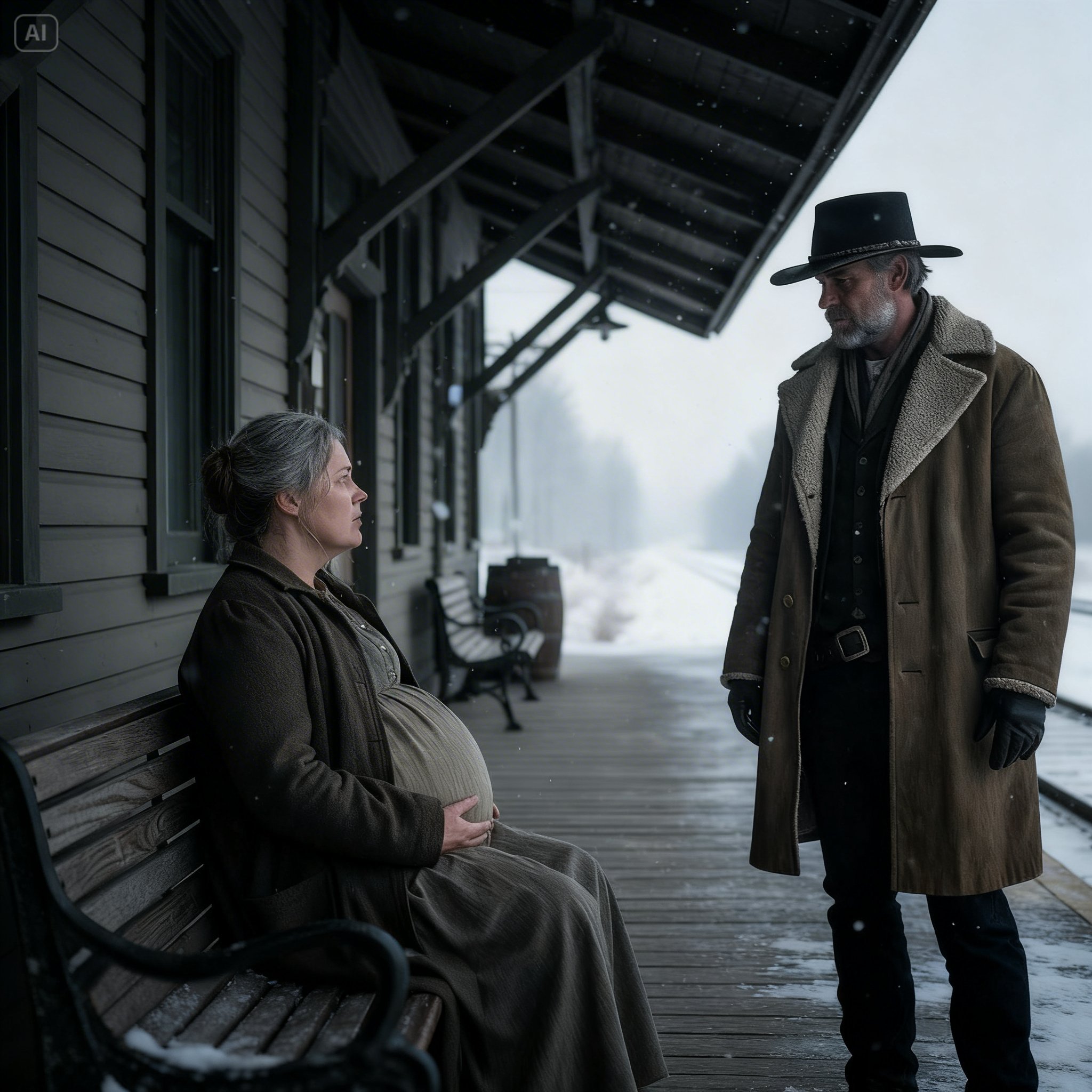
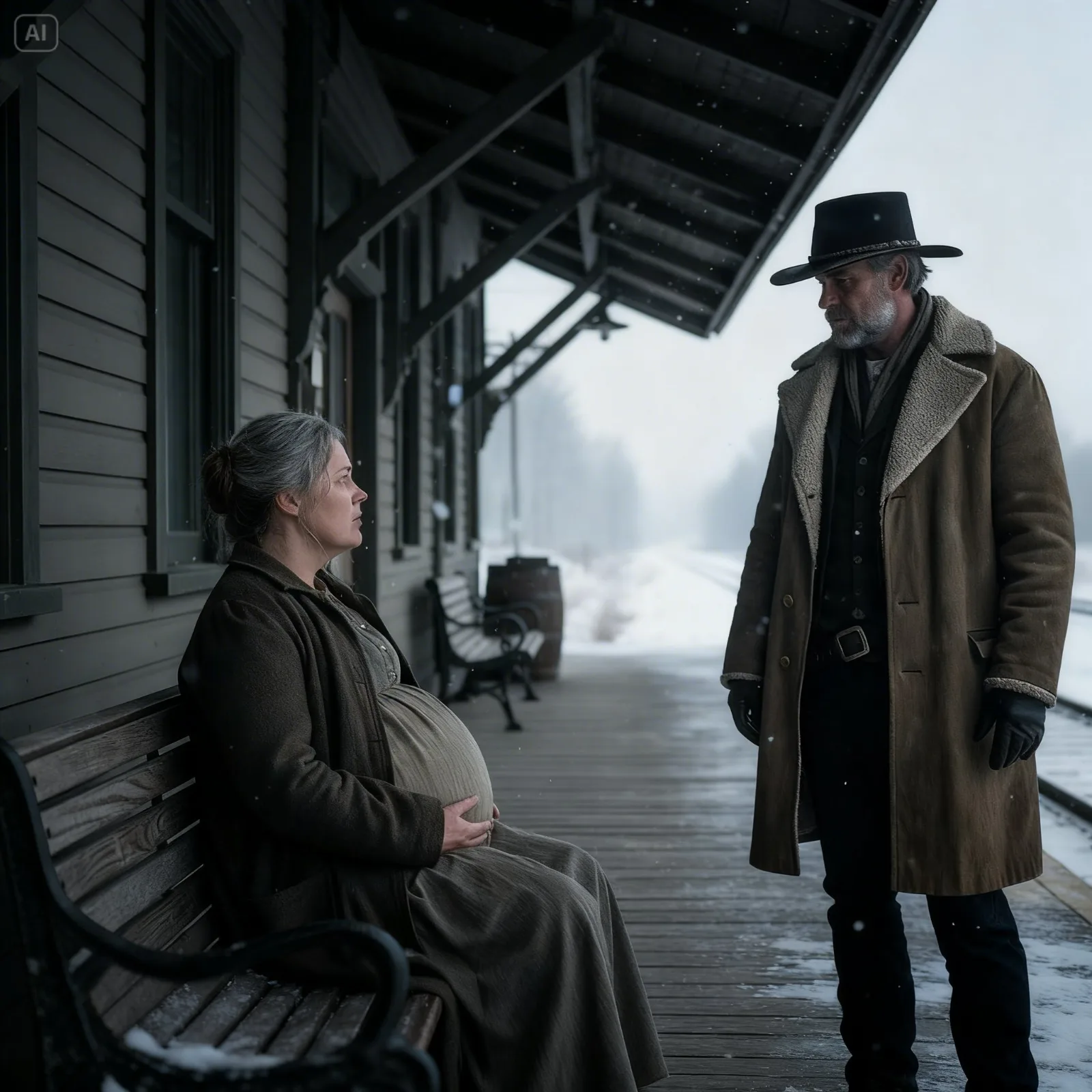
Mara Jun sat alone on the cold iron bench at Cinder Trace with her hands folded over the curve of her belly and her suitcase at her feet. The coat she wore had once fit properly. Now the wool stretched across the front where the child had made itself known in a way that could not be hidden, softened, or explained away. Her condition was visible to anyone who looked, and in places like this, visibility could be as dangerous as poverty.
The last train of the day was already gone. She had watched it pull away in a long hiss of steam and metal, watched the smoke thin into the whitening distance until there was nothing left but track, snow, and the sort of silence that made abandonment feel official. She had come to this place carrying 1 suitcase and half a promise. Now the promise was gone and only the suitcase remained.
The platform groaned under the wind. A torn timetable hung crooked against the station wall, its corners lifting and falling whenever the draft found them. Cinder Trace was not the kind of place where people arrived to begin bright new lives. It was the sort of place where people were set down and forgotten.
Mara knew that kind of place better than she wanted to admit.
She had taken the train from Abalene because Thomas Cray had painted her a future in warm colors and clean lies. He had spoken of mountain air and a chance to begin again. He had spoken the way men speak when they want a woman to step toward the edge without noticing she is being guided there. For a little while, she had allowed herself to believe him. At 38, with no husband, no remaining family to speak of, and a life that had narrowed into mending work and rented rooms, belief had come to feel almost necessary.
Then the child had made itself undeniable.
Thomas had looked at her changing body as though it were a debt he had never agreed to pay. He had called her old in a tone that made the word sound filthy. At the 3rd stop before the mountain pass, he had left her with no ring, no home, no name she could safely use, and no future more solid than his suggestion that she should head back east.
But east was ashes. East was a place full of graves and closed doors and nobody living who would care whether she returned.
So she sat at Cinder Trace while snow thickened over the tracks, pressed a gloved hand over her belly, and whispered to the child, “We’ll figure this out.”
The baby moved under her palm, a small steady kick, and that tiny answer nearly undid her.
A boy carrying a basket of apples passed along the platform. Mara offered him a tired smile. He dropped his eyes and kept moving. It was not cruelty. People in towns like this simply knew enough to keep distance from trouble when trouble arrived carrying a suitcase and a swollen belly.
By the time dusk began to swallow the far line of trees, she had made her decision. She would sleep on the bench if she had to. Tomorrow she would go into town and ask after sewing work. Curtains, mending, shirts, table linens, anything. Her hands had always known how to make broken things useful again. Perhaps that skill would keep the 2 of them alive a little longer.
A soft creak sounded at the far end of the platform.
She lifted her head and saw a man step out from beneath the roof overhang where the shadows had gathered deepest. He was tall and quiet and wrapped in a charcoal-colored coat and scarf. His hat brim cut the upper half of his face into darkness, but nothing in the way he moved felt reckless or predatory. He carried himself with the measured stillness of someone who had spent long years around storms and had learned that suddenness rarely improves anything.
Mara looked away first.
Men who approached in silence often carried intentions they had no wish to announce plainly.
He stopped a few steps from her, giving her room.
“Evening,” she said because politeness had outlived most of her optimism.
“You missed your train?”
His voice was low, roughened by cold or work or the simple habit of speaking infrequently.
“No,” she said. “It missed me.”
He nodded once, not as though he pitied her, not as though he doubted her, but as though he accepted the answer in the form it had been given. Then he stood there quietly long enough for the silence between them to become something unusual. It did not feel threatening. It did not even feel especially awkward. It was only silence, left undisturbed.
At last he said, “Station gets no fire. Snow’s coming in harder now. You got shelter somewhere?”
“I don’t take charity.”
He shrugged very slightly. “Didn’t offer that. Just warmth and supper. That’s neighborly, not charity.”
Before Mara could answer, the station house door behind them creaked open and Emma, the old station keeper, stepped out with a shawl wrapped tight around her shoulders.
“Elias,” she called. “Road ices by moonrise. You best get going.”
The man tipped his head in acknowledgment.
Emma’s eyes shifted to Mara and softened. “Child, you can sleep in the back room if you’d rather. Dusty, but it’s got walls.”
Walls, Mara thought, and no fire, no heat, no food.
She looked back at the man. “What’s your name?”
“Elias Hart.”
“Where’s your place?”
“Northridge. Cabin’s warm. No one there but me and a mule.”
Mara studied him as carefully as the fading light allowed. His coat was worn but clean. His boots were good leather and well-kept. His voice carried neither rush nor appetite. Nothing about him felt false, though she had been wrong before about men who knew how to look harmless.
“What do you want for it?” she asked.
His eyes lowered once to her belly, not long enough to wound, just long enough to understand the situation she was in and the caution she had earned.
“Nothing,” he said. “No one ought to sleep cold when there’s room enough for 2 by the stove.”
Mara stood slowly. Her knees had gone stiff from the bench, and the whole world tilted for a second as exhaustion caught up with her. But she steadied herself, picked up the suitcase, and said, “All right.”
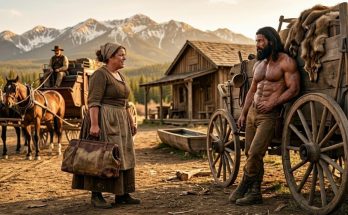
They walked together down the station steps without touching. Snow swirled around their boots and melted against the hem of her coat. At the bottom, near the wagon and the mule waiting in moonlit breath, Elias paused and turned toward her.
He looked at her with a calm certainty that pushed back some part of the storm.
“You’re mine now,” he said softly.
Her breath caught.
Not in fear. Not even in confusion, not really. Something in the way he said it made the meaning plain. He did not mean owned. He did not mean purchased or claimed or entitled. He meant kept safe. He meant under my protection now, and no harm will come to you while I am standing.
Mara said nothing. She only nodded once, and together they climbed into the wagon while the snow deepened around their footprints like the first page of a life neither of them had intended, but both of them had suddenly stepped into.
The mule’s breath rose in pale clouds as Elias tightened the reins. The wagon creaked forward, old iron and wood speaking in familiar complaints as they left the station behind. Mara kept her hands tucked deep in her sleeves and watched the pines lean above the road, black and towering under the burden of fresh snow.
They did not speak for the first mile, nor the second. But the silence between them did not feel like the silence she had known with Thomas Cray, where every unsaid thing had teeth. This silence was different. It felt steady. It felt like a blanket laid over both of them, not to smother but to warm.
When the cabin came into view at last, she realized only then how long she had been holding her breath.
Smoke rose from the chimney in a thin dark ribbon. Warm light spilled from a window. The path to the door had been shoveled clean in straight, careful lines. Everything about the place suggested effort without show. Nothing wasted. Nothing neglected.
Elias climbed down first, tied the mule, then turned and held out a hand.
Mara hesitated only a moment before placing her fingers in his. His grip was broad and warm and entirely without pressure beyond what was needed to steady her.
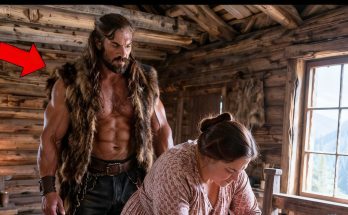
Inside, the heat struck her so quickly it almost hurt. Fire cracked in a stone hearth. The cabin was simple, orderly, and deeply lived in. A table with 2 chairs. Shelves lined with tins and jars. A rifle hanging on a peg. A cot in the corner made up neatly with blankets so tightly tucked that the discipline of it seemed almost personal.
“You can take the bed,” Elias said as he unlaced his boots.
“I can sleep on the floor,” Mara answered. “I’ve done worse.”
“Not tonight.”
He spoke with no softness for effect and no hardness for defense. The words were simply set down between them as fact. She took the folded blanket he offered because her hands had begun to shake and because refusing shelter out of pride has always been easier in theory than in practice.
“I don’t want to be trouble,” she said.
“You’re not.”
“And this is no trouble?”
“No.”
Mara sat on the edge of the cot. The child moved inside her again, the small pressure gentle and insistent. The room no longer felt like a place she had stumbled into by necessity. It felt, disturbingly and wonderfully, safe.
Elias poured warm broth into a tin cup and brought it to her. She sipped carefully. It was salty and plain, and it spread through her like mercy.
“You cook,” she said.
“Out of necessity.”
“It isn’t much, but it keeps a man on his feet.”
Her eyes went to a small carved horse on the mantel, its mane cut with unexpected delicacy. “You made that?”
He nodded. “Used to carve at night. Silence needs something to hold.”
Mara looked into the fire a while before saying, “I used to sew curtains. Linens. Wedding veils sometimes. I thought if I made beautiful things, maybe life would give me something beautiful back.”
He was quiet long enough that she almost regretted speaking. Then he said, “I imagine you’ve made more peace with those hands than most men do in a lifetime.”
She looked up at him then. No one had ever said anything like that to her. Not without wanting a favor, a bargain, a body, or gratitude they had not earned.
“You always speak like that?” she asked softly. “Like your thoughts are written down before you say them?”
“Words should earn their place.”
Something in her throat tightened. She looked away and folded her arms around herself.
“I won’t stay where I’m not welcome.”
He did not answer directly. Instead he crossed the room, took a second blanket from a shelf, and laid it beside the cot.
“You get the bed,” he said. “That’s not kindness. That’s just right.”
Later, after the fire had burned lower and the cabin had settled into the creaks and sighs of night, Mara lay awake staring at the ceiling beams. The child shifted under her ribs. Across the room, Elias sat in the chair rather than on the floor, one long leg stretched toward the hearth.
“All right?” he murmured.
“Yes,” she whispered. “Just thinking.”
Another soft silence passed. Then she said, without fully understanding why she said it then, “You don’t expect anything.”
He did not reply at once. But she felt the steadiness of him too clearly to mistake his silence for indifference.
At last she added, “I won’t give what isn’t asked for.”
He said nothing. Yet something about the quiet in the room told her he had heard exactly what she meant.
Snow whispered against the roof. The fire cracked low. The cabin held.
For the first time in weeks, Mara fell asleep without fear standing at the edge of sleep waiting to shove her awake again.
The days that followed arranged themselves into a rhythm so gentle she distrusted it at first.
Mara rose early, swept the floor, and fed the chickens scratching around the yard. Elias cut wood before dawn and stacked it where she would not have to bend and lift more than she should. When her back began to ache from the weight of the baby, he built her a stool with a support low and curved to fit the small of her spine. At dusk he heated water so she could soak her swollen feet. He did these things without explanation and without the smugness of a man who expects to be thanked for every ordinary decency.
One afternoon, while she stitched curtains from old trunk scraps because her hands felt restless when idle, she said without looking up, “I keep waiting.”
“For what?”
“For the cost.”
He was mending a harness strap at the table. He did not stop working.
“There’s no ledger here,” he said.
It should have been impossible to believe him. Yet some small, exhausted part of her wanted to.
That fragile peace lasted until the sound of hooves broke across the clearing.
Not 1 horse. Several. Too fast. Too hard.
Elias rose from the woodpile outside with the axe still in his hand and turned toward the tree line. Mara stepped onto the porch with 1 hand on her belly and saw the rider come out of the falling light.
Thomas Cray.
Her whole body turned to ice.
He rode in wearing the same easy smirk she had once mistaken for charm. That expression had always depended on 2 things: a woman’s uncertainty and his own belief that he would win. It looked uglier now, meaner. Less polished. More like what it had always been underneath.
“Darling,” he said when he swung down from the horse. “Miss me?”
Mara could not speak at first. Elias stepped beside her, calm and straight-backed, still holding the axe but not raising it.
Thomas looked him over. “So you’re the one keeping her?”
“She isn’t something to keep,” Elias said.
Thomas laughed. “I’ve come to bring her home.”
Mara stepped forward before she could lose her nerve. “I was never your home.”
His smile altered. Something uglier showed through. “You deny me what’s mine?”
“I was never yours,” she said. “And I never will be.”
Thomas’s hand moved toward his pistol.
Elias lifted the rifle from beside the porch door and brought it up in 1 smooth, economical motion.
“You want to draw?” he asked. “You better mean it.”
For a second all 3 of them stood in a silence so taut it seemed the snow itself had paused to listen.
Thomas looked from Mara to the rifle to Elias’s face, and for the first time uncertainty entered him.
Then he spat in the snow. “This ain’t over.”
He mounted and rode away, the horse kicking up white powder behind him.
Only when he vanished into the trees did Mara realize how badly her knees were shaking.
Elias set the rifle down and touched her arm lightly, carefully, as if she had become something easily startled.
“You’re safe,” he said.
She nodded, though safety still felt like a word she had not yet earned the right to trust.
Part 2
Dawn came in gray and uncertain, the kind of winter light that never fully rises so much as seeps into the edges of a room.
Mara woke to pain.
It began low and deep, a twisting force that stopped her where she stood when she tried to cross the cabin. Her fingers dug into the wall. Another wave came harder than the first, and this time she did not need anyone to tell her what it meant.
Elias was out of the chair by the hearth before she could call his name.
“It’s time?” he asked.
She nodded, jaw locked, her breath already shortening around the pain.
There was no doctor near enough to matter. No midwife. No neighbor close enough to outrun the weather and return before the road went bad. The world had narrowed to the cabin, the storm, the fire, and the 2 of them.
Elias did not hesitate.
He moved with the sure speed of a man who understood that fear and delay are luxuries some moments cannot afford. He put water on to boil. He laid out clean linens. He lit extra lamps until the dim blue morning gave way to warmer light. He cleared the table, warmed blankets, and kept his face steady.
Mara labored through the morning hours with a silence that was not calm so much as discipline. The pain came in waves and each wave seemed to claim more of her. She clung to Elias’s hand through the worst of it and found that he never once tried to pull away, never once looked uneasy at the force with which she gripped him. He only kept speaking in that low, grounding voice of his.
“I’m here.”
“You’re strong.”
“Breathe again.”
“She’s almost here.”
When the final pain took hold of her, it tore a cry from somewhere deeper than speech. She bore down with everything left in her, and then suddenly the room changed.
A new cry rose sharp and furious into the air.
Elias caught the baby in both hands, his own trembling only after the hard part was done. He wrapped the child quickly in the blanket they had folded the night before and looked at Mara with something close to wonder.
“It’s a girl,” he whispered.
The tears came at once then, not because Mara chose them but because relief and exhaustion and astonishment moved through her all together. She reached for the child, and he laid the tiny warm bundle against her chest.
The girl blinked at the world as though it had offended her by being cold and bright. Mara laughed and sobbed at the same time.
“She’s here,” Elias said.
“We’re whole,” Mara whispered.
The hours that followed moved in a hush so complete it almost felt sacred. The fire stayed alive. The child slept and woke and cried in turns. Mara drifted in and out of a deep aching tenderness she had not known she could survive. Elias moved quietly through the room making tea, fetching water, adjusting blankets, checking on her without hovering.
Peace had begun to feel possible.
Then someone knocked.
3 soft raps on the door.
Elias rose soundlessly, took the rifle from the wall, and crossed to the window. He looked through the frosted pane, and when he turned back she already knew.
“It’s him,” he said.
Thomas.
Mara’s heart slammed so hard she felt it in her throat. She tightened her hold on the baby.
“Don’t go out there,” she whispered.
“I won’t,” Elias said. “Not unless he steps in.”
Another knock. Then Thomas’s voice through the wood, thickened by whiskey and anger.
“You think you can shut me out forever, Elias? Let me see her.”
“She’s not yours,” Elias called back.
Thomas laughed, but it was a tired, ugly sound now. “I fed her once. Doesn’t that count for something?”
“You left her cold,” Elias said. “You don’t get to claim a life you abandoned.”
Silence followed that, but it did not end the matter.
“Let me speak to him,” Mara said.
Elias turned immediately. “No.”
“I need to.”
Her own voice surprised her. It was not loud, but it was clear in a way it had not been with Thomas before. She looked at the sleeping child in her arms and then back at Elias.
“This has always been mine to end.”
He hesitated, then gave 1 short nod.
Mara stood carefully and crossed the room with the baby held close. Elias positioned himself just behind her, rifle ready but lowered. She lifted the latch and opened the door.
Thomas stood a few steps away in the snow. His boots were white at the edges. His hair was disordered. His eyes were bloodshot from drink and failure and whatever remained in him that could not bear to lose even the things he had already thrown away.
His gaze went first to the baby, then to Mara’s face.
Something sagged in him when he saw her standing there whole, no longer pleading, no longer waiting.
“You don’t know what you’re doing,” he said.
“I know exactly what I’m doing.”
“You were mine.”
“No,” she said. “I was lonely and you used that. But I was never yours.”
He took half a step forward.
Behind her, Elias chambered a round.
The sound stopped Thomas colder than the weather had.
Mara held his gaze.
“You want to prove you’re the man you always pretend to be?” she asked. “Then leave. Walk away. Don’t come back.”
“She’ll never know me.”
“She doesn’t need to.”
He stood there in the snow with all his old certainty drained out of him, and for the first time Mara saw what lived underneath it. Not power. Not destiny. Only hollowness. A man built mostly out of appetite and cowardice.

At last he spat once into the drift, turned his back, and walked to the horse.
No threat this time. No grand declaration. No promise of revenge.
Just a man going away from a life he had imagined he could reclaim simply because he had once touched it.
Mara shut the door gently and lowered the latch. The whole cabin seemed to breathe again after the sound of the lock settling into place.
She sat by the fire with the baby in her arms and felt a lightness begin where fear had lived for so long she had stopped trying to separate herself from it.
Elias leaned the rifle aside and came to kneel in front of her.
“You all right?”
“Yes,” she said, and the answer startled her with its truth. “Now I am.”
He touched the back of her hand in a way that asked permission rather than assumed it.
“You don’t have to know what comes next,” he said. “You don’t have to decide anything today.”
She looked down at the baby, then at him. All the old instincts rose at once. Be careful. Don’t trust too fast. Safety can vanish. Kindness can turn. Warmth can be a doorway into another kind of hunger. But there was another truth now as well, simpler and steadier.
“I think I’d like to stay,” she said.
His smile came slowly, like light moving over a winter ridge.
“You’re already here,” he said.
And because there was no pressure in the words, no contract hidden inside them, she finally let herself believe what they meant.
She was home.
Days deepened into weeks.
The baby learned the shape of the cabin by sound: the scrape of Elias’s chair, the rhythm of Mara’s sewing needle, the pop of resin in pine logs, the soft mutter of chickens beyond the yard. Mara healed. Elias moved around her with the same practical gentleness he had shown from the first, always helping and never trapping the help inside obligation.
The child needed a name. They let the decision wait until 1 evening when the weather turned still and the world outside the window held that rare silver calm that comes only after hard snow.
“She looks like Lila,” Mara said at last, almost to herself.
Elias, holding the baby in the crook of 1 arm as though he had been born knowing how, looked down at the tiny sleeping face.
“Lila Hart,” he said quietly, trying the shape of it.
Mara’s eyes went to him. “Hart?”
The baby made a soft restless sound and settled again. Elias did not look up immediately.
“Only if you want it,” he said. “Only if you ever want any of that. Name. Paper. A thing spoken in front of witnesses.” Then he did look at her. “I’m not offering rescue. I’m offering staying.”
That was the moment something in her, something old and wary and half-starved, began to unclench.
She did not answer him that night. She did not need to. But later, when he laid Lila in the cradle he had built from pine planks and careful joints, Mara went to him, placed her hand against his chest, and let him kiss her for the first time.
It was nothing like Thomas.
There was no claim in it. No urgency sharpened by possession. Elias kissed like he approached everything else, with steadiness, attention, and the sense that what was being held mattered enough to handle carefully. Mara had not known until then how much hunger can exist in tenderness.
Through the rest of winter and into the first thin signs of spring, they lived in that growing nearness without naming it too quickly. He repaired the roof. She hemmed fresh curtains for the windows and lined the cradle with flannel salvaged from an old underskirt. He brought in early crocus from the south-facing slope and left them in a cup on the sill without explanation. She mended his shirts where the cuffs had gone rough and pretended not to notice how carefully he folded them afterward.
The valley, however, noticed everything.
People in towns and outlying roads always do.
By March, word had spread from Cinder Trace to the stores and kitchens and church porches. The abandoned pregnant woman had not frozen on the bench. She had not begged. She had not disappeared. Instead she had ended up at Elias Hart’s cabin, had borne a child there, and had stayed. Some people softened toward the story because hardship sanctifies a woman in ways mere loneliness never will. Others sharpened toward it for the same old reason: they could not bear to see something discarded become cherished.
The first sign that the outside world intended to push itself inward again came in the form of a woman named Delphine Weaver, who arrived at the cabin carrying a pie and the bright-faced curiosity of someone who believes concern gives her the right to pry.
Mara let her in because refusing pies from strangers in country places creates more problems than it solves. Delphine sat, looked around the cabin, looked pointedly at the cradle, and then at Mara.
“So it’s true.”
“I suppose it depends which part you mean.”
Delphine gave a little laugh, not quite embarrassed. “That you’re staying here. With him. Unmarried.”
Mara looked down at the pie cooling on the table.
“People talk,” Delphine continued. “You know how it is.”
“Yes,” Mara said. “I know exactly how it is.”
Delphine tried again, gentler this time. “You could come into town, you know. Rent a room. There are families who’d make arrangements.”
Mara thought of rooms with thin walls. Of arrangements. Of charity that keeps account in ways money never could.
“I’m already where I belong.”
The answer was so calm, so complete, that Delphine did not know what to do with it. She left the pie and her curiosity both behind.
That evening Mara told Elias about the visit while he carved small wooden pegs by lamplight.
“What did you tell her?”
“That I’m where I belong.”
He kept carving for a moment longer. Then he set the knife down and looked at her with a gravity she had come to understand meant he was deciding whether to speak from the center of himself or not at all.
“And are you?” he asked.
She stood by the table with Lila in her arms, warm and milk-heavy and dozing. Outside the wind had finally begun to smell less like iron and more like thawing earth.
“Yes,” Mara said. “I am.”
Part 3
Spring came slowly to Northridge.
Snow retreated from the pines in ragged patches and left the earth black and wet beneath. The path to the cabin softened. Water ran in the ditches. The sky, which all winter had pressed down low and gray, began to rise again into something broader and more forgiving.
With the thaw came the practical decisions the cold months had allowed them to postpone.
Mara had no legal standing in the valley. Lila had no official name beyond what they called her by the fire. Elias owned the cabin and the land around it in the plain, hard way men out west came to own things, through labor, receipts, and witness. But life, Mara knew too well, could turn mean very quickly when papers were absent and tongues began to wag.
It was Mara who raised the matter first.
She stood at the table one morning folding clean linens while Elias repaired the latch on the back door.
“If I stay,” she said, “I won’t stay half-hidden. Not for the town. Not for your sake. Not for hers.”
He straightened and looked at her.
“I know.”
“I won’t be the woman people point at and lower their voices over while our daughter learns to listen.”
He set the latch pieces down. “She’s our daughter now?”
Mara held his gaze. “If you still want her to be.”
The quiet that followed felt full rather than uncertain. Elias crossed the room and stood in front of her, close enough that she could smell pine shavings and clean sweat and the faint smoke that seemed to live permanently in his coat.
“I wanted that the night I drove you from the station,” he said. “I just knew better than to ask for all of it before you could breathe.”
Something inside her softened so quickly it nearly hurt.
“I have nothing to bring you,” she said. “No dowry. No land. No name worth keeping.”
“You bring a home,” he answered. “You bring that child. You bring yourself. I don’t know what a dowry’s worth against any of that.”
She laughed then, unexpectedly and helplessly, and the sound startled both of them because laughter had been so rare in her life before this one.
They were married 2 weeks later at the station house in Cinder Trace because Emma said the roof did not leak too badly in the back room and because she refused to let the place be remembered only for departures and abandonment. She pinned up her thinning gray hair, put on her best dark dress, and stood as witness with the station ledger under 1 arm as though she had been preparing for exactly such a duty all her life.
Ruthless, curious town opinion had wanted spectacle. It got something much better and much less satisfying: a quiet ceremony attended by Emma, 2 neighboring families from the ridge road, Delphine Weaver looking chastened and carrying flowers instead of questions, and Sheriff Hale from the next district over, who happened to be at the station on other business and signed where needed without making any grand event of it.
Mara wore a blue wool dress she had altered herself from a garment twice the price she could ever have afforded new. She had let out the seams carefully, lined the sleeves afresh, and added a simple collar of cream linen that made the whole thing look as though it had always been meant for her. Elias wore his dark coat brushed clean, his boots newly blacked, his face freshly shaved except for the roughness his beard left even a few hours after the razor.
When Emma asked whether he took Mara Jun to be his wife, Elias answered without hesitation, “I do.”
When Emma turned to Mara, the station room went very still.
Mara looked at Elias and thought of the bench at Cinder Trace, the snow, the gone train, the life she had believed had narrowed into survival alone. She thought of Lila’s first cry, of Thomas walking away at last, of the way Elias had never once tried to buy gratitude with decency or obedience with protection.
“I do,” she said.
No church bells rang. No polished shoes crossed a polished floor. No one spoke of romance in the decorated language city people preferred. But when Elias kissed her in the dim station room while Lila slept in Emma’s arms, the place felt more sanctified than any church Mara had ever entered.
Afterward, as they stepped out beneath a pale spring sky, Emma pressed the baby back into Mara’s arms and muttered, “Took the both of you long enough.”
Elias laughed. Mara smiled. The wind moved lightly across the platform boards where she had once sat abandoned, and she understood then that places can be remade by what happens in them later.
The town took time to adjust.
Some people accepted the new arrangement at once, because marriage has a miraculous way of making old judgments feel less entertaining. Others continued to mutter, only now they had to do it around the fact that Elias Hart was not ashamed, Mara was not shrinking, and the child they had once been prepared to pity now rode into town in her father’s arms wearing a knitted cap and looking entirely, defiantly loved.
It was Delphine Weaver, of all people, who shifted the town most. Once her curiosity had been answered and her shame properly ripened, she turned out to be useful. She began correcting women in the mercantile when they spoke of Mara in that old lowered tone. She told them, with the righteous force of a convert, that a woman who survives betrayal, childbirth, winter, and gossip deserves better than to be treated like a cautionary tale.
By summer, the story itself had changed.
People no longer said a foolish older woman had been left pregnant on the platform and rescued by chance. They said Mara Jun had come west alone, had borne a child in a snowbound cabin, and had married the best man in the district. They said Elias Hart had taken in a stranger and made a family of it. They said Lila Hart was a strong little thing, always watching, always listening, and likely to grow with her mother’s hands and her father’s steadiness.
All stories become cleaner in retelling. Mara knew that. But she let the cleaner version stand, because survival sometimes earns the right to simplification.
The cabin changed with the seasons.
Summer opened the windows to pine air and bees and distant birdsong. Mara planted beans and onions and herbs in a patch behind the house. Elias built a larger table with room for 4 though there were only 3 of them, because as he put it, “A table ought to leave room for whatever the future brings.” Mara sewed new curtains from flour sacks and stitched Lila’s first winter things long before the cold came back. Elias hung a cradle hook in the main room so the child could sway near the fire while they worked.
In the evenings, after Lila was fed and sleeping, Mara and Elias sat on the porch and watched the ridge darken. He carved when silence needed filling. She mended or stitched. Sometimes they spoke. Often they did not. But the quiet between them had by then become its own kind of language, made not of withholding but of trust.
Once, late in July, Mara said, “When you told me I was yours that first night, I nearly turned and ran.”
Elias looked at her over the piece of wood in his hands. “I know.”
“I thought you meant ownership.”
“I know that too.”
She watched the valley settle into shadow. “What did you mean?”
He set the carving knife aside and leaned his elbows on his knees.
“That no harm was getting past me if I could stop it. That you were under my protection as long as you wanted it. That I was done pretending I could leave someone alone in the cold and still sleep afterward.”
Mara turned toward him. “You said it like a vow.”
He gave the smallest shrug. “Maybe it was.”
By autumn, Lila had begun to toddle from chair to chair. She had Mara’s eyes, wide and observant, and Elias’s patience, which made her seem older than she was until she laughed and showed herself all baby again. Mara found herself saying our home, our daughter, our life without stumbling over the words anymore.
And yet peace, when it comes after fear, always carries its own fragile quality. Mara still woke some nights listening for hoofbeats. She still checked the road when anyone passed the ridge. Trauma, she was learning, does not depart simply because better things arrive. It softens slowly. It relearns slowly. It needs repetition, ordinary safe days stacked one atop another until the body begins to believe what the mind has understood for some time.
Elias seemed to know this without needing it explained. He never asked her why certain noises made her go still. He simply stood closer when he saw it happen. He did not mock caution or call it nervousness. He treated it like weather passing through, something to endure rather than scold.
The following winter, when the first snow came, Mara stood on the porch with Lila wrapped against her chest and watched white settle over the path to the house. For a moment the whole world looked like it had looked the night she arrived at Cinder Trace. But this time she was not alone. This time the smoke from the chimney was hers. The warm room behind her was hers. The man splitting wood below the porch steps and glancing up every so often to make sure she had not been standing too long in the cold was hers too, though she no longer thought of him in the old frightened way ownership had once been taught to her. He was hers because she was his in the truer way, by choosing, by staying, by daily proving.
Lila made a soft sound and burrowed closer into her coat.
Elias came up the steps carrying an armful of wood. “Cold?”
“A little.”
He leaned in and kissed her forehead. “Come inside then.”
She followed him into the cabin.
That night, after the child was asleep, Mara stood by the fire and asked the question that had been growing in her for months.
“If another woman had been sitting on that station bench that night, would you have done the same?”
Elias was quiet for a while. Then he said, “I’d have offered shelter.”
“And the rest?”
He looked at her in the firelight, his expression steady and almost solemn.
“The rest was you.”
That answer stayed with her longer than grander words might have. Love, she had discovered, was rarely built from dazzling speeches. More often it came in exact truthful sentences spoken by firelight after a child had gone to sleep.
Years later, when people asked how they had met, Mara would sometimes smile and say, “At a station in winter.” If they pressed, she might add, “I had a suitcase and no plan. He had a wagon and enough decency not to ask for more than I could give.” And when they laughed softly and called it romantic, she would think of the truth beneath the softness, of fear and exhaustion and childbirth and the long slow work of trust, and know that romance was only the smallest piece of it.
The deeper truth was simpler.
She had arrived at Cinder Trace believing herself too old, too burdened, too abandoned, and too late for any good future. She had thought the world had moved on without her. Instead she found a man who understood that broken things are not worthless, only waiting for the right hands. She found a child who anchored her to life in a new way. She found a home that did not require shrinking to fit inside it.
And on the nights when snow came early and the wind moved around the cabin with that same old lonely sound, Mara no longer heard abandonment in it.
She heard distance. Weather. Time. Nothing more.
Inside, the fire held. Lila slept. Elias sat carving by lamplight, his thoughts seeming, as ever, to arrive in him already worn smooth.
Sometimes he still called her his in that old quiet way, especially when the road was bad or the weather turned or she looked too tired for speech. And every time he said it, Mara felt again the precise meaning she had heard the first night.
Not owned. Not bound. Not trapped.
Kept safe. Chosen. Held.
Home.