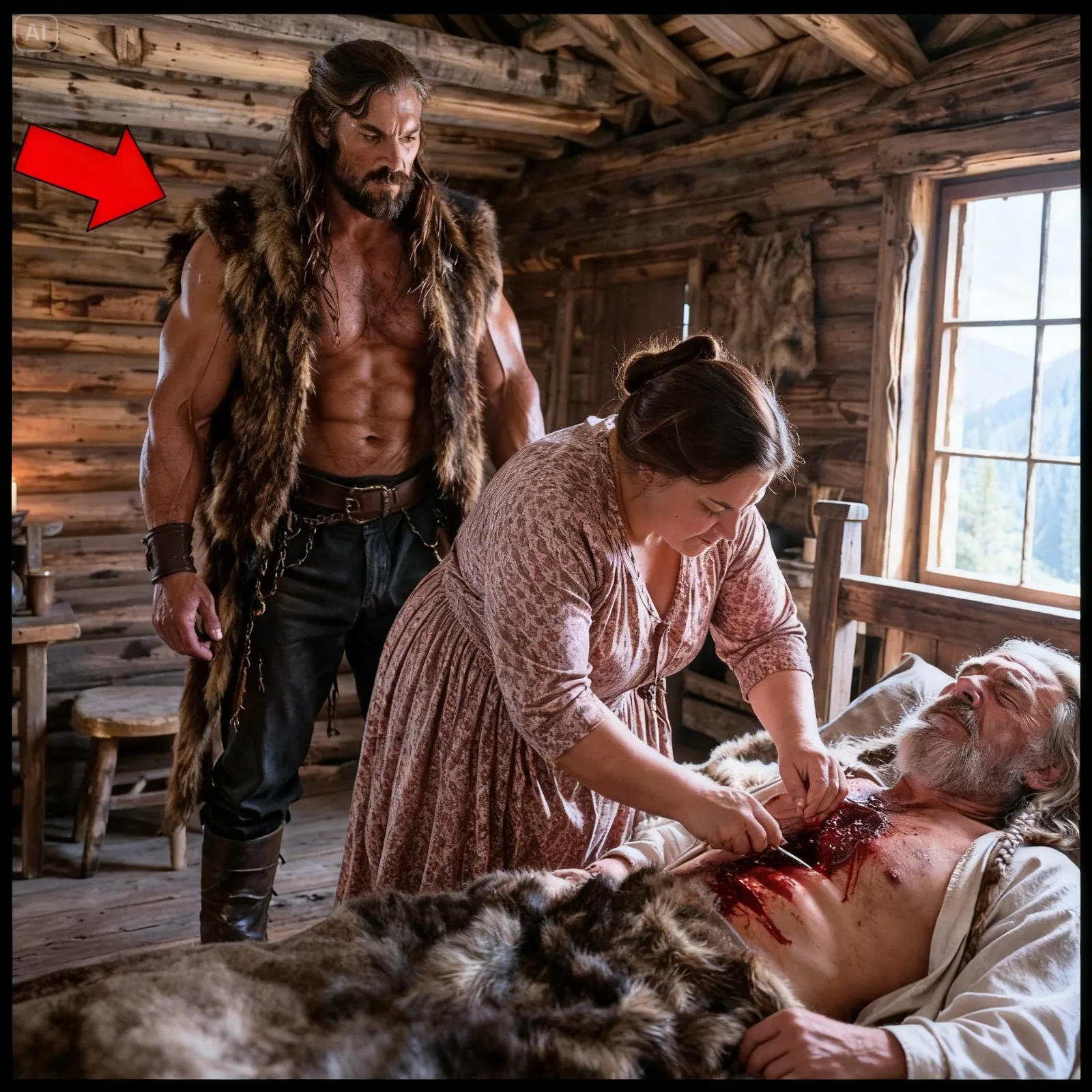
In the Gallatin Valley, people whispered that Sylvan Montgomery was more grizzly than man.
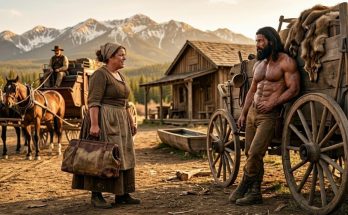
They said it in general stores and on church steps and in the polite parlors of Bozeman where women sat laced into whalebone corsets and men discussed land as if the earth itself had been created for speculation. They said Sylvan lived too high in the mountains to be civilized, that he spoke more easily to timber and snow than to people, that his temper was a living thing with claws. They said he had chased off a dozen thin, delicate brides sent up the ridge to soften him and secure his claim. They said no decent woman could survive in the brutal wilderness he called home.
What no one expected was that the woman who would save the Montgomerys from death, ruin, and theft would be the woman Bozeman mocked most cruelly: the town’s heaviest outcast, the broad-bodied apothecary who knew more medicine than the territory’s polished doctor and more human weakness than the men who sneered at her from the boardwalk.
The winter of 1886 came down over Montana Territory with the malice of a spurned widow. It buried the Gallatin ridges under savage drifts, pressed ice into every seam of every cabin, and turned the timbered slopes into a world that could kill a man simply by making him stop long enough to breathe too slowly.
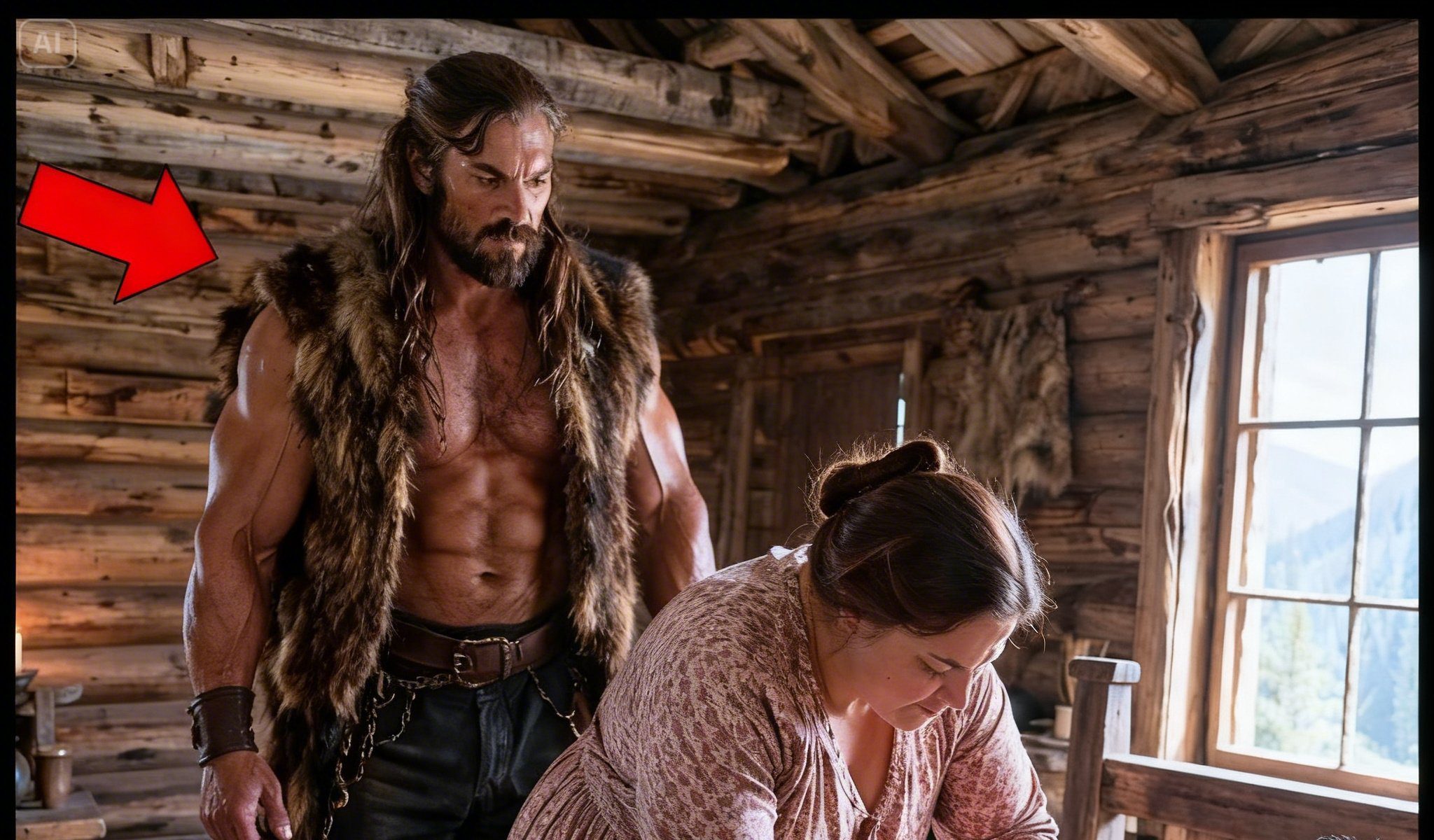
High in that frozen country, inside a heavy-walled log cabin banked against the mountain, the air was thick with burning pine, boiled coffee, damp wool, and the sweet, corrupted stench of rotting flesh.
Sylvan Montgomery stood over the bed with a blood-soaked rag in his hand.
He was a massive man, broad and towering, made in the same severe style as the mountains around him. Years of trapping, logging, and cutting a life out of unforgiving country had carved him into something hard and weathered. His hands, scarred and oversized, could fell timber, drag traps out of frozen creeks, and lift a full-grown man as if he were little more than a grain sack. Those hands trembled now as he wrung the rag into a basin and looked down at his father.
Jedediah Montgomery lay on the crude wooden bed, his face gray with pain, his breath rattling like dry leaves dragged over stone.
3 weeks earlier, a runaway logging wagon had crushed his leg against a ponderosa pine. The wheel had pinned him hard enough to break bone and tear muscle to pieces. Sylvan had dragged the old man free, carried him 3 miles uphill through waist-deep snow, and done what he could with splints, whiskey, boiled bandages, and the grim practical knowledge a mountain man accumulates because the wild rarely offers alternatives. He had set the bone. He had bound the wound. He had prayed in the rough, silent way of men who do not use the word prayer.
It had not been enough.
The infection had come anyway, creeping through torn flesh and ruined muscle, turning the leg an ugly, necrotic purple-black. The rot climbed higher every day.
Sylvan needed help.
At least, that was how the people of Bozeman chose to describe what they believed they saw. Sylvan Montgomery had 400 acres of the finest heavily timbered land in the territory, and everyone with money understood exactly what that meant. The railroad was pushing farther west. Timber was no longer merely useful. It was wealth. It was leverage. It was future power cut into board lengths and stacked in claims.
The town’s elite looked at Sylvan’s remote mountain acreage, at his sick father, at his absolute disinterest in society, and saw not a family in crisis but an opening.
If one of their daughters could marry the mountain man under the respectable excuse of nursing his father and bringing a woman’s touch to his savage household, then some elegant, well-positioned family in Bozeman would secure a legal foothold in Montgomery land.
So the parade of thin brides began.
Clara Higgins came first, the mayor’s daughter, swaddled in costly furs and cinched so tightly by her corset she breathed like a frightened bird. She arrived in a carriage with her father, her gloved hands folded demurely, her lashes lowered just enough to suggest sweetness without surrendering calculation. She managed the journey up the mountain with the tragic determination of someone certain that marrying Sylvan Montgomery would be a hardship worth enduring for 400 acres of old-growth wealth.
Then she stepped into the cabin.
The smell of Jedediah’s infected leg hit her full in the face. Clara gagged into a silk handkerchief, swayed once, and collapsed in a heap across Sylvan’s floorboards.
Sylvan carried her back outside, set her into her father’s carriage like a sack of flour, and shut the door without a word. The mayor, embarrassed and furious in equal measure, drove her straight back down the mountain.
Sarah Miller came next. Her family owned the local bank, and Sarah possessed the kind of sharp, cold beauty that relied less on softness than on precision. She did not faint. She did not retch. She stood over Jedediah’s bed, took in the smell and the blackened flesh, and gave Sylvan the sort of practical smile men are taught to mistake for intelligence.
“He is beyond saving, Mr. Montgomery,” she said in a voice as crisp as breaking ice. “Send him to the asylum in Helena. I will stay and help you manage your assets, but I will not play nursemaid to a corpse.”
Sylvan threw her out into the snow.
Her tailored trunk followed right behind her.
After that came others, each one some variation of delicate, ornamental ambition, daughters of merchants or lawyers or men who believed breeding and waist size somehow implied competence. None of them lasted. None could stomach the cabin, the sickness, the mountain, or the reality of a man whose first loyalty was not to property but to the father dying in front of him.
“Thin, useless porcelain dolls,” Sylvan muttered now as he changed the dressing again and watched fresh pus seep through old cloth.
Jedediah groaned and clutched weakly at the blankets.
“Hold on, Pa,” Sylvan whispered, though his own voice sounded strained and uncertain to his ears. “I’ll go back down. I’ll find a real doctor.”
20 miles away, in Bozeman’s mud-soaked streets, Beatrice Gallagher was hauling a 50-lb sack of oats off the back of a delivery wagon.
Beatrice, known as Bee to the very few people who spoke to her with any kindness at all, was not built for delicacy and never had been. Where other women in town fought themselves into tiny corseted silhouettes and treated appetite like a moral failing, Bee was broad, heavy-set, and powerful. Her arms were strong from lifting crates and grinding roots and hauling shipments into the apothecary. Her face was soft and round, but nothing about her suggested fragility. She moved with the steady certainty of a woman entirely accustomed to bearing real weight, both literal and social.
She was also, because Bozeman was Bozeman and cruelty often dresses itself as humor, the constant target of mean little jabs from women like Clara Higgins.
“Careful, Beatrice,” Clara called from the boardwalk as Bee hoisted the sack to her shoulder. “You’ll break the wagon axle.”
Bee did not answer. She had learned long ago that some insults deserve the dignity of being left unanswered. She carried the sack into the back room of Gallagher’s Apothecary, set it down, and got back to work.
Since her grandfather had died the previous spring, she had been running the shop alone. She kept the ledgers, filled the orders, mixed the tinctures, and stocked the shelves with remedies for coughs, burns, stomach ailments, childbirth, sleeplessness, fever, and grief in all the forms grief takes when it disguises itself as something physical. She knew the medicinal properties of roots, leaves, bark, moss, fungus, and honey the way other people knew church hymns or gossip. Her memory for botanical remedies was precise and nearly inexhaustible. She knew what grew in the valley, what had to be brought in, what should be dried, what must be used fresh, and what combined dangerously if some fool ignored the labels.
But Bozeman preferred appearances. It preferred Dr. Arthur Pendleton’s polished office, his glass bottles, his expensive imported patent cures, and the reassuring performance of a man in a clean wool suit speaking with borrowed certainty. Bee’s knowledge, inherited from an Irish grandfather who had lived among the Blackfoot for a decade and learned medicine from places deeper than textbooks, was too earthy, too practical, too unpretty to earn public respect.
To most of town, she was just the fat apothecary girl.
Too large to marry well. Too stubborn to leave. Too knowledgeable in ways that made other people uncomfortable.
Bee did not care what they called her. She cared about healing. Her grandfather had taught her that the earth provided remedies for almost every human misery if you had the wisdom to recognize them and the stomach to use them. Nature, he used to say, did not care about refinement. It cared about results.
She was in Dr. Pendleton’s clinic that afternoon delivering a basket of glass tincture bottles when the front door exploded off its hinges.
The heavy oak slab hit the floorboards with a crash so violent that Pendleton shrieked and dropped his ledger.
Sylvan Montgomery stood in the doorway.
He filled it completely. Freezing mud streaked his boots and lower coat. Snow clung to his shoulders. His chest rose and fell with angry, desperate force. His eyes looked wild enough that for a split second Bee thought the whispered stories about him being more beast than man might contain some fraction of truth.
“Doctor,” he growled.
Pendleton backed against a cabinet of bottles. “Montgomery, what is the meaning of this?”
“You’re coming with me. My father is dying. The infection is climbing to his hip. Get your bag.”
Pendleton swallowed visibly and glanced toward the darkening sky beyond the broken doorway. “Are you mad? There’s a blizzard rolling over the peaks. It’s 20 miles up a vertical grade. I’d freeze to death before we hit the timberline.”
“I will carry you if I have to.”
Sylvan closed the distance in 2 strides and seized the lapels of Pendleton’s expensive suit. The doctor let out a thin, panicked cry.
“Unhand me! Even if I go, it’s too late. If the gangrene has set in, the leg needs amputation, and I cannot perform a surgery of that magnitude in a filthy mountain shack. He is a dead man, Sylvan. Let him go.”
Sylvan’s fist rose. The whole room held itself in a single tight second.
“Violence won’t save your father’s leg, Mr. Montgomery.”
The voice came from the doorway.
Sylvan turned. Bee stood there with the basket still in her hand, completely unafraid.
For a moment he only stared at her. He took in the size of her, the strong roundness of her face, the plain wool dress pulled tight over broad hips, the absence of any decorative performance. She was not what the town had sent him before. She was not anything he had expected.
“Who are you?” he snapped.
“Someone who isn’t afraid of a little snow or a little blood,” Bee said, setting the basket down. She looked at Pendleton with a flash of contempt. “Doctor Pendleton is right about one thing. He’ll die on the trail. But I know how to halt necrosis. My grandfather taught me.”
Sylvan’s face hardened into disbelief. “You?”
He let the word land with all the cruelty his fear gave it.
“You wouldn’t make it halfway up the ridge. The horse would break under you, and the cold would take the rest. I need a real doctor.”
Bee did not flinch.
She stepped closer instead, until she was standing directly in front of him, lifting her chin to meet his height with a composure that made Pendleton look smaller still by comparison.
“A real doctor just told you your father is dead,” she said. “I am telling you I can save him. I have a draft horse out back built for logging. She can carry my weight and then some. I know the trail to your claim. You can stand here insulting me while your father’s blood turns to poison, or you can get out of my way so I can pack my medical bags.”
Her eyes did not leave his.
“Your choice, mountain man.”
No woman had ever spoken to Sylvan Montgomery like that. Certainly no woman from Bozeman. He stared at her for a long second, looking for fear, vanity, hesitation, anything that would reveal her as one more fraud beneath a different wrapping. He found none.
At last he gave a hard, abrupt nod.
“15 minutes. Meet me at the livery.”
The ride up the mountain became a descent into white violence.
The blizzard broke over them just beyond the foothills, wind screaming through the passes and driving sharp pellets of ice against exposed skin. Sylvan rode ahead, breaking trail, his shoulders hunched against the storm. More than once he glanced back, half expecting to see Bee turn around, fall behind, or fail in some way the town had taught him to assume about women shaped like comfort rather than fashion.
But Bee Gallagher rode steadily.
Her draft horse, enormous and patient, pushed through drifts that would have stalled lighter animals. Bee sat firm in the saddle, coat crusted with ice, her body absorbing the punishment of the storm without complaint. She did not cry out. She did not ask to stop. She did not once suggest retreat.
By the time they reached the cabin 5 hours later, Sylvan was too tired for pride and too desperate for argument.
He kicked open the door and the smell hit them at once, so thick and foul it seemed almost material. Rot, sickness, fever, damp blankets, old blood. The air of a room where life had been losing ground by inches.
Bee stripped off her frozen coat, marched straight to the bed, and pulled back the blankets without hesitation.
Jedediah’s leg was worse than anything Sylvan had yet seen in full daylight. The tissue around the wound had blackened and gone wet in places, purple in others, the skin shiny and stretched around swelling. Fever burned in the old man’s face. Delirium had turned his muttering into broken sounds without language.
Sylvan hovered near the stove, one hand resting unconsciously on the butt of his revolver.
“Can you fix it?” he asked.
Bee leaned in, studying the wound with absolute concentration. “The dead tissue is choking the living.”
She opened her apothecary bag and began laying things out on the table beside the bed. Glass jars. Wrapped linens. Small tools. Bundles of dried herbs.
“If I cut this out with a blade, he’ll bleed to death. The veins are too fragile.”
“Then what?”
She lifted a large glass jar.
Inside, in sterile sawdust, writhed hundreds of pale blowfly larvae.
Beside it she placed a second jar filled with dark raw pine honey and a bundle of ground echinacea root and golden seal.
Sylvan stared at the larvae, then at her, and rage crashed back into him on a wave of horror.
“Are you insane?” he roared, stepping forward. “You put those parasites on my father and I’ll throw you off the ridge. That’s witchcraft.”
Bee straightened to her full height and planted herself between him and the bed.
“It is medicine,” she shouted back, matching his fury blow for blow. “The maggots secrete an enzyme that dissolves only dead, rotting tissue. They will clean the wound down to healthy flesh without cutting a single living vein. The honey is antibacterial. It will suffocate what infection remains and seal the tissue.”
“I won’t let you feed my father to worms.”
She stepped even closer, close enough that her coat nearly brushed his.
“You brought me up here to save him,” she said. “Look at him. The rot is hours from his bloodstream. Shoot me and he dies. Let me work and he lives. But do not stand in the way of his survival because of your own ignorance.”
The cabin went silent except for the wind and Jedediah’s ragged breathing.
Sylvan looked at the woman in front of him, at her size, her steadiness, her refusal to move even an inch under his anger. Slowly, very slowly, he took his hand off the revolver.
“If he dies—”
“If he dies, you can bury us both,” Bee said coldly.
Then she turned back to the bed.
“Now boil me water. We have a long night ahead.”
Part 2
The cabin became a furnace against the blizzard.
Outside, the Gallatin wilderness was being erased under driven snow. Wind battered the walls, and the trees cracked in the night as sap froze hard in their trunks. Inside, Sylvan fed the cast-iron stove split lodgepole pine until the metal glowed a dull red and the air grew heavy with heat, steam, medicine, and the iron stink of the infected wound.
Bee worked without hesitation.
Sylvan had seen ugly things in his life. He had dressed elk by lantern light. He had skinned predators and hauled broken men from logging accidents. He had watched winter starve camps and spring bury them in mud. But there was something uniquely horrifying about standing in his own cabin and watching a woman deliberately pour a living mass of writhing larvae into his father’s blackened flesh.
Bee’s hands never shook.
They were large hands, broad-palmed and scrubbed raw with lye soap, the hands of a woman more accustomed to labor than ornament. She packed the larvae into the deepest parts of the wound with calm, efficient precision. The old man moaned once, weakly, but did not wake.
“They only eat the necrotic tissue,” Bee murmured, more to keep the work steady than to soothe Sylvan. “They secrete allantoin. It dissolves the rot and leaves the living veins alone. A scalpel would have killed him. This will not.”
“How long?” Sylvan asked, his voice dry.
“Hours. Maybe until dawn.” She drew a loose, breathable linen wrap over the leg to contain the larvae while they worked. “And then the fever will spike. That’s the dangerous part. If he thrashes and tears the healing tissue, he’ll bleed out.”
Night deepened around them.
For a long stretch there was only the stove, the wind, and Jedediah’s fevered breathing. Bee moved between bed and kettle, between the medicine table and the stove, keeping water hot and linens clean, checking pulse, checking the leg, measuring the old man’s muttering and the heat in his skin with the instinctive attention of someone who did not need a clock to understand when a body was turning one direction or another.
Shortly after midnight, the fever broke wide open.
Jedediah’s eyes flew open, glassy and unfocused, and he let out a scream so raw it made Sylvan’s blood turn cold. The old man surged upward with shocking strength, clawing for the wrap on his leg.
“Hold him!” Bee shouted.
Sylvan lunged for the bed and pinned his father’s shoulders, but the delirium gave Jedediah a kind of frantic force he had not possessed in health. He kicked with his good leg and nearly rolled himself and Sylvan off the narrow mattress.
Then Bee did something Sylvan would remember for the rest of his life.
Without hesitation, she climbed right onto the bed.
There was nothing delicate in her movement. Nothing apologetic. She used her weight the way another person might use leverage or rope or carpentry braces. She swung one leg over the mattress, planted herself across Jedediah’s hips, and used her broad, powerful frame to anchor him flat. Her hands closed around his wrists like clamps.
“Ease, Mr. Montgomery,” she commanded, her voice cutting through the chaos sharper than the wind outside. “You stay put, you stubborn old mule. You are not dying tonight.”
Sylvan, still straining to hold his father’s shoulders, stared at her in disbelief.
The women from town had fainted or flinched or offered advice from a safe distance. Bee Gallagher was physically wrestling a delirious grown lumberman into obedience and winning.
Sweat slicked her brow. Dark hair had come loose and stuck to her temples. Her sleeves were shoved above her elbows. Her arms, thick and strong, held steady. She was not a porcelain doll. She was not ornamental. She was a fortress, and for the first time in years Sylvan felt what it was like to stand beside another person in a fight and not be standing alone.
For 3 hours they held Jedediah down.
Every time the old man surged, Bee met him with equal force. Every time his breathing went wild, she spoke to him in that same booming, grounded tone, as if sound itself might build a wall around him and hold him here. Sylvan, braced close beside her in the cramped heat, could smell lavender and dried herbs lingering in her hair beneath the sweat and sickness.
By the time the old clock in the corner struck 4:00, Jedediah’s thrashing had subsided into exhausted sleep.
Bee climbed off the bed with her chest heaving, wiped her face with the back of her wrist, and moved immediately to the wound. Sylvan, half sick with dread, came closer.
When she lifted the linen and began washing away the larvae and dissolved sludge with cloths dipped in boiled water, he saw something he had not allowed himself to hope for.
The blackened rot was gone.
Not all the wound, not the damage, not the ruin of flesh and muscle, but the advancing purple-black death itself had been eaten clean away. In its place lay raw red tissue, bleeding and ugly and very much alive.
“The necrosis is halted,” Bee said.
Fatigue made her voice rough, but triumph burned in her eyes.
She crossed to the table, took up the jar of raw pine honey, and mixed it with the ground echinacea root and golden seal until it formed a thick medicinal paste. Then she spread it directly over the exposed tissue.
“The honey will suffocate what bacteria remain,” she said. “It seals the wound and pulls out the moisture the infection needs. The herbs will help with swelling and fever.”
Sylvan watched her wrap the leg in clean bandages, tight and even. When she was done, he crossed to the stove, poured coffee into a tin cup, and pressed it into her hands.
“I’ve never seen anything like that,” he said.
Bee wrapped both hands around the hot metal. “My grandfather taught me. He lived near the Marias River with the Blackfoot for a decade. He learned that the earth provides the cure if you know how to look for it.” She took a small sip. “But it isn’t always pretty. And it isn’t sold in a polished bottle at Dr. Pendleton’s clinic.”
Something in her expression shifted then, just for a moment, and he heard the older wound beneath the present one.
“The town ladies think I’m a savage for practicing it. They think I’m repulsive for…” She gave a short, dry half-laugh. “For a lot of reasons.”
Sylvan looked at her in the firelight.
He saw the heavy, sturdy lines of her body. The solid strength in her wrists and shoulders. The exhaustion she carried without collapse. The intelligence still sharp behind her eyes even after a night spent dragging a dying man back from infection and fever.
“They’re fools,” he said.
The sincerity in his voice startled her more than praise would have. She looked up quickly, and in that instant something subtle shifted between them.
At dawn he cooked venison hash and cast-iron biscuits.
Bee ate with an honest appetite, not pecking and pretending not to need food the way fashionable women in town did. She ate because she was hungry, because she had worked all night, because her body required fuel and she had long ago abandoned the idea that appetite needed apology.
Sylvan sat across from her at the rough table and watched her with growing astonishment at how quiet his cabin no longer felt.
It was not that she filled the room with chatter. Bee was not talkative for the sake of talk. It was that her presence removed the emptiness. The place no longer sounded like 1 man failing alone against winter and sickness. It sounded inhabited. Functional. Human.
And somewhere in that realization, respect became something more dangerous.
3 days passed.
The blizzard broke at last, leaving the Gallatin country drowned in white. 4 ft of fresh snow buried the slopes. The sky came back pale and hard and clear. Inside the cabin, the mood shifted from death watch to recovery.
Jedediah was sitting up in bed and finding enough strength to be difficult.
“There’s no salt in this broth,” he complained, eyeing the bowl Bee held out to him as if it were a personal insult.
Bee planted a hand on her hip. “You’ll eat what I give you, old man, or I’ll put the maggots back on you.”
Jedediah barked out a laugh that collapsed into a cough. “Sylvan, you better marry this one before I do. She’s the only creature on this mountain meaner than a grizzly.”
Sylvan, oiling his Winchester by the window, felt heat crawl unexpectedly up the back of his neck.
When he glanced over, Bee’s cheeks had gone pink, but she did not look away.
The thing between them had grown in those 3 days the way weather gathers over peaks: quietly, steadily, until you suddenly realize it has become unavoidable. They moved around each other now with the strange awareness of 2 people who were beginning to understand that the air between them had changed.
Then Sylvan went still.
“Riders,” he said.
His tone cut the warmth in the room clean in half.
Bee set down the broth and crossed to the frosted pane. Through the haze of bright snow she saw 4 dark figures on horseback laboring up the trail toward the cabin.
“It’s Mayor Higgins,” Sylvan said. “Sheriff Langdon. And Josiah Sterling.”
Bee knew the last name at once.
Josiah Sterling was a banker, a land speculator, and a man with cold, elegant manners that never quite hid the greed underneath. His interest in the Montgomery claim had not been subtle. He was the force behind the “helpful” parade of brides, the one trying to get a legal hook into the family land under the pretense of social rescue.
“They think Pa is dead,” Sylvan said. His jaw tightened so hard a muscle jumped in his cheek. “They think the storm took us out, or left me weak enough to bully off the claim.”
He racked the Winchester and chambered a .44-40 round.
Bee turned sharply. “Sylvan, put the gun down.”
“No.”
He moved toward the door, rifle in hand, the old wildness returning to his face. “Sterling has been circling my land for a year. I warned him what would happen if he ever stepped past the timberline.”
“If you shoot the mayor and the sheriff, they’ll hang you,” Bee said, stepping in front of him.
“He wants you angry. He wants you violent. He wants every story the valley tells about the savage mountain brute confirmed in 1 afternoon so he can arrest you, seize the claim, and call it lawful.”
Sylvan stared down at her. “Then what do I do? Let them walk in here and take everything my father bled for?”
“Let me handle them.”
The authority in her voice was the same iron tone she had used in Pendleton’s office and beside Jedediah’s bed. Before Sylvan could stop her, she unlatched the door and stepped onto the porch.
The cold hit hard and immediate, but Bee stood square and still, arms crossed over her chest, a broad immovable figure against the white glare.
The riders halted in the clearing below.
Mayor Higgins blinked at her in obvious surprise. Sheriff Langdon kept 1 gloved hand near his revolver but did not draw. Josiah Sterling, slender and immaculate even in winter riding clothes, took in the porch, the cabin, the visible signs of life, and let annoyance sharpen into a sneer.
“Miss Gallagher,” he said smoothly. “We feared the worst when Dr. Pendleton reported you had been forcibly taken up the mountain by this brute. We came to rescue you and collect the remains of poor Jedediah.”
“I was not taken forcibly, Mr. Sterling,” Bee called back. “I came because your doctor was too cowardly to brave the snow.” She raised her voice so it carried through the clearing. “And you may leave your casket wagon in town. Jedediah Montgomery is alive, upright, and currently complaining about his breakfast.”
Shock rippled through the riders.
Sterling’s polite expression cracked. “That is a lie. Pendleton said the gangrene was absolute. The man is dead, and Sylvan is holding you hostage to cover it up.” He turned to the sheriff. “Arrest Montgomery and confiscate the property ledgers until the deed can be transferred to the county.”
Sylvan stepped onto the porch behind Bee with the Winchester held low but ready.
The horses felt him before the men fully did. They shifted and tossed their heads. The size of him, the rifle, the mountain itself at his back, all of it altered the balance of the scene instantly.
“You take 1 more step on my land, Sterling,” Sylvan said, “and I’ll bury you under it.”
“Sheriff,” Sterling snapped, “do your duty.”
“Wait,” Bee said.
She stepped right to the edge of the porch, placing herself between Langdon’s hand and Sylvan’s rifle.
Then she fixed Josiah Sterling with a look so direct it might as well have been a blade.
“Before you claim this land for the county, perhaps the county would be interested in why you visit my apothecary at the back door every Tuesday at midnight.”
Sterling froze.
The color ran out of his face so quickly it seemed the cold had drained him.
Bee did not pause.
“Perhaps Mayor Higgins would like to know why you require twice the dosage of mercury salts as any other man in town. Or should I tell Sheriff Langdon exactly what kind of French pox you are trying so desperately to cure before your wealthy fiancée arrives from Chicago next month?”
Silence swallowed the clearing whole.
Mayor Higgins looked at Sterling with immediate revulsion. Sheriff Langdon’s hand slowly left his weapon. Even the horses seemed to go still.
“You insolent, lying sow,” Sterling hissed, panic wrecking his composure.
Bee’s eyes flashed. “I have the ledgers, Josiah. Signed in your own hand.”
She turned then, without missing a beat, to the mayor.
“And while we are discussing ledgers, Mayor Higgins, if you authorize the seizure of this land, I will be forced to cut off the supply of unrecorded laudanum tinctures I have been quietly giving your wife to settle her nerves before church. She will be screaming in withdrawal by Tuesday. Do you want the congregation to witness that?”
The mayor swallowed.
He looked at Sterling, then at Sylvan, then back to Bee, and the whole arrangement of power in the clearing shifted in a way he could not ignore.
“This is a mistake,” he muttered, already pulling at his reins. “The girl is fine. The old man is alive. Let’s go.”
“Arthur, wait—”
But Mayor Higgins was already turning his horse back toward the trail. Sheriff Langdon, who looked more amused than scandalized now that matters had become interesting, tipped his hat in Bee’s direction and followed him.
Sterling remained alone in the clearing for 1 suspended second, hatred and humiliation warring across his face. Without the mayor and sheriff behind him, and with Sylvan Montgomery standing armed on the porch, there was nothing left for him but retreat.
He glared once at Bee with pure venom, then wheeled his horse and rode hard after the others.
Only when the last sound of hooves had faded did Bee realize she was trembling.
The cold rushed back into her body all at once. So did the delayed force of the confrontation. Her heart pounded against her ribs. Her fingers had gone numb.
Then a heavy wool blanket settled over her shoulders.
She turned.
Sylvan stood close behind her. The rifle was gone. He looked at her not with mere gratitude, but with something like reverence.
“You kept the books on them,” he said.
Bee gave a shaky little laugh and pulled the blanket tighter. “Medicine is power, Sylvan. Knowing what ails people gives you a window into their souls.” Her mouth curved faintly. “Most of the souls in Bozeman are very sick.”
Sylvan reached up and brushed a loose strand of hair back from her face with a touch so unexpectedly gentle that it startled her more than the shouting had.
“You saved my father’s life,” he said quietly. “And you just saved my life and my home.”
He stepped closer.
“I spent a year chasing away fragile, hollow women who only wanted my timber. I never thought to look for a woman who could hold up the mountain herself.”
Bee looked up at him. “I am not a fragile woman, Sylvan.”
“I know,” he said. His gaze dropped to her mouth. “Thank God for that.”
Then he kissed her.
It was not a tentative kiss. It was deep and hungry and honest, tasting of woodsmoke and coffee and the shock of wanting something suddenly and without qualification. Bee leaned into him and felt, maybe for the first time in her life, not too large, not too loud, not too much of anything. In his arms, her body did not feel like an apology. It felt right. Entirely right.
Part 3
By late April the Montana winter finally loosened its grip.
The deep snowpack on the Gallatin ridge began to melt, turning frozen streams into roaring torrents and revealing the earth in ragged dark patches between drifts. The cabin changed with the season. Light lingered later in the windows. The smell of thawing pine and wet soil began to push aside the endless winter smoke.
Inside, life had shifted so thoroughly it no longer resembled the place Bee had first entered.
Jedediah was out of bed. He moved slowly, heavily, and with the help of a carved hickory cane, but he moved. His leg, though marked by an intricate silvery scarring where the dead tissue had once been, was whole enough to bear him. He complained about salt, weather, coffee strength, and the stupidity of younger men with the same vigor he had brought to everything else in his life, which Bee considered a very promising sign.
The more profound change, though, was not medical.
Bee had not gone back down to Bozeman.
She had sent word to an apprentice to mind the apothecary. That was the practical version of events. The truer version was that Sylvan had asked her to stay, not with polished courtship or grand declarations, but in the simple rough way that belonged entirely to him. He had taken her hands in his and said the cabin was too quiet without her, that the mountain felt empty when she was not in it, and that he did not want to wake another morning wondering whether she would ride back up again.
She had stayed.
What formed between them in those weeks was not delicate. It was not built of sighs and staged tenderness. It was forged in ordinary work: chopping wood side by side, dressing Jedediah’s healing leg, feeding stock, mending harness, cooking heavy suppers, and sharing a table where neither of them had to pretend to be less hungry, less strong, or less themselves.
Sylvan found in Bee something he had not known to want until it stood in front of him. Not softness in the way Bozeman defined softness, but solidity. Intelligence. A woman who could look directly at pain, ugliness, danger, and greed without flinching or dressing any of it in pretty lies. Bee found in Sylvan not a brute, but a man whose harshness had been worn into him by weather, labor, and the long habit of defending what was his with no help from anyone. There was gentleness in him, but it lived under layers of hard use, and she seemed to be the only person who had ever reached it without being frightened by the rest.
One rainy afternoon she was sorting through a rusted tin box of Jedediah’s old documents, land deeds, tax receipts, timber notes, survey scraps, and trapping journals, when she found a yellowed parchment folded twice and stamped with the seal of the Northern Pacific Railway.
Sylvan came in from the woodshed shaking rain from his shoulders and saw her studying it under the lantern.
“What is it?”
“Come here,” Bee said.
He crossed behind her and leaned over, one hand braced on the table, his body warm against her back. She pointed to a red line inked across the map.
“Look at these survey marks.”
“That’s the canyon pass,” Sylvan said.
“It’s more than a marker. Look at the grade measurements. It’s the only slope in this part of the Gallatin range gentle enough to support heavy locomotive steel.” She looked up at him, her mind already racing ahead. “Josiah Sterling didn’t want your land for the timber, Sylvan. He wanted it because the Northern Pacific needs this exact pass to build its spur line to the copper mines in Butte. Your land isn’t just valuable. It’s the bottleneck for the most profitable rail expansion in the territory.”
The betrayal clicked into place behind his eyes.
“Sterling knew.”
“He’s an investor,” Bee said. “If he could bully you off the claim or marry you into 1 of his puppet arrangements, he could sell the right-of-way to the railroad for a fortune.”
Sylvan swore softly.
Bee stood. The discovery sharpened every line of her face into purpose.
“He thought he could outmaneuver a mountain man and an apothecary. He was wrong on both counts.” She met his gaze directly. “We need to go to Bozeman tomorrow. We’ll bind the land into an irrevocable trust and sell the right-of-way ourselves directly to the railway barons in Chicago.”
He was already thinking ahead. “To do that cleanly, to keep Sterling from challenging my father’s fitness or my authority to sign—”
“We need to be married,” Bee said.
The words landed between them and changed the air in the room.
For the first time in many weeks Bee lost some of her certainty. She became suddenly aware of her own size, of her plain dress, of the old humiliations Bozeman had used to shape her sense of herself. The whole legal logic was sound. It made perfect sense. But in the quiet after she heard how it might sound to him if spoken wrong: practical, strategic, almost bloodless.
“It is the most sound legal arrangement,” she said, and hated how formal the words felt. “As your legal wife, my signature and standing—”
Sylvan did not let her finish.
He stepped toward her, lifted both hands, and framed her face with a tenderness that undid her more efficiently than roughness ever could have.
“Bee,” he said. “I don’t give a damn about the legal arrangement. I don’t care about Sterling, the railroad, or the copper.”
He looked at her with such directness that she could not look away.
“I want to marry you because you are the only woman who ever looked at the ugliest, hardest parts of my life and didn’t run. You are beautiful. You are strong. You are everything I ever needed.”
Then he kissed her again, and this time there was no fear left in it at all.
The next morning they rode down into Bozeman side by side.
If Sylvan’s earlier descents from the mountain had ever looked like the grim business of a solitary man forced into town against his will, this one looked like conquest. The people on Main Street stopped mid-step to stare. Clerks came to windows. Women paused outside bakeries and dry goods shops. Men stepped from the boardwalk into the street mud for a better look.
There went Sylvan Montgomery, the mountain brute they had long ago decided would never submit to polite society. And there, riding beside him, was Beatrice Gallagher, broad-backed, unashamed, wearing a tailored wool riding habit that emphasized rather than hid the generous power of her body.
They did not look at the town.
They rode straight to the county courthouse.
Inside, with Sheriff Langdon as witness and the justice of the peace trying very hard not to look as delighted as he plainly was by the scandalous romance of it, Sylvan Montgomery and Beatrice Gallagher were married. There were no lace gloves, no veil, no corseted waist, no performance of fragility. Bee stood beside her husband exactly as she was, substantial and steady and entirely unembarrassed. Sylvan looked at her as though all the rest of the room had become scenery.
Afterward they signed the marriage certificate and the legal trust documents securing the land and the future railway negotiations beyond Sterling’s reach.
When they emerged onto the courthouse steps, Josiah Sterling was waiting below.
He looked pale with fury.
“You think you’ve won?” he hissed, keeping a careful distance from Sylvan.
Bee looked down at him with a serene calm that only seemed to further unravel him.
“Mr. Sterling,” she said. “My husband and I will be negotiating the railway lease directly with Chicago. We might consider opening an account at your bank with the proceeds, assuming, of course, your medical ailments haven’t forced your early retirement.”
Sterling opened his mouth. Closed it. Opened it again. No words came. He looked, in that moment, like a man drowning in his own public humiliation.
Then he turned and hurried down the boardwalk with all the dignity of a kicked dog.
Sylvan threw back his head and laughed.
It was a full, booming, joyous sound, so unlike the rough bitterness the town expected from him that people turned just to hear it. Then, before all of Bozeman, he lifted his new wife clear off the ground, utterly unconcerned with her weight, and kissed her hard enough to set half the street blushing.
That spring the story of the Montgomery claim changed.
No one spoke anymore of the savage mountain man and the outcast fat apothecary as separate curiosities. Instead, people spoke of them as a force, a partnership built out of timber, medicine, law, intelligence, and a mutual refusal to bow to the small cruelties of other people’s expectations.
Jedediah recovered enough to hobble the property and offer unwanted opinions about everything. The railway deal went through on Montgomery terms, not Sterling’s. The right-of-way brought wealth enough to secure the family, but the land remained theirs. Sylvan oversaw timber and claim work. Bee expanded the apothecary business into a larger territorial network, providing remedies directly to camps and remote claims where polished doctors rarely bothered to go. Between them they built not merely safety, but influence.
And yet the real victory was smaller, quieter, and far more profound than contracts or rail money.
In the evenings, when the mountain light went blue and the stove crackled and Jedediah dozed by the fire with his cane across his lap, Bee would sit at the table with account books or medicine orders while Sylvan worked on harness or trap repairs. Sometimes he would look up from whatever his hands were doing and simply watch her. She had spent so much of her life being looked at with mockery, pity, or appetite sharpened by humiliation that reverence still startled her.
“You keep staring,” she told him once without lifting her eyes from the ledger.
“I know.”
“It’s unnerving.”
“Good.”
She looked up then. He had that rough half-smile of his, the one that appeared rarely and always felt earned.
“What am I supposed to do with a husband who enjoys unnerving me?”
“Get used to being adored.”
The words, spoken in that low gravelly voice of his, landed in her with a force no elegant speech ever could have managed.
Later, in bed, with the whole mountain quiet around them, Bee lay wrapped against the enormous warmth of him and understood that her body had finally found a place where it was not an object of ridicule or negotiation. In Sylvan’s hands she was not too much. In his house she was not in the way. In his life she was not a compromise made out of necessity. She was wanted fully, fiercely, and with gratitude.
Sylvan, for his part, had spent years turning away women who looked right to other people and felt wrong to him. He had mistaken his refusals for stubbornness when in truth they had been instinct. It was not that he hated women or marriage. It was that he had no use for delicacy that collapsed at the first hint of real life. What he needed, though he had not known how to name it, was someone who could hold ground. Someone who could face rot, greed, danger, cold, old wounds, and the ordinary ugliness of human weakness without losing herself.
Bee had done more than hold ground.
She had saved his father with a jar of maggots and raw pine honey. She had routed a banker, a mayor, and a sheriff with ledger books and nerve. She had seen the ugliest parts of his world and remained. She had not merely entered his mountain life. She had matched it.
By summer’s full arrival, the Gallatin Valley had given up its old jokes.
No one called Bee repulsive now, at least not where anyone could hear and hope to keep their teeth. No one called Sylvan untamable in that old mocking way. The word that replaced all the others, though people used it reluctantly at first, was formidable.
They were formidable together.
And that, more than the land or the timber or the railroad money, was what the town remembered.
Sylvan Montgomery had rejected a dozen fragile brides sent to secure his fortune. In the end, his salvation came from the woman those same people had dismissed, the woman too large, too blunt, too knowledgeable, too much of everything polite society preferred not to see.
The mountain man had spent years refusing every thin bride placed in his path.
Then Beatrice Gallagher climbed through a blizzard, halted gangrene with maggots and honey, blackmailed half of Bozeman from a snowy porch, and married him in broad daylight.
After that, no one in the Gallatin Valley ever again confused delicacy with strength.