The day Sam turned 18, the system released him without ceremony.
There was no gathering in a break room, no cake, no envelope with a plan inside, no one lingering to say anything that might sound too much like apology. He left with a worn duffel bag, a thin jacket that was not made for real winter, and $120 folded in his pocket. A social worker gave him a tight, professional smile that was trying to be kind and failing under the weight of repetition.
“Good luck out there,” she said.
Out there.
The words stayed with him as he stepped into the Midwest cold. It was the kind of winter that ignored clothing and went straight for bone. The sky was a flat, exhausted gray, and the wind moved hard through the streets with the impatience of something that had somewhere else to be. Sam pulled his jacket tighter, but there was no tightening fabric against weather like that. The cold found every seam. It knifed through his sleeves, slipped under his collar, and settled in his fingers until they felt less like part of him and more like fragile tools he was already beginning to lose.
If I mess this up, there’s nowhere left to go, he thought.
The thought did not arrive dramatically. It was not a speech. It was simply a fact, or what felt like one. He had reached the age at which help turned into paperwork completed, and whatever came next belonged to him whether he was ready for it or not.
By late afternoon he was already hungry.
By then his stomach had gone from complaining to tightening in on itself, and the numbness in his hands had become a problem rather than a discomfort. He walked because walking produced heat, however little. He kept moving through streets where people passed him without looking twice, each of them apparently on the way to someplace warm, someplace known, someplace with walls. As daylight thinned, his options did the same. He found himself slipping into an alley mostly to block the wind, standing there with his shoulders hunched and his duffel bag hanging from one hand.
That was when a crumpled piece of paper skittered across the pavement, hit his boot, and stopped.
He bent, picked it up, and unfolded it against the wind.
Farm equipment auction, today only.
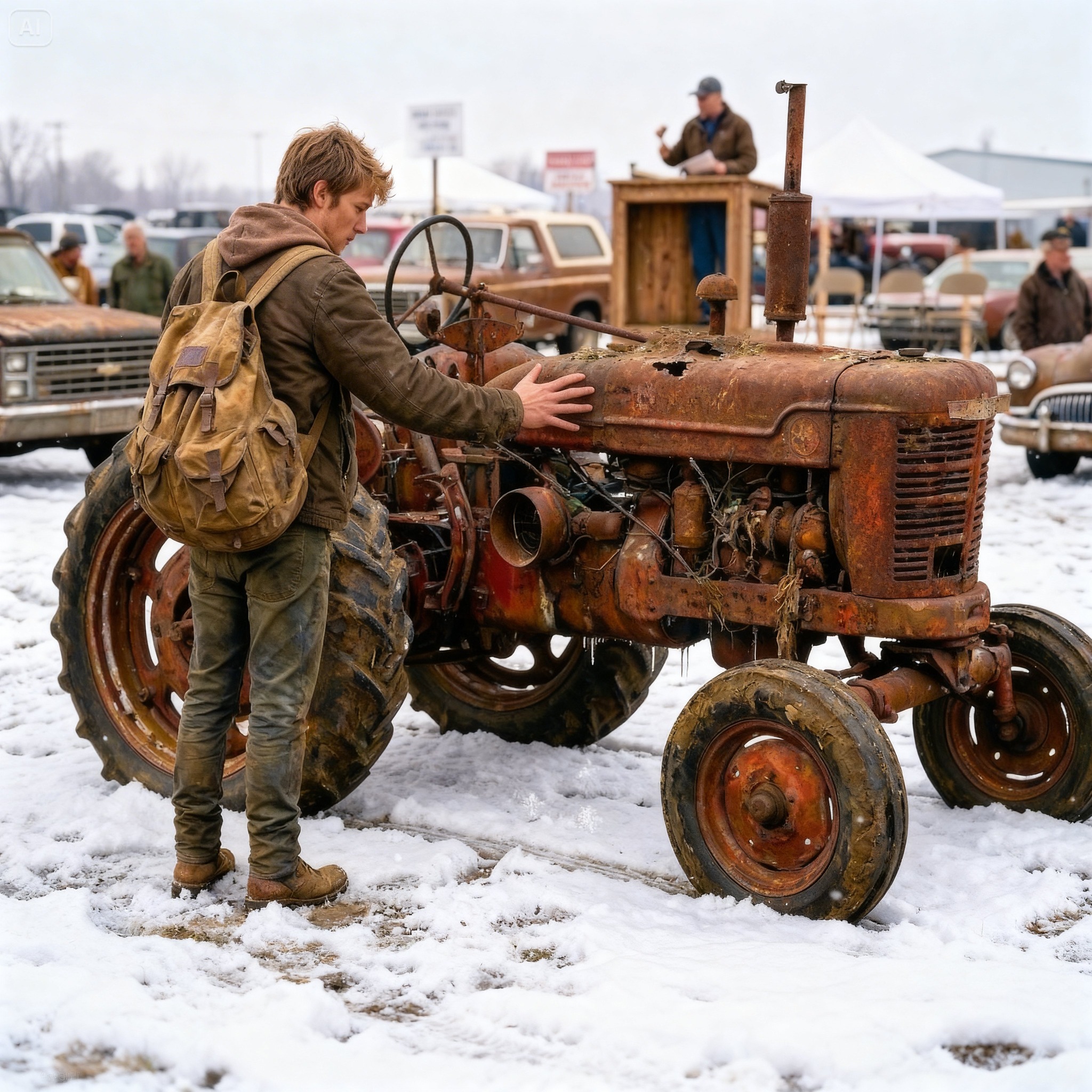
The paper looked cheap, already dirt-streaked and half ruined by being blown through the street, but something about it caught him. Maybe it was the word auction, which suggested things changing hands for less than they were worth. Maybe it was the word equipment, which implied usefulness. Maybe it was simply that he had nothing else. An hour later, following directions that led farther out than he had expected, Sam found himself standing at the edge of a muddy lot packed with pickup trucks, diesel fumes, heavy boots, and voices that all seemed too loud for the weather.
Men in work jackets stood in groups, laughing, arguing, slapping machinery with gloved hands, and inspecting engines as though their judgment alone might improve the metal under it. Some of them looked as if they had been buying and selling equipment all their lives. Sam felt entirely misplaced among them. He was thin, cold, carrying everything he owned, and had no experience with any of what lay before him except whatever loose impressions machinery carried in the imagination of someone who had spent more time being moved through institutions than learning a trade.
Then he saw the tractor.
It sat near the edge of the lot, rusted nearly the color of dried blood and old earth, its tires flat, paint peeling, and metal body pitted by years of weather and neglect. It looked as if it had not moved in decades. Not old in the dignified sense, not preserved or valuable, but abandoned. A machine no one expected to work again.
Something tightened in his chest when he looked at it.
It’s junk, he told himself.
“Kid, you lost?”
The voice came from a tall man in a heavy coat whose embroidered chest patch identified him as Bartholomew Creel. His grin was sharp enough to pass for friendliness at a distance and contempt up close. He nodded toward the tractor.
“You thinking about buying that?”
A few men nearby glanced over.
“That thing’s scrap metal,” Creel said.
Several of them laughed.
Sam’s hand went instinctively to the pocket holding his money. $120. That was everything. Food, shelter, whatever came next, if there was a next. The laughter landed where it was meant to land. He felt it as a heat in his face that had nothing to do with warmth.
They’re right, he thought. This is stupid.
He turned away.
He even took a step.
And then another voice, quieter and more dangerous because it sounded like his own mind stripped of hope, asked what exactly he intended to do instead. Freeze tonight? Starve tomorrow? Spend the last of his money on a room he could not keep beyond a day or 2 and then face the same problem again with nothing left? The wind hit his face hard from the side, and something in him stopped drifting.
He turned back around.
His heart was pounding now, not from confidence but from the knowledge that he was about to commit himself to an outcome he did not understand. He raised his hand.
HOMELESS AT 18, HE BOUGHT A $90 JUNK TRACTOR — WHAT HE BUILT WITH IT LEFT EVERYONE SPEECHLESS