Black Hills, Dakota Territory, August 1883.
The heat came down like a hammer. It beat the dust of the unpaved street into a pale choking powder that drifted over everything in Promise and settled there, fine as ash, a ghostly reminder that winter would arrive soon enough to bury it. For most of the town, the heat was only a temporary cruelty, a last siege before the relief of autumn. For Anya Jensen, it was a clock. Every wave of air shimmering above the baked earth was another tick toward a future she could not yet fully see, though she feared it all the same.
She was a widow, and the word hung on her as heavily as the weather. It was not a title she had chosen, only one she had been made to wear. Her husband, Erik, had been a well digger, a man who understood the temper of ground and stone better than he had ever understood the easy speech of other men. He had come west carrying the same promise that had pulled so many others across the plains, believing that water hidden underground could become fortune if a man knew where to listen for it. He had bought a hard, unwanted patch of land just outside town, a rough stretch of rock and thin grass no one else cared to claim, and he had begun to dig.
He was looking for water.
He found only his grave.
The collapse had happened quickly, the way such things always did. One moment there had been the rhythm of labor, the scrape of tools, the hope that the next foot might break into something living and cool. The next there had been a rush of dry earth, a failure in the wall, and Erik, who had spent his life listening to the deep ground, had been swallowed by it forever.
What he left behind seemed pitiful when listed plainly. A small piece of land. A shack barely fit to stand against a serious wind. A half-finished well lined with timber and descending 40 ft into Dakota bedrock. The well was dry, perfectly and stubbornly dry, a monument to a gamble that had failed. The town pitied her, of course. A woman alone, foreign, quiet, with eyes the color of a northern sea and a tongue that never wasted words. It did not take long for pity to wear thin and reveal the harder thing beneath it: certainty.
She will be on the church’s charity by first snow.
The shack will never survive.
The land is useless.
Nothing there but a dry well.
Mr. Silas Croft had said as much himself. He was the most respected builder in Promise, owner of the sawmill, master of squared logs, joined beams, and the practical authority that came from making solid things with his hands. He had looked at her little structure and told her the truth as he understood it.
“That shack won’t survive a real blizzard,” he had said. “And the land’s no use. Nothing there but a dry well.”
He was not wrong about the shack.
It leaned against the wind like a tired man refusing to lie down. It was more argument than building, a loose assembly of boards that kept out only enough weather to make a person notice how much more was still getting through. But about the land, about the well, Silas Croft was profoundly mistaken.
He saw a failure.
Anya saw a doorway.
Erik had not only been a well digger. He had been the last in a long Danish line of men who worked underground, men who understood stone, heat, air, and the strange, exact habits of the earth below the reach of weather. In the old country his people had labored in mines and quarries. The language of soil and shale was in his blood, and over the years of their marriage he had given pieces of that language to her.
He had not filled their evenings with stories of saints or kings. Lying beside her after work, in the narrow bed they had shared in one temporary place after another, he had spoken instead of thermal gradients, frost lines, bedrock seams, and the patient, indifferent intelligence of the deep earth. The surface world, he used to say, was childish in its moods. It screamed with heat, shrieked with cold, and exhausted itself in spectacle. But go down a little way, just past the shallow reach of the seasons, and the earth remembered a different time. There, it kept a steady heart.
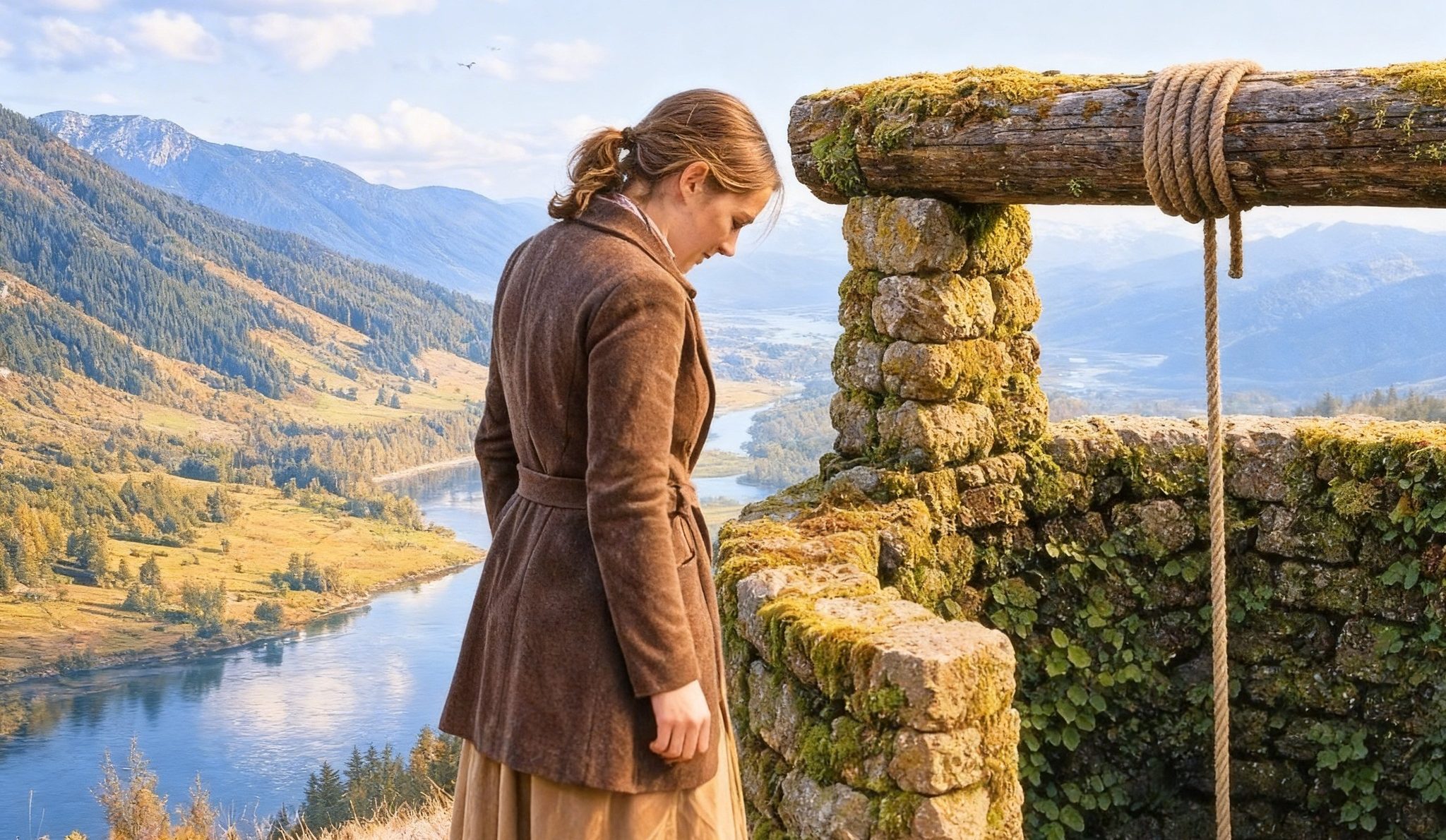
One sweltering afternoon, while the rest of Promise retreated to the shade of porches and saloon awnings, Anya walked to the edge of the dry well and looked down into its circular dark. The shaft did not smell of dampness or rot. It smelled of cool dust, shale, and old silence. She stood there a long time, listening to nothing, and knew with a certainty so calm it did not feel like fear or desperation at all that she had been looking at her inheritance the wrong way. This was not a failed well. It was a beginning.
Her decision did not arrive in a fever of grief. It came by logic, by memory, and by trust in what Erik had taught her.
She would not build upward into the frantic air.
She would not spend the winter fighting a season stronger than wood, stronger than pride, stronger than all the bluff frontier confidence in town. She would step out of the season’s path entirely. She would let winter pass over her instead of through her. She would use the well not as a shaft to go deeper in search of water, but as an entrance.
She tied a rope to the sturdy windlass Erik had built with his own hands. She lit a lantern. Then she climbed down.
The August heat fell away almost at once. At 10 ft below the rim it had already weakened. At 20 ft it was gone. By the time she reached the bottom, 40 ft down, the air felt like late autumn in a root cellar, cool and still in a way that did not suggest the absence of heat, but the presence of something stronger than weather itself. She held the lantern high and slowly turned.
The walls were solid, a layered mix of compacted earth and shale, the shoring timbers expertly placed. Erik had built with care. Even in failure he had not been careless. The shaft was round, stable, and cleanly cut. He had not found water, but he had made a perfect entrance.
Her Late Father Left Her a Dry Well — When She Climbed Down, She Never Came Back Up the Same