Every Farmer Threw Away the Rocks — He Built a Wall That Stopped the Wind and Doubled His Yield
There was a sound the farmers of western Kansas knew the way sailors know surf in the dark. It was not a breeze. Kansas did not deal in breezes. It was wind, a steady, relentless 25 mph current of air that came off the Colorado plains and crossed the western third of the state without striking a mountain, a forest, or even a hill worth naming. There was nothing there to interrupt it. No meaningful rise in the land. No timber line. No barrier. Just open prairie and the old, punishing logic of the Great Plains.
In most places, wind was weather. It arrived, made itself felt, and passed on. In western Kansas, wind was geography. It was as permanent as the soil under a man’s boots—at least it had been, before that soil started lifting and leaving with it.
Hamilton County sat at the far western edge of the state, close enough to Colorado that the border was only 30 miles away. The land rose to around 3,400 feet, flat in the ruthless, unbroken way a tabletop is flat. It received about 17 inches of rainfall in a good year, which was not enough to raise much of anything without help from the Ogallala Aquifer running hidden below. By 1962, there were roughly 200 active farms in the county, most of them planted in wheat and grain sorghum, most of them irrigated, and nearly all of them losing the same battle their predecessors had been fighting since the first plow split the native sod.

Wind erosion.
People tended to remember the Dust Bowl in pictures. Great rolling walls of brown air. Men in hats and women in aprons staring into a horizon erased by dirt. But wind erosion did not need to become dramatic to become devastating. Most of the time, it worked invisibly. On a windy day in Hamilton County—and there were about 120 of those a year—a farmer might lose only a fraction of an inch of topsoil. Not enough to see in a single afternoon. Not enough to measure cleanly with a ruler. But enough that over 10 years, a field that once carried 12 inches of rich dark topsoil might be down to 8, then 6, then 4.
Four inches of topsoil would still grow something. It just would not grow a good crop. It would not hold water the way 12 inches would. It would not support the same microbial life, or retain nutrients the same way, or cushion a farm through a dry year. Every inch the wind took was productivity gone in a form nature would need centuries to replace. It took about 500 years to build 1 inch of topsoil. The Kansas wind could strip it in 5.
The government knew this. After the Dust Bowl, federal planners planted 220 million trees across the Great Plains in what became known as the Shelterbelt Project. The idea was simple and sound: rows of trees set against prevailing winds to slow air, reduce erosion, hold moisture, and protect fields downwind. The system worked. The trouble was time. By 1962, many of those original shelterbelts were 30 years old and beginning to fail under drought, disease, age, and neglect. Younger farmers had little appetite for planting new ones. Shelterbelts took 15 to 20 years to grow tall and dense enough to matter, and by then a man could lose a generation’s worth of soil and income waiting for saplings to become strategy.
Every year, the county extension agent, Roger Voss, stood up at the conservation meeting and said the same thing: plant shelterbelts. Trees are your best defense against wind erosion. Every year, the farmers said back, Roger, trees take 20 years. We need help now.
They weren’t wrong.
Most of them accepted the situation in the only way Kansas farmers knew how to accept a problem no one could solve quickly. They farmed anyway. They watched the wind lift a little more of their future every season. They hoped the next year would be a little wetter, a little calmer, a little kinder than the last.
Every farmer in Hamilton County accepted that arrangement.
Every farmer except Nolan Kreider.
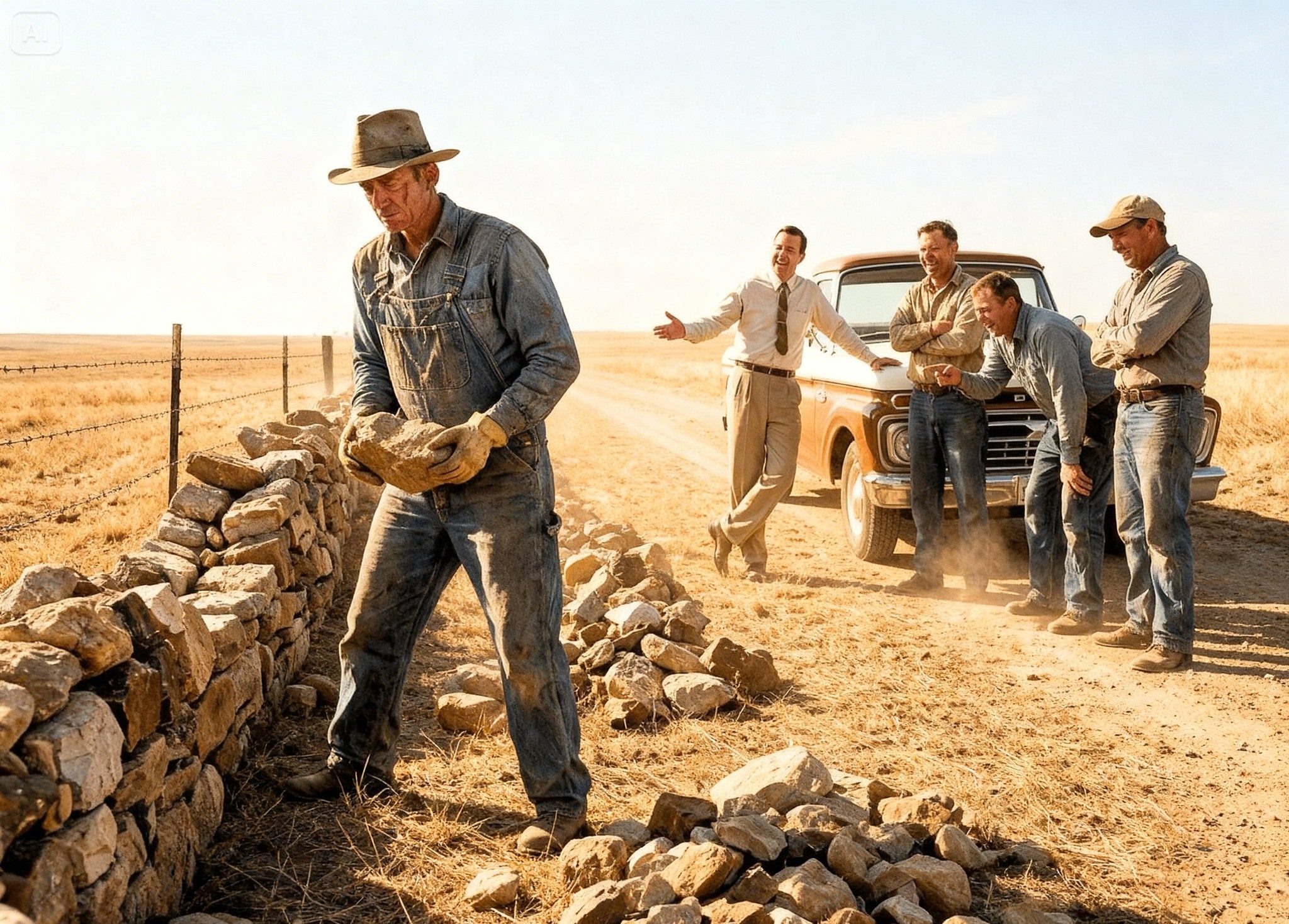
Nolan was 44 in 1962. He had been farming 320 acres on the county’s western edge since 1946, the year he came home from the Navy and married Helen Pankratz, whose father owned the land. For 16 years, Nolan had done what everyone else did. He plowed, planted, irrigated, harvested, repaired, worried, recalculated, and watched the wind take what it could. His farm was positioned badly even by local standards. It lay on the western edge of the county, first in line for the Colorado wind. There was nothing to the west but open range and short-grass prairie for nearly 80 miles. The air that hit Nolan’s fields had been building speed since the Rockies.