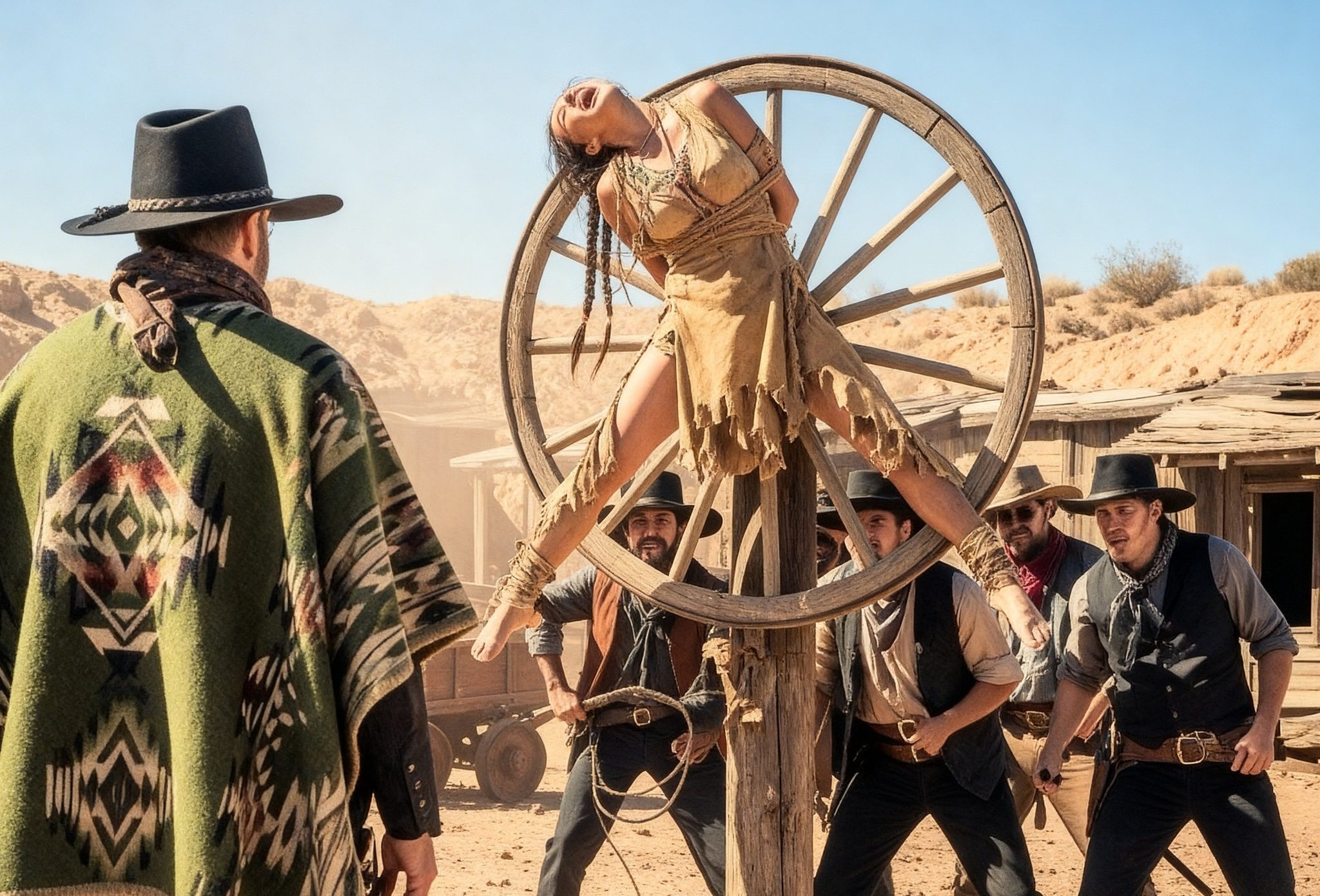
In the middle of Abilene, a wagon wheel had been set upright like a rack.
A young woman was tied to it with her legs forced apart, her body stretched so tightly that every breath made her tremble. The skin on her arms and shoulders was sunburned and torn. Her lips were cracked. Dust clung to the sweat and blood on her face. Yet her eyes still refused surrender. She was barely holding herself inside her own body, but she was still there, still looking back at the men around her as if defiance were the last possession they had failed to take.
Briggs Larkin stood in front of her wearing the kind of grin men wore when cruelty had become performance. He spun his gun in one hand as if he were on a stage and not in the middle of a dry street with a bound woman in front of him and 4 laughing men behind him.
“Look at that,” he said. “Wild, but it still knows how to be afraid.”
The men with him laughed because that was what men like them always did. They laughed to prove to one another that they were beyond shame, that whatever human limit might stop another man did not apply to them. Briggs lifted his hand, whip ready to fall again.
The gunshot broke across the street with such sharp finality that it sounded less like noise than judgment.
Every head turned.
A man stood there through the drifting dust, coat gray with road grime, hat pulled low, one smoking revolver in his hand. His face was lean and hard from distance, sun, and years that had not left much behind except weariness. But there was something colder than exhaustion in his eyes. Something flat and settled. Not anger exactly. Something past anger.
He took one step forward.
“Stop, you bastards.”
He did not shout. He did not need to. The whole street heard him.
Briggs lowered the whip a few inches and curled his lip. “This ain’t your business. Walk away.”
The stranger kept walking.
“Yeah,” he said. “I do not care about your business.”
Then he lifted his eyes to the young woman tied to the wheel.
“But the moment you turned it into injustice, it became mine.”
He moved straight through the silence that followed, holstered the gun as if the men around him were an inconvenience rather than a threat, and cut the ropes one by one. The woman sagged the moment the last one gave way. He caught her before she struck the ground and lowered her carefully into his arms as though the violence done to her had made her fragile in every possible way. She weighed almost nothing. Less like a person than like someone the world had drained nearly empty.
She was not unconscious.
That was the worst part of it.
Her eyes were open, but they did not focus on the street or the men or the stranger carrying her. They seemed fixed on some distance beyond all of it, some place the rest of them could not see and perhaps should have been grateful not to.
The man turned away from Briggs Larkin and the others as if they had already ceased to matter. He carried her down the street without haste and without fear, stopping at an old wooden house with a crooked sign swinging out front.
Dr. Nathaniel Burke.
He kicked the door open.
Inside, an old man with silver hair looked up from a notebook, his expression remarkably free of surprise. If anything, he only seemed tired in the way old frontier doctors often did, as though shock had left his body years ago and never bothered to return.
“Just another normal day in Abilene, huh?” he muttered.
The stranger laid the young woman on a wooden table.
“Still alive,” he said.
Dr. Burke came forward immediately. His hands trembled with age, but not with indecision. He began cutting the remaining rope from her wrists and examining the deep abrasions left there. He studied her face, her dark eyes, the shape of her features, then glanced toward the man who had brought her.
“Apache?” he asked.
The stranger did not answer.
Burke gave a short nod to himself. “Doesn’t matter,” he said. “Pain is the same here.”
Time slowed inside the room. Cloth tore. Scissors clipped through blood-stiffened fabric. The doctor’s hands moved with careful urgency. The young woman breathed in shallow, fragile pulls, and the stranger stood by the wall near the door, never taking his eyes off the street outside. He looked like a man who did not stay anywhere long. A man who had carried wounded people before and knew better than to mistake a rescue for a promise.
When Burke had finished cleaning and bandaging the worst of the injuries, the stranger straightened.
“She’ll be fine,” he said. “I’m leaving.”
The doctor did not look up.
“Stop…You Bastards!”Nameless Gunslinger Said To Most Notorious Thugs In Abilene