MY FIANCÉ TRADED ME TO THE ‘ROTTING’ DUKE—HE NEVER EXPECTED I’D BECOME HIS DUCHESS
They told her the Duke was rotting.
They told Catherine Foster that his flesh was failing beneath silk and shadow, that no physician could stop the slow decay moving through him, that servants only entered his rooms when duty forced them and left again with their faces drained of color. They told her Blackthorn Estate was less a home than a waiting room for death, and that no woman of sense would willingly remain there once she understood what lived behind its heavy doors.
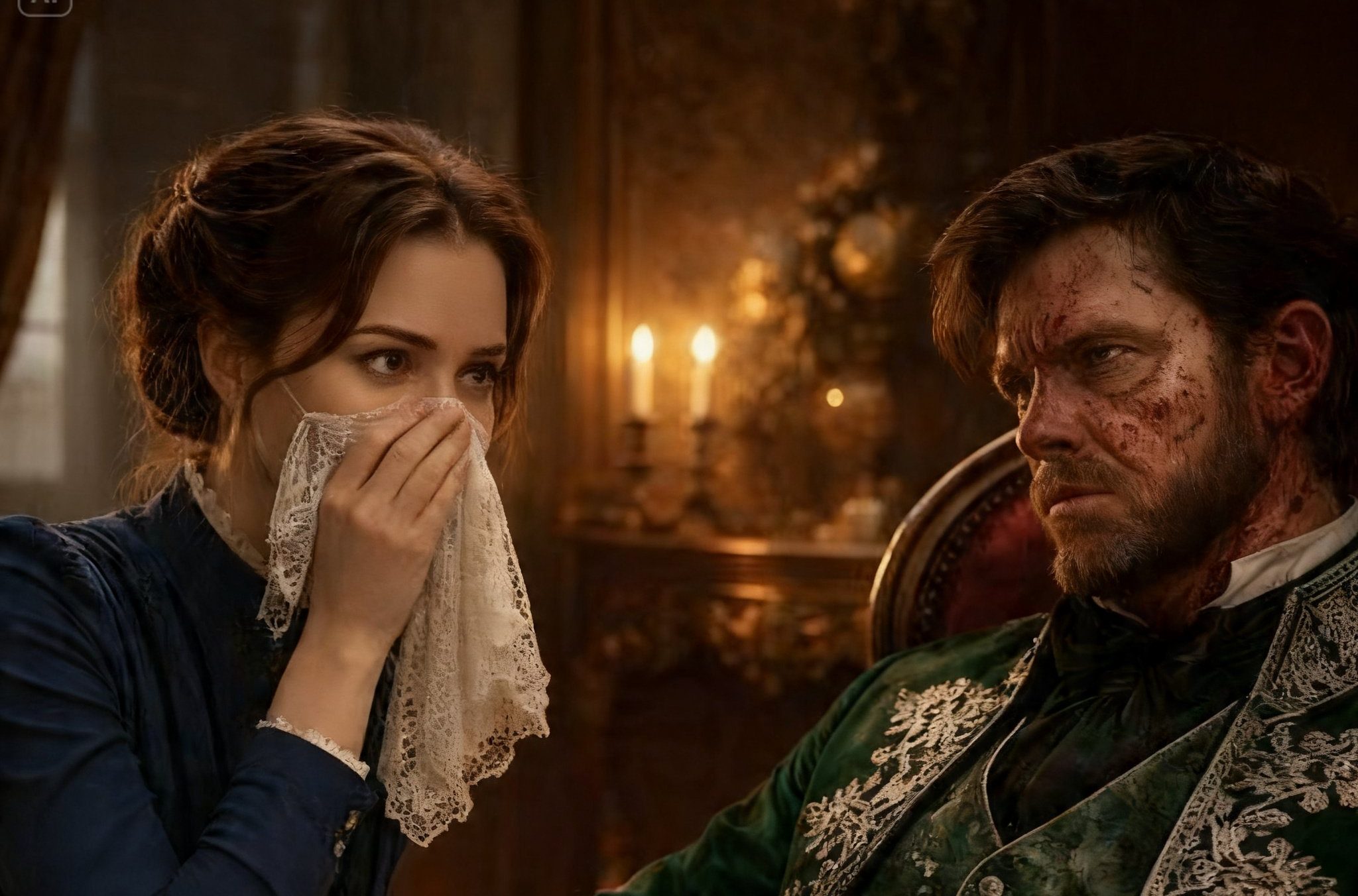
So when the carriage delivered her to the estate just after dusk and the servants led her through echoing corridors into the east wing, Catherine did what any reasonable woman might have done before meeting a dying stranger she had been sent to comfort against her will. She pressed a lace handkerchief to her nose and steeled herself for stench, for disease, for the sickly air of corruption everyone had promised would greet her the moment the chamber opened.
But when the heavy oak doors finally swung inward, there was nothing.
No rot.
No foulness.

No sweetness of death hanging in the velvet drapes or settling into the Persian rugs.
Only silence. Clean air. Candlelight. And somewhere in the shadows, the quiet sound of a man breathing.
Catherine lowered the handkerchief slowly, fingers trembling in spite of herself.
The room stretched before her in blue-black shadow and silver flame. Everything was immaculate. The furniture gleamed. Books lined the shelves in severe, orderly rows. The rugs were clean. The fire in the grate burned low and controlled. Nothing in the chamber looked diseased, abandoned, or desperate. It looked inhabited by someone who valued order enough to maintain it even when the rest of the world had already decided to speak of him as half gone.
“You may enter fully,” a voice said from the darkness near the window. “Or you may leave. Either choice is yours.”
The voice was calm. Masculine. Not weak.
Catherine straightened instinctively. She had been raised to solve problems, not retreat from them. Useful women did not flee because rooms were darker than expected. Useful women stepped forward, gathered the truth, and made themselves necessary.
So she crossed the threshold and let the door close behind her with a soft, decisive click.
The man emerged from the shadows slowly, and Catherine’s breath caught before she could stop it.
The Duke Fabian Osborne was not the monster Victor had described to her.
He was tall and lean, moving with the careful economy of someone who knew pain intimately and had learned not to waste motion under its weight. His face bore the unmistakable structure of old bloodlines—sharp cheekbones, a straight aristocratic nose, a mouth too controlled to be warm by accident. But it was his skin that held her attention. Pale in a way that looked less delicate than strained, marked at the jaw and along the visible length of his neck by strange discolorations that were not bruises, not burns, not anything Catherine had a name for. They looked as if his body had become the site of some private war no physician had yet translated into language.
Yet his eyes were clear.
Intelligent.
Steady.
He watched her not as a dying man watches comfort brought to him, but as a stranger assessing another stranger who had crossed into his life under suspicious circumstances.
“I was told you required a woman,” Catherine said. She meant for the line to sound cold. It came out colder than intended.
Fabian’s expression did not change.
“I was told nothing.”
Catherine blinked.
“I don’t understand.”
“Neither do I.”
He moved to a chair near the fire and sat with the same measured precision he used to walk. “I did not request companionship. I did not ask for assistance. And I certainly did not ask for a woman to be sent here like a sacrificial offering.”
The words struck far harder than they should have.
Until that moment, Catherine had assumed many things. That the Duke was desperate. That he had accepted or even bargained for her presence. That whatever humiliation existed in the arrangement had at least been mutually understood. But if he had not asked for her, then the entire foundation of what she had been told dissolved at once.
“Victor Stevens,” she said slowly. “My fiancé. He told me you had made an arrangement.”
Something dark crossed Fabian’s face and vanished again.
“Victor Stevens is a man who builds his fortune on the misfortunes of others,” he said. “If he told you I requested this, he lied.”
The room tilted.
Catherine gripped the back of a nearby chair to steady herself, because the truth beneath the words landed with terrible force. She had not been offered to the Duke as some solemn act of necessity or compassion. She had been traded. Sent. Positioned. Moved from one man’s scheme into another man’s household without the second man’s consent and, as far as she could suddenly tell, without any regard for her as a person at all.
“You should sit,” Fabian said quietly, “before you fall.”
She wanted to refuse. Pride urged it. But her knees had already weakened, and she sank into the chair opposite him with as much dignity as she could gather.
“What happens now?” she asked.
Fabian leaned back slightly, studying her.
“That depends entirely on what you were told to do here.”
Catherine swallowed. There seemed no point protecting Victor’s intentions any longer, not now that the man had already betrayed her.