NO BRIDE WOULD STAY WITH THE SCARRED MOUNTAIN MAN OF THE HILLS — UNTIL THE OVERWEIGHT WOMAN EVERYONE LAUGHED AT CHOSE HIM, AND UNCOVERED THE DARK REASON THE OTHERS VANISHED
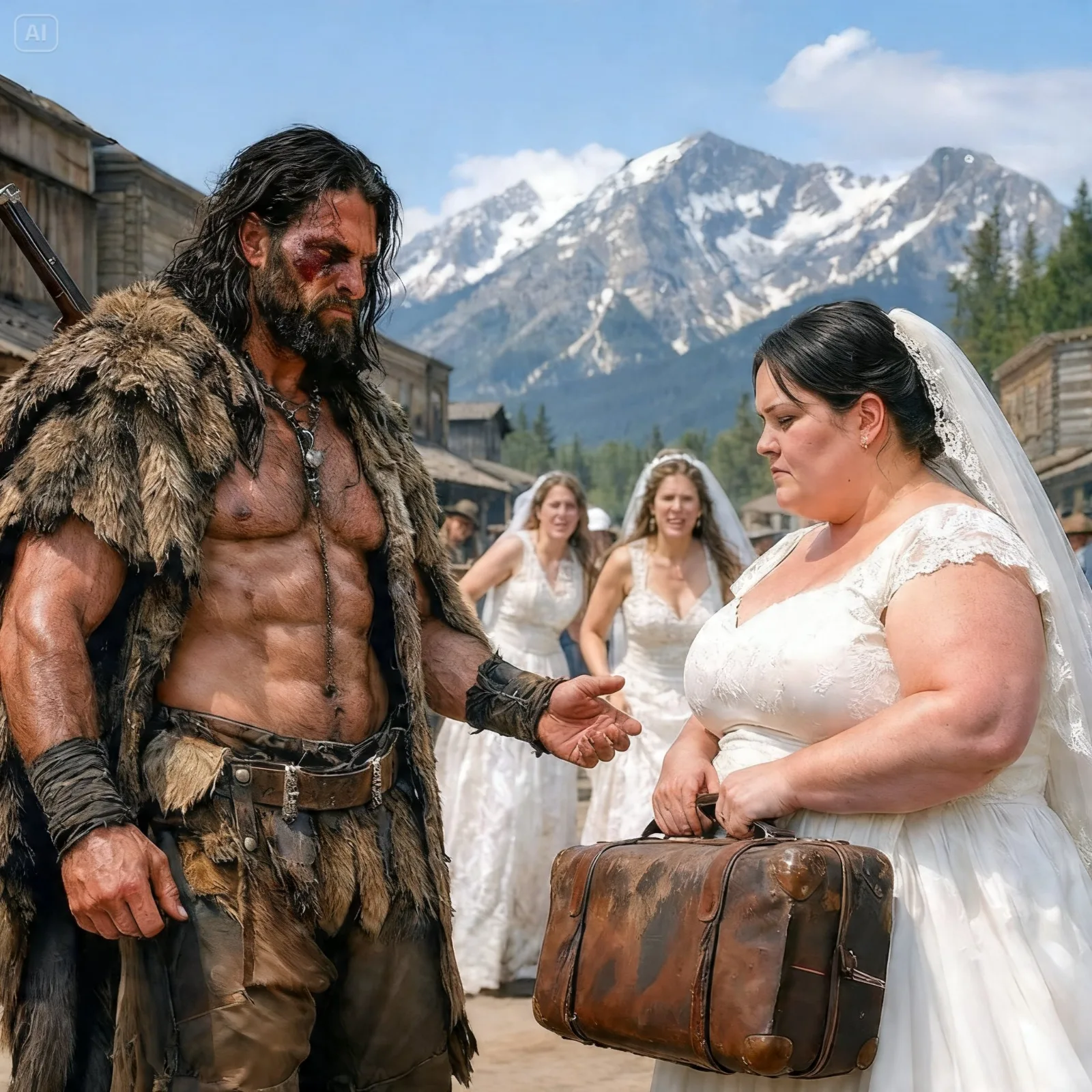
They called him the Beast of Bitterroot.
In Oak Haven, Montana, names like that did not begin as gossip. They began as warnings, carried in low voices across boardwalks and saloon tables, handed from one uneasy soul to another until the name itself became more real than the man beneath it. By the autumn of 1888, Oak Haven had become the kind of frontier town where secrets did not stay hidden for long, but the truth of a man could still be buried under enough fear to make it unrecognizable.
The town crouched at the jagged base of the Bitterroot Mountains, a rough sprawl of weathered timber buildings and mud-rutted streets that smelled of pine smoke, horse sweat, and damp earth. In the cold months, the peaks pressed down on Oak Haven like a threat. The mountain shadows arrived early, and the people who lived beneath them learned to glance upward without meaning to, as if expecting judgment or avalanche or the descent of some half-forgotten thing from the high country.
But the real shadow over the town was not the mountain itself.
It was Jaime Caldwell.
10 years earlier, Jaime had not been a legend, nor a monster, nor the grim subject of church whispers and saloon conjecture. He had simply been a trapper, a quiet man from the mountain who came down to trade furs and purchase salt, flour, lamp oil, and whatever else a solitary life required. Then a grizzly had nearly killed him in a territorial fight over a freshly killed elk. The bear took his left eye, ripped his jaw open nearly to the bone, and left a branching map of jagged purple scars across the left side of his face and neck. He survived by what most people in Oak Haven believed must have been some unnatural stubbornness. But the man who came down the mountain afterward was not the same man who had once walked through town in silence and left without trouble.
He had become bitter.
He had become hideous to look at.
And perhaps worst of all in the eyes of others, he had become a man who no longer seemed to care what seeing him did to them.
Isolation settled over him year by year. Men can live alone a long time in the mountains, but loneliness has a way of turning from weather into illness. Eventually Jaime Caldwell tried to cure it by placing advertisements in Eastern newspapers. They were direct and unsentimental, as though he had cut every unnecessary flourish from the truth before allowing it into print.
Seeking a strong, pragmatic woman for marriage. Mountain life. Hard work. No delicate constitutions.
Three women answered over the years.
The first, Sarah Higgins, was a widow driven by need more than hope. She came up the mountain and fled back down 2 days later in a freezing rainstorm, wild-eyed and shaking, telling anyone who would listen that the man was a demon.
The second, Clara Bowen, had been a factory girl from New York. She lasted 1 week. When she returned to Oak Haven, her clothes were torn and her nerves shattered so completely that she refused to speak of what had happened in Jaime Caldwell’s cabin.
The third, an older spinster named Martha Hayes, did not come back at all.
Jaime said she stole a horse in the night and rode west. Sheriff Tobias Flint went up to investigate, found nothing, and came back with no evidence of murder. But evidence mattered less than certainty in a town already prepared to believe the worst. Martha Hayes vanished, Jaime Caldwell lived alone with his scars on a mountain, and that was enough to let the whispers harden into conviction. By the time the first frost silvered Oak Haven’s roofs in 1888, most people in town no longer spoke of him as a man who might have done something terrible. They spoke of him as though monstrosity itself had simply settled into a cabin above Dead Man’s Creek and learned to wear a human shape.
Then the stagecoach arrived carrying Beatrice Gallagher.
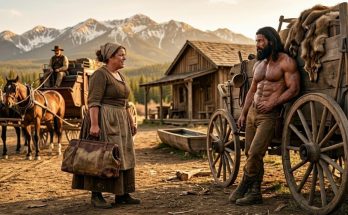
It came rattling into town on a bitter November afternoon, wheels churning through mud already beginning to freeze at the edges. Beatrice stepped down from it with the tired steadiness of someone who had been jostled across 2,000 miles and no longer believed discomfort was worth commenting on. She was 28, heavily built and robust, with a broad face flushed red by the cold and dark eyes that missed very little. In Philadelphia, she had been made to feel monstrous in a different way. High society mocked her weight with the polished cruelty of people who consider humiliation a form of refinement. Her brother Arthur, a banker with a gift for arrogance and a talent for squandering their late father’s estate, had hidden her away like an embarrassment, working her like an unpaid servant in her own family home while pretending he was protecting the family name.
Beatrice had survived that life by developing a useful indifference to other people’s opinions.
She had endured starvation diets imposed upon her, endured whispered jokes from suitors who found sport in her body, endured Arthur’s contempt until the day she found Jaime Caldwell’s advertisement and saw in its brutal plainness not romance, but escape. She did not come west looking for tenderness. She wanted a home. She wanted work. Above all, she wanted to live somewhere she would not spend every hour apologizing for the space she occupied.
When her boots sank into Oak Haven’s freezing mud, she adjusted her heavy wool shawl and surveyed the town as if taking stock of a place she might yet outlast.
People were already staring.
They always stared.
This time, though, it was not only because of her size. Word had traveled from the stage stop. Another bride had come for the mountain man, and the town had gathered in half-curious, half-horrified anticipation to see what sort of desperate fool had answered the ad this time.
The first person to approach her was Reverend Josiah Miller, a narrow, anxious man with a collar that always seemed too tight and a face that carried permanent concern.
“Excuse me, miss,” he said. “Are you expecting someone?”
“I am Beatrice Gallagher,” she answered, voice rich and steady despite the fatigue of the journey. “I am here to marry Mr. Jaime Caldwell.”
The reaction passed through the small crowd like an involuntary gasp.
The reverend blanched. “Miss Gallagher, please, come inside the church. Let me buy you some tea and we can wire your family for a return ticket.”
“I have no family to return to, Reverend.”
Before he could attempt another gentler persuasion, Sheriff Tobias Flint stepped forward. He rested one hand on the butt of his revolver with such casual ownership that it seemed less a threat than an extension of his personality.
“Caldwell ain’t a normal man,” he said. “He’s a brute. A monster. 3 women have gone up to Dead Man’s Creek. 2 came back broken. 1 didn’t come back at all. A woman of your disposition won’t survive the winter, let alone the man.”
Beatrice looked him over with a cool, measuring gaze.
She was used to men seeing her body first and deciding the rest from there. To them, largeness meant softness, weakness, slowness, stupidity, or some combination of all 4. The labor of proving otherwise had become so familiar that she no longer bothered resenting it.
“Sheriff Flint, is it?” she asked. “Tell me, is there a warrant out for Mr. Caldwell’s arrest?”
Flint’s mouth tightened. “No. No proof of foul play with the Hayes woman.”
“Then he is a free man, and I am a free woman.”
There was steel in her voice now, and the people nearest her shifted under it.
“I have traveled 2,000 miles. I am tired. I am cold. And I am in no mood to be treated like a wayward child. If someone would be kind enough to point me toward the mountain trail, I will walk it myself.”
The crowd exchanged pitying looks. They saw a fat, desperate woman marching into the jaws of something terrible because she was too foolish, too proud, or too lonely to listen. They did not see the thing Beatrice had spent most of her life carefully cultivating beneath insult and shame. They did not see the spine of iron under all the softness.
It was the reverend who finally relented.
“He comes down tomorrow for provisions,” he said quietly. “Stay the night at Mrs. Gable’s boarding house. If you still wish to throw your life away in the morning, you can meet him at the supply store.”
“Thank you, Reverend,” Beatrice said. “I will.”
That night, in the cramped room at the boarding house, she stood before a cracked mirror and looked at herself.
She placed both hands over her broad hips, the thick softness of her arms, the body that had made so many people dismiss her before she even spoke. For the first time in years, her size felt like something close to advantage. If Jaime Caldwell truly was a monster, then he would discover what the rest of the world had always underestimated. A woman built like Beatrice Gallagher was not easily broken. She was certainly not easily moved.
Morning brought frost sharp as glass along the timber frames of Oak Haven.
Beatrice stood outside the general store with her 2 heavy canvas trunks at her feet. She had not wasted effort on nervousness. She had already made the journey. Whatever waited at its end, it would not be solved by trembling.
Then Jaime Caldwell turned the corner.
For one brief second, her breath caught.
The rumors had not exaggerated.
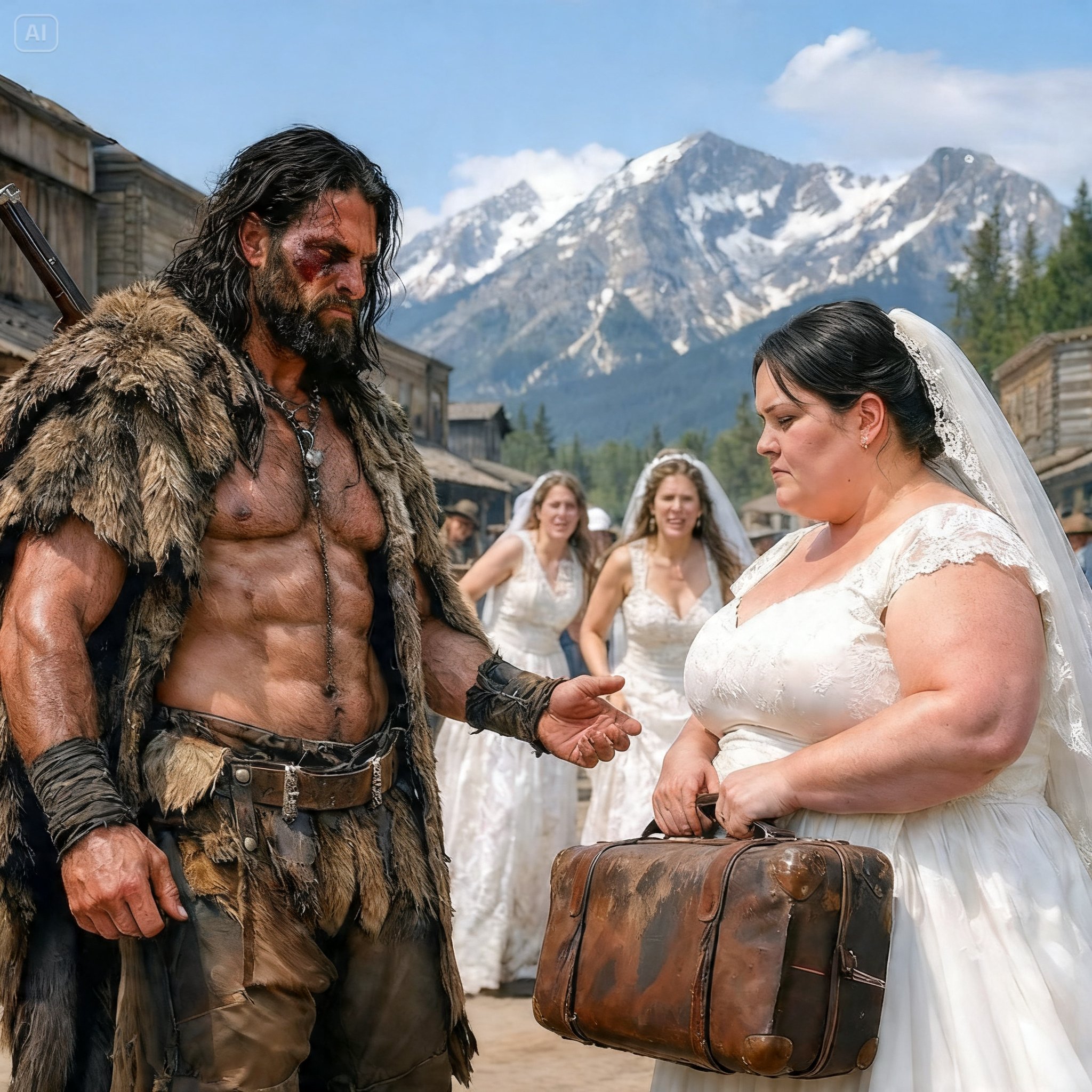
He was a giant of a man, made even larger by the heavy bearskins draped over his shoulders. But it was his face that forced attention. The left side was a ruin of puckered, shiny flesh. The blind eye sat clouded and pale in a socket dragged low by scar tissue. His jawline had been twisted permanently by the bear’s work into a grotesque, lopsided shape that made every resting expression look like pain or contempt. He moved with the economy of a man long accustomed to being watched but entirely uninterested in easing what people felt when they saw him.
The street emptied as he approached.
Women pulled children closer. Men stepped back into doorways. Jaime seemed not to notice. He kept one good eye lowered until he reached the store and at last looked up at the woman waiting with the trunks.
He took in her size first. There was no use pretending otherwise. His eye moved over the broad lines of her body, the practical gray dress stretched over her chest, the heavy boots, the wool shawl, the face that did not flinch from his own.
Something flickered through the ruined lines of his features. Surprise perhaps. Or disappointment.
“You’re the Gallagher woman,” he said.
His voice was deep and rough, pushed through damage that made it sound like gravel dragged over wood.
“I am Beatrice,” she corrected him. “And you are Jaime.”
His gaze sharpened.
“You’re big,” he said.
There was no politeness in it. No tact. It was meant as insult or test or both.
Beatrice did not so much as blink.
“I am. And you are ugly. Now that we’ve established the obvious, Mr. Caldwell, are we going to stand here freezing or are you going to help me load these trunks onto your mule?”
The words landed with enough force that even the onlookers fell still.
No one spoke to Jaime Caldwell like that. No one, so far as Oak Haven knew, had ever looked him in the eye longer than a second and answered bluntness with bluntness.
He let out a harsh sound that might once have been a laugh before the ruined half of his face had changed its shape. Then he stepped forward and lifted both of her trunks with an ease that made their weight seem insulting.
The climb to Dead Man’s Creek was punishing.
The trail wound upward through old pines and ice-slick stone. It narrowed where the mountain dropped away and steepened where the roots rose like hidden fingers under the frost. The air thinned as they climbed, grew sharper, meaner. Jaime set a merciless pace. Whether he meant to test her or simply saw no reason to accommodate weakness, Beatrice could not tell. Perhaps it was both. He walked ahead beside the mule without once turning to ask if she needed rest. He waited, she suspected, for the same thing everyone else had been waiting for since she arrived in Oak Haven, for her to break, complain, weep, or decide the cost was too high.
She did none of those things.
Her lungs burned. Her heavy thighs ached with every step. Sweat dampened the layers under her dress even in the freezing air. More than once she thought she might collapse outright. But she fixed her eyes on the back of Jaime’s boots and kept going. One step. Then another. If she died on the mountain, she would at least deny him the satisfaction of seeing her fail.
By the time they reached the cabin, dusk had begun settling into the pines.
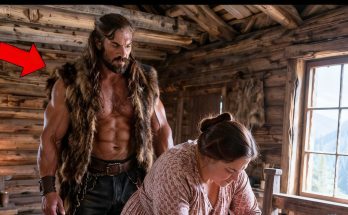
The structure itself was sturdy but crude, built of thick logs and set in a clearing girdled by granite walls and old trees. It looked less like a home than a thing determined to resist weather by force. The smell around it hit her first, blood, earth, smoke, hides, cold ash. Inside was worse.
It was a ruin of solitary male living.
Animal traps lay where they had been dropped. The hearth was choked with old ash. The table gleamed with a skin of grease. The air smelled of raw meat, tanned hide, damp wool, and a long neglect so complete it had become its own atmosphere.
Jaime stood in the doorway behind her watching.
He waited for hysteria.
He waited for a gasp, a complaint, a hand over the mouth, some visible recoil at the squalor or at him. Instead Beatrice took off her coat, hung it on a rusty nail, rolled her sleeves above her thick pale forearms, and said, “Where’s the well, Jaime?”
He blinked. “Out back.”
“Fetch 2 buckets of water. Then move those traps before someone loses a toe. This place smells like a slaughterhouse.”
For the next 3 hours she worked with the terrifying efficiency of a woman who had spent years making order from other people’s negligence.
She scrubbed the table with lye, swept out debris, righted what could be righted, and unpacked her own cast iron skillet from one of the trunks as if she had always expected to need it. Jaime sat near the fire whittling a stick and watching her with his one good eye, still trying to understand the game. The other women had been frightened. They had recoiled. This one behaved as though his dreadful cabin were merely a badly managed household requiring correction.
Dinner only deepened his confusion.
Jaime brought in a freshly skinned hare and slammed it onto the clean table with deliberate force, blood pooling over the wood as if he wanted to see whether revulsion could finally do what the cabin had not.
Beatrice looked at the carcass, then at him, and calmly took a boning knife from her trunk.
Without comment, she butchered the hare with practiced hands, tossed the scraps into the fire, and laid the good cuts in her skillet with salt and whatever else she had brought in her own stores.
“You lack manners, Mr. Caldwell,” she said while working. “But I suppose the bears didn’t teach you etiquette.”
He ate in silence.
She noticed, however, that he took a second helping.
When night came, Jaime showed her to the back room. It was small, cold, and held a lumpy mattress with no lock on the door. He left her there without threat or explanation.
Exhaustion should have taken her instantly, but sleep would not come. The mountain wind howled around the cabin. The boards creaked. Her body ached from the climb, yet her mind remained taut and bright in the dark.
Around midnight she heard a new sound.
Shovel against frozen earth.
It came rhythmically from outside, steady and unmistakable. Beatrice rose from bed, ignoring the protest in her legs, and went to the window. Through the frost-laced pane she saw him.
Jaime was waist-deep in a trench behind the woodpile, digging in the moonlight with a frantic, desperate intensity.
Cold dread moved through her at once.
Sheriff Flint’s warning returned to her with sudden, poisonous clarity. 3 women had gone up. 1 did not come down. Beatrice retreated from the window and sat back on the bed, heart pounding.
Then her bare foot struck something hard beneath the floorboards.
She stilled.
A splintered board near the bed had lifted slightly. Kneeling with difficulty, she pried it up with her fingers and found beneath it a silver cameo locket wrapped in a stained scrap of lace. Her breath thinned as she opened it.
Inside was the miniature portrait of a young woman and an inscription.
To Martha, forever yours.
Martha Hayes.
The vanished bride.
Beatrice sat very still with the locket in her hand while the shovel continued to bite into frozen earth outside. Until that moment the town’s people had frightened her with Jaime’s face, with stories of his temper and the women who had fled him. But looking at the locket and listening to the grave-like rhythm of the digging, Beatrice understood a more terrible possibility.
Perhaps the scars on his face were the least monstrous thing about him.
She was alone on a mountain miles from civilization with a man digging in the dark and a dead woman’s locket hidden beneath her bed.
And she was far too heavy to outrun him.
Part 2
Morning arrived under a hard, colorless sky.
The light that entered the cabin did not so much illuminate as expose, turning the frost at the window edges into pale lace and the rough interior into a sharper version of itself. Beatrice had not slept. She sat wrapped in her heaviest wool shawl at the table with her broad hands folded over the silver locket, waiting.
Fear had settled into something colder and more useful during the night. She had spent a lifetime being taught to make herself smaller, gentler, easier to bear. In Philadelphia that had been called femininity. On the mountain it would have been suicide. Whatever waited in Jaime Caldwell, she meant to meet it awake and full-sized.
When the door opened, it was Jaime who froze.
Snow dusted his bearskin coat and silvered his hair. He carried split cedar under one arm, but when he saw her sitting motionless at the table with Martha Hayes’s cameo gleaming between them, he stopped as if struck. The scars along his ruined cheek tightened. His one good eye fixed on the locket.
He did not drop the wood.
He did not reach for the knife at his thigh.
Instead he let out one long, ragged breath.
“You found it,” he said.
“I did.”
Beatrice’s voice did not shake.
“I also watched you digging in the frozen dirt behind the woodpile at midnight. Jaime, I have endured a lifetime of cruel men and liars. I will not endure another. Tell me whose grave you were digging, and tell me why Martha Hayes’s locket was hidden beneath my bed.”
For a long moment he only stood there. Then he set the cedar down by the hearth, stripped off his gloves, and walked to the table. When he sat opposite her, the breadth of his shoulders seemed to take the light from the room.
“I wasn’t digging a grave,” he said at last. “I was digging up a lockbox.”
Beatrice arched a dark brow.
“A lockbox.”
“Dynamite. Spare ammunition.”
His damaged voice dropped lower.
“To use on the men coming to kill us.”
She stared at him.
“To use on me?”
A flash of real offense crossed his face. It transformed him more than anger would have, because it showed feeling unconnected to menace.
“No,” he said. “To use on them.”
Then, pointing at the locket, he added, “I didn’t kill Martha Hayes. I didn’t touch her. She was frightened, but she was good. She didn’t run from my face, Beatrice. She ran because she saw something she wasn’t meant to see.”
“Explain.”
He did.
The mountain pass above Dead Man’s Creek, he told her, was the only trail through the Bitterroots that stayed open until January. It was technically federal land, but Sheriff Tobias Flint treated it as though it belonged to him. Flint was more than a lawman. He ran the largest cattle-rustling operation in the territory, stealing herds from the valley, driving them through the pass, and selling them over the Idaho border. Jaime’s cabin sat directly on the route.
“And you are the one man in the way,” Beatrice said.
He nodded.
“I’m the only squatter up here. Legally registered. Flint has been trying to run me off 5 years. Can’t just evict me. Can’t shoot me openly unless he wants federal marshals from Helena asking questions. So he decided to drive me mad. Or make sure town folks think I’m capable of a hanging offense.”
“The brides.”
Every piece fell into place with terrible neatness.
Jaime lowered his gaze to his scarred hands as he spoke of them.
“Sarah Higgins didn’t just flee in the rain. Flint’s deputies stopped her on the trail and told her I was a cannibal. Clara Bowen, they intercepted halfway down. I don’t know what they did, but when she got back to town, her mind was gone. Martha…” His voice caught there, roughened even further. “Martha liked to pick blackberries near the eastern ridge. She stumbled into Flint’s camp while they were moving stolen herds. Flint shot her in the back. I heard the gunshot. By the time I found her, she was dead.”
“You buried her.”
“I buried her deep so wolves wouldn’t get her. Took the locket as proof. I’ve been waiting for winter to break so I can ride to Helena and put it in a federal judge’s hand.”
Beatrice thought suddenly of Sheriff Flint in Oak Haven, the loose confidence in his body, the casual way he told her she would not survive the winter. It had not been concern. It had not even been cruelty for its own sake. It had been foreknowledge.
“He’s going to come up here,” Jaime said softly. “Soon. He knows you arrived. He’ll claim he’s making a welfare call. He’ll kill me, kill you, and tell the town the Beast of Bitterroot finally snapped and murdered his new bride before turning the gun on himself.”
Silence followed. It did not feel empty. It felt like the stillness before an avalanche.
Jaime waited for what he assumed was inevitable. He expected tears, panic, maybe a desperate insistence on a horse and immediate flight. Beatrice instead picked up the locket, snapped it closed, and tucked it into the pocket of her apron with care.
Then she planted her broad hands on the table and rose to her full, solid height.
“Well,” she said, “it appears Sheriff Flint has made a severe miscalculation.”
Jaime looked up at her.
“My brother Arthur made the same mistake,” she went on, “right up until I locked him in the cellar and bought my stagecoach ticket with his gambling funds.”
She turned toward the kitchen counter and took up her cast iron skillet.
“How much dynamite did you dig up, Jaime?”
For the first time since she had met him, the ruined lines of his face shifted into something unmistakable.
He smiled.
Not fully, because the scars would not let him, but enough that the expression lit what damage had not destroyed. It was a smile of astonishment, relief, and something almost like joy.
“Good,” Beatrice said. “I’ll make coffee. We have work to do.”
The next 2 days transformed the cabin from a neglected bachelor’s den into a fortified holdfast.
They worked without wasting motion. Jaime showed her the lockbox, the sticks of dynamite, the ammunition, the places around the clearing where snow drifts and brush could hide charges. Beatrice learned quickly, not because she had any prior knowledge of mountain war, but because practical minds translate well across danger. She asked clear questions and expected clear answers. Jaime, who had lived too long alone, found himself obeying the rhythm she imposed almost before he noticed.
The cabin’s disorder vanished first.
Beatrice refused to defend a hovel. She made him help her clear the floors, organize supplies, shore up weak boards, move the traps, and restore some kind of order to the place. If they were going to face armed men, she told him, they would do it in a house fit for thinking.
Outside, they prepared the ground.
Jaime planted hidden charges beneath likely approaches. They rehearsed fields of fire. He showed her where the sheriff’s men would have to ride if they wanted a direct line to the porch. She showed him where a man’s arrogance might push him to step if invited into conversation by a woman he believed harmless. Piece by piece, the terrain became less a trap for them than for whoever came with violence in mind.
Something else changed during those days too, quieter and harder to name.
They began, without intending to, to understand one another.
Jaime saw very quickly that Beatrice’s endurance was not performance. She hauled water, chopped what wood she could manage, lifted more than he expected, and moved through fatigue with the sort of grim stamina born of long practice rather than pride. She was not delicate. She was not slow in any way that mattered. She also did not pity him, which unsettled and relieved him in equal measure.
Beatrice, in turn, began to see beneath the scars.
Jaime was rough, yes. Abrasive. Abrupt. His manners had been gnawed away by solitude and long distrust. Yet none of that resembled the ugliness she had feared on that first sleepless night. The cabin’s squalor was neglect, not sadism. The blood on the table, the carcasses, the bachelor chaos, all of it belonged to a man who had stopped expecting anyone else to share his life, not to one who enjoyed terror. What lay beneath his ruin was not monstrosity, but fatigue so deep it had curdled into bitterness.
By the third day, when the snow began falling thick and blinding through the pines, they were ready.
Sheriff Tobias Flint rode at the front of 3 mounted men, his deputies close behind, rifles balanced across their saddles as if they were approaching nothing more dangerous than a troublesome animal. The storm wrapped the mountain in white, but the men moved with confidence. They believed law belonged to them. They believed the cold, the mountain, and fear itself would help them.
Inside the cabin, Beatrice stood at the frost-laced window and counted.
“3,” she said calmly.
Jaime nodded from his place by the wall with his rifle in hand. “Stay away from the window.”
“I am not fragile,” she said.
Outside, Flint called up to the cabin with a voice steeped in false concern. He demanded that Miss Gallagher come out. He said he was there on official business. He said he wanted only to make certain she was safe.
Beatrice looked once at Jaime, then opened the door.
She filled the doorway completely, broad-shouldered and unyielding against the storm, wrapped in wool and steadiness.
“I am well, Sheriff,” she called. “You may leave.”
Flint studied her, suspicion rising too late.
He had expected fear. He had expected a plea, or a visible sign of coercion, or at the very least the rattled demeanor of a woman trapped by a brute on a mountain. What he found instead was a woman planted firmly in the doorway of that cabin as if she had belonged there for years.
His hand drifted toward his gun.
He signaled to one of the deputies.
The man grinned and urged his horse forward toward the porch. He was still climbing off when Beatrice moved.
The shotgun appeared in her hands with astonishing speed, but she did not aim at him. She aimed at the timber beam above him and fired.
The blast shattered the support. Snow already piled heavy across the porch roof collapsed in a violent rush of timber, ice, and white weight, burying the deputy beneath the wreckage. The mountain swallowed his mocking grin before he could even shape it into surprise.
Then everything exploded into motion.
Gunfire cracked through the storm. Jaime burst from the cabin firing with terrifying precision. One horse screamed and reared, throwing its rider. Another deputy got off a shot that tore through the cabin wall in a spray of splinters. Beatrice came off the porch like a battering ram. A second man rose with his rifle half-lifted. She closed the distance before he could settle his aim and swung the shotgun like a hammer. The blow sent him crashing backward into the snow, broken and gasping.
Across the clearing, Jaime and Flint found each other at last.
Flint fired twice. One shot missed. The other tore into Jaime’s shoulder. He dropped to one knee, blood spilling hot and bright across the snow. Flint smiled as he advanced, the sort of smile that appears only on men who believe they have already won.
Then Jaime said, “You forgot something.”
Flint frowned.
Jaime pulled the line.
The mountain answered.
The explosion ripped the trail open behind Flint and his men. Snow and earth surged upward in a roaring white wall. The ground shook hard enough to knock one horse sideways. The narrow path they had ridden in on vanished beneath a collapse of stone, powder, and ice.
There would be no easy retreat.
No reinforcements.
No clean lie told later in town.
Flint staggered, disoriented, one hand still reaching for control that no longer existed. He went for his weapon again and found a heavy boot crushing his wrist into the snow.
When he looked up, he saw Beatrice.
Soot blackened one side of her face. Blood flecked her sleeve. Her chest rose and fell with the force of effort. But her eyes were steady, cold, and entirely awake. She seized him by the coat and hauled him upright with a strength so shocking that his remaining bravado broke before he fully understood why. The shotgun barrel rose under his chin.
“My husband told you to leave,” she said.
The word husband landed harder than the gun.
There was no tremor in her voice. No uncertainty. Behind her, Jaime rose slowly to his feet, clutching his shoulder, and looked at her with something deeper than gratitude.
“Are you hurt?” he asked.
Beatrice glanced back at him and offered a small, practical smile.
“I’m fine,” she said. “Though I think we’ll need a new porch.”
They bound Flint and the surviving deputy and locked them away to face justice once the mountain thawed enough to let the law from outside reach them. Outside, the storm raged on. Inside, the cabin glowed with firelight and the sharp scent of blood, whiskey, and burned powder.
Beatrice cleaned Jaime’s shoulder wound herself.
Her hands, large and steady, stitched and bandaged with the same practical care she had once given butchered hares and grimy tabletops. Jaime sat still and watched her while she worked, something loosening inside him that had been locked there for years.
“You didn’t run,” he said at last.
Beatrice paused, then looked at him.
“I spent my whole life being told I was too much,” she said softly. “Too loud. Too large. Too difficult to love.”
She rested one hand gently against the scarred ruin of his cheek.
“And you were told you were too broken to be seen.”
Then she leaned forward and kissed the damaged skin with quiet certainty.
“I think,” she whispered, “we were exactly enough.”
Outside, the storm kept howling through the Bitterroots. Inside, for the first time in a very long while, neither of them felt alone.
Part 3
The mountain kept them for the rest of the winter.
Sheriff Tobias Flint and the surviving deputy remained prisoners while the snow closed every easy path and sealed Dead Man’s Creek from the town below. In the beginning, the arrangement felt less like peace than a pause. The storm had prevented immediate consequences, but it had not erased them. A corrupt sheriff sat tied and humiliated in a cabin he had meant to turn into a grave. A wounded mountain man sat by the fire while the woman he was supposed to terrify wrapped his shoulder and gave orders as if she had been born there. Beatrice and Jaime were still half-strangers joined by danger, and danger has a way of creating intimacy before trust fully understands what is happening.
Yet trust grew all the same.
In those first days after the fight, Beatrice saw how poorly Jaime had learned to receive care. He endured it stiffly, suspicious of tenderness as though pain made more sense to him. He resisted help where habit told him to, then stopped resisting where exhaustion or honesty forced him to admit he could not manage alone. Beatrice, for her part, discovered how naturally she filled silence with competence. She cooked, cleaned, inventoried supplies, changed dressings, checked the knots on Flint’s bindings, and rebuilt the rhythm of the cabin into something that felt less like a trapper’s lair and more like a home under siege.
That difference mattered.
People often think affection begins with dramatic confession or physical longing. For Beatrice and Jaime, affection arrived first through usefulness. He split wood one-handed when he should not have. She scolded him for it and then handed him coffee. He showed her where the best water ran under the frozen bank. She taught him that meat could be seasoned properly and not simply burned or boiled. He repaired the latch on the back room door without mentioning it, and she understood the gesture for what it was: not apology, exactly, but recognition. A woman living under his roof should be able to close a door and know it would stay closed.
By the time the storms began easing, Oak Haven had already started imagining its own version of events.
Nothing feeds a frontier town like absence and uncertainty. Flint did not return. His deputy did not return. The deputy buried under the porch collapse certainly did not return. Wagons and riders trying to approach the lower trail found it shattered and impassable. Rumor thickened under the church rafters and beside the stove at the general store. Some said the Beast of Bitterroot had finally snapped and murdered the lawman. Others said Beatrice Gallagher had died screaming like the others and Flint had covered it up. A few swore that dead men had been seen riding in the blizzard. None of them came close to the truth.
When the first workable thaw opened a route down the mountain, Beatrice and Jaime sent word not to Sheriff Flint’s own deputies, but beyond Oak Haven entirely, to federal authorities in Helena.
The evidence traveled with the message. Martha Hayes’s locket. Names. Dates. Flint’s own panicked statements once he realized the mountain would not let him lie his way free. The rustling route through Dead Man’s Creek. Missing herds. Deputies whose loyalty had been bought by fear or stolen profit. By the time marshals arrived, Flint’s crimes had shape enough to stand on their own.
He was taken from the mountain in irons.
Oak Haven watched him leave in a silence very different from the one that had greeted Beatrice’s arrival months earlier. There is a particular look that settles over towns when the man they feared is publicly reduced to what he always was: not power itself, but only a criminal who succeeded because everyone else behaved as if he were untouchable. Flint had carried himself like law because no one stronger than his corruption had yet confronted him. Now he rode out under guard, stripped of badge and pretense alike.
He hanged for his crimes.
The story of his death traveled through the territory quickly, carried by stage lines, ranch hands, and drifters who preferred a scandal with a body count. But just as swiftly, another story grew around it. The bride who went up the mountain and did not run. The scarred mountain man who was not the villain after all. The cabin at Dead Man’s Creek where a corrupt sheriff had gone to commit murder and instead lost everything. Some versions made Beatrice six feet tall and able to lift men clear off their horses. Some said Jaime fought a dozen deputies alone with a rifle in one hand and dynamite in the other. Others swore the two of them were half-devils and deserved one another. Legend, as ever, improved on truth where it thought the truth insufficiently dramatic.
The reality was quieter and better.
Beatrice and Jaime did not come down the mountain to ask society’s forgiveness or approval. They did not return to Oak Haven to host suppers or prove to the good churchgoers that they could pass, under gentler light, as acceptable company. The town had judged them both too quickly and too stupidly for that. She had spent her whole life being called too large, too difficult, too visible. He had spent 10 years being called too hideous, too savage, too damaged for ordinary human regard. Neither of them needed the opinions of people who only knew how to admire what frightened them after the danger had passed.
So they stayed on the mountain.
And from that choice, everything else followed.
The cabin changed first.
Beatrice would not live forever in a place shaped by neglect and threat. Once the snow retreated enough for work to begin in earnest, she remade the cabin from the inside out. Floors were repaired. The porch was rebuilt stronger than before. The hearth was properly cleaned and expanded. Curtains appeared at the windows. Shelves were installed. Crockery was sorted. A place for meat. A place for preserves. A place for blankets. A place for tools. She made order not out of some domestic fantasy, but because a defended, well-run household was one of the strongest things on earth.
Jaime, who had once lived as though comfort were weakness and beauty an insult, found himself making additions without complaint. He cut timber for a larger room. He built a proper smokehouse. He raised fencing. He trapped, hunted, and bartered. Where once he had held the mountain as though mere survival were enough, now he began building as though the future might include more than endurance.
Dead Man’s Creek slowly transformed into an empire by frontier standards.
Timber came first, because the slopes were thick with it and Jaime understood the land better than any surveyor ever could. Then cattle, once rustling no longer threatened the pass and clean routes could be established through the valley. Then more fencing, more outbuildings, more land under active use. The place grew not through greed, but through competence. Beatrice managed accounts, supplies, and labor with the same ruthless efficiency she had first brought to scrubbing his table. Jaime handled the mountain itself, the weather, the stock, the risks. Together they built something large and durable enough that even Oak Haven, for all its gossip, had to admit success when it saw it.
People began coming to them instead of the other way around.
Traders. teamsters. neighboring ranchers. Men who needed timber. Women who needed work. Families willing to settle the edges of harsher land if someone strong already held the center. Beatrice met them with clear eyes and no patience for pretense. Jaime met them with his ruined face, his one fierce eye, and the reputation that no longer worked against him in the way it once had. Fear still followed him, but respect began to replace some of it. Not because his scars softened, but because people learned what kind of man wore them.
And for those who worked under or with them, the truth became impossible to miss.
Jaime Caldwell was not gentle in any decorative sense. He remained abrupt, formidable, and built of mountain weather and old pain. But he was fair. He paid what he owed. He protected what was his. He did not tolerate cruelty. Men who came expecting some half-feral brute instead found someone who understood suffering too well to make a sport of it in others.
Beatrice, meanwhile, proved even more formidable than the town had ever guessed.
The thing Oak Haven had mocked in her became the foundation of her authority. She took up space in every sense of the phrase. Nothing about her asked permission. She was not embarrassed by her size. She used it, inhabited it, made it part of how she moved through the world. Workers learned quickly that when Beatrice Gallagher Caldwell stood in a doorway with her arms crossed and a decision already made, arguments tended to die where they stood. Jaime himself learned that her cast iron skillet was not metaphorical power alone. It remained a perfectly serviceable instrument for emphasizing a point when lesser methods failed.
Love arrived between them not as a sudden blaze, but as a long-earned certainty.
Jaime had spent years expecting recoil the moment a woman saw his face in full daylight. Beatrice did not look away. That mattered more to him than flattery ever could have. She had spent years being treated as a body to apologize for. Jaime never asked her to shrink, never once suggested that she would be more worthy if smaller, softer, or less visible. That mattered more to her than any polished eastern compliment could have. Between them there was no performance, because neither had been rewarded by life for performance. There was only the hard and precious relief of being seen accurately.
At some point, without formal declaration, the marriage they had traveled west to make under desperation became a real one.
Not merely legal. Not merely practical. Real.
He stopped bracing when she touched him.
She stopped expecting him to retreat from tenderness.
They learned each other’s habits, his tendency to wake at the smallest unnatural sound, her refusal to sit idle if there was work unfinished, his silences, her muttered commentary while cooking, the way his one good eye softened when watching her unseen, the way her broad hand would rest on his back in passing as if checking that he was still there.
Eventually there were children.
3 of them.
They grew fierce and capable under mountain skies, with a father whose scars were never hidden from them and a mother who taught them from infancy that power and gentleness were not opposites. Those children knew that the torn side of Jaime’s face was not shame but survival made visible. They knew that their mother’s broad, mighty body had stood between death and the life they now inherited. They learned to move through the world without apologizing for size, damage, or difference, because in the Caldwell house such things were facts, not failings.
As the years passed, Oak Haven’s version of the story changed again.
The Beast of Bitterroot became, grudgingly, then openly, Jaime Caldwell of Dead Man’s Creek, a hard man, yes, but a just one. Beatrice became less the absurd eastern bride and more the formidable matriarch on the mountain, the woman who once stared down a sheriff with a shotgun under his chin and rebuilt a kingdom out of timber, cattle, and refusal.
The town still told stories.
Frontier towns always do. But the mockery vanished from them. In its place came something like awe. Children were still warned about the mountain, but now in the half-admiring way legends are used to frighten and inspire at once. Men who tried to be clever about Beatrice’s size usually did so only once. Women passing through sometimes looked at the growing spread of Dead Man’s Creek and saw, perhaps for the first time, another possible shape of life, one not dependent on fitting the narrow, foolish expectations of towns like Oak Haven.
If there was a moral in any of it, it lived in the mistake nearly everyone had made at the beginning.
Oak Haven looked at Jaime’s ruined face and saw a monster.
It looked at Beatrice’s heavy body and saw desperation, weakness, and some sort of pitiable last resort.
The town was wrong about both of them.
Jaime’s scars were never the ugliest thing in the story. The ugliest thing was what a man like Tobias Flint had been allowed to become while wearing the law like a disguise. Beatrice’s size was never evidence of failure. It was one more way the world had misjudged a woman too solid to be managed by other people’s ideas of lovability.
They were both, in different ways, exiles from ordinary approval.
That was what let them recognize each other so quickly once fear and misunderstanding had been stripped away. He had been told he was too broken to belong among other people. She had been told she was too much to deserve tenderness. Together they discovered that the world making those judgments had simply been too small to understand them.
Dead Man’s Creek prospered for years.
Timber mills expanded. Herds increased. Winters came and went. Children grew. Scars faded only in color, not in meaning. Beatrice kept Martha Hayes’s locket in a drawer lined with cloth, not as a relic of horror alone, but as a reminder of the truth that had bound her to the mountain in the first place. Jaime never forgot how near he had come to letting the town’s version of him become the last version. She never forgot that the journey west had begun as escape and become belonging.
And in all the territory, no one ever again tried to tell either of them what shape love ought to take.
Because the truth of it stood too plainly on the mountain to deny: a scarred man whom the world called a beast and a woman the world called too heavy to love had found in one another not rescue, not charity, but recognition.
That was the thing both had needed most.
Not beauty.
Not approval.
Not the town’s forgiveness.
Recognition.
Someone looking directly at the wound, the body, the damage, the history, and saying not despite this, but with all of this included, yes. You. Exactly you.
So they remained where they were, high above Oak Haven, building their life in the shadow of the Bitterroots until the land itself seemed to accept them as part of its own hard design.
And when the story was told later, as all good frontier stories eventually are, people always lingered over the same beginning.
Three brides had gone up the mountain.
Three had not stayed.
Then came Beatrice Gallagher.
She looked at the scarred mountain man with his mangled face, heard the rumors, smelled the blood and ash of his lonely cabin, and did not run.
She simply unpacked her bags.