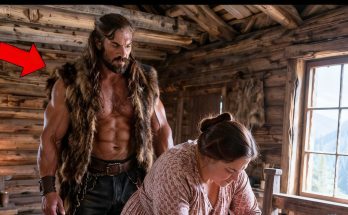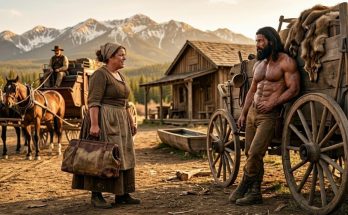

The man holding Clara Whitmore down looked, at first glance, like every other danger the Kansas grass had ever taught her to fear.
The sun stood high over the open land, bleaching the country flat and yellow until everything seemed stripped bare before it could hide a soul. The earth under her back was hot enough to sting through the thin fabric of her dress. Dry weeds scratched her arms. Dust clung to the sweat on her face. Her legs were pulled wide and fastened low between two short posts driven into the ground, the ropes cinched so tightly around her ankles that any effort to twist free only burned her skin rawer. There was nowhere to crawl, nowhere to disappear, nowhere left to pretend she had not already been caught.
“Please, not like this.”
The plea tore out of her dry and cracked, thin with terror and exhaustion. She had spent too much breath already, spent too much strength running, fighting, begging. What little remained barely carried. It might not have reached the ears of the man above her at all, but if it did, he gave no sign.
Elias Boone had one hand braced near her hip and the other pressing her shoulder into the dirt. His weight held her still with a control that did not feel merciful. From where she lay, squinting into the hard white glare, he looked like the end of the road rather than any kind of rescue. Men who stopped women on lonely stretches between Ellsworth and the next bend south did not stop to do right. They stopped for what they could take, or what they had been paid to bring back.
She kicked once, uselessly. The ropes on her legs kept her from getting any leverage. Pain flashed through her calves and up into her hips.
“Don’t,” she whispered, shaking now in earnest. “Please, don’t.”
Elias leaned closer, his shadow falling across her face. His voice, when it came, was rough and low enough to sound like a threat. “Stay still.”
It did not soothe her. It sharpened her fear.
What Clara could not see from beneath him was that the worst danger was not, in that moment, the man restraining her. A few yards away one of the men who had chased her lay half-conscious in the dirt, hat thrown clear off, blood darkening the side of his head where Elias had struck him hard enough to drop him. Another had backed away just far enough to lift a revolver, uncertain whether to fire or wait. And farther off, still hidden by the swell of the trail, came the slow grinding approach of something worse.
Clara had not seen Elias emerge from the brush. She had not seen him come upon the men just after they dragged her back and forced her down like livestock. She had not seen the first man fall beneath his blow or the second hesitate with the gun in his hand. Her world had narrowed to the weight on her chest, the pull of the ropes at her legs, the heat in her lungs, and the certainty that another man had come only to finish what the others had begun.
Elias kept his eyes fixed on the gunman. “Drop it,” he said.
There was no drama in his tone. No shout. No flaring anger. Just a voice worn by use, the kind a man acquires after saying hard things at hard moments and living through what came next.
The gunman did not lower the weapon. He did not fire, either. His attention shifted past Elias, toward the trail behind them.
Then the sound carried clear at last—wood creaking, iron rims grinding over dry earth, harness leather straining, horses stepping with the dull, steady patience of animals made to haul burdens longer than conscience could stand.

Clara heard it too.
Her breath caught. Her body went rigid beneath Elias, every muscle gone still with a knowledge deeper than surprise. She no longer strained against him. She no longer fought. Fear changed shape so quickly that Elias felt it under his hand like a current turning in water.
The wagon rose over the low swell of the trail with canvas stretched tight across its frame and a driver sitting high, quiet, and practiced on the seat. Even before the man climbing down from beside it came fully into view, Elias knew help had not arrived. Men did not haul that kind of wagon under that kind of canvas for decent work. Not on roads like these.
The second man stepping into sight was one Clara recognized.
Virgil Pike.
The name was not spoken aloud, but Elias saw it in the way her eyes fixed on him, saw it in the way the last fight ran out of her all at once. Whatever strength had kept her clawing at the dirt and kicking against the rope bled away in a single breath.
“No,” she whispered. “No, not again.”
That told him almost everything.
This was no family quarrel. No runaway daughter from a hard house. No wild misunderstanding that could be settled with a threat and a turned back. The man with the revolver stepped toward the approaching wagon, his confidence returning now that backup had arrived.
“Found her again,” he called. “Tried to run.”
Virgil Pike climbed down as if time itself belonged to him. He was not hurried because men like him never had to be. He stepped onto the ground with the smooth assurance of someone who had crossed too many roads unchallenged, someone who had learned that fear usually did half his work before he said a word. He looked first at Clara, then at the ropes binding her legs, then at Elias.
A stillness settled over the ground so abruptly it seemed even the insects had gone quiet. Heat pressed down. Horses snorted. The injured man groaned in the dust.
Elias shifted just enough to keep Clara still without hurting her more than he had to.
“Please,” she said again, and now there was almost no voice left in it. “Not like this.”
He did not answer her. He was looking at Virgil, because now the shape of the thing had become clearer, and stepping into it no longer seemed like an accident. The wagon rolled closer and stopped. Something moved beneath the canvas from inside.
Not cargo.
People.
More than one.
The knowledge landed in Elias’s chest with a weight that had nothing to do with the heat. He had seen ugly business on these roads. Men beaten over cattle, stage lines cut open for money, whiskey-fueled cruelty passed off as frontier law. But this was a different kind of quiet. A system quiet. A practiced wrongness.
Virgil smiled, thin and easy. “You’re a long way from where you should be.”
Elias did not answer.
The real question was not who these men were. It was how many there were, how many more might be near, and whether he had already placed himself between one terrified woman and a machine too large for one man to stop.
Virgil glanced at the felled man, then at the gunman, then back at Elias. “Messy,” he said.
“She ran,” the gunman replied. “We had to remind her.”
Virgil gave a slight nod, as though this were an inconvenience rather than an outrage. Then he studied Elias again. “You part of this?”
Elias took a moment before answering. A man could buy himself time with silence if he knew how to use it.
Clara shook her head weakly. “No,” she whispered. “No, he’s not.”
But her voice carried no weight here. Not with Virgil. Not with the armed men. Not on a road where whatever had happened to her had already been happening long enough to teach everyone their role.
Virgil crouched just enough to look directly into her face. “You had your chance,” he said quietly. “Next time you run, we don’t tie you.”
He did not have to explain the rest.
Clara closed her eyes for a single second, and Elias saw something in that expression he had seen before in other faces: not merely fear, but familiarity with fear. This was not the first time. This was a known torment, a repeated one. That changed the balance of the ground as surely as if a new gun had appeared.
Elias made his choice then.
He did not announce it to himself. Men like him rarely did. A choice like that did not arrive with music or righteousness. It came with a recognition that after a certain point, standing still was the same thing as siding with whoever already held the whip hand.
He lifted his hand from Clara’s shoulder slowly, careful not to trigger alarm too soon, and rose to his feet.
“She’s coming with me,” he said.
Virgil smiled a little wider, though the amusement never touched his eyes. “You fixing to die today, stranger.”
“Not planning on it.”
Virgil let the silence stretch. “What’s your name?”
“Doesn’t change the job.”
That earned him a small chuckle. “Fair enough.”
Virgil straightened, dusted his hands, and nodded toward the wagon. “Load her up. We’re late already.”
The ropes at Clara’s legs were cut, though not in any spirit of mercy. Her muscles shook when the tension released. Elias caught her beneath the arm and pulled her to her feet. For a second her body leaned into him, involuntary, more weakness than trust. Then she recoiled as if the contact burned.
“Don’t,” she muttered under her breath. “Don’t pretend.”
Elias said nothing. Words were the cheapest thing a man could offer out here, and he had no intention of spending them where they would not yet buy belief.
He guided her toward the wagon.
Up close the canvas shifted again. A hand pressed against the inside, then withdrew. Another shape moved behind it. Clara saw it too, and whatever fragile hope had survived in her face died there in the dust. This was no single capture. No isolated bargain. The smell drifting from the opened door—sweat, old wood, fear, gunmetal, rust from iron hinges—said enough before a single face was revealed.
Inside sat women.
Not free. Not bound like Clara had been. Just contained, watched, and being moved beneath a lie.
That was the moment Elias understood the road itself had become part of the trap. A route built to make women disappear under paperwork, distance, and men willing to keep their mouths shut.
He helped Clara up into the wagon, then climbed in after her before anyone told him to. It was the only way forward that made any sense. From the outside it would look like he belonged. From the inside he could count, watch, wait, and maybe find a seam in the thing.
The door shut. Light narrowed to cracks around the boards. The wagon lurched and rolled south again.
Clara sat opposite him with her knees drawn in, her arms wrapped around herself as if she could still make her body smaller, harder to claim. She kept her eyes down, refusing to look at him for long. Elias did not press her with questions. He watched instead. Counted breaths. Counted the women. Counted voices outside. Counted every shift in the wagon’s pace and what might be causing it.
Three women inside, including Clara.
One driver.
At least 2 riders outside.
Virgil nearby enough to hear trouble.
The driver, perched on the bench beyond the front boards, never turned to look in. Yet once, when the wagon hit a deep rut, he checked the team just enough to spare the women the worst of the jolt. It was a small thing. Easy to dismiss. But Elias noticed. Men in bad work usually revealed themselves in the small choices long before the large ones.
Ned Tolliver, one of the men outside had called him.
Clara finally lifted her eyes to Elias. They were red-rimmed from dust and strain, and harder now than they had been on the ground.
“You’re one of them,” she said.
Elias let the accusation hang. He did not deny it. Not because it was true, but because denial would mean nothing coming from him. If she was going to learn otherwise, it would not be by his mouth.
The wagon rolled on.
The woman to Clara’s left winced now and then, one hand pressed to her side as if she had been struck recently. The other sat so still she might have been mistaken for calm, if not for the way her fingers trembled in her lap whenever voices rose outside. Hours dragged by under the canvas, thick with heat and silence and the grinding certainty of motion away from any place that might still help.
By the time the wagon slowed again, Clara’s fear had settled into something sharper than panic. Panic wasted energy. This had gone beyond that.
The stop came not at a town or station, but in open country near a thin creek bed running low and dry. One of the men outside called for a change of team. The order came quick, practiced, routine. That, more than anything, spoke of repetition. This was not improvisation. It was a route. A business.
The flap opened. Daylight spilled in.
Clara’s body tightened.
Elias saw the decision in her before she moved. Her eyes darted once toward the gap, once toward the men preoccupied with the horses, once toward the stretch of empty land beyond. Then she was gone.
She hit the ground hard but kept her footing and ran.
For one honest second it looked possible. Fear drove her faster than her weakened legs had any right to carry her. She made it past the wheel. Past the first patch of churned dirt. Past the shadow of the team.
Then a shot cracked through the air.
The bullet struck the ground just ahead of her feet, kicking dirt into her skirts.
It was not meant to kill. It was meant to stop.
And it did.
Two men were on her before she could turn, dragging her back with none of the earlier restraint. No more patience. No more warnings. They hauled her against the wagon wheel hard enough to make the spokes shudder.
Elias climbed down after them, moving without hurry and without calling attention to himself. He came only close enough to see the change in her face when they threw her there, close enough to hear the break in her breathing.
She looked at him then, and for the first time since the road, something in her expression had shifted.
Not trust. It was too early for that, maybe too much to ask at all. But doubt had entered where certainty once sat. If he had meant to hurt her, he could have done it already. She knew that now, even if she hated knowing it.
Elias bent slightly, as though checking the wheel, and spoke low enough for her alone.
“Running blind gets you buried.”
She stared at him, anger and understanding colliding behind her eyes. He could tell she despised the words. He could also tell she heard the warning inside them.
Up ahead one of the riders pointed toward the horizon. “Another mile. Then we hold.”
Elias followed the gesture. There was something there, though hard to make out at first—a low place off the main track, screened by dying grass and a broken line of trees. Not a town. Not a proper ranch. Something tucked away on purpose.
When the wagon rolled again, it turned off the main route and into land that looked forgotten by accident until a closer eye saw the design in it. Low ground. Half-dead grass. Trees positioned just so, enough to hide the approach from the road. Beyond them stood a long, low barn with no sign and almost no sound around it.
No fresh tracks leading away.
That was all Elias needed to know.
This was not a stop. It was a hold.
The wagon door opened. “Out,” one of the riders said.
Nobody inside moved at first. Clara, the other women, even Elias seemed held by the same understanding: stepping down would mean crossing a line harder to cross back. But hesitation bought nothing. Elias stepped out first because he needed to see.
The yard was hard-packed dirt scarred by wagon wheels that came often and left little. Fencing leaned in places but stood in others. A water trough sat half full beneath a slanting awning. No animals moved in the open. No children. No house sounds. Just the barn, the trees, the men, and the thick wrong silence of a place built for transactions no decent person wanted named.
The women were pulled down after him.
Clara stumbled when her boots hit the ground, but did not fall. She stood with her chest rising and falling hard, looking over everything as though trying to memorize the place before it erased her inside it.
Then she saw the man standing near the barn door.
He wore a clean shirt and a hat set properly, the sort of man whose boots had not touched honest labor in a while. He looked as though he had come merely to witness a delivery before returning to safer rooms, and for one terrible second Clara’s face emptied of every expression but disbelief.
“Harlan,” she said, though the word barely breathed free.
Harlan Whitmore.
Her father.
The yard went still in a deeper way than before. Even the men seemed to sense the shift.
No tears came. No scream. Clara only stared, and in that stillness Elias saw something inside her give way.
“You said…” she began, then stopped because the rest could not survive the crossing from mind to mouth.
Harlan stepped closer, not warm, not ashamed enough. He looked at her the way a man might look at an unpaid bill. “You made this harder than it had to be.”
She shook her head once, slowly. “You sold me.”
He looked away almost at once, unable or unwilling to hold his daughter’s eyes. “Your mother’s gone. The debts kept coming. Land, feed, notes, all of it. I ran out of road.”
“That don’t make it right.”
“No,” he said, quieter than before. “It just makes it what it is.”
In that moment Clara stopped waiting for him to become her father again. Whatever had still lived of him in memory died standing a few feet from the barn in clean clothes and careful excuses.
Near the doorway, half in shade, stood another man whose silence carried the weight of office. Sheriff Amos Keen kept his attention angled away from Clara as if direct recognition might stain him. He addressed Virgil instead.
“The line’s clean?”
Virgil gave a short nod. “Contract says service out west. County mark says she signed on willing.”
Amos adjusted his vest and offered no more than that.
But Elias understood enough. No chains in the ledger. No crime in the wording. A paper somewhere bearing the lie of consent, backed by men who could stamp it and call the road lawful. That was the true size of the thing. Not one villain, not one wagon. A system of hands passing women along beneath respectable language.
Clara took one step back, perhaps without meaning to. One of the men seized her arm.
That was when the balance broke.
Elias scooped a handful of dry dirt and flung it hard into the man’s eyes. The man cursed and reeled. Elias drove his shoulder into him a heartbeat later, knocking him away from Clara and sending both of them staggering into the side of the barn.
Shouts erupted at once. Boots pounded. Hands went for guns.
And in the middle of the sudden violence Clara stood between the man who had sold her and the man who had finally chosen a side.
Part 2
The yard burst apart so fast that for a second it seemed less like a fight than a structure collapsing under its own rot.
Dust flew up from the ground beneath stamping boots and scrambling horses. Someone shouted for a gun. Someone else cursed loud enough to turn the words into noise. The man Elias had struck slammed against the barn wall hard enough to crack a board loose, then dropped to one knee clawing at his pistol. Elias did not give him the chance to clear leather cleanly. He drove forward again, all weight and momentum, and the two of them hit the planks a second time. Wood splintered. Breath left the man in a grunt.
A shot went off somewhere to the left.
The bullet tore into dirt and shattered a fence post, spraying chips through the air.
Clara stood frozen for one heartbeat too long. She had spent so many hours being dragged, ordered, pinned, and handled that action itself felt unfamiliar now, as though movement had become something belonging to other people. But then something in her changed. Not hope. Hope was too soft a word for it. Choice was closer. Choice and a kind of raw refusal that had been building under fear since the moment she recognized the wagon for what it was.
She turned not away from the danger, but toward the wagon.
Its side door still stood shut from the outside latch. Behind that rough wood were the other women. She could leave them there and run for herself if she got clear. The thought existed for half a second and died at once. She had already seen their faces in the dark. She knew too well what staying behind meant.
She ran toward the wagon.
Her hands were shaking so badly that when she reached the latch she missed it once. The iron handle slipped under her fingers. Another shot cracked from behind her. She flinched, grabbed again, got it this time, and yanked the door open.
The women inside stared back at her with the same fear that had filled her own body not long ago.
“It’s open,” she said, breath breaking with urgency. “Move.”
The first woman lurched down too fast and nearly fell. The second tried to squeeze past her and tangled in her skirt. Before either could fully clear the step, a shot struck the wagon rail above them, splintering wood so close that one of the women screamed and ducked on instinct. Clara caught her by the arm, dragged her down and clear, and shoved her toward the open ground beyond the horses.
That was all it took.
Sometimes people do not need a plan. They need proof. They need to see, with their own eyes, that the door is truly open and that one soul has already crossed through it alive.
Behind Clara, Harlan Whitmore had not moved to stop her. He had not called for the men to seize her. He stood rooted in place with a look she had never seen on him before, as though he were watching not merely disobedience but the collapse of some story he had told himself to survive what he had done.
“Clara,” he said.
She turned to him.
There was dirt on her face, dust in her hair, and a tear in the sleeve of her dress, but she no longer looked like the woman pinned in the road. Something in her spine had come back. Something clear and unbending.
“You don’t understand what you’re doing,” he said.
For the first time since he stepped out of the shade of that barn, her answer carried no pleading in it at all. “I do.”
Nothing more needed saying between them. What father he had been to her was over. If there had once been explanations large enough to hold his weakness, his debts, his grief, his loneliness after her mother’s death, they had all run out in the face of what he had arranged.
Up on the wagon bench, Ned Tolliver had remained still through the first surge of chaos. He had the posture of a man who had spent too long staying quiet because quiet kept him fed. But stillness was no longer neutral in a place like this. Every second of it became a decision.
Then he stood.
He did not brandish a weapon. He did not shout himself righteous. He simply climbed down from the seat, walked past the confusion of men lunging, cursing, and reaching, and kicked the wheel block free from under the wagon.
The wagon shifted. The team surged half a step. Space opened where there had been none.
A gunshot rang out almost at once.
Ned folded sideways with one hand gripping his own flank. The bullet had caught him low in the side. He gritted his teeth against the pain, kept his feet, and hauled the lead horse wider anyway. The wagon rolled just enough to drag the rear clear and widen the gap toward the trees.
When he looked back over his shoulder, searching for Elias, there was something like relief on his face. The look of a man who had hated his own part in things for too long and had finally, though imperfectly and too late for comfort, stepped away from it.
Elias saw the opening. He broke clear of the man at the barn and crossed the yard fast.
“Now,” he said, grabbing Clara’s arm—not to restrain her this time, but to pull her through the gap Ned had made.
Another shot cracked behind them, lower than the others. One of the women Clara had freed cried out and went down hard into the dirt. For an instant it looked like she might not rise. Clara dropped toward her, but Elias wheeled and fired twice toward the fence line, not to kill so much as to force the men there to duck and buy them one narrow stretch of safety.
Virgil Pike had managed to regain his feet after being driven against the boards, but he was slow, stunned, and furious rather than ready. The yard no longer belonged to him the way it had minutes before. Horses plunged against their harness. Men shouted different orders over one another. Sheriff Amos Keen stood near the barn with one hand half raised and no idea whether to defend the arrangement or protect himself from being seen defending it. Harlan Whitmore remained fixed in a horror that was part shame and part fear, as useless to the moment as a broken hinge.
Clara reached the fallen woman after all. The bullet had struck low enough to tear across flesh without dropping her dead, but pain had folded her body under her. Clara and the third woman hauled her up between them. Elias backed toward the tree line, pistol still raised, every movement telling the men in the yard that one more step might be costly.
“Run,” he said.
They did.
It was not graceful. It was not clean. The wounded woman stumbled almost at once. Clara hooked an arm around her waist. The other woman caught her other side. Elias stayed behind them, watching the open ground, listening for the shift in sound that meant a rider breaking pursuit. Branches whipped at their faces as they reached the first line of scrub and half-dead trees. Dust gave way to brittle grass and patches of shadow.
Behind them the yard roared on for a little while—shouts, missed shots, frightened horses, men trying to gather authority that had spilled all over the ground.
Then the noise fell back.
The barn vanished behind the trees. The road, when they reached it again in fragments beyond the hidden turnoff, looked almost innocent. Just dirt, wheel ruts, distance, sky.
They did not stop until Clara could no longer hear the men behind them and her chest felt lined with fire.
She bent at the waist with her hands on her knees, dragging air into her lungs. The two other women went down to sit in the grass, one holding the wounded one upright while she pressed shaking hands to the torn place along her thigh. Elias stood a few paces off, half turned toward the horizon, scanning instinctively for movement. He had the look of a man who would not trust quiet simply because it had arrived.
For a long time nobody spoke.
Then Clara straightened.
“You didn’t have to do that,” she said.
Elias kept his eyes on the distance a moment longer before looking back at her. “Most men see trouble and ride around it.”
“Few ride straight through.”
“Guess today I was one of the few.”
Clara held his gaze. The heat still shimmered around them. Dust still gritted between her teeth. Her father was still alive somewhere behind them, as were Virgil Pike and the sheriff and whatever business they had built in that hidden place. Nothing had been solved. Nothing had been made safe. Yet something had changed that could not be undone.
“Then I was wrong about you,” she said.
He touched the brim of his hat with two fingers, not out of charm but out of habit. “Don’t matter. Just keep walking.”
The words should have sounded cold. Instead they sounded like what they were: practical mercy.
They moved again, slower now, deeper into the cover of the broken land.
The woman who had been grazed by the shot was named Ruth. She was older than Clara by perhaps 10 years, with a face weathered by work and fear that had settled long enough to carve itself into her brow. The other woman called herself June, though so softly at first that Clara had to ask twice to be sure. June had a bruised cheek and a stiffness in one shoulder that suggested an older injury, something earned before the wagon ride. Names mattered in moments like this. Not because they fixed anything, but because the road and the barn and the papers that called them willing all depended on stripping people down until they could be moved like cargo. Saying a name aloud pushed back against that.
They found a shallow cut in the land where a little shade pooled beneath cottonwoods bent by years of wind. There, with the sky tilting toward late afternoon, they stopped long enough for Elias to inspect Ruth’s wound.
“It tore through soft,” he said after a look. “Hurts like hell. Bleeds, too. But you keep pressure there and keep walking, you’ve got a chance.”
Ruth gave a short laugh that held no amusement. “A chance. Sounds dear.”
“It is.”
June tore a strip from her petticoat. Clara wet it from a trickle of water found in the bottom of a shallow, muddy pool under the cut bank. Between the three of them they bound Ruth’s leg as tightly as she could stand. She bit her knuckle to keep from crying out, then nodded once when they were done.
No one asked Elias where they were headed yet. The question hung anyway. South toward Great Bend, as the men had been driving. East might lead toward scattered farms, but farms could hide enemies as well as friends. North meant back toward roads where Virgil’s men might search first. Every direction came with risk.
Elias squatted on his heels and drew rough lines in the dust with a stick. “That place is meant to stay unseen. Which means they trust distance and silence more than numbers. Virgil won’t scatter too wide at first. He’ll think fear will keep you close.” He glanced up at Clara. “He’ll also think he knows how you think.”
“He doesn’t,” she said.
“Maybe not anymore.”
The answer sat between them heavier than either wanted to show. Once, he had known enough. Enough to catch her once. Enough to bring her to that road. Enough, with her father’s help, to do it all under a story that called it lawful.
Night would be both danger and cover. They needed water, distance, and somewhere not obvious. Elias said there was an abandoned line shack east of a dry crossing perhaps 4 miles on, left over from a failed cattle route. If it still stood, it would be little more than 4 walls and a roof leaning toward surrender, but it might hide them until dark.
So they walked.
The sun lowered slowly, staining the grass bronze and then copper. Insects began to replace the day birds. The land widened into that strange evening openness where every sound seemed farther than it was. Ruth leaned heavily on Clara at times, on June at others. Elias took the rear, then the lead, then drifted out to the flank when the ground required it, always watching.
Clara had a hundred questions and no wish to ask them like a frightened child. Yet the silence grew crowded.
At last she said, “Why did you stop on the road?”
He did not pretend not to understand. “Heard her scream,” he said, nodding toward where she walked. “Yours, I mean. Came through the brush and saw enough.”
“Most men would’ve kept riding.”
“So you said.”
She looked ahead. “You could have pulled your gun and walked away when you saw the wagon.”
“I could have.”
“But you didn’t.”
“No.”
She waited, but no more explanation came. It annoyed her even as it steadied something in her. He was not a man who dressed himself in reasons. He had done what he had done, and perhaps that was all he believed a person owned in the end.
The line shack stood where he said it might, though only just. It leaned in the last of the light like a tired man too stubborn to fall. One shutter hung crooked. The roof sagged in the middle. But the walls held, and a rusted pump nearby still coughed up a little water after enough effort.
June almost wept when the first muddy stream spat into the bucket.
Inside, the shack smelled of dust, old boards, mouse droppings, and the faint ghost of smoke from fires burned years before. To Clara, it smelled better than the wagon.
They barred the door as best they could with a length of split timber. Elias checked the window, then the back wall, then sat near the entrance with his gun close and his back against the boards. The women clustered deeper in the room, though not as far from him as they might have earlier that day.
As dusk thickened into night, the strain of hours began to show in all of them. Ruth shivered despite the heat retained in the walls. June ate a few dry crumbs from a biscuit found wrapped in a cloth at the bottom of her skirt pocket, then passed half to Clara without a word. Clara accepted because refusing would have been pride and nothing more.
In the dark, conversation came easier in fragments.
June had been told there was work waiting in a hotel kitchen farther west, wages and board included. Ruth had been promised passage after her husband died and debts pressed in. Neither knew exactly when the promise had shifted into captivity. It happened the way many terrible things happened: one step at a time, each one deniable on its own until the whole road behind you was gone.
Clara listened and thought of her father signing something with steady hands.
When the others had fallen into an uneasy sleep, she remained awake, knees drawn close, looking at the faint strip of moonlight beneath the warped shutter. Elias still sat at the door. He had not moved much at all.
“You knew my father was there before I did?” she asked quietly.
“No.”
“But once you saw him.”
“I knew what kind of place it was before he stepped out. Him being there just told me how far it reached.”
She let that settle. “Sheriff Keen.”
Elias nodded once. “He’s in it.”
She laughed without humor. “Of course he is.”
Outside, wind brushed the grass. Somewhere farther off a coyote called. The ordinary sounds of night felt almost unbearable in their indifference.
“My mother died 2 winters ago,” Clara said after a while. “Everything changed after that. The place got quieter. Father talked less. Then he talked too much, but never about the right thing. Notes on the land. Feed costs. A bad season. Men I didn’t know coming by and drinking coffee at the table while he sent me to the well or the shed. I thought he was ashamed.” She swallowed. “Turns out he was negotiating.”
Elias did not interrupt.
“I kept trying to find the line,” she said. “The one where a man can still be weak but not gone. Where a father can fail and still be a father. Maybe I kept waiting because the truth was uglier than anything I could imagine.”
“Truth usually is,” he said.
She looked over at him then, his face mostly shadow in the dim shack. “What about you?”
“What about me?”
“Where’d you learn to move like that?”
He was quiet long enough that she thought he might refuse. “Enough places,” he said at last. “None worth much remembering.”
It was not an answer, but it was the edge of one. Clara did not push harder. Something told her that if there were names and events beneath his skill, they belonged to the same part of him that knew how men like Virgil built a business and how sheriffs learned to look away.
Toward midnight hoofbeats passed somewhere distant, then faded. No one in the shack slept deeply after that.
By dawn they were moving again.
Morning light made everything look cleaner than it was. Clara hated it for that. Ruth could still walk, though badly. Elias said they could not keep the line shack once day broke properly. If Virgil had any sense, and he clearly did, he would send riders to likely shelter points. They had to stay ahead of the guesswork.
As they crossed a dry wash an hour after sunrise, June stopped and pointed back. A rider on the horizon. Maybe 2. Too far to know who, close enough to matter.
Elias looked once and changed their path at once, angling them through a field of broken gullies where horses would have to slow. “Move steady,” he said. “No running unless I say. Running burns you out and leaves sign.”
So they moved steady, hearts racing under controlled steps.
The day became a hard test of endurance. Twice they dropped flat in cut banks while riders passed above them on distant rises. Once Elias led them knee-deep through a narrow ribbon of muddy water to hide their tracks for nearly half a mile, though the stink of it clung afterward to hems and boots. Ruth nearly fell more than once. June’s shoulder worsened until she held it with her free hand. Clara’s own body reminded her of the ropes, the ground, the wagon, every mile. But she did not ask to stop.
Near noon, with the heat gathering again, Elias led them toward a stand of trees lining a broader creek bed. Beyond it lay a small farmstead, not much more than a cabin, smokehouse, and pen. He studied it from a distance for a long minute.
“Could be help,” June whispered.
“Could be trouble,” Elias replied.
Clara watched the place. Laundry moved on a line. A child’s shirt among the pieces. A woman’s apron. That meant something, though not enough. Plenty of women had closed doors against other women when fear told them to.
“Do we have a better choice?” Clara asked.
Elias did not answer right away. Then, “No.”
They approached openly, because sneaking up on strangers rarely ended well.
A woman stepped out onto the cabin porch before they reached the yard. She held no weapon in sight, but her posture said she knew where one was. She was broad-shouldered, gray-haired, and watchful in the way of people who had lived too long on exposed land to mistake caution for unkindness.
Her eyes took in the whole picture at once: the limping woman, the bruised one, the dirt and blood, the armed man, the hunted look beneath all of it.
“You bring law with you?” she asked.
“No,” Elias said.
“You bring men behind you?”
“Maybe.”
She considered that. “Then don’t stand there. Bring the hurt one in first.”
Her name was Mrs. Larkin. Her husband had died years earlier. She lived with a grandson too young to understand the shape of the world but old enough to watch everything from the doorway with solemn eyes. She did not ask questions at once. She set water on, cleaned Ruth’s wound properly, found clean cloth, and gave June a sling for her shoulder. Only after the worst of the immediate need was handled did she look at Clara and say, “Now. Tell me what sort of devils are worth risking my place over.”
So Clara told her.
Not every detail, not the whole ruin of her father’s betrayal in one breath, but enough. The wagon. The women. The hidden barn. Virgil Pike. Sheriff Amos Keen. Contracts calling forced service willing. The route south toward Great Bend. Elias listened while standing near the window, watching the yard.
Mrs. Larkin’s mouth hardened more with every sentence. “I’ve heard whispers,” she said at last. “Girls sent off to service, folks say. Widows disappearing after hard seasons. Men always know how to word a theft so it sounds like order.”
That she had heard whispers mattered. It meant the thing had edges beyond one county. It meant silence had not entirely smothered rumor.
“Can you hide us?” June asked.
“For a night, perhaps.” Mrs. Larkin looked toward the road. “But if a sheriff is in it, and men are making money, they’ll search broader than usual. Hiding’s a pause, not a finish.”
She was right, and everyone in the room knew it.
The question was what came after hiding.
Part 3
That evening, after the boy had been sent to the loft and the lamps turned low, the five of them sat around Mrs. Larkin’s kitchen table with the windows shuttered and the door bolted. Outside, darkness settled across the farm in layers of cricket song and wind against the cottonwoods. Inside, the table held a chipped crock of coffee, a loaf of coarse bread, a tin plate with the last of the salt pork, and more truth than any of them would have chosen.
Mrs. Larkin drew a finger across the grain of the table as she thought. “If you keep running, maybe you outrun this stretch of it. Maybe not. But men like Pike don’t stop because 3 women get loose. They just fetch another wagon and change the route.”
Clara looked down at her hands. They were clean now, cleaner than they had been since the road, but the sight of them still brought back dust and rope and the feel of hard earth under her spine.
“I know,” she said.
Ruth shifted in her chair, pale with pain but steady-eyed. “Then we don’t just run.”
June looked from her to Elias. “Do what, then? March into a town and tell people the sheriff sells women?”
“No,” Elias said. “Not just tell.”
The room quieted.
He had spoken little all day, conserving words the way other men conserved cartridges. When he did speak now, everyone listened.
“That barn is hidden because the business wants privacy, not because it’s ready for war. Virgil counts on fear, distance, paperwork, and the fact most folks don’t want to know what keeps their own hands clean. But once the thing’s visible, once names and faces and bodies step into daylight together, it gets harder to deny.”
Mrs. Larkin nodded slowly. “Harder, yes. Not impossible.”
“No. But harder.” Elias looked at Clara. “Question is whether you want out alone or want the whole line broken.”
He did not ask it softly, and he did not spare her what it meant. Breaking the line would mean more danger, not less. It would mean going back toward the people who had caged her, not away. It would mean that escape, which had seemed like the whole goal an afternoon earlier, was only a beginning.
Clara sat with the question.
She thought of her father standing outside the barn in clean clothes, speaking of debt as though debt were weather. She thought of Sheriff Keen asking if the line was clean. She thought of the women in the wagon before the door opened, waiting with that terrible mixture of fear and practiced silence. She thought of how near she herself had come to vanishing into some ledger entry no one would ever read twice.
At some point, a line inside her had changed. She could feel it now with the same certainty as a healed bone aching before rain.
“I want it broken,” she said.
Ruth gave one tight nod. June looked frightened but did not disagree. Mrs. Larkin leaned back, folded her arms, and breathed out through her nose.
“All right,” she said. “Then we need a plan better than courage.”
The shape of it came together slowly.
Mrs. Larkin knew a minister in Great Bend who kept records for families too poor or too proud to trust county offices. He was not powerful, but he was known, and more important, he was stubborn. If anyone could help put names and dates to disappearances, it might be him. Elias said a public handoff point must exist somewhere nearer town, some place where papers changed hands before women were moved farther west under cleaner cover. Virgil’s hidden barn felt like a holding site, not the final market. Men doing that kind of work preferred transition points where legitimacy could be borrowed from commerce.
Clara, listening, understood something she hated: she knew pieces of the pattern already. Not because her father had confided in her, but because grief and debt had taught her to overhear. She remembered names mentioned at the table. Great Bend. A freight office near the yards. Service contracts. A boarding house keeper named Mrs. Vale who “asked no questions.” At the time, the words had floated past her like the meaningless talk of men discussing money. Now they returned sharpened.
“There was a name,” she said. “Calder. Father spoke it once with Pike. Said Calder handled the handoff papers at Great Bend.”
Elias lifted his eyes. “You sure?”
“I’m sure of the name. Not of the face.”
Mrs. Larkin said, “Names are enough to start.”
By dawn they had decided on the only course that made sense and too much did not: they would not all move together. Mrs. Larkin would keep Ruth and June for a day or 2, long enough for Ruth to regain strength and for the farm not to appear suddenly emptied if watchers came by. Elias and Clara would head for Great Bend with a different story and different appearance as best they could manage. If Calder existed and if the freight office or boarding house tied into the route, they needed eyes on it before Virgil rearranged everything.
“You send her back toward men who caught her once?” Mrs. Larkin asked Elias bluntly while Clara was out at the pump washing the sleep from her face.
“I send no one anywhere,” he answered. “She chose.”
Mrs. Larkin studied him. “And you?”
“I’m going.”
“That isn’t what I asked.”
He met her gaze evenly. “I know.”
She let the matter rest, but not because she had misunderstood him. She had simply learned, as Clara already had, that some men answered only the exact shape of a question they were willing to bear.
They left after sunrise in clothes Mrs. Larkin provided from trunks and shelves: a plain dark dress and faded bonnet for Clara, a worn coat and cleaner shirt for Elias. With Clara’s hair pinned differently and her face shaded, she looked less like a rancher’s daughter on the run and more like a woman traveling poor but respectably beside a taciturn husband or hired escort. The role sat badly on her, yet it would draw fewer eyes than the truth.
The road to Great Bend took most of the day.
Traveling in open sight after hiding felt like stepping onto a stage. Clara kept waiting for recognition to leap from every passing rider. She expected Virgil’s men around each bend, Sheriff Keen on some borrowed horse, her father perhaps riding out at last in a burst of conscience too late to help. But the road, indifferent as ever, simply carried commerce and distance. A drover with 6 half-starved cattle. A woman in a wagon with 2 children and a crate of hens. A peddler asleep under his hat. The ordinary world went on, which was in its way its own cruelty.
By late afternoon Great Bend appeared low against the land, more a gathering of purpose than a proper city: freight yards, stores, a few false-fronted businesses, the hotel, livery, church spire, the usual spread of growth where trade sniffed opportunity. Men moved with the quick, distracted energy of places trying to become important. Wagons creaked through rutted streets. Dogs barked. Someone hammered metal in a smithy down the way.
Clara had never been so close to vanishing as she was among all those people.
Crowds could hide the hunted, but they could hide hunters too.
Elias chose a boarding room over the saloon road house, paying cash with the look of a man who did not intend to talk. The proprietor barely lifted his eyes. That suited them. They took a room at the back with 1 bed, 1 chair, and a washstand scarred by years of use. Elias said he would sleep against the door. Clara did not argue.
Before dusk they began looking.
The freight office near the yards bore the name Calder & Sloane on a painted board weathered at the edges. Men came and went carrying ledgers, manifests, bills of lading. Nothing on its face announced crime. That, Clara thought bitterly, was exactly how crime preferred to dress when it wanted longevity.
From across the street, under the shade of an awning, Elias watched the door while pretending interest in a harness display. Clara kept to the edge of the boardwalk, bonnet low. Near sunset a man emerged carrying a leather folio under one arm and speaking with another man in a tone too casual for the quickness in his eyes. Mid-40s, narrow face, trimmed beard going gray, careful boots.
“Could be Calder,” Elias murmured.
Clara studied him. Something in the set of his shoulders tugged at memory. Not certainty. Recognition’s shadow. “Maybe.”
They followed at a distance.
He went first to a stable office, then to a boarding house on a side street whose painted sign read VALE HOUSE. Clara felt the name strike her like cold water. Mrs. Vale. Her father’s table. Virgil’s low voice. The pieces aligned.
A woman opened the boarding house door to the man with the folio. She was stout, dark-haired, dressed neatly enough to suggest propriety and cheaply enough to deny luxury. She took the folio, glanced once up and down the street, and let him in.
Elias and Clara kept walking past.
At the corner he said, “That’s a node.”
“A what?”
“A place where business changes shape.”
She understood. Women brought under one lie. Held under another. Moved forward under papers neat enough to satisfy anyone paid not to look closely.
That night they made contact with Mrs. Larkin’s minister, Reverend Abel Crowe, a lean man with tired eyes and ink-stained fingers who kept parish records in a cramped office behind the church. He listened without interruption while Clara told him what she knew. Unlike Sheriff Keen, he looked directly at her the whole time, and unlike Harlan Whitmore, he did not glance away when the truth became ugly.
When she finished, he opened a drawer and laid out 3 letters and 2 copied notices.
“You are not the first,” he said quietly. “I feared as much but could prove nothing.”
The letters came from families asking after daughters gone west to service who never wrote again, from a widow’s brother inquiring about a promised placement that turned to silence, from a woman in another county wondering whether the church had seen her niece pass through. The notices were names copied from county sheets and shipping lines, women recorded as voluntary hires but with dates and routes that now formed a pattern too ugly to ignore.
Elias read them in silence.
“Can you take this public?” Clara asked.
Reverend Crowe gave a bleak little smile. “I can preach it. Printing it is another matter. The newspaper owner owes half his advertising to freight and stock interests. The county judge plays cards with the sheriff. Public truth needs either undeniable proof or enough witnesses that burying it costs more than admitting it.”
“Then we get both,” Elias said.
How, exactly, remained the trouble.
The answer came from the boarding house sooner than expected.
On the second morning in Great Bend, Clara and Elias returned to watch Vale House from separate points. Near noon, a wagon without markings rolled up to the side alley. Not the same wagon from the road, but the same kind of usefulness—ordinary enough not to attract memory, solid enough to carry weight. Two women were brought out the rear entrance accompanied by Mrs. Vale and a clerk Clara now recognized as the man from Calder & Sloane. The women carried small satchels and wore expressions that might pass, to an ignorant eye, for nervous travel rather than coercion. But one held herself the way people do when they have already learned resistance has a cost.
“Now,” Clara whispered.
Not because she had a full plan. Because if those women climbed into that wagon, the line would continue one more link beyond easy reach.
Elias moved first, angling down the alley from the far side. Clara came from the street. The clerk saw Elias too late. Mrs. Vale saw Clara first and blanched as if the dead had stepped up from a grave she had helped dig.
“You,” Mrs. Vale breathed.
The women by the wagon froze.
“Get away from them,” Clara said.
The clerk reached inside his coat. Elias hit him before he finished. They went down together against the side of the wagon. Mrs. Vale tried to bolt toward the door, but Clara seized her arm and slammed her back against the wall harder than she knew she had strength for.
“Who else?” Clara demanded.
Mrs. Vale stared at her in naked calculation. “You don’t know what you’re touching.”
“I know exactly.”
In the street beyond the alley, voices were already rising. A scuffle in daylight drew eyes fast in a town like Great Bend. That was good. That was necessary. This could no longer be done quietly.
One of the women by the wagon looked from Clara to the open street and back again. “Are you helping us?”
“Yes,” Clara said. “Run to the church. Reverend Crowe. Go now.”
They ran.
The clerk elbowed Elias hard enough to split his lip and almost got free, but Elias twisted his wrist until papers spilled from the leather folio across the dirt. Manifests. Contracts. Names. Dates. Destination entries. Mrs. Vale saw them and lunged, but Clara held her pinned long enough for a half dozen townspeople to crowd the mouth of the alley.
“What’s this?” someone demanded.
That was the moment the thing turned public.
Reverend Crowe arrived within minutes, breathless but purposeful, having been warned by the women. He knelt and began gathering the scattered papers while reading enough aloud for the gathered crowd to catch the shape of them.
“Service contract… county mark… transfer receipt…”
A murmur ran through the onlookers.
Then came a voice no one there expected to hear.
“I’ll speak to it.”
Harlan Whitmore stood at the alley entrance looking 10 years older than when Clara had last seen him. Dust coated his boots. His collar sat wrong. He had the appearance of a man who had ridden hard without once escaping himself.
For a second Clara could not move.
He stepped forward past the townspeople, past the wagon, past Mrs. Vale, and stopped where everyone could see him. His eyes found Clara only briefly, then fell away as though that wound remained the deepest thing in sight.
“I signed the papers,” he said.
A hush spread. Even Elias, still holding the clerk down, went still enough to listen.
“I let Virgil Pike tell me it was service. Then I learned what sort of service.” Harlan swallowed. “And I still took the money.”
Mrs. Vale went pale. “You fool.”
He ignored her. “Sheriff Amos Keen knew. Virgil Pike arranged the transport. I brought my own daughter into it.”
The words did not cleanse him. Clara knew that at once. Confession was not restoration. But spoken there, in public, with papers on the ground and witnesses crowding the alley, they shifted the ground beneath everyone.
“Why now?” Clara asked, and the question came out sharper than any blade.
He looked at her properly then, and whatever she saw in his face was not courage but wreckage. “Because when you looked at me out there,” he said, voice failing at the edges, “I saw what I’d become. And then I watched them hunt you. And there wasn’t one thing left in me worth keeping if I stayed silent.”
It was not enough. It would never be enough. But it was something, and in that alley something was what the truth required to keep breathing.
The clerk tried to twist away again. Elias hauled him upright and shoved him toward 2 men from the freight yard who had stepped forward now that public opinion was turning. Mrs. Vale began shouting that everything was legal, every contract marked and filed, every woman willing. Reverend Crowe read names louder in response. A man in the crowd recognized one. A woman on the boardwalk recognized another. Recognition spread like fire in dry grass.
By the time deputies from outside Keen’s immediate circle arrived, the alley had become a reckoning rather than a private disturbance. The papers were in Reverend Crowe’s hands. Witnesses had heard Harlan. The women intended for transport stood under the church awning in plain view. Whatever Amos Keen had managed through silence would not survive open contradiction from this many mouths at once.
Virgil Pike did not come to town that day. Maybe word reached him in time. Maybe he chose distance over defiance. It did not save him for long. Within a week men from beyond the county, drawn by the public tangle and the threat of scandal spilling farther, rode to the hidden barn. What they found there—records, restraints, evidence of repeated holding and transfer—broke whatever remained of the polite fiction.
Sheriff Amos Keen was removed in disgrace before he could shape a clean defense. Mrs. Vale’s boarding house was shuttered. Calder & Sloane claimed ignorance until the ledgers proved otherwise. Names surfaced. Routes surfaced. Other towns began asking questions they had found convenient to avoid. Not every guilty man was punished. The world rarely arranged itself that neatly. But the line was broken badly enough that it could not continue in the same quiet form.
And Clara Whitmore, who had once been pinned in the dirt under a sky too bright to bear, found herself standing at the center of something larger than survival.
Weeks passed.
Ruth recovered enough to travel under safer company east toward family who had thought her lost. June stayed in Great Bend for a time helping Reverend Crowe sort letters from other frightened families, then took work with Mrs. Larkin’s cousin farther north, by her own choosing and with her own pay in hand. Harlan Whitmore faced the court and the contempt of men whose own decencies were often thin, though not thin enough for this. Clara did not visit him in the cell where they held him before transfer. She could not yet decide whether forgiveness was a thing she owed the dead parts of people.
As for Elias, he might have ridden out the morning after the alley and never been seen again. Clara half expected him to. He was built for departure, for horizon, for not leaving tracks in any one place longer than necessary. But he stayed long enough to testify, long enough to help Reverend Crowe escort 2 more frightened women safely in from a nearby county, long enough for rumor about him to settle into town the way all rumors did—some calling him a drifter, some a former soldier, some a man with ghosts enough to recognize other people’s when they cried out.
One evening, nearly a month after the road, Clara found him behind the church fixing a broken gate hinge with tools borrowed from the livery.
“You missed a spot,” she said, nodding toward the rust.
He glanced up. “You came to criticize my work?”
“Thought I’d start small.”
A hint of a smile touched his mouth and vanished.
The sun was lowering over Great Bend, turning the edges of buildings gold and the street dust soft. For the first time in many days, Clara felt the hour rather than merely enduring it.
“Reverend Crowe says the letters keep coming,” she said. “Families asking if we know anything. Women asking if we can help them leave places they don’t trust.”
Elias set the hinge, tested it once, and straightened. “You can.”
“We can.”
He gave her a look that acknowledged the correction without naming it.
She folded her arms. “Are you leaving?”
“Probably.”
“Tomorrow?”
He shrugged. “Road’s still there.”
“So am I.”
The words hung between them larger than their surface. Not a declaration. Not a plea. Simply a truth placed carefully where it could be either accepted or stepped around.
He looked past her toward the church, where lamplight had begun to bloom in the office window. Reverend Crowe was inside, likely bent over another letter, another name, another plea. The work ahead was not dramatic. It would be ledgers, affidavits, escorts, introductions, listening, believing, refusing to let silence reclaim ground it had lost. Hard work of a quieter kind. Work that lasted longer than a fistfight in a yard.
“Most men ride around trouble,” Clara said.
He looked back at her.
“Few ride straight through,” he answered.
“Maybe,” she said, “but some stop riding and build something after.”
For a moment she thought he would deflect again, let the words slide off him as he had let so many others do. Instead he rested the hammer on the fence rail and considered the yard, the church, the street beyond, the town that had nearly swallowed people whole and now had to learn how to answer for it.
“I’m no builder,” he said.
“Maybe not houses.”
That earned her the ghost of the smile again, a little less fleeting this time.
Days later he was still there.
Not because he had become a different man all at once, and not because every wound in Clara’s life had neatly closed around a sense of justice. Those things belonged to stories simpler than theirs. He stayed because leaving kept not happening, and because each morning brought one more task that needed doing. A horse to saddle for a frightened traveler. A ledger entry to compare against a church record. A visit to a farm where a girl had not been seen in 2 weeks. A talk with a judge from outside the county who might yet prove useful if approached with facts rather than outrage.
Clara found, to her own surprise, that purpose steadied grief in ways anger alone never could.
She still dreamed of the road sometimes. In sleep she felt again the ropes at her ankles, the weight on her shoulder, the terror of hearing wheels when she could not move. But now another image lived beside it: the wagon door swinging open under her hands, the other women staring out, the instant before motion when the whole world could still have gone either way. She returned to that moment often. Not because it was easy, but because it was the first moment she understood that fear and action could occupy the same body at once.
People in town began coming to her, quietly at first and then more openly. A mother asking whether an offer of placement for her niece sounded wrong. A widow wanting someone to read a contract before she signed. A girl working at the hotel who had overheard names that made her uneasy. Clara listened to all of them. She learned which questions to ask. She learned that evil rarely announced itself as evil when it wanted to thrive. It called itself work, help, necessity, order, survival. It arrived wearing ink and calm voices.
Months later, when prairie summer had turned toward fall and the grasses browned again under a cooler sun, Clara rode once out past the bend south of Ellsworth where the road had nearly ended her life.
She went alone.
The posts that had held her were gone. Maybe pulled by some passing hand. Maybe rotted loose. Maybe never as fixed as they had felt in the moment. The land looked indifferent, almost peaceful. Wind moved through the grass in long whispers. A hawk circled high. The world gave no sign that anything terrible had happened there.
Clara dismounted and stood for a while in the place where she had begged a stranger not to hurt her because she did not yet know he had come to stop something worse.
Memory came hard but did not own her the way it once had.
At last she bent, scooped a handful of dry dirt, and let it sift slowly through her fingers back to the earth.
The road had taken much from her. Her mother. Her trust in her father. The simplicity of believing law meant protection. The easier version of herself who thought betrayal must always come from enemies and rescue must always arrive looking kind.
But the road had also shown her something she might never have learned otherwise: the exact point at which another person’s decision stopped governing her soul.
When she rode back toward town, the light was fading. Smoke lifted from chimneys. Somewhere ahead, in the growing dusk, lamps would be lit in the church office and in Mrs. Larkin’s cousin’s kitchen and in rooms where women now signed only what they chose to sign. Somewhere ahead Elias Boone was likely mending something or watching a street corner or pretending not to belong where he had, by now, undeniably stayed.
Clara urged her horse forward.
The town came into view, ordinary and imperfect and alive. She knew better now than to mistake ordinary for safe. Safety was not a condition that descended on decent people by luck. It was built, defended, spoken for, and sometimes torn back from men who profited by its absence.
That was the lesson left in the wake of dust, wagons, papers, and the hidden barn south of the road. Not that evil always lost, because it did not. Not that fathers always redeemed themselves, because many never did. Not that one good man could set the whole world straight, because no one man could. The truth was sterner and, in its way, more useful than that.
When something is wrong, the world usually offers you a hundred reasons to look away. To call it complicated. To call it lawful. To tell yourself someone else will step in. Most do exactly that. They ride around the trouble and keep their lives simpler for another day.
A few do not.
A few stop on the road.
A few open the wagon door.
A few stand in the alley and say the names aloud where everyone can hear.
And after that, if they have the strength for it, they keep going. Not toward glory, but toward the slower work of making it harder for darkness to pass itself off as order ever again.
By the time Clara reached town, the first stars had begun to show. She rode through them without lowering her eyes.