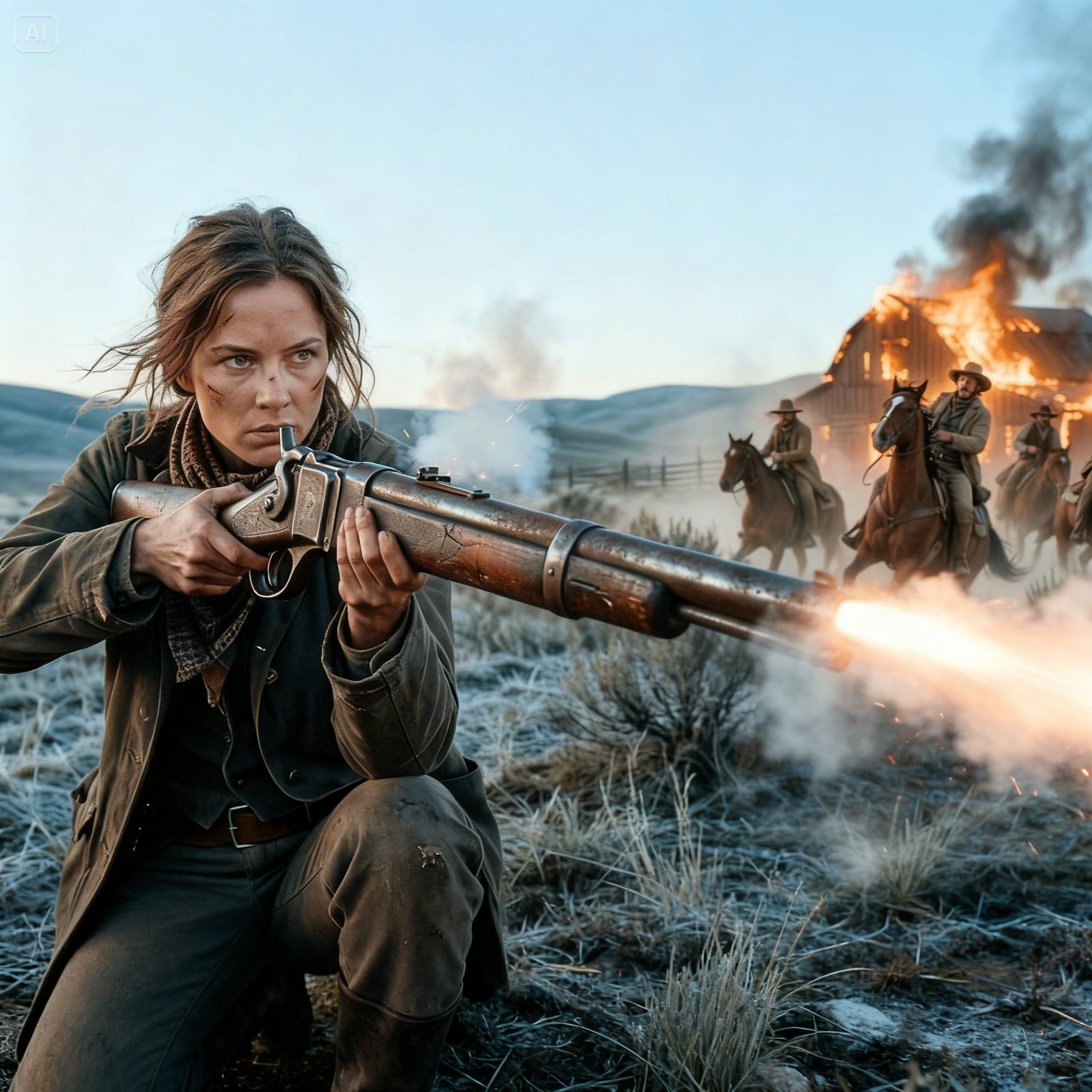
They Torched a Widow’s Barn at Night… At First Light, Her Buffalo Rifle Spoke
They found 5 bodies in the canyon at first light, laid out with a kind of terrible order, each one farther into the pass than the last. The sun had only just begun to lift itself over the ridge when Sheriff William Garrett pulled his horse up short and felt his breath catch in his throat.
The first man lay 20 yards past the canyon mouth. The second was another 50 yards beyond. The third and fourth had fallen higher up where the slope turned mean and stony. The fifth rested near a standing stone at the throat of the pass where the walls narrowed and the sound of anything, hoofbeats, voices, gunfire, became something strange and doubled.
Garrett dismounted slowly. His boots crunched over loose rock and brittle brush. He knelt beside the nearest body and turned it over. There was a single bullet hole centered neatly through the chest. He moved to the second. The same. Clean. Final. By the time he reached the fifth, his hands were shaking.

“Sweet Jesus,” he whispered.
His deputy, a young man named Collins, rode up behind him and went pale the moment he saw what lay scattered across the canyon floor.
“Who could do this?” Collins asked.
Garrett did not answer. He was staring at something half-buried in the dust near the second body. He bent, picked it up, and held it to the light. It was a spent casing, brass and heavy, longer than his thumb.
A buffalo rifle shell.
That changed everything.
“Get back to town,” Garrett said. “Fast as you can. Tell everyone to stay inside.”
“Why? What is it?”
“Just go.”
Collins hesitated only a second before wheeling his horse and spurring it hard. Dust rose behind him in a pale cloud and vanished around the bend.
Garrett remained alone in the canyon with the dead. Wind moved through the pass carrying the smell of gunpowder and hot brass and something older that reminded him against his will of the war. He looked up toward the ridges on either side and imagined the shooter somewhere above, flat against stone, waiting through heat and glare and shifting wind for each exact moment the shot was right.
5 shots. 5 bodies.
He had seen skilled marksmen before. He had ridden beside Union sharpshooters who could put a bullet through a man at distances that made lesser men stop talking and stare. But this was different. The wind in that canyon shifted every few seconds. The light glanced off the rock and made liars of angles. The echoes rolled and folded over themselves until direction ceased to mean anything at all.
No one could shoot like that.
No one Garrett knew.
Then, as he turned back toward his horse, he saw tracks leading up the eastern slope. Boot prints. Small and narrow.
A woman’s boots.
He stared at them, then shook his head and muttered, “No. Impossible.”
By midmorning the whole town had the look of a place waking into fever. Doors stood open. Men spoke in low clusters outside the saloon and the general store. Women stood on porches with their arms folded tight. Every face turned toward the road when Garrett rode in.
Inside the saloon the talk was already moving in anxious circles.
“It was Pike’s gang,” someone said. “Had to be.”
“Then who killed them?”
A silence followed.
“Maybe they turned on each other.”
“5 clean shots, all from the same rifle? That ain’t men turning on each other. That’s execution.”
The word hung over the room.
Old Ruth Hawthorne sat in her corner with both hands folded over the handle of her cane. She said nothing. She simply watched.
Garrett crossed to the bar, set the spent casing down on the wood, and let it roll once before it settled.
“Anybody recognize this?” he asked.
One of the men picked it up and turned it between thick fingers.
“Buffalo rifle. .50 caliber, maybe bigger.”
“Who in this valley shoots one?”
The room fell quiet again.
Garrett felt frustration rise hot in his chest. “Somebody knows something. 5 men don’t die in our canyon without somebody knowing why.”
“Maybe it wasn’t our business to know,” Ruth said from the corner.
The room turned toward her.
Garrett looked over. “What’s that supposed to mean?”
Ruth pushed herself upright with the cane. She was old, but there was nothing soft about her. “It means Pike’s gang has been terrorizing this valley for 2 years. It means we all knew it. And it means none of us did a damn thing about it.”
“We couldn’t,” Garrett said. “They were too many. Too well armed.”
“And now they’re dead.”
Ruth’s voice remained even, almost quiet. “Maybe the valley took care of itself.”
“The valley didn’t pull that trigger,” Garrett said. “A person did. And I need to know who.”
Ruth looked at him for a long moment, then turned and made for the door.
“Where are you going?” Garrett called after her.
“To check on a friend,” she said, and left without another word.
Something in the way she moved told him she knew more than she had said. He grabbed his hat and followed her out into the street.
But the story had begun before the bodies, before the canyon, before sunrise laid the dead out for witnesses. It had begun 2 days earlier, when the valley still believed itself quiet.
Eleanor Cross stood at her kitchen window at dawn with both hands resting on the edge of the sink and a cup of black coffee cooling untouched beside her. Outside, the ranch looked as it always looked, worn and serviceable and a little tired. The porch sagged in the middle. The fence leaned. The barn stood broad-backed and weathered against the morning sky, gray wood silvered by years of sun and wind.
She had lived there for 5 years, and the town thought of her in the way small towns think of women who ask for little and offer even less of themselves: a widow, solitary, harmless, perhaps a little sad, certainly no threat to anyone. That was how she wanted it.
She heard the rider before she saw her and felt her right hand move toward the drawer beside the sink before she stopped herself. Then she saw the horse, the rider’s stiff posture, the familiar shape of a cane tied beside the saddle.
Ruth Hawthorne.
The tension left Eleanor’s shoulders by degrees. She stepped onto the porch as Ruth rode up.
“Morning, Ruth.”
“Morning, Eleanor.”
Ruth dismounted slowly, favoring the left leg that had never healed right. Eleanor offered coffee. Ruth accepted. They sat together on the porch steps with the sun just beginning to warm the boards and for a long while neither of them spoke.
At last Ruth said, “You heard about the strangers in town?”
Eleanor’s hands tightened around the cup. “No.”
“5 of them. Rode in yesterday afternoon. Rough looking. The kind that don’t ask permission.” Ruth glanced sideways at her. “They were asking questions about the ranches out this way. Yours specifically.”
Eleanor looked out over the fence and the line of creek beyond without answering.