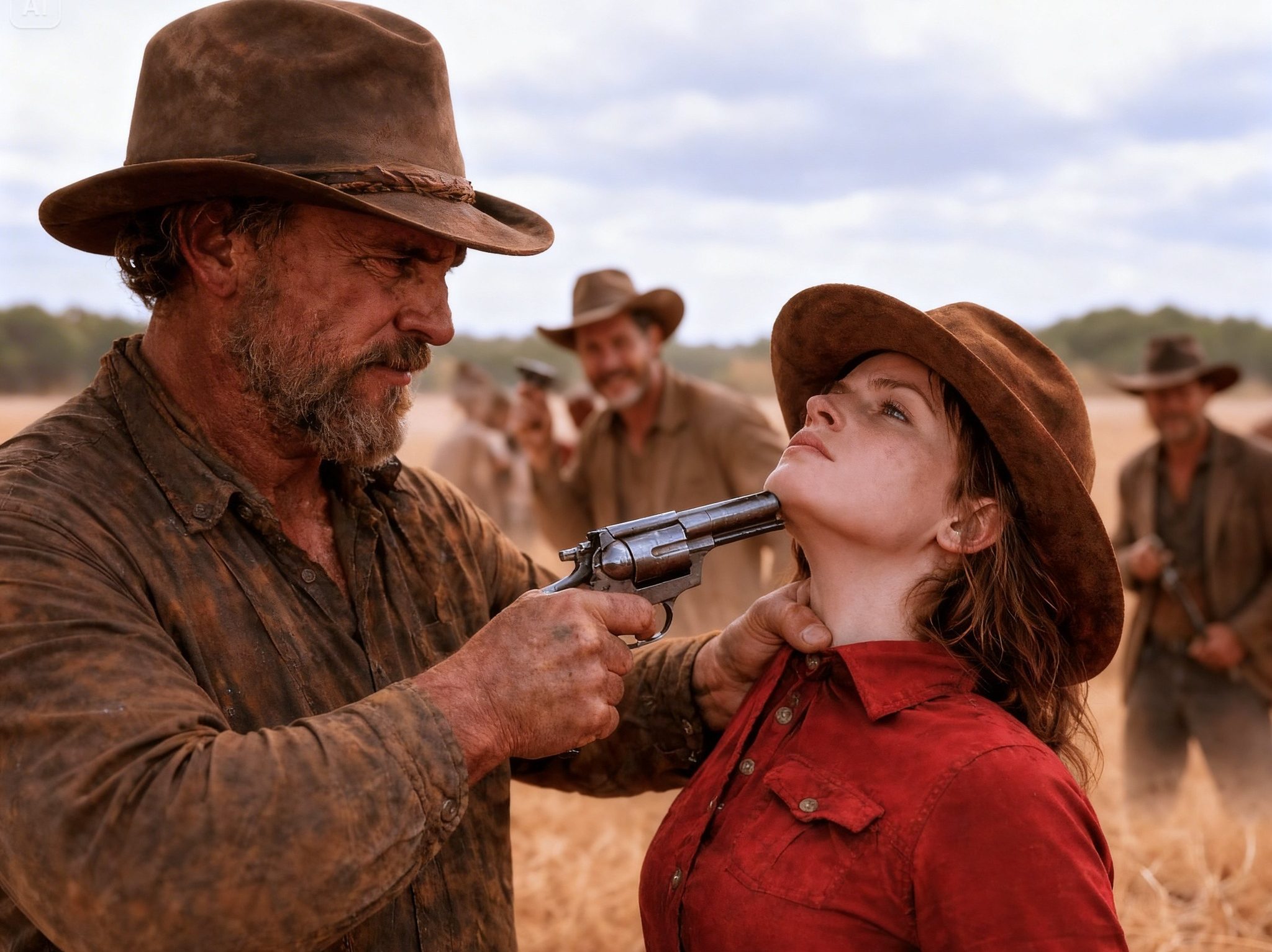
Thugs Set Their Sights on a Farmer’s Daughter —Unaware She Could Outshoot Any Gunslinger in the West
The 6 men rode into the McGraw place just after moonrise believing they had found an isolated ranch, a limping old farmer, and a girl alone enough to frighten easily. By sunrise, only 1 of them still had his gun, and people in town would spend months afterward asking the same question in lower voices than before.
It was not how Clara McGraw had done it.
It was why she had let any of them live at all.
That evening had begun the way most evenings did in that hard stretch of Arizona Territory, with the land holding its breath under the last light of day. The sky was molten gold over the canyon walls, the desert floor still radiating the heat it had stored all afternoon, and the wind moving through the mesquite with a dry whisper that carried dust, sage, and old memory. Clara stood at the south fence line mending a break in the wire where one of the mares had leaned too hard against the post earlier in the week. Her hands moved with the practiced economy of someone who had done such work since childhood. A coil of rope hung at her hip. Her rifle leaned against the fence post beside her, never out of reach, never left to chance.

She was 24 and looked as if the land had shaped her as much as it had shaped the canyons and scrub around her. Dark hair pulled back. Sun-browned skin. A stillness in her face that strangers often mistook for softness until they stayed long enough to understand it was only control. In town, most people called her quiet. Hardworking. Eliza Hawkeye McGraw’s daughter. Some said the last part with admiration. Others said it with caution. Her mother’s name had never entirely settled into the past. Too many men still told stories about Eliza’s rifle, about shots taken in impossible wind, about raiders who learned too late that the beautiful half-Apache woman on the ridge had steadier hands than any lawman in 3 counties.
Clara had been 12 when Eliza died, but the lessons had remained. They lived in muscle memory now. In the way her gaze judged distance. In the way her hand touched the rifle the moment a jackrabbit broke unexpectedly through brush. She didn’t raise the weapon. She didn’t need to. But the reflex was there, old and permanent.
From the porch of the small clapboard house, her father watched.
He had grown stooped over the years, his shoulders rounded by labor and weather and the kind of grief that never quite leaves a man’s posture once it settles there. But his eyes were still sharp. The McGraw land was not vast, not compared to the big spreads farther east, but it was good ground—good water, workable pasture, and a house built by hands that had wanted permanence more than elegance. Clara’s father, Thomas McGraw, had held it through drought and cattle sickness and bad years and widowhood. He held it still. But lately there had been something new in the way he watched horizons, something tighter in the jaw, something more aware of how quickly peace could vanish out here.
That evening, both of them heard the gunfire almost at once.
It came faint at first, irregular pops half swallowed by distance and dust, far enough off to sound almost imagined. But the desert has a way of carrying violence in fragments, and Clara knew the difference between celebratory noise and trouble even before she looked up. A pale smear of dust was rising on the far horizon. Her father stepped off the porch and stood in the yard, listening.
“That’s in town,” he said.
Clara did not answer.
She finished tightening the wire without looking down. The dust thickened. The gunfire stopped. Silence dropped back over the land as if the desert itself had decided to listen more closely.
A rider came hard along the far property line before sunset gave way completely. He did not slow. He only shouted the news as his horse tore past in a spray of stones and red dirt.
“Coulter boys hit the bank! Left 2 men bleeding in the street! Took the sheriff’s horse on their way out!”
Then he was gone.
Thomas McGraw swore under his breath, turned, and went into the house. When he came back, he carried the small tin box they kept hidden under the bed. Inside was what little ready money they had, along with the folded deed to the land. He buried it under grain in the feed bin without a word.
“I’ll go to town,” Clara said. “Warn the Millers. The Ashfords.”
He shook his head. “Too late.”
She was already moving toward the barn.
The ride into town was short, but the dust and the coming dark stretched it into something longer. By the time she reached the main street, lanterns had been lit in windows and a crowd had gathered near the general store. Men stood with rifles. Women kept children close. Fear had its own smell, and it was strong in the air.
Conversations stopped when Clara rode in.
They always did.
People looked at her differently from the way they looked at other women. Not exactly with respect, and not exactly with distrust. Something more complicated lived in those glances. She was Eliza’s daughter. She had Apache blood from her mother’s side. She was capable in ways that unsettled people who preferred their women either decorative or domestic. One of the ranchers, Holloway, stepped forward.
“Heard your place is south of here,” he said.
“That’s the way they rode,” Clara replied. “How many?”
“Six. Silas Coulter and his boys. Mean sons of bitches, all of them.”
A woman in the back muttered something Clara didn’t catch fully, but she heard the word savage in it and knew exactly to whom it referred. She ignored it.
“The sheriff?”
“Holloway took a breath. “Out cold. Got a rifle stock to the head. Deputy’s with him.”
Tom Ashford.
The name came to her before Holloway said it. Tom had been deputy for 2 years now. Before that, he had been the boy who met her at the creek with stolen peaches and clumsy jokes, the young man who kissed her once under the cottonwoods and then seemed to spend 5 years building a future around the hope that if he waited long enough, she might become the kind of woman who wanted the same life he did.
She found him in the sheriff’s office bent over a basin of pink water, sleeves rolled to the elbow, hands stained red. He looked up when she entered. Relief passed over his face too quickly to hide.
“Clara.”
“How bad is he?”
“He’ll live. But he won’t be riding tonight.”
The sheriff lay on a cot in the corner, breathing shallowly, head bandaged. Tom dried his hands on a rag.
“They’ll be looking for places to hole up,” he said. “Your ranch is isolated. Good water. Good cover.”
“I know.”
The space between them tightened with all the things that had never found the right shape for language. Tom looked at her, then away, then back again.
“Come stay in town,” he said. “Just for tonight. You and your father.”
Clara shook her head.
“If we run now, we’ll never stop running.”