She Was Beaten and Left to Die on the Side of the Road—The Cowboy Who Found Her Thought He Was Saving a Stranger, Until He Realized Who She Really Was
Funny thing about the road—people talk about it like it’s honest. Like it only leads where you intend to go.
That’s a lie.
Sometimes it just drops you where you don’t belong and waits to see what happens.
By the time the sun climbed high enough to bleach the color out of the California hills, Penelope James was already losing the argument with her own body.
The dirt beneath her cheek was hot. Burning, actually. It pressed into her skin the way truth does when you don’t want to face it. Every breath came shallow and sharp, like her ribs had decided they were done cooperating. She tasted copper. Blood, dust, something bitter she couldn’t place. Her dress—once white, once respectable—was torn open like a bad confession, fabric stiff where it had dried dark.
She tried to move. Nothing useful happened.
Her mind drifted in and out, snagging on half-thoughts. A room with ledgers. A raised voice. The smell of ink and whiskey. Someone shouting her name like it was an accusation.

Then nothing again.
If this was dying, she thought dimly, it was taking its time.
The sound came first—hooves, distant and rhythmic, not part of the desert’s usual vocabulary. Penelope didn’t lift her head. Couldn’t. She barely registered hope. Hope required energy, and she was running low.
The horse slowed.
A shadow fell across her.
“Well, I’ll be damned.”
The voice was male. Deep. Roughened by wind and years of talking to animals more than people. Not angry. Not cruel. Surprised, mostly.
Hands appeared in her field of vision—bare, calloused, careful. Someone knelt beside her. She felt water touch her face, cool and startling enough to make her flinch.
“Easy,” the voice said. Softer now. “You’re all right. Or… you will be.”
She tried to crawl away. Instinct, not logic. A whimper escaped before she could stop it, thin and humiliating.
“I’m not going to hurt you,” he said quickly, palms lifted like he knew the look she’d just given him. “I swear it.”
She wanted to believe him. God help her, she did. But belief felt slippery.
“Please,” she rasped.
It came out wrong. Barely a word.
That was enough.
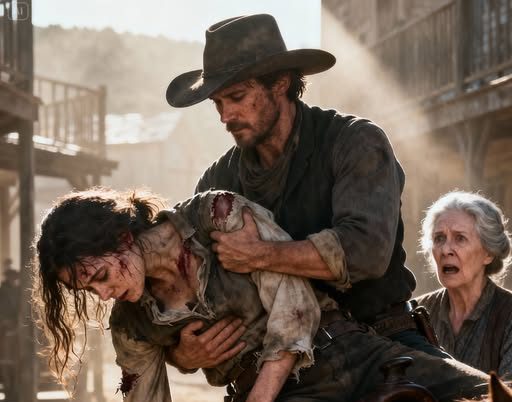
The man—Xavier Hayes, though she didn’t know his name yet—didn’t hesitate after that. He slid one arm beneath her shoulders, another under her knees, and lifted her like she was something worth saving. Pain exploded bright and fast, but she didn’t scream. She bit down on it, jaw trembling.
“I’ve got you,” he muttered, more to himself than to her. “I’ve got you.”
His horse shifted impatiently as he settled Penelope in front of the saddle, steadying her against his chest. She felt the solidness of him—heat, heartbeat, the smell of leather and sun. He wrapped an arm around her waist like he’d been doing it his whole life.
“Ranch isn’t far,” he said. “You just hold on. Or don’t. I’ll do it for you.”
She lost consciousness before she could answer.
Pine Creek Ranch wasn’t grand. It wasn’t meant to be.
It sat where the hills softened and the land decided to cooperate, a sprawl of fence lines, a barn that had seen better paint, and a two-story house that stood straight out of stubbornness more than elegance. Xavier had built it piece by piece over four years, after deciding California was as good a place as any to start over and worse places definitely existed.
He rode in faster than he should’ve, calling out before he’d even dismounted.
“Mrs. Finch!”
The front door flew open.
Mercy Finch took one look at the woman in his arms and forgot every rule she’d ever enforced about propriety.
“Sweet Jesus,” she breathed. “Bring her in. Now.”
They moved like a practiced team, though this wasn’t a situation they’d practiced for. Penelope was laid gently on the spare bed, the quilt folded back. Mrs. Finch’s mouth pressed into a thin, focused line as she examined bruises, swelling, the way Penelope’s chest rose unevenly.