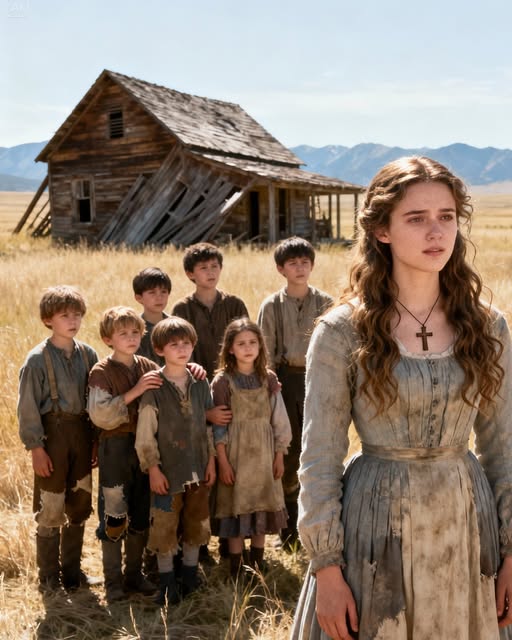
The letter had been careful.
Too careful, if Mara Keene had known how to read the silences between words.
She’d read it anyway. Over and over. On the train. At night in the boardinghouse. Once aloud, just to hear a future sound possible in her own voice. A home on the prairie. A steady man. Children old enough to help, young enough to need guiding. A life that required staying.
Staying sounded like mercy.
So when the train slowed and the land opened wide—too wide, really, as if the sky had swallowed its edges—Mara smoothed her coat and lifted her chin. She expected to see a man waiting. Someone solid. Someone whose name she already carried folded inside her like a pressed flower.
Instead, there was only wind.
And a boy.
He stood a little back from the platform, hat in his hands, boots mismatched, eyes fixed on the train as if it might still change its mind and take her with it when it left. He was thin in the way hunger thins children early. Not sickly. Just… used up faster than he should’ve been.
“Miz Keene?” he asked.
His voice cracked halfway through her name.
“Yes,” she said, and stepped down.
The ground felt wrong under her boots—too open, too final. The train hissed behind her, impatient.
“I’m Noah,” the boy said. “I was sent.”
“Sent by your father?” she asked, still searching the platform.
He swallowed. “By the house.”
The words didn’t settle right.
She waited. Silence stretched until the train gave a warning groan.
“Noah,” she said carefully, “where is your father?”
The boy’s jaw worked. He looked down at the dirt, then back up at her, eyes bright but steady in a way that made her chest ache.
“He died last week.”
The sound the train made as it pulled away was loud enough to feel personal.
Mara didn’t sit. Didn’t sway. She simply stood there, holding her bag, watching the only road back east narrow into nothing.
“I’m sorry,” she said.
“So are we,” Noah replied, and then—like a child suddenly remembering his duty—he added, “There’s seven of us.”
Seven.
He said it like a fact that had weight. Like something she should lift carefully.
The station emptied fast. The man who’d unloaded mail tipped his hat and climbed back into his wagon without looking at her too long. She understood that look. It meant this is not my problem.
The Mail-Order Bride Stepped Off the Wagon Expecting a Husband — Instead She Found SEVEN Motherless Children and a Truth That Broke Her Heart