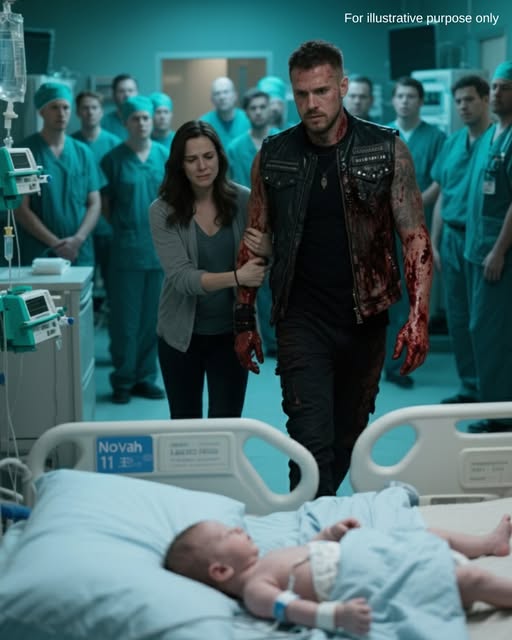
18 doctors stood around a dying baby and did nothing. Not because they didn’t care, but because they didn’t know. For 11 days, they ran tests, tried treatments, and watched a newborn slip away while the best medical minds in America stood helpless. Then, a biker with blood on his face walked into the hospital and did something none of them would ever forget.
The monitor flatlined at 3:47 a.m. Elena Whitfield screamed. It wasn’t a human sound. It was the sound of a mother watching her child die. Nurses rushed in. Dr. Patterson barked orders. Someone shoved Elena against the wall while they worked on her son. Their movements were frantic, desperate, and useless. 11 days.

Noah Whitfield had been alive for 11 days, and for 10 of them, he had been dying. It started with a fever, followed by seizures, and then organ failure. Slowly, systematically, and without mercy, his tiny body shut down piece by piece as doctors ran every test known to medicine. They found nothing. No infection, no genetic disorder, no explanation—just a baby dying for no reason anyone could name.
The crash cart charged. Paddles touched Noah’s chest—impossibly small paddles for a body that weighed less than seven pounds. Clear. His body jerked. The monitor stayed flat. Again, clear. Another jerk. Nothing. Come on, baby. Come on. Elena couldn’t breathe. Her husband Marcus held her, his own body shaking with silent sobs.
They had tried everything—called every specialist, flown in experts from across the country—18 doctors, the best in their fields: neonatologists, immunologists, infectious disease specialists, and a Harvard researcher who had written textbooks on rare pediatric conditions. None of them could save Noah.
“We have a rhythm,” the monitor beeped, weak and irregular. But it was there. Dr. Patterson stepped back, sweat dripping down his face. He was the hospital’s chief of pediatrics, with 30 years of experience and thousands of lives saved, but this case had broken something inside him. He turned to the Whitfields. “He’s back, but I have to be honest with you…”
“That’s the third time tonight. His heart is getting weaker. His organs are failing.”
“Then do something!” Marcus shouted. “You have 18 doctors here. Someone has to know what’s wrong with him. We’ve tried everything. Try harder!”
Dr. Patterson looked at the father, this broken man clutching his wife while their son died inch by inch. He felt his own heart crack.
“Mr. Whitfield, I think you need to prepare yourselves.”
“No,” Marcus replied, stepping forward, rage and grief twisting his face. “You don’t get to give up. Not on my son. Not while he’s still breathing.”
Elena collapsed into a chair, her sobs echoing off the sterile walls. 11 days ago, she had been the happiest woman in the world. She had held her perfect baby boy, counted his fingers and toes, and dreamed of his first words, his first steps, his first day of school. Now, she was picking out burial clothes. “There has to be something,” she whispered.
“Someone, something we haven’t tried.”
Dr. Patterson shook his head. “I’m sorry. I’m so sorry.”
Three floors down, paramedics burst through the emergency room doors. Motorcycle accident. Male, approximately 40. Multiple trauma. The man on the stretcher was a mess. Blood covered half his face. His leather jacket was shredded.
Road rash painted his arms in angry red patterns. But he was conscious. More than conscious. He was fighting. “Get off me,” he growled. “I’m fine, sir. You have at least three broken ribs and a possible concussion.”
“I’ve had worse. Let me up, sir.” He grabbed the paramedic’s wrist with a grip like a vice.
“I said, I’m fine.”
The ER doctor, a young woman named Dr. Chen, stepped in. “Sir, I need you to calm down. You were in a serious accident. We need to run tests.”
“No tests. Patch me up and let me go.”
“That’s not how this works.”
The man sat up, despite the protests, wincing as his broken ribs shifted. In the harsh hospital light, his face came into focus: weather-beaten, scarred.
A beard streaked with gray and now smeared with blood. Eyes that had seen too much of the world. His jacket, what was left of it, was covered in patches, clubs he’d ridden with, a life measured in miles and midnight roads.
“Name?” Dr. Chen asked, pulling out a chart.
“Jax. Jack’s Carver.”
“Mister Carver, I need to insist—”
“You need to calm down,” Jax interrupted. “I’ve been riding for 40 years. I know when I’m hurt bad, and when I’m hurt, manageable. This is manageable. So, tape my ribs, glue my head, and point me to the exit.”
Dr. Chen stared at him. She should refuse, should call security. But something in his eyes stopped her. Not aggression, something older, sadder.
“Fine, but you’re signing an AMA form against medical advice.”
“I wouldn’t have it any other way.”
An hour later, Jax sat in the hallway, waiting for his discharge papers. His ribs were taped, his head glued. Every breath hurt like fire, but he’d had worse. Much worse. He should leave. Get back on the road.
He had no business being in this town, this hospital, this life. But something held him there. Maybe it was the crying. A woman’s sobs drifting from somewhere nearby. Not the sharp cry of physical pain. Something deeper. Something broken.
Jax had heard that sound before. In villages ravaged by disease, in refugee camps, in places where hope went to die.
He shouldn’t investigate, shouldn’t get involved. He had learned that lesson a long time ago. But his feet were already moving.
The NICU was on the third floor. Jax found it by following the sound of grief. Through the window, he saw them: a couple, mid-30s, clinging to each other beside an incubator. Inside the plastic box, a tiny form lay motionless, connected to more tubes and wires than seemed possible for something so small.
A nurse emerged, tears on her cheeks. She almost walked into Jax.
“Sorry, sir. You can’t be up here. This is the neonatal unit.”
“What’s wrong with the baby?”
“I can’t discuss patient information.”
“Humor me.”
The nurse looked at the bloody stranger, this biker who had no business asking questions. She should call security. Instead, she started crying harder. “Nobody knows. 18 specialists and nobody knows. He’s been dying for 11 days and we can’t figure out why.” She wiped her eyes. “Sorry, I shouldn’t. It’s just hard watching a baby die when you can’t do anything.”
Jax stared through the window at the tiny form in the incubator.
“18 specialists, 11 days, no answers. What are the symptoms, sir?”
“I really can’t—”
“Fever, seizures, organ failure. Am I close?”
The nurse’s eyes widened. “How did you—?”
“Does he have a rash?”
“Small one, probably on his torso. Looks like a birthmark, but it’s not.”
“I don’t know. The doctors have done full examinations. They would have missed it.”
“It’s small, easy to overlook.”
Jax’s voice had changed—harder, more focused.
“Check him now.”
“Sir, I can’t just—”
“That baby is dying because 18 doctors are looking for something complicated when the answer is simple. Check for the rash.”
The nurse stood frozen. This was insane. This man was a stranger, a biker, clearly concussed and possibly delusional, but something in his eyes…
“Wait here,” she said. She disappeared through the NICU doors.
Jax watched through the window. Saw her approach the incubator. Saw her speak to Dr. Patterson, who shook his head dismissively. Then he saw her lift the baby’s gown. Even from the hallway, Jax saw her freeze, saw her call Dr. Patterson over, saw the doctor’s face go pale.
The nurse came back out, her expression a mix of shock and fear.
“How did you know?”
“There’s a mark exactly where you said. We all thought it was just a birthmark. It’s not.”
Jax pushed off the wall, wincing as his ribs protested.
“I need to talk to those parents right now.”
“Sir, I can’t let you.”
“That baby has maybe 12 hours, probably less. I know what’s killing him, and I know how to stop it. But I need the parents to trust me, and I need your doctors to get out of my way.”
The nurse stared at him.
“Who are you?”
Jax’s jaw tightened.
“Someone who’s seen this before. Someone who watched children die from it because nobody knew what to do.”
His voice dropped.
“And someone who learned eventually how to save them.”
The conference room was tense. Marcus and Elena Whitfield sat on one side of the table, hollow-eyed and desperate. Dr. Patterson and three other specialists sat on the other, their expressions ranging from skeptical to hostile. Jax stood at the head of the table, still bloody, still broken, still refusing to sit down.
“This is absurd,” Dr. Patterson said. “You want us to believe that a motorcycle drifter knows more about our patient than 18 board-certified specialists?”
“I want you to listen for five minutes, then decide.”
“We don’t have five minutes to waste on your—”
“Your patient doesn’t have five minutes to waste on your ego,” Jax’s voice cut like a blade.
“That baby is dying, doctor. And it’s not because you’re stupid or incompetent. It’s because you’ve been looking for the wrong thing.”
Dr. Patterson scoffed. “And what should we be looking for?”
“Nothing.” Jax let the word hang in the air. “You shouldn’t be looking for anything because there’s nothing to find. Not anymore.”
The room went silent.
“Fifteen years ago,” Jax continued, “I was in Peru. Small village in the mountains. Kids were dying. Same symptoms your baby has. Fever, seizures, organ failure. Local doctors were baffled. International aid workers were baffled. Everyone assumed it was some new disease, some mutation, something they could identify and treat.”
He leaned forward.
“It wasn’t. It was something ancient, something the local curanderos—healers—had seen before. They called it La Sombra, the shadow. Not because it was mysterious, but because of how it worked.”
“How did it work?” Elena asked, desperation clear in her voice.
“A specific combination of environmental factors—altitude, humidity, a particular type of mold that only grows in certain conditions. The mold releases spores that are harmless to adults but devastating to newborns. It gets into their system, triggers an immune response that the body can’t control.”
Dr. Patterson scoffed again. “There’s no mold in our hospital.”
“Not anymore, but there was. Check your maintenance records. Any water damage in the past month? Any flooding? Any construction that might have disturbed old materials?”
The specialists exchanged glances.
“There was a pipe burst,” one of them admitted. “Two weeks ago, in the supply closet adjacent to the delivery room.”
“And when was Noah born?” Elena’s hand flew to her mouth.
“Three days after the pipe burst.”
“The spores were in the air. He breathed them in. His immune system responded, and it’s been attacking itself ever since.”
Jax straightened.
“The good news is, it’s treatable. The bad news is, not with anything you have in this hospital.”
“What does he need?” Marcus demanded.
Jax hesitated. This was the part they wouldn’t believe. The part that sounded like insanity. A compound, plant-based. The curanderos made it from a combination of local herbs.
“I don’t know the scientific names, but I know the plants. More importantly, I know someone who can get them.”
“You’re asking us to give our son some jungle witch doctor remedy?” Dr. Patterson stood up. “This is malpractice waiting to happen.”
“Mr. and Mrs. Whitfield, I strongly advise—”
“He’s dying anyway!” Elena screamed.
“What do we have to lose?”
“Your son’s life.”
“If this man is wrong, our son dies. At least his way gives him a chance.”

The room erupted in shouting—doctors arguing about liability, parents shouting about hope. Jax stood silent, watching the chaos. Then Marcus Whitfield stood up.
“Everyone shut up.” Silence.
He walked to Jax, stood inches from his face.
“Look me in the eyes and tell me you can save my son.”
Jax met his gaze.
“I can’t promise anything. Medicine doesn’t work that way, and neither does life. But I’ve seen this before. I’ve watched children die from it. And I’ve watched children survive because someone knew what to do.”
He didn’t blink.
“I know what to do.”
Marcus studied him. This stranger, this bloody broken biker who had walked into their nightmare and offered the impossible.
“Do it,” Marcus said.
“Mr. Whitfield,” Dr. Patterson started.
“I said, do it.”
Marcus turned on the doctor. Years of grief and rage exploded at once.
“You’ve had 11 days, 18 experts, and my son is still dying.”
“This man knew about the rash in five minutes. He knew about the pipe burst. He knows something you don’t.” He looked at his wife. She nodded, tears streaming down her face.
“Save our son,” Marcus said to Jax. “Whatever it takes, whatever you need, save him.”
Jax nodded once.
“I need a phone and about six hours. You have four. After that, it might be too late.”
Jax was already moving. The call connected on the third ring.
“Who is this?”
“Maria, it’s Jax.”
Silence, then, “Jax. Dios Mio, it’s been seven years. I thought you were dead.”
“Not yet. Listen, I need your help.”
Maria Vasquez had been the village healer’s apprentice in Peru. Now she ran a nonprofit that preserved traditional medicine knowledge. If anyone could get what Jax needed, it was her.
“What kind of help?”
“La Sombra. You remember?”
“How could I forget? We lost six children before grandfather figured it out.”
“There’s a baby here. Same thing. I need the compound.”
“Jax, that takes days to prepare.”
“I don’t have days. I have hours.”
Maria was quiet. Jax could hear her thinking.
“Where are you?”
“Cedar Falls, Missouri. Middle of nowhere.”
“I have a contact in St. Louis. Traditional medicine researcher. She might have preserved samples from grandfather’s work.”
More silence.
“Jax, why do you care about this baby? You don’t do attachment. You told me that yourself.”
Jax looked through the window at Noah’s incubator.
At the tiny chest rising and falling with mechanical assistance, at the parents clutching each other like drowning people.
“I don’t know,” he admitted. “Something about this one. Something about all of them.”
Maria’s voice softened.
“You never stopped caring, Jax. You just pretended you did.”
“Can you get me the compound or not?”
“I’ll call Elena, my contact. If she has it, she can be there in three hours.”
“Make it two.”
“I’ll try.”
“And Jax?”
“Yeah?”
“Whatever demons you’re running from, they’ll catch up eventually. They always do.”
She hung up.
Jax stood in the hallway, phone in hand, surrounded by the antiseptic smell of a place he had avoided for 20 years.
Demons.
Yeah, he had plenty of those, but right now there was a baby dying.
The demons could wait.
The next three hours were the longest of Jax’s life. He stayed in the NICU, watching Noah’s vital signs fluctuate. The doctors had been pushed back, literally in Dr. Patterson’s case, but they hovered nearby, ready to intervene, ready to say, “I told you so.” If Jax failed, Elena and Marcus took turns holding vigil. When Elena finally collapsed from exhaustion, Jax helped Marcus move her to a chair.
“Thank you,” Marcus said. “For trying.”
“Don’t thank me yet.”
“Why are you doing this?” Marcus asked. “You don’t know us.”
Jax watched the monitor, watching the numbers that meant life or death.
“I had a son once,” he heard himself say. “Long time ago. Different life.”
Marcus went still.
“He died. Same symptoms, different country. I didn’t know then what I know now.”
Jax’s voice was flat, distant.
“By the time I learned it was too late for him, but I swore if I ever got the chance to save another one…”
He didn’t finish. He didn’t have to.
At 2:17 a.m., a woman burst into the NICU. She was small, dark-haired, carrying a cooler like it contained the Holy Grail.
“I’m Elena Vasquez. Maria’s contact.”
She thrust the cooler at Jax.
“It’s all there. Three doses just in case.”
Jax opened the cooler. Inside, packed in ice, were three small vials of dark liquid.
“How do we administer it?” Dr. Patterson demanded. “This hasn’t been tested. We don’t know the dosage.”
“One milliliter, orally,” Jax was already moving toward the incubator. “It needs to be absorbed through the digestive system.”
“This is insane.”
“Watch me or stop me. Those are your options.”
He opened the incubator. Noah was so small, so fragile. Tubes and wires everywhere, keeping him alive by force of technology. Jax’s hands, hands that had built engines, thrown punches, and held dying friends, trembled as he lifted the tiny body.
One milliliter. One chance.
He administered the compound.
Then he held Noah against his chest, something the doctors said was impossible with all the monitoring equipment, and waited.
One minute. Five minutes. Ten.
Noah’s monitor beeped.
His heart rate, which had been erratic for days, began to stabilize. Twenty minutes. His temperature, stuck at 103 for almost a week, started to drop. One hour. The seizures stopped.
Dr. Patterson stared at the monitors like he was watching a miracle—because he was.
“That’s… That’s impossible.”
“Apparently not.”
Jax carefully placed Noah back in the incubator.
“He’ll need the other two doses. One every six hours. After that, his body should be able to heal itself.”
Elena was sobbing, clutching her husband. “Is he going to live? Please tell me he’s going to live.”
Jax looked at Noah, at the color returning to his cheeks, at the monitors showing numbers that finally, finally made sense.
“Yeah,” he said.
“He’s going to live.”
The room exploded. Nurses crying. Doctors arguing about what they had just witnessed. Parents collapsing with relief. Jax slipped out. He had done what he came to do. Now it was time to go.
But at the elevator, a voice stopped him.
“You’re not leaving.”
He turned. Marcus Whitfield stood in the hallway, exhaustion and gratitude warring on his face.
“You saved my son’s life. The least I can do is buy you breakfast.”
“I don’t need—”
“It’s not about what you need. It’s about what you deserve.”
Marcus walked closer.
“Whoever you are, whatever you’ve done tonight, you were a hero. Let someone thank you for once.”
Jax stood at the elevator, finger hovering over the button. He should leave. Should get back on the road. Should run like he always ran, but his ribs were broken. His head was pounding. And for the first time in 20 years, someone was looking at him like he mattered.
“Fine,” he said. “But you’re buying the good coffee.”
Marcus smiled.
“Deal.”
The diner was empty at 4:00 a.m. Jack sat across from Marcus, his hands wrapped around a coffee cup, his broken ribs screaming with every breath. The adrenaline was fading. The pain was setting in.
“Who are you?” Marcus asked. “Really?”
“Nobody special,” Jax said finally. “Just a guy who’s been around.”
“Nobody special doesn’t know about rare Peruvian diseases. Nobody special doesn’t have contacts who can deliver miracle cures at 2:00 a.m.”
Marcus leaned forward. “My son is alive because of you. I think I deserve the truth.”
Jax stared at his coffee. The truth. He hadn’t told anyone the truth in 20 years.
“I was a medic,” he said finally. “Army, two tours in Afghanistan. Came back broken like everyone does. Couldn’t hold a job. Couldn’t hold a relationship. The only thing that made sense was the road.”
“So you became a biker.”
“I became a ghost. Rode from town to town, country to country. Never staying long, never getting attached.” He took a sip of coffee. “Along the way, I learned things from healers in Peru, shamans in Nepal, medicine men in places most Americans don’t know exist. I learned that Western doctors don’t have all the answers. Sometimes the old ways know things we’ve forgotten.”
“And La Sombra?” Jax’s jaw tightened.
“A village in the Andes. I was passing through when kids started dying. Same symptoms as Noah. The doctors from the city were useless. But the local curanderos, an old man named Quispe, he’d seen it before. His grandfather had seen it. Knowledge passed down for generations.”
“He taught you the cure?”
“He taught me everything. I stayed six months. Learned plants, compounds, treatments that no medical school would ever approve.”
Jax’s voice dropped.
“I thought I could use it. Thought I could help people.”
“You did help. Tonight.”
“Tonight was the first time in 20 years,” Jax said quietly.
Marcus frowned. “Why?”
“If you had this knowledge…”
“Because the last time I tried to save someone, I failed.”
The diner went silent except for the hum of fluorescent lights.
“My son,” Jax’s voice cracked. “Tommy. He was three. His mother and I were living in Guatemala. She was a journalist. I was her fixer. Tommy got sick. Same symptoms. I didn’t know then.”
“What I know now.”
Jax’s hands trembled around the cup.
“By the time I found someone who could help, it was too late. Twelve hours too late. He died in my arms.”
He looked up, and Marcus saw something shattered in those weathered eyes.
“I spent the next five years learning everything I could about what killed him. Every traditional remedy, every indigenous treatment. I became an expert in something I couldn’t use to save my own child.”
“Jesus.”
“After that, I couldn’t stop. Everywhere I went, I found people who needed help. Sometimes I could give it, sometimes I couldn’t. But every time I tried, I saw Tommy’s face.”
Jax set down his cup.
“Eventually, I stopped trying. Stopped getting close, stopped caring.”
“But you cared tonight.”
“Yeah.”
Jax looked toward the window, toward the hospital where Noah was finally, finally getting better.
“I don’t know why. Something about that kid. Something about those parents.”
Marcus was quiet for a long moment.
“Maybe,” he said softly, “it was time to stop running.”

The news spread fast. By noon, the story was everywhere. A mysterious biker saves dying baby that 18 doctors couldn’t help. Local news picked it up first, then National reporters descended on Cedar Falls like locusts.
Jax tried to leave. Three times he walked to his motorcycle, still parked at the accident scene, miraculously intact. And three times something pulled him back. The fourth time Elena Whitfield was waiting.
“He’s asking for you.”
“Who?”
“Noah. Well, not asking. He’s 11 days old, but his vitals spike every time you’re in the room. The doctors can’t explain it.”
She smiled through tears. “I can’t explain it either, but I know my son wants you there.”
Jax followed her back to the NICU. Noah looked different now. Color in his cheeks, movement in his tiny limbs. The ventilator had been removed. He was breathing on his own.
“Can I?” Jax gestured toward the incubator.
“Please.”
He lifted the baby carefully, cradling him against his chest. Noah made a small sound, not crying, just acknowledging.
“Hey, little man,” Jax whispered. “You gave everyone quite a scare.”
Noah’s eyes opened, unfocused like all newborn eyes, but somehow finding Jax’s face.
“You’re going to be okay. Strong kid like you. You’re going to be just fine.”
Dr. Patterson appeared in the doorway. He looked like he hadn’t slept in days. He probably hadn’t.
“Mr. Carver, I owe you an apology.”
Jax didn’t look up.
“No, you don’t.”
“I dismissed you. Called your knowledge worthless. Meanwhile, a baby was dying, and I couldn’t…” His voice cracked. “I’ve been a doctor for 30 years. I thought I knew everything. Turns out, I knew nothing.”
“You knew plenty. You just didn’t know this one thing.”
Jax finally met his eyes. “That’s not a crime. That’s being human.”
Patterson stepped closer, watching Jax hold Noah with surprising gentleness.
“Where did you learn to do that? Hold a baby like that?”
“My son taught me.”
The words came easier now. “Long time ago.”
“What happened to him?”
Jax told him. The whole story this time. Guatemala, the illness, the failure, the years of wandering and learning and running. When he finished, Patterson was crying.
“I’m sorry. I’m so sorry.”
“Don’t be. He’s why I knew how to save Noah. Tommy didn’t die for nothing. He died so this kid could live.”
Jax looked down at the baby in his arms. “At least that’s what I’m choosing to believe.”
The town wanted to make Jax a hero. They organized a ceremony. The mayor wanted to give him a key to the city. The hospital board wanted to create a fund in his name. Parents from across the county wanted to meet the man who had done the impossible.
Jax refused everything.
“I didn’t do this for recognition,” he told Marcus. “I did it because a kid needed help.”
“Then what do you want?”
Jax thought about it. Really thought. To stop running? He admitted for the first time in 20 years.
“I want to stay somewhere. Put down roots. Maybe actually live instead of just existing.”
Marcus smiled.
“Cedar Falls isn’t much. Small town, not a lot of excitement.”
“I’ve had enough excitement. Small sounds good.”
The Whitfields helped Jax find a place. A small cabin on the edge of town, owned by an elderly widow who was happy to rent it cheap to the man who saved that baby. He fixed it up himself. Roof, plumbing, the works. Turns out 20 years of living on the road teaches you how to repair almost anything.
The local garage offered him a job when they saw his mechanical skills. He took it, and every Sunday he had dinner with the Whitfields. One year later, Noah’s first birthday party was held in the Whitfield’s backyard. Half the town showed up. The other half sent gifts. Jax stood near the grill flipping burgers, watching the chaos with something that might have been a smile.
“You look happy.”
He turned. Elena stood beside him, Noah on her hip. The baby had grown into a healthy, chubby one-year-old with his mother’s eyes and his father’s stubborn chin.
“I’m getting there,” Jax admitted.
“He asks for you, you know.”
“Well, not in words yet, but whenever you’re not at Sunday dinner, he fusses until we show him your picture. Kid’s got good taste.”
Elena laughed. Then her expression grew serious.
“We never properly thanked you for everything. Words don’t seem like enough.”
“Words are fine. Living is better.”
Jax looked at Noah. “Every time I see him growing, laughing, being a regular kid, that’s all the thanks I need.”
Noah reached out with chubby hands, grabbing for Jax. Without thinking, Jax took him, settling the baby against his shoulder like he’d done it a thousand times. Maybe he had.
“Marcus and I talked,” Elena said. “We want to ask you something.”
“Okay.”
“We want you to be Noah’s godfather. Officially. Legally.”
Jax froze.
“You saved his life. You stayed when you could have left. You became part of our family without even trying.”
Elena’s eyes were wet. “We can’t imagine anyone else.”
Jax looked at the baby in his arms. At this child who had almost died. At this life he had somehow saved. 20 years ago, he had watched his son die and sworn never to get close to anyone again. Now a family was asking him to be closer than ever.
“Yeah,” he heard himself say. “Yeah, I’d be honored.”
That night, Jack sat on his cabin porch, looking at the stars. His phone buzzed. A message from Maria in Peru.
“Heard you stayed. Never thought I’d see the day. Grandfather would be proud.”
He typed back, “Grandfather was right. Running doesn’t heal anything.”
He set down the phone and thought about the last year. The baby he had saved. The family that had adopted him. The town that had accepted him despite his past.
The demons Maria had warned him about had caught up, just like she said. But instead of destroying him, he had faced them, acknowledged them, made peace with them.
Tommy was still gone. That wound would never fully heal. But Noah was alive. Growing. Thriving.
And every time Jax held that baby, he felt something he thought he had lost forever. Purpose.
A motorcycle rumbled in the distance. Old habits made him tense. The road calling. The urge to run.
But he didn’t move. The sound faded. The night settled. And Jack’s Carver, the man who had spent 20 years running from his past, finally sat still. He was home.
Epilogue
Five years later, Noah Whitfield started kindergarten. His first day, he drew a picture of his family. Mom, dad, and a big figure in a leather jacket with a motorcycle.
“Who’s that?” His teacher asked.
“That’s Uncle Jack. He’s my godfather.”
Noah beamed. “He saved my life when I was a baby.”
“Really? How?”
Noah thought about it very seriously.
“I don’t remember. But mom says he did something no one else could do.”
“He loved me when I needed it most.”
The teacher didn’t quite understand, but she smiled and hung the picture on the wall.
That afternoon, Jax picked Noah up from school on his motorcycle, carefully with a child seat and helmet that met every safety regulation.
“How was it, buddy?”
“Good. I drew a picture of you.”
“Yeah. Did you make me look handsome?”
“I made you look like you.”
“That’s better.”
Jax laughed. A real laugh, the kind he hadn’t known he was capable of once. They rode home together through the small town that had become their world, past the hospital where a miracle had happened 5 years ago.
The truth was, 18 doctors couldn’t save that baby. But one broken man could. Not because he was smarter, not because he was special, because he cared enough to try.