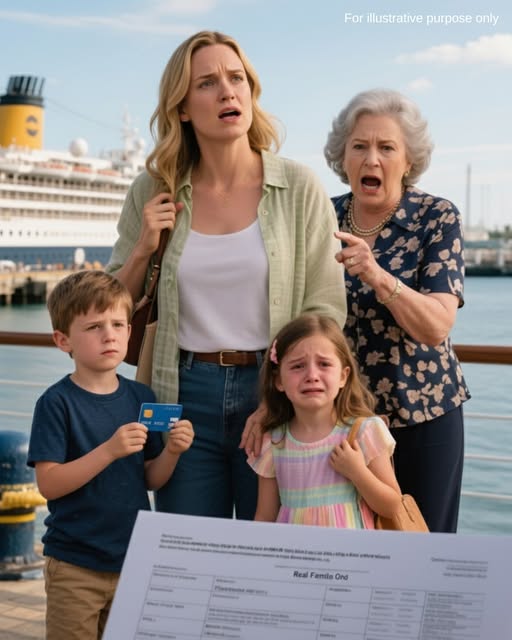
At the Harbor
It wasn’t until I was at the harbor that I noticed only my children’s names were missing from the passenger list. My mother smiled and brushed it off, saying it was a “family-only” reservation. My sister laughed, thanking me for the ride, joking that she saved on a taxi fare. But then my son, his eyes full of tears, asked, “Am I not family?” I squeezed his hand and walked away. Days later, they returned, begging for help.

The morning air at the Port of Miami was heavy with salt and anticipation. Families gathered with suitcases, laughing and snapping photos before boarding the cruise ship bound for the Caribbean. My children, Evan and Mia, stood beside me, each with a small backpack in hand. This was supposed to be our first real vacation together, after years of saving.
I approached the check-in counter, handed over our documents. The staff member typed, frowned, and typed again.
“I’m sorry,” she said carefully. “Your children are not on the passenger list.”
I laughed, confused. “That can’t be right. My mother booked everything.”
Behind me, my mother Diane chuckled softly. “Oops,” she said, smiling. “‘Family-only’ booking.”
I turned slowly. “What does that mean?”
My sister Lauren stepped forward, grinning. “It means real family. Thanks for the ride, by the way. Saved me the taxi fare.”
My stomach dropped.
Evan tugged at my hand, his eyes already glistening with tears. “Mom,” he whispered, “Am I not family?”
I knelt beside him, my chest burning. I wanted to scream, but I refused to break in front of my children. I stood, took their hands, and said calmly, “We’re leaving.”
Diane sighed dramatically. “Don’t be so sensitive. This trip wasn’t meant for kids anyway.”
I didn’t respond. With each step I took away from the port, my heart felt heavier. Around us, vacationers cheered as the ship prepared to depart.
That night, in a small hotel near the airport, Evan asked if he had done something wrong. I held him tightly and assured him he hadn’t.
I didn’t cry until they were asleep.
What Diane and Lauren didn’t know was that I had quietly been funding this trip. They’d used my credit card “temporarily,” promising to pay me back.
I canceled it that night.
They sailed without us.
And for the first time, I let them go too.

Three days into the cruise, my phone started buzzing nonstop. I ignored it at first, but soon the messages became desperate.
Apparently, my credit card cancellation caused a domino effect. Onboard purchases were frozen. Their return flight—booked through my account—was canceled. And to top it off, Diane had failed to disclose a medical condition on the cruise paperwork. She had a health issue at sea, and the ship’s medical team required a verified insurance guarantee before continuing treatment.
They didn’t have one.
That’s when they began begging.
Diane left voicemails, crying, saying she “didn’t mean it like that.” Lauren sent messages apologizing in vague, self-serving terms. “We were just joking,” she wrote. “You know how Mom is.”
I listened to each message. Then, I deleted them.
Instead, I focused on my children. We went to the beach near our home in Tampa, Florida. We ate ice cream, built sandcastles, and talked about what family really meant.
When the cruise returned early due to Diane’s condition, they were met by port authorities and medical billing staff. Without active insurance or payment authorization, Diane was transported to a public hospital. Lauren called me again, sobbing.
“You have to help us,” she said. “You’re my sister.”
I responded calmly, “Family-only, remember?”
She hung up.
Later, a hospital social worker reached out, asking if I would assist. I explained the situation calmly, without emotion. The social worker understood, saying adults were responsible for their own arrangements.
Diane was stabilized. She wasn’t dying. She was embarrassed and financially cornered.
That distinction mattered.
Weeks passed. Diane eventually paid her medical bills through a payment plan. Lauren moved back in with her temporarily. Neither apologized properly. I stopped waiting for one.
Instead, I enrolled Evan and Mia in a children’s counseling program. Not because they were broken—but because they deserved the tools to handle rejection that wasn’t their fault.
One night, Evan said something that changed everything. “Mom,” he said, “I think family is who stays.”
He was right.
I blocked Diane and Lauren on my phone. Not out of anger, but clarity.
Holidays became quieter. Happier. We started new traditions—movie nights, weekend trips, birthdays where no one was an afterthought.

Months later, Diane tried one last time to reach out through a cousin. She said she missed us. She said she’d learned her lesson.
I asked one question: “Has she explained to my children why she left them behind?”
There was no answer.
So neither was mine.
Walking away that day at the port wasn’t weakness. It was protection. And when they begged for help later, I understood something clearly for the first time:
You don’t owe loyalty to people who deny your children their place.