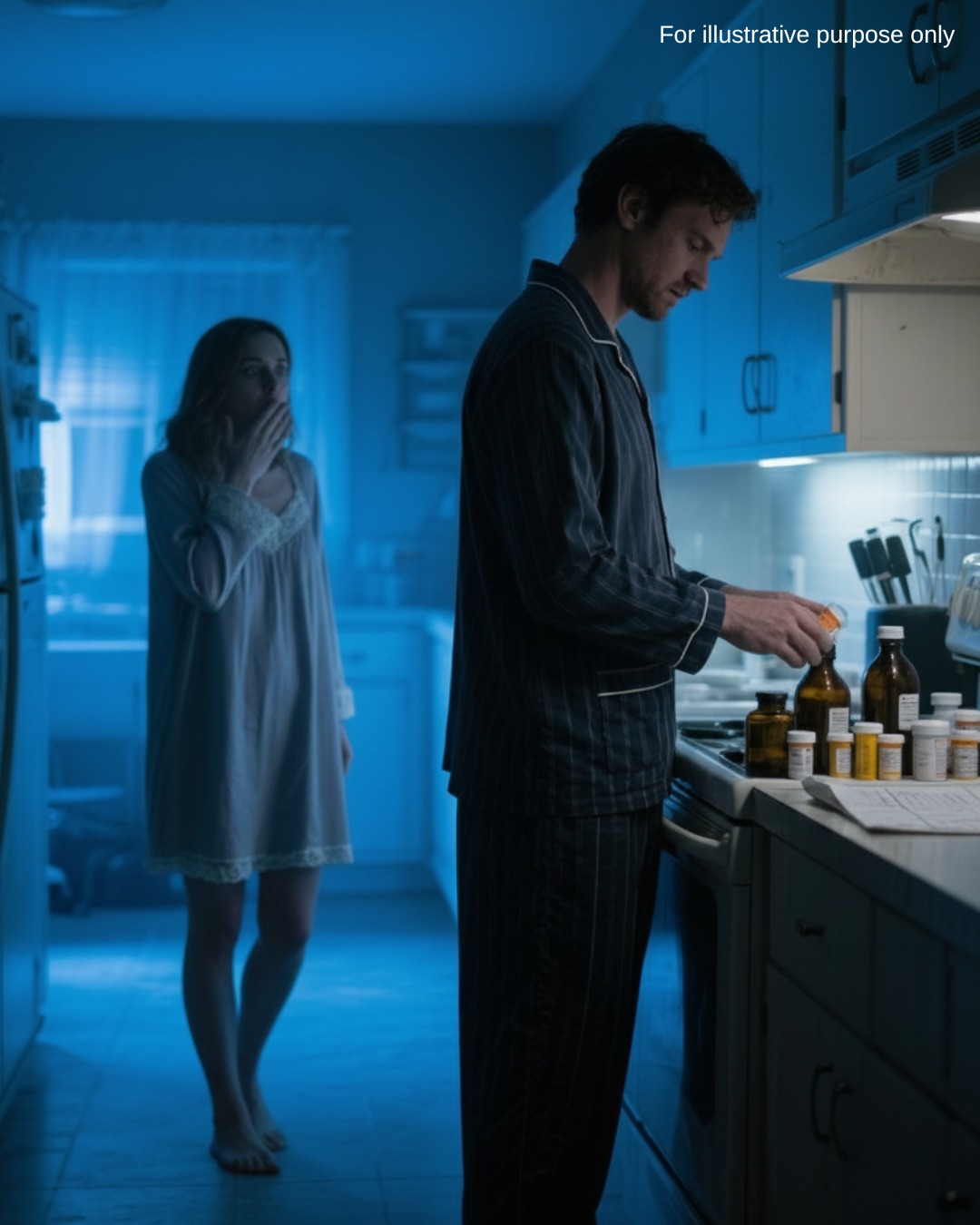
My husband had been drugging me every single night… One evening, I only pretended to take the pill and lay motionless, fully conscious. I saw him leave the bedroom at 2 a.m. I followed him downstairs—and what I witnessed there rooted me to the spot…

I had always trusted Ethan. In our ten years of marriage, he’d been my calm center—the man who made my coffee every morning and reminded me to take my vitamins each night. So when he began urging me to take a “new prescription” for stress, I didn’t question it—at first. But not long after, every night I took the pill, my body sank into a heaviness that didn’t feel like sleep. My memories blurred. Entire evenings disappeared.
A quiet fear took hold of me. One night, with Ethan watching, I tucked the pill beneath my tongue and pretended to swallow. When he kissed my forehead goodnight, I stayed perfectly still, fighting the urge to shake. Minutes passed. Then an hour. At exactly 2 a.m., he got out of bed carefully, trying not to wake me. I watched his silhouette drift through the thin strip of hallway light before he vanished downstairs.
I waited thirty seconds before moving, then slipped from the bed. My limbs felt unfamiliar, half-numb from weeks of sedatives, but adrenaline carried me forward. Each step down the carpeted stairs sounded impossibly loud. I kept my breathing shallow, terrified even the air might give me away.
From the base of the stairs, I saw him in the kitchen—his back to me, his motions disturbingly precise. He wasn’t cooking. He wasn’t cleaning. He was lining up small glass vials on the counter. Dozens of them. My prescription bottles sat beside them, their labels peeled away. Ethan poured a clear liquid from one vial into another, humming softly, like he was doing something ordinary.
My heart slammed against my ribs. This wasn’t medication. This wasn’t normal. Then he reached under the counter and pulled out a thick folder—one with my name written on it in his handwriting.
He opened it. Inside were pages of notes. Photographs. Timetables charting my behavior, my drowsiness, my reactions.
Without meaning to, I stepped closer—and that’s when it happened. Ethan stopped humming. His shoulders tensed. Slowly, he turned toward the staircase.
Our eyes met.
And he realized I wasn’t asleep.

For a beat, neither of us moved. The kitchen clock ticked too loudly, echoing the pounding in my chest. His face shifted—shock, calculation, and then a chilling calm I had never seen before.
“Hannah,” he said evenly, “you shouldn’t be awake.”
I swallowed. “What… what are you doing?”
He closed the folder carefully, as though we were discussing household bills, not my life. “You weren’t handling things well. I had to help you. You don’t realize how fragile you’ve been.”
Fragile. The word cut deep. My hands tightened on the railing. “You’ve been drugging me.”
“I was protecting you,” he replied, stepping closer. “You’ve been overwhelmed. Forgetful. Emotional. I was keeping things manageable.”
I retreated, but he followed with slow, deliberate steps. In that moment, I understood—with icy clarity—that he had imagined this confrontation many times.
“You tracked me,” I whispered. “You wrote reports about me.”
Ethan sighed, almost sadly. “Do you think I wanted to? You left me no alternative. You needed structure. Control. And I was the only one capable of providing that.”
My stomach twisted. He wasn’t admitting guilt. He was explaining why he was right.
When he reached the bottom stair, I lunged for the front door. My fingers brushed the lock—
Then he caught my wrist, his grip like iron.
“Hannah. Stop.”
“Let go of me!”
He didn’t. His other hand moved toward his pocket, and I heard the unmistakable rattle of the pill bottle he always carried. Panic exploded through me. I twisted sharply, using the sweat on my skin to slip free. He stumbled, startled by my strength.
I ran. Not outside—he’d reach me before I could undo the deadbolt. Instead, I sprinted to the study, slammed the door shut, and locked it. The study had one thing the kitchen didn’t: a window.
My hands shook violently as I forced it open. Cold air rushed in. I didn’t hesitate—I climbed out, scraping my knees on the frame, and dropped into the bushes below. Pain shot up my leg, but fear drowned it out.
I limped into the dark, barefoot on the pavement, refusing to look back at the house where my husband had been watching me sleep… drugging me… studying me.
As I turned the corner, I heard the front door open behind me.
He was coming.
I didn’t stop until I reached the gas station two blocks away, its fluorescent lights flickering like salvation. The clerk jumped when he saw me—barefoot, shaking, barely coherent—but pulled me inside and locked the door. Relief crashed over me as I sank onto the cold tiles.
The police arrived minutes later, though it felt endless. I told them everything—my slurred speech, the missing memories, the pills, the vials, the folder with my name. They listened, wrote notes, asked questions. One officer placed a reassuring hand on my shoulder and said, “You’re safe now.”
But safety felt distant. My body still buzzed with adrenaline, and every passing car made me flinch. I kept expecting Ethan to appear at the window, calm and patient—the way he always was when convincing me something terrible was for my own good.
They found him at home, seated at the kitchen table with the folder still open, as if ready to present his findings. He didn’t struggle. He didn’t deny anything. He spoke about me like a scientist discussing a test subject—detached, clinical, unsettlingly proud.
The investigation revealed months’ worth of sedatives hidden in vitamin bottles, altered prescriptions, and detailed notes documenting my reactions to each dose. With every discovery, the ground beneath me felt less real. I’d spent years believing I was losing myself—forgetful, foggy, doubting my own mind. But it hadn’t been me. It was him.
Recovery wasn’t instant. My body needed weeks to flush out the remnants. My mind needed even longer. Therapy became the place where I learned to separate fear from instinct, control from care, obsession from love.
Some nights, I still wake at 2 a.m., listening for footsteps that never come. But I remind myself: I left. I survived. And my life, at last, belongs to me.
If you’re reading this, maybe my story stirred something quiet inside you—an instinct you’ve ignored, a question you’ve been afraid to ask.
If you were in my place, what moment would have made you run?
I’d truly like to know. Sometimes sharing perspective matters more than we expect.
PART 2
The weeks after Ethan’s arrest passed in a haze of interviews, medical tests, and legal meetings. Though I was physically safe, fear still clung to me like smoke after a fire. My sister, Claire, refused to let me stay alone, insisting I move in with her.

“You survived something unimaginable,” she said as she poured tea into my shaking hands. “Your body needs rest. Your mind needs room.”
I nodded, but rest felt unreachable. Every unfamiliar sound startled me. Every shadow seemed ready to move. Even kindness made me flinch—gentleness had become something I no longer trusted.
Detective Marlowe, assigned to my case, visited often. He was patient and thorough, never pushing when my voice faltered.
“We’re building a strong case,” he told me one afternoon. “What we found in the house… Hannah, you were in danger for a long time.”
Danger. The word echoed inside me.
As the investigation deepened, it grew darker. One evening, Marlowe arrived carrying a box—documents seized from Ethan’s home office.
“They’re… notes,” he said carefully. “More of them.”
My throat tightened as I lifted the lid. Page after page of observations filled it—not only recent months, but years. He’d tracked my sleep, my stress responses, even my work habits. Arguments I barely remembered were meticulously recorded. One entry listed what he called my “emotional instability triggers”—my friends, my hobbies, any hint of independence.
“He wasn’t helping you,” Marlowe said quietly. “He was molding you.”
The realization twisted my stomach. Ethan hadn’t suddenly become controlling—he’d been shaping my reality slowly, patiently. And I had lived inside it without seeing the walls.
That night, for the first time since fleeing the house, I cried without restraint. Grief, betrayal, terror poured out until my chest ached. Claire held me, whispering, “You’re free now.” Yet part of me wondered—if someone rewrites your life without permission, does freedom ever feel whole?
Therapy became the only space where I could speak without feeling monitored. My therapist, Dr. Levin, urged me to address not just the trauma, but the years of quiet conditioning before it.
“Coercive control doesn’t always look violent,” she said. “Sometimes it looks like care. Routine. Stability. It’s meant to feel safe.”
Safe. The word had turned bitter.
With her help, I began noticing moments I’d ignored. Times Ethan insisted on driving me everywhere. Times he discouraged me from seeing coworkers. Times he suggested I quit my job because I seemed “overwhelmed.” I’d thought it was love.
But love doesn’t erase you.
One afternoon after therapy, I noticed a black SUV idling across the street. Tinted windows. Nothing obvious—but its stillness unsettled me. I forced myself to look away, reminding myself fear could color ordinary things.
That night, Marlowe called.
“Ethan requested bail today,” he said.
My breath caught. “Is he getting out?”
“No,” he replied quickly. “The judge denied it. But he tried to argue you were mentally unstable, that your statements couldn’t be trusted.”
My knees weakened. Claire steadied me.
“He’s still controlling the story,” I whispered. “Even from jail.”
“That’s why we stay alert,” Marlowe said. “And why you need to tell us if anything feels wrong.”
The next morning, I found an envelope slipped under Claire’s front door. My name written in handwriting I knew too well.
My blood ran cold.
Inside was a single page.
No matter where you go, I know you better than you know yourself.
There was no signature. There didn’t need to be one.
I sank to the floor, shaking. He wasn’t supposed to contact me. He wasn’t supposed to know where I was.
Yet the message lay in my hands, undeniable:
Ethan wasn’t finished.
Marlowe arrived quickly. The envelope was bagged, photographed, tested. His calm grounded me, even as my pulse raced.
“We’ll increase patrols,” he said. “This could be an attempt at psychological control.”
“But how?” I asked. “He’s in jail.”
“Incarceration doesn’t end influence,” Marlowe replied. “Some people manipulate others just as easily as they once manipulated their partners.”
The thought chilled me.
That night, I lay awake on the couch while Claire slept upstairs. Every creak echoed. Every passing car cast moving shadows. Fear lingered like fog.
Around 3 a.m., I stepped onto the balcony for air.
Across the street, the same black SUV was parked.
My breath stopped.
After a long minute, the driver’s door opened. A tall man stepped out—broad-shouldered, hood pulled low. He didn’t look at the house, but he waited.
Waiting for what?

I retreated indoors and locked the door, dialing Marlowe with shaking hands.
He arrived with patrol units. The SUV was gone.
“It may be unrelated,” he said gently. “But we’re treating it seriously. You’re not imagining danger—you survived it.”
Days later, investigators discovered the man was a former coworker of Ethan’s—someone he influenced deeply. The man admitted Ethan had asked him to “deliver a message” because his wife was “emotionally fragile.”
Something inside me finally broke—not from fear, but clarity.
Ethan’s control was ending.
He had built a world where he knew me better than I knew myself. That world collapsed the night I followed him downstairs and saw the truth.
Now, standing in the sunlight outside the police station after my final statement, I understood what he never did:
I know myself better now than he ever could.
And I’m no longer afraid of him.