They laughed when they dumped the broken mountain man on Abigail Weston’s porch.
It was the kind of laughter meant to do damage before a single word had fully landed, loud and careless and sharpened by the certainty that everyone watching would understand the joke. Dust rose around the wagon wheels in the hard Colorado light. Horses stamped and snorted in the yard. A few ranch hands grinned openly as if they had brought some grand entertainment instead of a wounded human being wrapped in filthy canvas.
The spring of 1881 had already hollowed Abigail down to iron and grit by then.
She stood on the porch of her homestead with flour on her forearms and dust worked deep into the hem of her dress, looking out over 100 acres of grazing land that should have been an inheritance and had instead become a battlefield. Behind her, the Sangre de Cristo mountains shouldered against the sky in blue-gray ridges, beautiful and indifferent. In front of her, Horace Blackwood sat his black gelding with the easy poise of a man used to having other people’s futures bend around his wants.

It had been 6 months since Arthur Weston was found dead in the shallow water at Creek Bend. The official story, given by Sheriff Brodie in that flat tone lawmen used when they wanted grief to settle into the shape of paperwork, was that Arthur had slipped, struck his head, and drowned. Abigail had never liked the story. It sounded too clean, too convenient, too small for a death that had left so much wrongness behind it. Still, the body had been buried, and life on the homestead did what life always does after a death. It turned brutal and practical.
Arthur had not left her comfort. He had left her debts.
Not the ordinary kind, either. Not the sort 1 can meet with a tighter belt, another season of work, and some modest bargaining at the bank. These were sprawling, suffocating obligations she had not known existed, debts that seemed to multiply every time she opened a ledger or accepted a letter. Within weeks, Horace Blackwood had bought them all. He had cut off her credit at the mercantile, turned the town with whispers that she had harried Arthur into the grave, and made it plain in a hundred small ways that he wanted the Weston land and meant to get it.
He wanted the northern ridge most of all, though he pretended it was the springs running through it that interested him.
Abigail did not believe him.
No matter. Belief had nothing to do with power, and Horace Blackwood had power enough to make disbelief expensive.
She had refused to sell. She had refused to marry him. She had refused to be driven out and packed east on a train like some unwanted parcel. So he had come up her dirt road that Tuesday afternoon with Sheriff Brodie, 4 laughing ranch hands, and a wagon carrying a human insult.
“Afternoon, Widow Weston,” Blackwood called, tipping his hat with a smile that never touched his eyes. “Brought you a little housewarming gift. Or should I say, a husband.”
Abigail’s face did not change.
“I told you I’m not selling,” she said. “And I’m certainly not marrying you. Get off my property.”
Blackwood laughed, dry and ugly.
“Oh, I ain’t offering myself. I know you said you needed a strong man to help you hold this place together since poor Arthur passed. Well, the town took up a collection. Found you the strongest man in the territory. Least he used to be.”
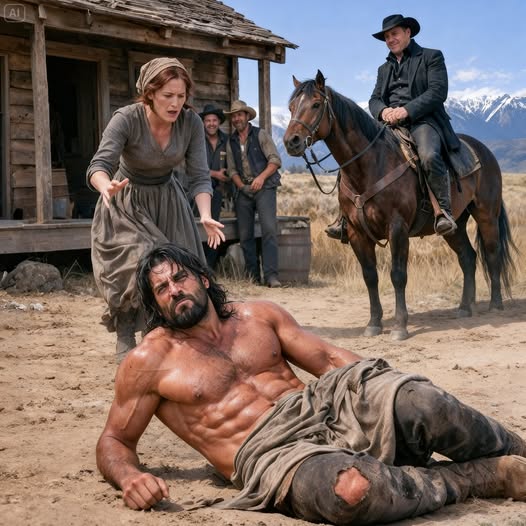
At a gesture from him, 2 of the hands jumped down from the wagon, dropped the tailgate, and dragged the canvas-wrapped figure into the dirt.
The body hit hard.
A low groan came from inside the bundle.
For a second the whole yard seemed to go still around the sound.
Abigail went down the porch steps with her heartbeat pounding hard enough to shake her vision. She pulled the canvas back and found a man beneath it, massive even half-curled in pain, his hair matted, beard gone wild, face bruised, filthy, and burned by weather. His shoulders were broad enough to seem almost unnatural on someone laid so helplessly on the ground. But it was his legs that fixed her there. They lay wrong, limp and motionless beneath him, their stillness more disturbing than any visible wound.
“Meet Wyatt Cole,” Blackwood said. “Best trapper and timber man north of Denver. Until a few weeks ago, when a redwood laid him flat at the logging camp. Doc Higgins says he’s paralyzed from the waist down. Dead from the belt to the boots. Logging company dumped him in town. Town sure as hell ain’t paying to feed a cripple.”
The men laughed again.
Blackwood leaned over his saddle horn, savoring it.
“The law says an unmarried woman can’t hold a deed in this county if a qualified buyer steps up. But a married woman is protected. So the town council married you 2 this morning by proxy. You got your husband, Abigail. A broken mountain man. You can feed him, wash him, and watch him die. Or you can sign that deed over to me right now, and I’ll have my men take him to the county poorhouse and put you on a train to St. Louis.”
It was a trap designed with care. Humiliation disguised as law. She was meant to break in public. Meant to cry. Meant to yield because the burden was too grotesque to carry.
Wyatt Cole opened his eyes then.
They were gray, cold and storm-heavy, and full of pain so bright it almost looked like hatred. Not hatred for her. Hatred for the men standing above him, for the body that no longer obeyed him, for the fact that he understood perfectly the part he had been made to play. He was the joke. The final insult. The proof Blackwood thought would end the matter.
Abigail looked from him to Sheriff Brodie.
“Is this true?” she asked. “Is this man legally my husband?”
The sheriff shifted under her gaze.
“Yes, ma’am. Mayor signed the papers himself. Under the provisions of—”
“Save it.”
She straightened and turned back to Horace Blackwood.
“Thank you for the delivery, Horace,” she said. “You’ve just secured my claim to this land. Now get off my property before I fetch my shotgun and start shooting for trespassing.”
The smile vanished from his face so quickly it might never have been there.
“You’re a fool, Abigail. You can’t run a ranch and nurse a paralyzed giant. He’ll drag you down and you’ll both starve before the first snow.”
“Get off my land.”
She said it softly that time. More dangerously. Blackwood heard the difference. He spat into the dirt, wheeled his horse, and jerked his chin at the others.
“Let’s go, boys. Give her a week. The smell alone will have her begging.”
Then he was gone, the wagon rattling back down the road, the ranch hands laughing until distance swallowed it all.
The silence that followed felt enormous.
The wind moved through the grass. A chicken scratched under the porch. Wyatt Cole lay where they had dumped him, half in the dust, breathing shallow through pain and shame.
“Why didn’t you let them take me?” he asked after a moment. His voice was a gravelly rasp, barely strong enough to carry.
“Because,” Abigail said, sliding her arms under his shoulders, “I don’t like Horace Blackwood, and I don’t believe in dead weight. Now grit your teeth, Mr. Cole. We’ve got a long way to the porch.”
It took nearly an hour to get him inside.
He was enormous. Not simply tall, but heavy in the way of a man built by hard country and harder labor. She ended up pulling an old barn door from the shed, laying it flat in the dirt, and using it as a sled. She levered him onto it by degrees, then dragged him inch by inch up the steps and through the doorway, stopping every few feet to breathe and curse under her breath. By the time she had maneuvered him onto Arthur’s old bed in the main room, her palms were blistered open, her dress soaked through, and every muscle in her back was screaming.
Wyatt was half-conscious from pain, but not gone enough not to know what was happening.
He smelled of pine, old blood, wet wool, and unwashed misery. Shame came off him almost as strongly as heat.
Abigail boiled water, cut away the dirt-stiffened cloth from his wounds, and got to work.
She did not ask permission to pity him because she did not pity him at all. That was the 1st thing he noticed.
The 2nd was that she did not move like a woman playing at fortitude. She moved like a person who had been carrying more than she ought to for a long time and had ceased to expect applause for it.
The first 3 weeks were bad enough that later, when both of them had reason to speak more gently of the beginning, neither ever tried to soften them with false romance.
Wyatt Cole was a difficult patient because he was still, beneath the injury, very much Wyatt Cole.
He had spent his life in mountains, timber camps, trap lines, and high country winters where weakness got buried quickly. Men had depended on the power of his body. He had depended on it even more. To be hauled, fed, washed, turned in bed, and emptied of dignity by the sheer logistics of paralysis was a humiliation he could not hide from, and humiliation in a proud man often comes out as rage.
He snapped at her constantly in those early days. Turned mean. Threw a plate of beans against the wall 1 evening so hard it shattered, bellowing that he would sooner starve than be fed like an infant.
Abigail bent, picked up the pieces, and set a rag and pail beside him.
“Then starve,” she said calmly. “But you’ll clean the wall first. Your arms still work, don’t they?