HE LEFT US IN THE HOSPITAL THE MOMENT OUR SON WAS BORN BUT TWENTY FIVE YEARS LATER HE REGRETTED EVERYTHING AT GRADUATION
They say a slammed door is an act of anger, and anger is a living thing that can be reasoned with or fought. But the way Warren left me wasn’t loud. It wasn’t fueled by a heated argument or a moment of passion. It was a silence so clean and sharpened that it felt like it was cutting through the very fabric of our lives. I was lying in a hospital bed, the scent of antiseptic thick in the air, with my newborn son, Henry, tucked against my chest. He was less than three hours old, a tiny bundle of potential with one fist curled into my hospital gown. Then the neurologist walked in, and the world split into two distinct eras: before and after.
The diagnosis was delivered with that soft, practiced gentleness that doctors use when they are about to change your life forever. There was motor impairment, she said. Henry would need physical therapy, constant support, and a lifestyle defined by close follow-ups and medical intervention. I sat there, nodding like a woman receiving mundane directions to a grocery store, while my brain struggled to process the weight of it. Warren, however, didn’t nod. He didn’t ask questions. He simply stood by the window, his jaw tightened, looking at our son not with the eyes of a father, but with the cold appraisal of a man looking at a ruined investment.
Warren wanted a son he could throw a baseball with, a boy he could take surfing on the weekends. In his narrow view of the world, a child who required braces and therapy was a “broken” child. He looked at me, his eyes devoid of the love we had built over years of marriage, and said six words that defined the rest of my life: “I’m not doing this, Bella.” He picked up his jacket, reached for his car keys, and walked out of the delivery room as if he were leaving a business meeting that had simply run too long. He left me with an IV still in my arm, a folder of therapy instructions, and a son who deserved better.
The years that followed were not the noble, cinematic struggle people like to imagine. They were expensive, exhausting, and often lonely. While other mothers were celebrating first steps, I was learning how to stretch Henry’s legs while he cried in frustration and my own hands shook from sleep deprivation. I became an expert in insurance loopholes and a warrior in school district offices. I learned that some people speak to single mothers of children with disabilities in a “funeral voice”—low, pitying, and ultimately useless.
One Sunday, when Henry was still an infant, a woman from our church choir stopped me to ask how Warren was “coping.” I didn’t sugarcoat the truth. I told her he had left long before my stitches had even melted. The look of shock on her face was a small satisfaction, but it didn’t pay the medical bills or keep the apartment smelling like anything other than formula and lemon cleaner. I cleaned when I was scared, and because the future was a giant, gaping unknown, our home was always spotless.
As Henry grew, he developed a personality that was as sharp as his father’s had been shallow. By age seven, he was already correcting school administrators who tried to suggest he should “aim lower” or attend a different facility. He sat in a principal’s office and asked a woman point-blank if she thought he was physically slow or just stupid. I had to bite my lip to keep from cheering. My son wasn’t just surviving; he was building a mind that could outpace anyone who dared to underestimate him.
Physical therapy became the forge where Henry’s anger turned into muscle. He spent his childhood on exam tables, swinging his legs and reading his own charts. By fifteen, he was reading medical journals at the kitchen table while I balanced our checkbook. He told me he was tired of being a “cautionary tale” in other people’s stories. He wanted to be the person in the room who actually spoke to the patient, rather than talking over them as if they were an inanimate object. He decided he was going to be a doctor, not in spite of his condition, but because of it.
Against every statistic and every person who told him to be “realistic,” Henry climbed. He got into medical school at the top of his class. He worked twice as hard as his peers, navigating the grueling shifts and the physical demands of residency with a quiet, steely determination. We had made it. We were a team of two, and we had won.
Then, a few days before his graduation, the past came knocking. Warren had found Henry online. Now that my son was a soon-to-be surgeon with a prestigious title, Warren suddenly felt a surge of fatherly pride. He hadn’t been there for the braces we couldn’t afford, the nights Henry spent in tears from nerve pain, or the grueling hours of gait training. But he wanted to be there for the cameras. He wanted to be there for the “proud father” moment. To my surprise, Henry invited him. I was furious, but Henry told me he didn’t want his father walking around with the “wrong version” of the story.
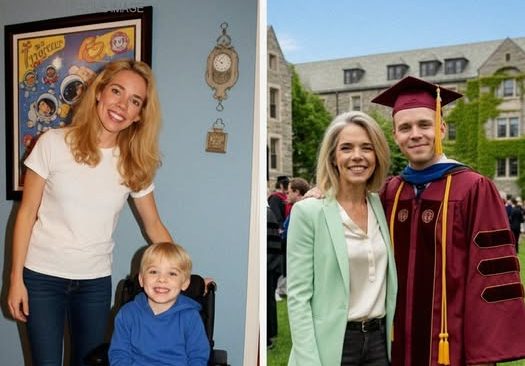
Graduation night was a sea of black gowns and golden tassels. When Warren walked into the hall, he looked exactly like the man who had left us—polished, wearing a dark suit and a smile that assumed he was entitled to a seat at the table. He came up to us, looking at Henry’s broad shoulders and steady stance. He marveled at the fact that Henry didn’t even use a cane. “You’ve done well for yourself, son,” he said, his voice full of a false, hollow warmth. “You don’t even walk with a limp.”
Henry didn’t correct him then. He just waited.
When Henry was called to the podium to deliver the final address as the top student in his class, the room went silent. Warren sat in the front row, preening, ready to soak up the reflected glory. Henry looked out at the audience and began to speak. He didn’t talk about his own perseverance as a solo act. Instead, he told the room about the day he was born. He told the assembled deans, doctors, and families about the man who saw a diagnosis and walked out the door because he wanted a life that was “easy.”
The air in the room seemed to vanish. Henry described how I had carried him into rooms his father was too weak to enter. He told them that his success didn’t belong to a “proud pair of parents,” but to the woman who stayed when life stopped looking fair. He looked directly at Warren and said, “Everything good in me learned your name first, Mom.”
The applause was a deafening roar that brought the entire room to its feet. I sat there with my hand over my mouth, crying tears that were twenty-five years in the making. I didn’t look at Warren, but I didn’t have to. The silence that followed him out of that auditorium was even heavier than the one he had left in the hospital room all those years ago. He had wanted to be part of the ending without ever showing up for the beginning. As Henry found me in the hallway afterward, we didn’t need to say a word. The man who had abandoned us was gone, and for the first time, the story was finally ours alone.