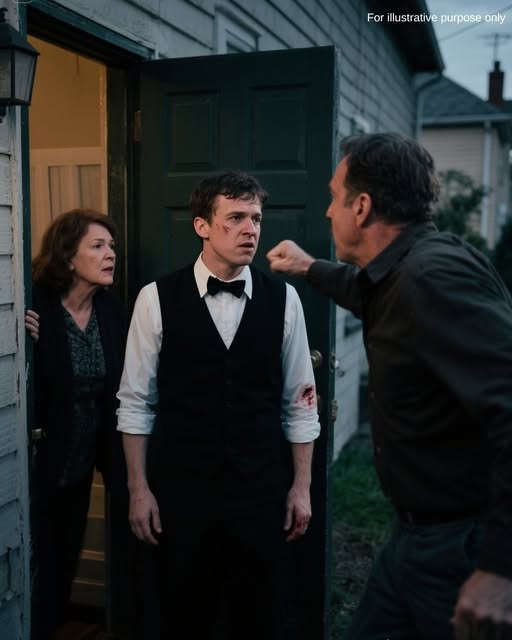
After being away for eleven years, I returned home for one reason only: my grandfather’s funeral. My mother opened the door, but it was her new husband who greeted me with a fist. He told me this house was no longer mine. He didn’t know I still had the original ownership papers… and a very good lawyer.

Eleven years after leaving, I returned to my hometown for a single purpose: my grandfather’s funeral. His name was Edward Miller, and he was the one person who had ever made that house feel like home. I arrived, exhausted from the overnight flight, dressed in black, carrying nothing but a small suitcase and memories I hadn’t touched in a decade.
Standing on the porch of the old colonial house on Maple Street, my hands trembled. The door opened slowly. My mother, Linda, appeared, looking older and thinner, her eyes flickering with a mix of shock and guilt. She didn’t hug me. She didn’t even say my name. Before she could react, a man stepped forward from behind her.
“Who the hell are you?” he demanded.
“I’m her son,” I replied. “I’m here for my grandfather.”
Then Richard Hale, her new husband, did something I never saw coming. Without warning, he swung his fist and hit me square in the jaw. I staggered back against the railing, stunned, tasting blood.
“You don’t belong here,” he sneered. “This is my house now.”
My mother screamed his name, but she didn’t touch him. She didn’t touch me either.
Neighbors peeked through their windows as Richard leaned in close, whispering, “You left. You’re nobody here. Get off my property before I call the police.”
I wanted to scream that this was my childhood home. That my grandfather had raised me here after my father died. That I painted these walls with him, fixed the roof with him, and learned the meaning of dignity from him. Instead, I slowly stood up, wiped my mouth, and nodded.
“Fine,” I said. “I’ll leave.”
As I walked back down the steps, Richard laughed, victorious. He had no idea that before I left town all those years ago, my grandfather had given me something: a worn manila envelope with the original ownership papers to the house—signed, notarized, and legally transferred to me.
And he certainly didn’t know that, standing there on the sidewalk, I was already dialing a lawyer who owed me a huge favor.
The funeral was two days later. I didn’t return to the house. I stayed in a small hotel near the courthouse, barely sleeping, replaying the events over and over— the punch, my mother’s silence, Richard’s arrogance. People only act that sure when they think they’re on the right side of the law.
They were wrong.
At the service, Richard sat proudly in the front row, as if he owned the world. My mother kept her eyes down. When she saw me walk in, she froze. Richard smirked. He thought he had already won.
After the burial, he blocked my way. “I told you not to come back,” he said quietly.
“I came to bury my grandfather,” I replied. “And to reclaim what he left me.”
That night, my lawyer, Thomas Reed, filed an emergency motion. The deed transfer dated back thirteen years, recorded but conveniently “forgotten” when my mother remarried. Richard had never checked properly. He assumed marriage gave him power. It didn’t.
Three days later, the sheriff knocked on the door of the Maple Street house. I watched from across the street as Richard’s face drained of color as he read the documents. An eviction notice. Immediate effect.
My mother called me for the first time in eleven years. She cried. She said she didn’t know. She said she was scared. I listened, but I didn’t interrupt. Fear explains silence, but it doesn’t erase it.
Richard tried to fight it in court. He claimed he made improvements, made payments, and had a “family understanding.” None of it mattered. Paper always beats ego. The judge ruled swiftly: The house was mine. It always had been.
When Richard was forced to leave, he looked at me with pure hatred. “You planned this,” he spat.
“No,” I said calmly. “You did. The moment you raised your fist.”

I moved back into the house a week later. It smelled like dust and old wood, but also like memories. I stood in my grandfather’s study and opened the drawer where he once kept the envelope. I finally understood why he trusted me with it. He knew I’d need proof one day—proof that love doesn’t always come from blood, but protection sometimes comes from preparation.
The house is quiet now. Too quiet, at times. I didn’t throw a celebration. I didn’t make a big show of it. I just cleaned room by room, slowly, almost apologizing to the walls for being gone so long.
My mother asked to meet. We sat at the old kitchen table. She told me she loved me. I said I believed she did—but love without action leaves scars that last longer than fists. We’re talking again, cautiously. Healing isn’t dramatic. It’s slow and uncomfortable.
As for Richard, the last I heard, he moved to another state and tells people a story where he’s the victim. That’s fine. I don’t need his apology. I needed accountability—and I got it.
Sometimes people ask why I didn’t fight back that day on the porch. The truth is simple: not every battle is won with force. Some are won with patience, legal documents, and knowing when to let someone reveal exactly who they are.
Had I reacted with violence, I would’ve lost everything. Instead, I walked away—and came back with the law on my side.
This isn’t a story of revenge. It’s about knowing your worth, even when your own family forgets it. It’s about understanding that leaving doesn’t mean surrendering, and silence doesn’t erase truth.