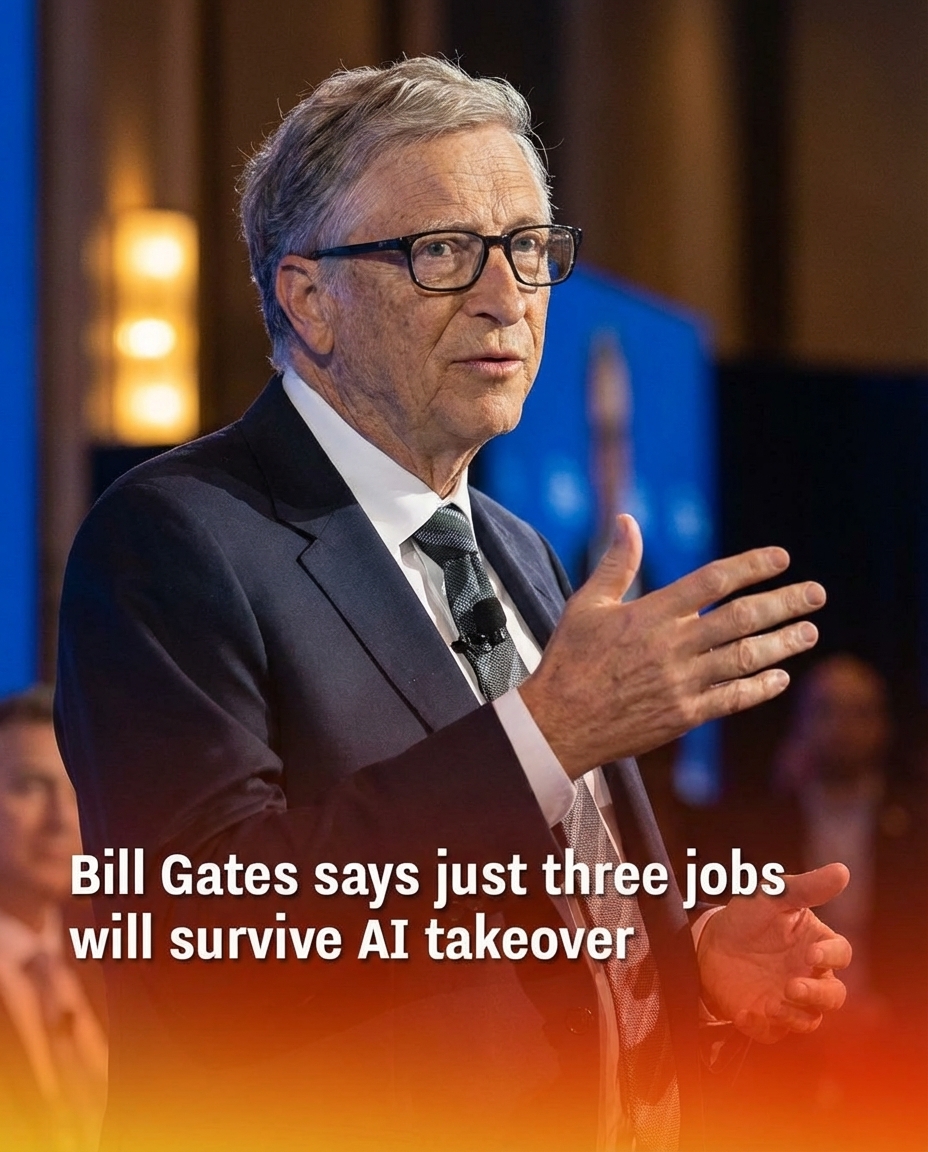
As artificial intelligence accelerates from a futuristic novelty to a global economic engine, a chilling question has begun to haunt boardrooms and breakrooms alike: is my job next? In a world where algorithms can now draft legal briefs, compose symphonies, and diagnose diseases with startling accuracy, the traditional career ladder feels more like a disappearing act. However, tech visionary and Microsoft co-founder Bill Gates has stepped forward with a definitive forecast, identifying the three specific professional pillars he believes are virtually untouchable by the encroaching AI revolution.
The anxiety gripping the global workforce is not without merit. By early 2026, the integration of generative AI into everyday business operations has moved beyond simple automation. We are witnessing a fundamental shift in how value is created, with routine cognitive tasks being swallowed by smarter, faster systems. Yet, Gates remains an optimist, suggesting that the “AI Era” is not a funeral for human employment, but rather a massive reorganization. His perspective hinges on the belief that while AI can replicate data processing, it still struggles to simulate the “human spark”—the unique combination of creative intuition, ethical judgment, and high-stakes physical responsibility.
According to Gates, the first group of “survivors” consists of those who build the digital world: software developers and AI specialists. While it may seem counterintuitive that the creators of AI would be safe from it, Gates argues that the complexity of these systems requires constant human guidance. AI is an incredibly powerful tool, but it lacks the intentionality required to innovate its own architecture or understand the nuanced needs of a specific industry. Developers will transition from writing every line of code to acting as “conductors,” overseeing vast digital orchestras and ensuring that technology remains aligned with human goals and safety protocols.
The second sanctuary for human talent lies in the realm of high-level scientific research, particularly in biology and healthcare. Gates points out that while an AI can cross-reference millions of chemical compounds in seconds, it cannot replicate the “Aha!” moment of a biological researcher who connects disparate observations into a breakthrough cure. The critical thinking and imaginative leaps required to push the boundaries of human knowledge remain a strictly human domain. In fields where the stakes involve life and death, the oversight of a human scientist provides a moral and intellectual anchor that an algorithm simply cannot provide.
Finally, Gates identifies the energy sector as a critical stronghold for human labor. As the world pivots toward a green energy transition, the management of global resources and infrastructure becomes increasingly complex and physically demanding. Managing a power grid or overseeing the deployment of next-generation nuclear and solar technologies involves a level of real-world responsibility and logistical troubleshooting that cannot be outsourced to a server farm. These are roles that require a presence in the physical world and a level of accountability that society is not yet ready to hand over to an autonomous system.
Ultimately, the future of work in the wake of Gates’ predictions isn’t about a war between man and machine; it’s about a new kind of partnership. The most successful professionals of the next decade will be those who learn to “speak” AI—using it as a high-powered bicycle for the mind. While certain roles will undoubtedly fade into history, the professions that survive will be defined by their reliance on human insight, creativity, and the ability to navigate a world that is becoming more digital, but no less human. For those worried about their future, the message is clear: lean into the skills that a machine can’t find in a database.