Annabeth first heard his voice long before she understood what it would mean.
But that came later.
At the beginning, there was only the barn, the smell of sweat and straw and old fear, and the sign hanging crooked above the platform that read, Unclaimed brides, auction ends at noon.
She stood beneath it in a borrowed dress yellowed with age, its sleeves too short to hide the bruises fading along her arms. The lace at the collar scratched her skin. The bonnet tied beneath her chin had once belonged to her mother, the only thing of hers Annabeth had managed to keep after sickness, debt, and men with ledgers stripped the house down to almost nothing. Her mother had died before teaching her the soft things, before explaining what marriage was meant to feel like when it was chosen rather than arranged. By 19, Annabeth knew almost nothing about love and far too much about what men could do when given power over a woman.
The auctioneer gripped her chin with the curve of one finger and tipped her face toward the room.
“A virgin,” he called, and the word struck the rafters like something obscene made festive. “Not a mark on her except those you can’t see.”
The men in the barn laughed.
They were ranch hands mostly, gamblers, drifters, men who smelled of tobacco, whiskey, and long habit. Some leaned against the rails. Others sat on feed sacks with their hats tilted low. They watched her the way buyers watched stock, assessing usefulness, novelty, and the likelihood of trouble.
“Starting at $3,” the auctioneer barked. “Don’t be shy, gents.”
Annabeth stared at the floorboards and tried to leave her body in pieces. She had learned how to do that in small ways over the years. Not enough to escape pain entirely, but enough to survive humiliation without screaming.
Someone laughed and offered $2.
Someone else called him cheap.
Then a voice from the back of the barn said, “$3.”
It was not loud. Not eager. It carried because it did not need force to be heard.
Every head turned.
The man who stepped forward was taller than anyone else there by enough to make the difference feel symbolic. A cowboy, clearly, though not one of the rowdy young men who spent too much time showing off in town. His shoulders were broad beneath a dark coat. His hat brim shadowed most of his face, but what showed beneath it suggested weather, labor, and grief rather than vice. He looked like a man who had buried too much to still believe life owed him anything soft.
He counted 3 silver dollars into the auctioneer’s palm.
Then he looked at Annabeth.
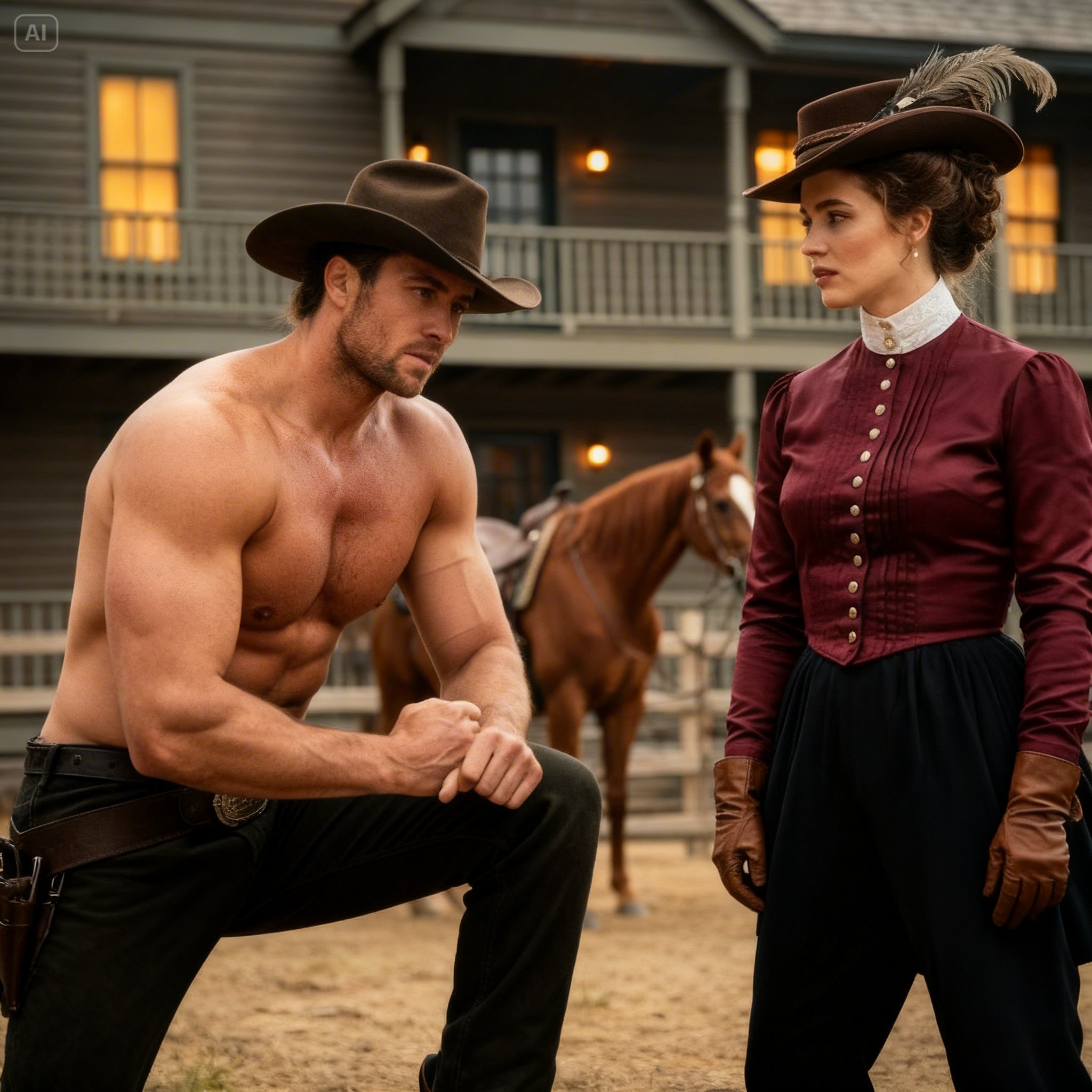
And instead of reaching for her, claiming her, or dragging her down from the platform the way other men had already done to other women that morning, he dropped to one knee in the dirt.
The whole barn went silent.
Not a shifting silence. Not a murmuring pause. A true break in the air, as if something invisible had cracked straight through the room. Annabeth’s breath hitched so sharply it hurt. Then the sound tore loose from her throat all at once.
She screamed.
Not because he had hurt her. Not because she expected him to.
Because he had knelt.
No man had ever lowered himself before her in any posture that was not mockery or threat. Men loomed. Men reached. Men took up space and expected women to shrink around them. Yet here was this stranger, down in the dust, hands steady, eyes level with her trembling body as if he understood something sacred about not frightening what had already been frightened enough.
He reached for the frayed laces of her shoes and untied them carefully.
His fingers brushed her ankle with a gentleness so alien she almost cried out again.
“You don’t belong to me,” he said in a voice low enough that only she could hear it. “I just paid so no one else could hurt you.”
Her knees weakened. Her fingers dug into the edge of the platform to keep from collapsing.
“Why?” she whispered.
He did not answer.
He rose, placed her shoes neatly at the edge of the boards, removed his coat, and draped it around her shoulders. The wool smelled of pine, smoke, leather, and cold wind. Then he turned and walked toward the barn doors without once touching her again.
The men watched.
The auctioneer watched.
The crowd waited for some punchline, some catch, some proof that the mercy was false and the real humiliation had not yet arrived.
But the cowboy kept walking.
After 3 long seconds, Annabeth followed him because there was nowhere else to go and because his coat was warm and because something inside her, something almost buried beyond rescue, had just felt the first thin edge of safety.
The wagon ride passed in silence.
He drove. She sat hunched on the bench seat, wrapped in the coat, staring ahead at the winter fields and the road cut pale through them. Once, when the reins cracked and the horses lurched harder than she expected, she flinched so visibly the motion embarrassed her. The cowboy slowed the team at once.
Still he said nothing.
She kept waiting for the demand. The explanation. The price. But only the wind spoke, brushing over the open land and through the wheels’ steady turn.
By the time his cabin came into view, she had built and discarded 12 different versions of what would happen next.
The cabin itself unraveled all of them at once.
She had expected roughness. Perhaps a mean little shack, a bachelor’s hole with whiskey bottles, dirty floors, and a bed too visible from the doorway. Instead she saw a place worn but cared for. Firewood stacked high beneath the eaves. Curtains in the windows. Smoke curling from the chimney in a way that spoke not of neglect, but of a hearth already lit against the cold.
He climbed down first and opened the door. Then he stepped aside.
“You’re free to walk,” he said. “But if you need heat, food, or quiet, it’s inside.”
No man had ever offered her quiet before.
Only commands.
Only expectations.
Only consequences.
Annabeth stood there with her fingers clutching the coat together at her throat and looked past him into the cabin. Warm light flickered. A kettle hummed softly. A table stood neatly set with 2 bowls. Blankets folded over chairs. Books on a shelf. Not many, but enough to suggest someone in this place read for reasons beyond necessity.
She stepped inside because the warmth felt like a thing alive and because she was too tired to keep standing in fear.
It smelled of stew and pine smoke and old wool dried by the fire.
He closed the door behind them, moved to the stove, and lifted the lid from the pot.
“What now?” she asked.
“You wait,” he said. “Until you’re hungry.”
He did not tell her where to sit. He did not ask questions. He did not corner her with pity or curiosity. He simply let her stand there until her body, after a long moment of disbelieving the room, moved of its own accord toward the chair nearest the hearth.
On the mantel sat a wooden carving of an eagle in flight.
He noticed her looking at it and picked it up, turning it once in his hand.
“Why did you kneel?” she asked.
He met her eyes then.
“Because every man in that barn stood over you,” he said. “And not one of them saw you.”……
“Let Me Stay and Work For You—I’ll Even Get You Pregnant Again,” Giant Begged the Rich Widow