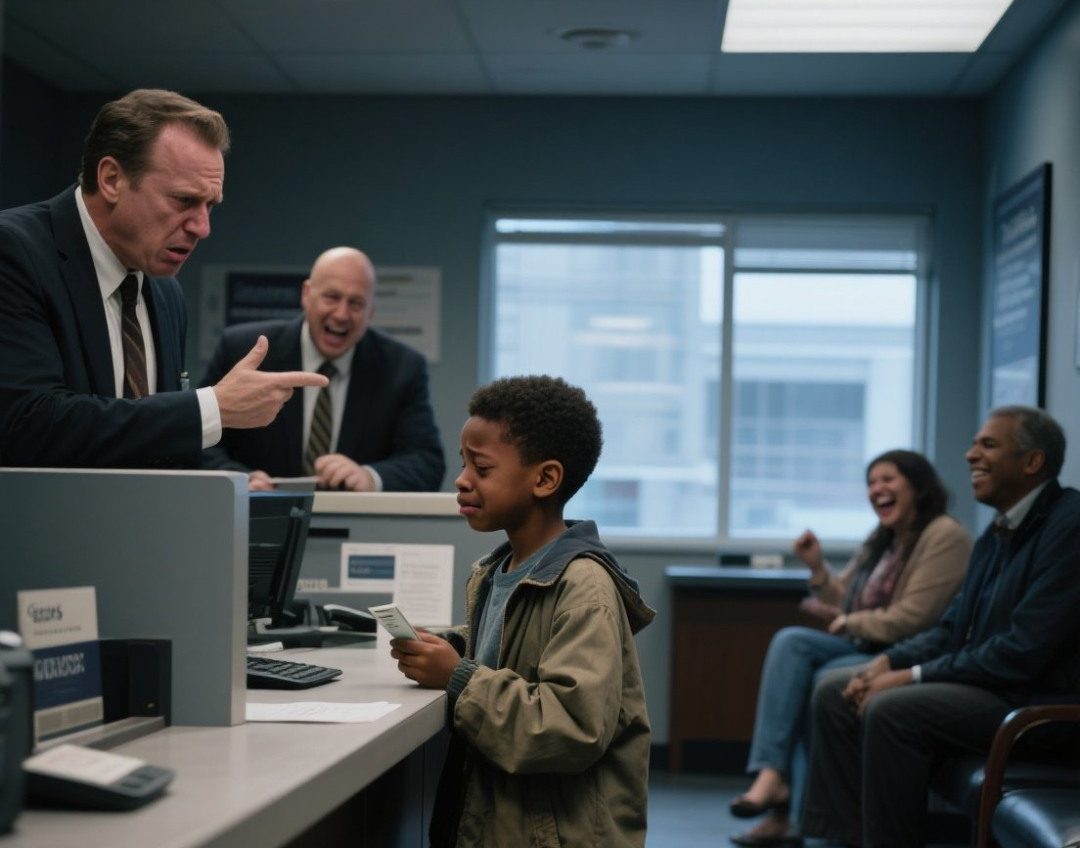
The marble floors of Crestview National Bank reflected the afternoon sun, but no amount of light could soften the harsh judgment burning in the eyes of those who held power. Near the entrance, a boy barely ten years old stepped inside. His sneakers were worn thin, soles split, laces trailing like loose strings. A jacket far too large weighed down his small frame, sleeves covering his hands. Eliot Moreno took a breath, steadied himself, and walked to the counter. “I’d like to check my account, please,” he said, his voice quiet yet composed.

The bank manager, Tristan Vale, paused mid-motion and studied the boy as if he were a curiosity behind glass. Then a laugh broke out—low, sharp, and cruel—echoing off the marble walls. “Check your account?” he sneered. “This isn’t some charity. Who even let you in here?”
Nearby, the security guard shifted his stance, tension visible beneath the crisp uniform. A man in an expensive suit laughed, slapping his leg. “Throw the kid out,” he said. “He doesn’t belong here.” The laughter spread quickly, merciless and loud. Eliot felt his chest tighten. His grandmother’s words echoed in his mind: stand tall, even when the world tries to crush you.
“My grandmother opened the account,” Eliot said, lifting a battered envelope. Inside were documents, a bank card, and a letter written in trembling but loving handwriting. Tristan scoffed, rolling his eyes dramatically. “Let me guess,” he said, “she left you a mansion too?” More laughter followed. Eliot felt the sting but refused to look away.
Tristan grabbed the envelope, flipped through the papers, then paused as his eyes landed on the black, platinum-tier card. Eliot’s card. One glance made the truth clear—this wasn’t charity. It belonged to a high-net-worth client. Confusion flashed across Tristan’s face before prejudice quickly replaced it.
“Where did you steal this?” Tristan snapped, shaking the card like proof. “You expect me to believe a kid from the streets has this?”
“I didn’t steal it,” Eliot said. “It’s mine. My grandma…”
Tristan slid the card back across the counter with contempt. “Sit over there. Don’t move. Don’t speak. I’m calling headquarters to verify this nonsense.”
Seated alone in the corner, Eliot unfolded his grandmother’s letter. My brave Eliot, never let anyone make you feel small. You are worth more than they will ever know. Each line strengthened him, a quiet shield of love in a room full of scorn. His phone vibrated. Uncle Rafael Moreno. Stuck in a meeting. Be there soon. You’re doing great, champ.

Minutes dragged on. Twenty, then thirty. Eliot watched customers pass by, greeted with warmth and respect, while he remained invisible. A few glanced at him, but no one intervened. Dahlia Kane, an older woman, hesitated briefly, guilt flickering across her face, then walked away. Eliot clutched the letter tighter, letting it ground him.
Eventually, Tristan summoned him to a desk tucked away from smiling tellers and welcoming chairs. Leaning back, arms folded, eyes cold, he spoke. “You claim an account, but you have no guardian, no proper ID. This is absurd.”
“I have my school ID, the letter, and my card,” Eliot replied, his voice shaking but steady. Tristan flicked the school ID across the desk. “This proves nothing.” He pressed cruelly about Eliot’s parents. Eliot answered that he lived with Rafael, who was on his way.
Before Tristan could continue, teller Chelsea Moran whispered urgently in his ear. Tristan stiffened. “I’m freezing the account pending investigation,” he barked. Eliot’s heart dropped.
Hours of humiliation weighed heavily, but his grandmother’s lesson—dignity is carried, not given—kept him standing. Jerome Fields, the security guard, watched with shame tightening his chest. For eleven years, he had stayed silent in moments like this; today, he was still frozen.
Outside, the cold wind cut through Eliot’s thin jacket. A sleek black sedan pulled up. Rafael Moreno stepped out—tall, commanding, authority in every movement. He knelt in front of his nephew. “I’m here now,” he said gently. Eliot broke down, sobbing into his arms. Rafael listened as Eliot recounted every insult, every laugh, every moment of degradation.
They reentered the bank together, Patricia Lockwood, the regional director, walking beside them. The lobby went silent. Tristan Whitmore turned pale at the sight of the boy he had mocked, now holding hands with a man powerful enough to end careers.

“This is Eliot Moreno,” Patricia said. “And this is Rafael Moreno, CEO of Dominion Capital, our largest investor.” The silence was crushing. Tristan stammered, speechless.
Lawrence spoke calmly, methodically, pointing to the account balance. $487,263. Tristan’s face drained of color. All his prejudice now looked absurd. The child he dismissed as a beggar was the rightful owner of nearly half a million dollars.
The fallout was immediate. Tristan was suspended, his bonus revoked, and placed under investigation. Chelsea Moran received a formal reprimand and mandatory retraining. Jerome Fields, shaken by what he witnessed, vowed never to stay silent again. Dahlia Kane found her voice and filed a witness report.
Weeks later, Eliot’s grandmother’s legacy lived on through a scholarship created in her honor, opening doors for students from underserved communities. The boy once humiliated became a symbol of dignity, courage, and quiet strength.
Eight years later, Eliot crossed the sunlit campus of Hawthorne University. His grandmother’s letter was laminated, his worn sneakers proudly displayed. They reminded him that love and sacrifice aren’t measured in luxury, but in care, patience, and selflessness. His journey had been shaped by courage, by dignity carried through injustice, and by the choice to endure instead of break.
Whenever Eliot looked at those worn shoes, he remembered: some judge worth by appearance, others by money, but a rare few by character. Be the rare ones, he thought—and never stay silent when injustice appears.