The road was empty, the kind of empty that only exists in the deep hours before dawn. At three in the morning, the world feels paused, as if everything living has agreed to hold its breath. I pulled my motorcycle onto the gravel shoulder near an old bridge, the engine ticking softly as it cooled. A loose chain had been rattling for miles, and I wasn’t about to push my luck any farther down a dark stretch of road with no traffic and no signal.
As I crouched beside the bike, tightening the chain by the glow of my headlamp, I heard it—a sound so soft at first I thought I imagined it. A whimper. Thin, shaky, desperate. It cut through the silence in a way that made the hair on my arms stand up.
I followed the sound toward the bridge railing.
There, chained to the cold metal, was a Golden Retriever.
She was lying on her side, ribs faintly visible beneath dull fur. Her breathing was shallow, each rise of her chest a visible effort. Her belly was swollen, unnaturally so, and even in the dim light it was clear something was very wrong. Beside her sat a dented bowl with a little water left inside and a small stuffed duck, its seams worn and fabric faded from years of being carried, chewed, and loved.
When she saw me, her tail thumped weakly against the concrete.
That single movement hit harder than any words could have.
I knelt beside her, speaking softly, letting her smell my hand. She didn’t flinch. Her eyes were tired but gentle, full of trust she had no reason left to give. As I reached for her collar, I felt something folded beneath it.
A note.
The first one was written in an adult’s hand, hurried and uneven. “I can’t afford to put her down. Please don’t let her suffer.” No name. No explanation. Just that.
My chest tightened, but it was the second note that made my hands start to shake.
It was written in crayon, on lined notebook paper, the letters uneven but careful.
“Please save Daisy. She’s all I have left. Daddy says she has to die but I know angels ride motorcycles. I prayed you’d find her. There’s $7.43 in her collar. It’s all my tooth fairy money. Please don’t let her die alone. Love, Madison, age 7.”
I checked the small pocket sewn into the collar. Inside were coins wrapped neatly in tissue, counted and saved with the seriousness only a child can give to something that matters.
I looked back at Daisy. She watched me, eyes half-lidded, tail still tapping faintly like she was afraid to stop in case that meant I’d leave.
There was no choice to make.
I untied the chain, wrapped her gently in my jacket, and lifted her as carefully as I could. She was lighter than she should have been. I secured her against me, climbed back onto the bike, and rode straight for the nearest emergency animal clinic, every mile feeling longer than the last.
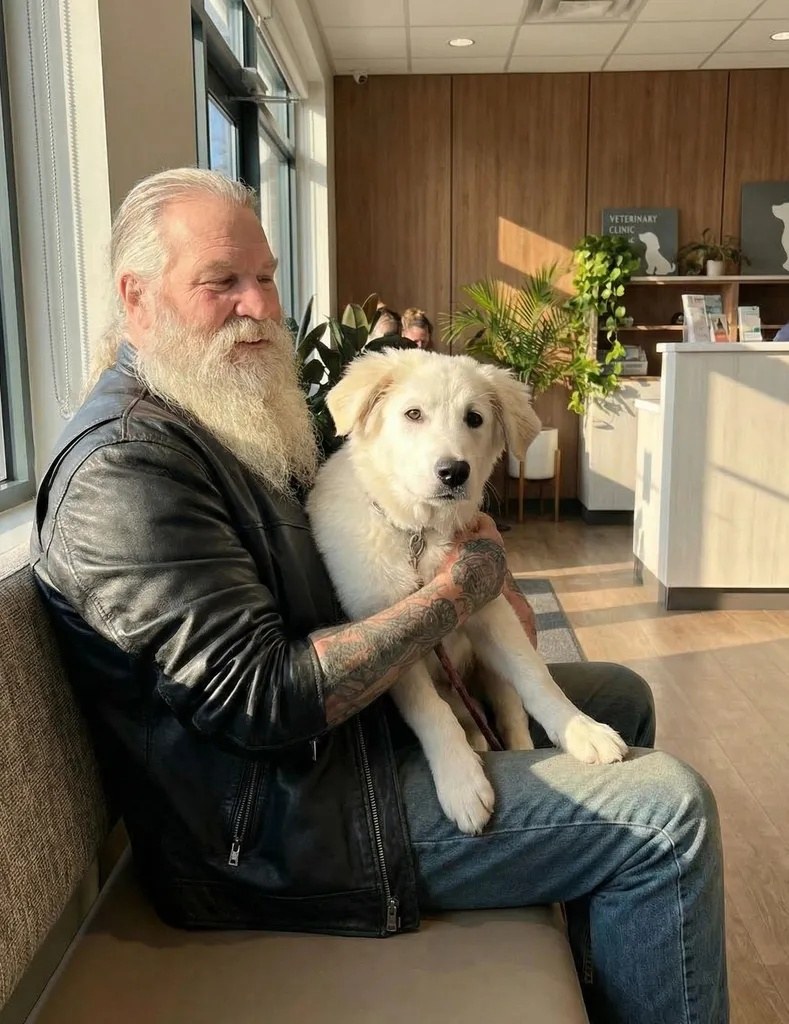
The staff moved quickly when they saw her. Oxygen. Pain relief. Gentle hands. The veterinarian explained the swelling could be a serious internal condition. Surgery might not be possible, but treatment could ease her pain and maybe give her more time. Time mattered.
While they worked, I sat nearby, staring at my grease-stained hands and thinking about a seven-year-old girl who believed angels came on motorcycles. I thought about the father mentioned in the note. I didn’t know his story, didn’t know what broke him enough to leave a family dog on a bridge instead of asking for help. All I knew was that a child had tried to buy hope with tooth fairy money.
Before dawn, Daisy was resting. Her breathing had steadied. The stuffed duck had been placed under her paw like a guard on duty. I left my number with the clinic and told them I’d cover whatever I could. Money felt small compared to what was at stake, but it was something.
Some debts are paid with cash. Others are paid with showing up.
Later that morning, after a few hours of restless sleep, I started making calls. Local shelters. Community boards. Animal rescue groups. I described Daisy, the notes, the stuffed duck. I didn’t want to take her away from Madison if there was any way to avoid it.
By early afternoon, my phone rang.
A woman on the other end sounded breathless. She explained that a little girl had been frantically searching online all night, convinced her dog had been stolen or killed. She had posted messages everywhere, begging anyone to tell her Daisy was alive.
We coordinated carefully. No blame. No drama. Just the goal of doing right by the child and the dog.
When Madison walked into the clinic room, she froze.
Daisy lifted her head.
Her tail wagged.
The sound Madison made wasn’t quite a sob and wasn’t quite a laugh. She ran forward, wrapping her arms around Daisy’s neck, pressing her face into warm fur like she was anchoring herself to the world. Daisy licked her cheek weakly, tail thumping harder now, like she’d been saving that strength just for this moment.
The room went quiet in that way where everyone is pretending not to cry.
Madison turned to me, eyes red, face serious in a way no seven-year-old should have to be. She hugged me tightly and whispered, “I knew an angel would come.”
I smiled and knelt to her level. “Sometimes angels just ride loud motorcycles,” I said.
The adults talked logistics. Care plans. Support. What came next. I stayed out of it, watching Daisy breathe, watching Madison stroke her ears, watching a story bend away from tragedy at the last possible moment.
That evening, I rode home under a rising sun, the road no longer empty but still quiet. The chain was fixed. The bike hummed steady beneath me. My jacket smelled like dog fur and antiseptic, and I didn’t bother cleaning it.
Kindness doesn’t always look grand. Sometimes it’s stopping when you hear a sound no one else does. Sometimes it’s reading a note written in crayon and deciding to believe in it. Sometimes it’s being exactly where you are, at exactly the wrong hour, and choosing not to look away.
That night changed nothing about the world at large. But it changed one little girl’s prayer into something real. And that was enough.