I slammed the biker’s face into the hood of my cruiser hard enough to dent the metal.
My knee was in his back, my full 220 pounds crushing him against the hot steel while I wrenched his arms behind him. I heard something crack—maybe his ribs, maybe something in his shoulder—and I didn’t care.
“You people think you own the road,” I snarled in his ear while blood dripped from his nose onto my police car.
He didn’t fight back. Didn’t resist. Just grunted in pain and said through gritted teeth, “Officer, I wasn’t speeding.”
“Don’t talk back to me.” I cranked his arm higher until I heard him gasp. “You were weaving. Reckless driving.”
That was a lie. He’d done nothing wrong. But I was Officer Marcus Chen, and I hated bikers with every fiber of my being.
My younger brother had been killed by a drunk biker when I was nineteen, and I’d spent twelve years as a cop making every biker I could find pay for it.
This particular biker—leather vest, gray beard, arms covered in tattoos—had committed no crime except riding past me on the highway. So I followed him for six miles until I could invent a reason to pull him over.
His name was James Sullivan. I charged him with crimes he didn’t commit. He spent the night in jail. His bike got impounded. And I went home feeling like I’d done my job.
Eighteen months later, my five-year-old daughter disappeared in a rainstorm. The massive search party found nothing. For forty-seven hours, I lived in hell while hundreds of volunteers combed 4,000 acres of forest.
The temperature dropped to thirty-eight degrees. Emma was wearing only a t-shirt and shorts. Every hour that passed made it less likely we’d find her alive.
On the second day, as the official search teams were talking about pulling back, I saw him. James Sullivan. Standing at the edge of the search perimeter with about thirty other bikers, all wearing leather vests, all soaked from the rain.
The man whose face I’d slammed into my car. The man I’d brutalized and falsely arrested.
He was holding a map and pointing to areas of the forest no one else knew existed.
But he wasn’t there to find my daughter, he was there for revenge. That’s what I thought after seeing him, but I was wrong.
The emergency call came on a Friday afternoon in October. My wife Lisa was hysterical on the phone. “Emma’s gone. Marcus, Emma’s gone. We were at the park and I turned around for one second and she’s gone.”
I was in my patrol car and at Henderson Park in four minutes. Lisa was surrounded by other parents, crying so hard she could barely breathe.
“She was on the swings. I was watching her. I looked at my phone for just a second to answer a text and when I looked up, she wasn’t there.”
Henderson Park backs up to 4,000 acres of state forest. Dense woods, steep ravines, abandoned logging roads. If Emma had wandered into those woods, she could be anywhere.
I called it in immediately. Within thirty minutes, we had forty officers, fifty volunteers, and three search and rescue teams combing the area.
Dogs tracked her scent to the tree line and then lost it in a creek. A helicopter with thermal imaging found nothing.
By nightfall, we had 200 people searching. By midnight, that number had doubled. The temperature was dropping fast—forecasted to hit thirty-eight degrees—and Emma was wearing only a t-shirt and shorts.
Lisa and I spent that first night at the command center, drinking coffee we couldn’t taste, staring at maps that meant nothing, waiting for news that didn’t come.
Every hour that passed made it less likely we’d find her alive. Five-year-olds don’t survive long alone in the wilderness.
“She’s scared of the dark,” Lisa kept saying. “She’s so scared of the dark, Marcus. She’s out there alone and scared and it’s dark.”
I held my wife and tried not to think about what animals lived in those woods. What could happen to a small child alone at night.
The second day brought rain. Cold, relentless rain that turned the forest floor into mud and made the search nearly impossible. The dogs couldn’t track. The helicopter couldn’t fly. We were running out of options.
That’s when I saw him. James Sullivan. Standing at the edge of the search perimeter with a group of about thirty other bikers, all wearing leather vests, all soaked from the rain.
My sergeant saw me staring. “Those bikers showed up about an hour ago. Said they heard about the missing girl on the news and wanted to help. I told them we had enough volunteers, but they said they know these woods better than anyone.”
I walked over to them, my stomach churning. James recognized me immediately. I saw something flicker in his eyes—fear, anger, I couldn’t tell.
“Officer Chen.” His voice was neutral, careful. “We’re here to help find your daughter.”
“Why?” The word came out harsher than I intended.
“Because a little girl is missing.” He held my gaze. “Because that’s more important than whatever history you and I have.”
One of the other bikers spoke up. “We’ve been riding these woods for twenty years. We know every trail, every shelter, every old cabin. We can cover ground the search parties can’t reach.”
The incident commander was hesitant. “These aren’t official search and rescue personnel. If something happens to them out there—”
“Let them search,” I said. “Please.”
James nodded. “We’ll cover the eastern quadrant. Old logging roads and hunting grounds. If she wandered that direction, we’ll find her.”
They left on their bikes, splitting into groups of three, heading into areas of the forest that weren’t on any official map. I watched them disappear into the rain and realized I was praying—praying that the man I’d brutalized would be the one to save my daughter.
Hour forty-three. No news. The rain got worse. The temperature kept dropping. The official search teams were talking about pulling back, regrouping, waiting for better weather. Nobody said what we were all thinking: we were searching for a body now, not a survivor.
Hour forty-five. My phone rang. Unknown number.
“Officer Chen, this is James Sullivan.” His voice was strained, breathless. “I found her. I found Emma. She’s alive.”
I actually fell to my knees. “Where? Where are you?”
“Three miles northeast of the park. Old hunting shelter, mostly collapsed. She’s hypothermic and scared but she’s breathing. I’ve got her wrapped in my jacket. We need medical immediately.”
“I’m sending coordinates to dispatch now.”
I could hear my daughter crying in the background. Then I heard James’s voice, gentle and soft: “It’s okay, sweetheart. Your daddy’s coming. You’re safe now. I’ve got you.”
The EMTs reached them eighteen minutes later. By the time Lisa and I got there, James was sitting on a fallen log, soaked to the bone, no jacket, shivering violently. Emma was being loaded into an ambulance, wrapped in thermal blankets.
But when Emma saw James start to walk away, she started screaming. “No! Mr. James! Don’t leave! Mr. James!”
The EMTs tried to calm her, but she was hysterical. James turned back, and Emma reached out her arms to him. “Please don’t go. Please. You promised you’d stay with me until my daddy came.”
James looked at me. I nodded, tears streaming down my face.
He climbed into the ambulance and sat next to Emma, and she immediately grabbed his hand. “You’re my best friend,” she said. “You saved me.”
“You saved yourself, little one,” he said gently. “You were so brave.”
At the hospital, the doctors said Emma had moderate hypothermia and severe dehydration, but she was going to be fine. She’d survived forty-seven hours in the wilderness because she’d found that old hunting shelter and stayed put. Smart kid. My smart, brave kid.
James was treated for exposure and released. When I found him in the waiting room, he was preparing to leave.
“Wait.” I walked up to him, and this big, tough biker looked at me warily. “Please. I need to talk to you.”
We sat in that waiting room, and I told him everything. About Danny. About the rage. About the guilt. About how I’d turned my brother’s death into an excuse to hurt innocent people.
“What I did to you was unforgivable,” I said. “I brutalized you. I falsely arrested you. I hurt you because of something you had nothing to do with. And then you… you saved my daughter.”
James was quiet for a long time. “I didn’t save her because of you. I saved her despite you.”
That hurt, but it was fair.
“But I also saved her because I know what it’s like to lose a child.” His voice cracked. “I had a daughter. Sarah. She died when she was six. Leukemia. I would have given anything—anything—for someone to save her. So when I heard your little girl was missing, I couldn’t not search. I had to try.”
I started crying. This man I’d hated, this man I’d hurt, had lost his own daughter and still spent two days in the rain searching for mine.
“I’m so sorry,” I whispered. “I’m so, so sorry.”
“I know you are.” He stood up. “Take care of your daughter, Officer Chen. You got a second chance. Don’t waste it.”
He started to walk away, and then I heard Emma’s voice from down the hallway. “Mr. James! Mr. James, where are you going?”
A nurse was wheeling Emma out in a wheelchair to take her for X-rays. The moment Emma saw James, she started reaching for him. “Don’t leave! You’re my best friend!”
James looked at me. I nodded. “Please. Stay.”
He knelt down next to Emma’s wheelchair. “Hey, brave girl. I’m right here.”
“Will you come visit me? Please? I want you to meet my stuffed animals. And I want to show you my drawings. And I want to hear more stories about motorcycles.”
James smiled, and it was the first real smile I’d seen from him. “If your parents say it’s okay, I’ll come visit.”
Emma looked at me with those big eyes. “Daddy, can Mr. James visit? Please? He’s my hero.”
“Yes, sweetheart. He can visit.”
That was three years ago. James has been to our house every Sunday since then. He comes for dinner, brings Emma small gifts—books, art supplies, stuffed animals. He taught her how to ride a bicycle. He helps her with her homework. He attends her school programs and her dance recitals.
Emma adores him. She calls him “Uncle James.” She draws pictures of him on his motorcycle. She tells everyone at school about her “biker best friend who saved her life.”
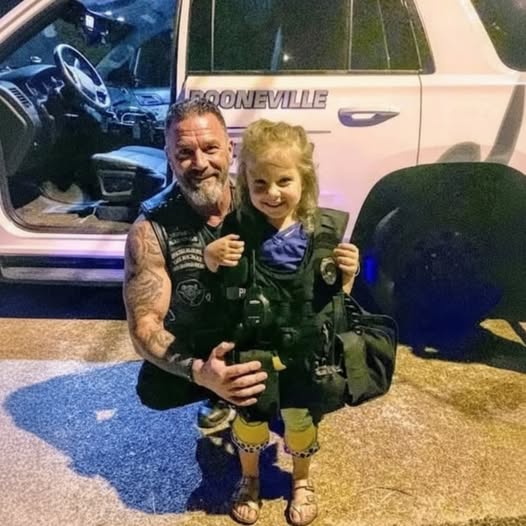
Last month was Emma’s eighth birthday. James showed up with a custom-made leather vest—child-sized, with patches that said “James’s Little Rider” and “Bravest Girl I Know.” Emma put it on immediately and refused to take it off for three days.
At the party, James pulled me aside. “I want you to see something.” He showed me his phone. It was a photo of a little girl with dark hair and a bright smile. “That’s Sarah. My daughter. She would have been twenty-one this year.”
“James, I—”
“Emma reminds me of her. That same fearlessness. That same joy.” His voice was thick with emotion. “I know I can never get Sarah back. But getting to be part of Emma’s life… it heals something in me I didn’t think could be healed.”
I hugged him. This man I’d hated. This man I’d hurt. This man who’d saved my daughter and forgiven me when I didn’t deserve forgiveness.
“You’re not just Emma’s best friend,” I told him. “You’re family. You’ll always be family.”
Lisa walked over with Emma, who was showing off her vest to anyone who would look. “Uncle James, take a picture with me! I want to show everyone at school!”
They posed together—this big, tattooed biker and my tiny daughter in her matching vest—and Emma was grinning like it was the best day of her life.
Later that night, after the party, after the guests had left, Emma climbed into my lap. “Daddy, I’m glad I got lost in the woods.”
“What? Sweetheart, why?”
“Because if I didn’t get lost, Mr. James wouldn’t be my best friend. And he’s the best best friend ever.”
She was right. In the worst moment of our lives, something beautiful had emerged. A friendship that transcended my hate, my prejudice, my cruelty. A friendship built on forgiveness and second chances and the simple truth that good people come in all forms—even in leather vests and on motorcycles.
I still have nightmares about those forty-seven hours. About what could have happened if James hadn’t searched those back trails. If he’d decided that finding my daughter wasn’t worth his time. If he’d let his justified anger at me override his compassion for a missing child.
But he didn’t. He searched anyway. He saved her anyway. He forgave me anyway.
And now, every Sunday when James walks through our door and Emma runs to him yelling “Uncle James!”, I’m reminded that the best people aren’t always the ones wearing badges. Sometimes they’re the ones we’re too blind to see.
Sometimes they’re the ones we hurt the most.
And sometimes, if we’re very lucky, they give us a second chance to see them clearly.
James Sullivan saved my daughter’s life. But more than that, he saved mine. He showed me what real strength looks like. What real forgiveness looks like. What real love looks like.
My brother Danny would have liked him. I’m sure of that now.
And Emma—my brave, beautiful Emma—she knows what I’m only beginning to understand: that family isn’t always blood. Sometimes it’s a biker with a gray beard and a leather vest who carried you through the woods when you were lost.
Sometimes it’s the person you wronged who becomes your greatest blessing.
Sometimes it’s the friend you never knew you needed until they saved everything you love.