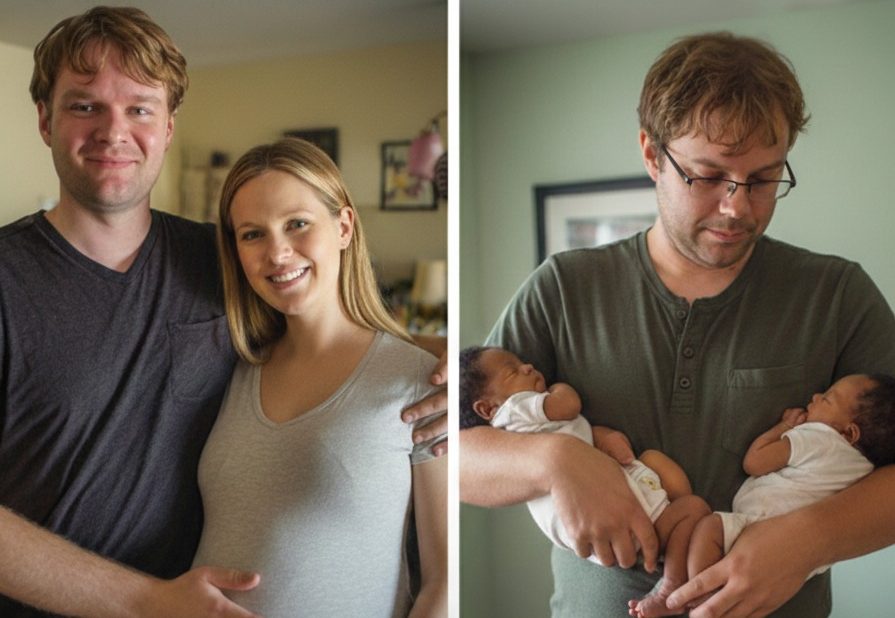
When I went to the hospital to bring my wife and our newborn twins home, I walked straight into devastation: Suzie was gone, leaving behind only a cryptic note. As I struggled to care for the babies and piece together the truth, I uncovered the dark secrets that had shattered my family.

As I drove to the hospital, balloons bounced gently in the passenger seat beside me. I couldn’t stop smiling. Today, I was bringing my girls home. I imagined Suzie’s face lighting up when she saw the nursery, the dinner I’d prepared, the photos I’d carefully framed for the mantel. After nine months of back pain, nausea, and an endless stream of opinions from my overbearing mother, she deserved happiness.
This moment felt like the reward for every dream I’d ever had for us. I waved to the nurses at the station as I hurried toward Suzie’s room. But the second I pushed open the door, my steps faltered.
My daughters were asleep in their bassinets—but Suzie was nowhere to be seen. At first, I thought she might have stepped out for air. Then I noticed the note. I ripped it open, my hands shaking.
“Goodbye. Take care of them. Ask your mother WHY she did this to me.”
My vision blurred as I read it again. And again. The words stayed exactly the same, refusing to soften. A chill crept over my skin, rooting me to the floor. What did she mean? Why would she… no. This wasn’t possible. Suzie was happy. She’d been happy. Hadn’t she?
A nurse with a clipboard walked in. “Good morning, sir, here’s the discharge—”
“Where’s my wife?” I cut in.
The nurse hesitated, chewing her lip. “She checked out this morning. She said you knew.”
“She—where did she go?” I asked, thrusting the note toward her. “Did she say anything else? Was she upset?”
The nurse frowned. “She seemed fine. Just… quiet. Are you saying you didn’t know?”
I shook my head. “She said nothing… just left me this note.”
I left the hospital in a haze, holding my daughters close, the note crushed in my fist. Suzie was gone. My wife. My partner. The woman I thought I knew had disappeared without warning. All that remained were two tiny girls, my broken plans, and that ominous message.
When I pulled into the driveway, my mom—Mandy—was waiting on the porch, smiling brightly and holding a casserole dish. The smell of cheesy potatoes drifted toward me, but it did nothing to calm the storm inside.
“Oh, let me see my grandbabies!” she cried, setting the dish down and hurrying over. “They’re beautiful, Ben, absolutely beautiful.”
I stepped back, gripping the car seat. “Not yet, Mom.”
Her smile faltered. “What’s wrong?”
I shoved the note at her. “This is what’s wrong. What did you do to Suzie?”

Her smile vanished. She took the note with trembling hands, her pale blue eyes scanning it. For a moment, she looked like she might collapse.
“Ben, I don’t know what this is about,” she said. “She’s… she’s always been emotional. Maybe she—”
“Don’t lie to me!” I shouted, my voice echoing off the porch. “You never liked her. You’ve always criticized her, undermined her—”
“I was only trying to help!” she cried, tears spilling down her face.
I turned away, my stomach twisting. I couldn’t trust her anymore. Whatever had happened between them had driven Suzie away, and now I was left to deal with the aftermath alone.
That night, after Callie and Jessica were settled in their cribs, I sat at the kitchen table with the note in one hand and a glass of whiskey in the other. My mother’s protests echoed in my head, but they couldn’t drown out the question looping endlessly: What did you do, Mom?
I replayed family gatherings in my mind—the subtle jabs my mother aimed at Suzie. Suzie had laughed them off, but now I could see, too late, how deeply they must have hurt.
I started searching—literally and figuratively.
As I went through Suzie’s things, my grief only deepened. I found her jewelry box in the closet and moved it aside, then noticed a slip of paper tucked beneath the lid. When I pulled it out, my heart slammed in my chest.
It was a letter, written in my mother’s handwriting.
“Suzie, you’ll never be good enough for my son. You’ve trapped him with this pregnancy, but don’t think for a second you can fool me. If you care about them, you’ll leave before you ruin their lives.”
My hand shook as I dropped the letter. This was it. This was why she’d left. My mother had been poisoning her behind my back. Every dismissed moment came rushing back. How had I been so blind?
It was nearly midnight, but I didn’t care. I went to the guest room and pounded on the door until my mom opened it.
“How could you?” I thrust the letter at her. “I thought you were just overbearing—but you’ve been bullying Suzie for years, haven’t you?”
Her face drained of color as she read. “Ben, listen—”
“No,” I snapped. “You listen. Suzie left because of you. Because you made her feel worthless. And now she’s gone, and I’m raising two babies alone.”
“I only wanted to protect you,” she whispered. “She wasn’t good enough—”
“She’s the mother of my children! You don’t get to decide who’s good enough for me or them. You’re done here, Mom. Pack your things. Leave.”

Her tears fell freely. “You don’t mean that.”
“I do,” I said coldly.
She started to argue, then stopped. Whatever she saw in my eyes told her I wasn’t bluffing. An hour later, her car disappeared down the street.
The following weeks were brutal. Sleepless nights, endless diapers, constant crying—sometimes from the babies, sometimes from me—left little room to think.
But in every quiet moment, Suzie haunted my thoughts. I called her friends and family, desperate for any clue. None had heard from her. Until her college friend Sara hesitated on the phone.
“She felt… trapped,” Sara admitted. “Not by you, Ben, but by everything. The pregnancy. Your mom. Mandy told her once the twins would be better off without her.”
The words cut deep. “Why didn’t she tell me?”
“She was scared,” Sara said softly. “She thought your mom would turn you against her. I told her to talk to you, but…” Her voice cracked. “I should’ve pushed harder.”
“Do you think she’s okay?”
“I hope so,” Sara replied. “Suzie’s stronger than she knows. But Ben… don’t stop looking for her.”
Weeks became months.
One afternoon, while Callie and Jessica napped, my phone buzzed. An unknown number.
When I opened it, my breath caught. It was a photo of Suzie holding the twins at the hospital, her face pale but peaceful. Below it read:
“I wish I was the type of mother they deserve. I hope you forgive me.”
I called immediately. No connection. I texted back. Nothing. It felt like shouting into emptiness. But the photo reignited my resolve. Suzie was alive. A part of her still wanted us. I refused to give up.
A year passed with no answers. The twins’ first birthday was bittersweet. I’d poured everything into raising them, but the ache for Suzie never faded.
That evening, as the girls played on the floor, someone knocked at the door.
At first, I thought I was imagining it. But there she was—Suzie—standing on the porch with a small gift bag, tears filling her eyes. She looked healthier, stronger, yet the sadness still lingered behind her smile.
“I’m sorry,” she whispered.
I didn’t think. I pulled her into my arms, holding her as tightly as I dared. She sobbed against me, and for the first time in a year, I felt whole.

In the weeks that followed, Suzie told me everything—how postpartum depression, my mother’s cruelty, and her own feelings of inadequacy had overwhelmed her. Leaving had felt like the only way to protect the twins and escape the spiral. Therapy helped her rebuild, step by step.
“I didn’t want to leave,” she said one night, sitting on the nursery floor while the girls slept. “But I didn’t know how to stay.”
I squeezed her hand. “We’ll figure it out. Together.”
And we did. It wasn’t easy—healing never is. But love, resilience, and the shared joy of watching Callie and Jessica grow helped us rebuild what we almost lost.