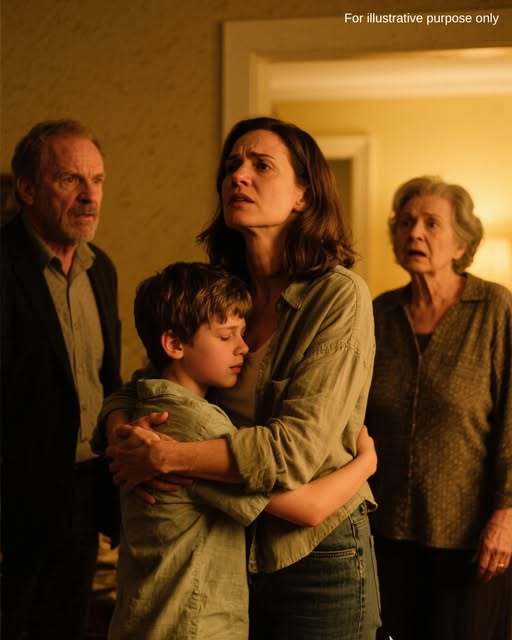
My parents walked into the house like they were in a daze. For the first five minutes, they didn’t say a word—just stared at Leo, their faces drained of color. Leo sat quietly on the couch, legs neatly together, looking back and forth between them and me.

My father was the first to speak. “He looks… familiar.”
“He should,” I replied, my voice calm. “Because you know his father.”
My mother blinked in confusion. “What are you talking about? Who is he?”
I fixed my gaze on my dad. “Do you remember Robert Keller?”
His expression shifted in an instant.
Robert Keller had been my father’s business partner, a family friend. He’d come over for dinner often. Fifteen years older than me. Always smiling. Always taking an interest in my schoolwork, my hobbies—more than a friend should.
“You’re lying,” Dad whispered.
“No, I’m not.”
I pulled a folder from my bag and set it on the table. Inside were legal papers: DNA test results, notarized statements, a sealed court file.
“I didn’t tell you before because I was scared. I knew how you’d react. I knew you’d protect your reputation, your business. Not me.”
My mother gasped, her hand over her mouth. “Oh my god…”
“I met with a lawyer a year after Leo was born. But I never pressed charges. I didn’t want to drag Leo through that. I just wanted to survive.”
“But he…” Dad’s voice wavered. “He was my friend.”
“Exactly,” I replied. “He was your friend. Not mine.”
He slumped back into the armchair like he’d been punched.
“You threw me out,” I said, bitterness creeping into my words. “You called me a liar. You threatened me. But you never once asked why I couldn’t say who the father was.”
Leo looked at me, confused. “Mom?”
I gently touched his shoulder. “You’re safe, baby. None of this is your fault.”
My mother turned to my father. “We… we have to do something. Apologize. Make this right.”
He shook his head slowly. “How? Ten years? I kicked out my daughter while her abuser stayed my friend.”
The weight of shame hung thick in the room. I hadn’t come for revenge, but I wasn’t going to sugarcoat the truth.
“I’m not here for an apology,” I said. “I just wanted you to meet your grandson—and understand why you lost ten years of his life.”
The hours that followed were a blur—tears, apologies, disbelief. My mother cried for nearly half an hour straight. My father didn’t shed a tear, but he looked ten years older by the time we left that evening.
They begged us to stay overnight. I refused.
But Leo… Leo hugged them both before we left.

That boy had more grace than I ever could have imagined.
Over the next few months, things changed, but slowly. My mother called. Then my father sent a letter. Then came pictures, gifts for Leo, requests to visit. At first, I resisted. I had learned to live without them. But Leo wanted a relationship—and I wasn’t going to deny him the chance if they were genuinely remorseful.
Eventually, I allowed supervised visits. My father, now retired, seemed humbled. He told Leo stories about fishing, took him to minor league baseball games, helped him with his math homework. My mother knitted him a scarf for winter and made hot cocoa, just like she used to make for me.
Still, I never forgot.
Robert Keller disappeared shortly after I filed the report years ago. He left the state, shut down the business. Word was, he’d remarried. I didn’t pursue it. I just wanted him gone.
Then one afternoon, my father handed me a newspaper clipping.
“Keller passed away. Heart attack. Age 59,” he said quietly.
I felt nothing. Not relief. Not closure. Just… nothing.
Because closure didn’t come with his death—it came from finally being believed.
Leo grew up knowing the truth: that he was wanted, that he was never a mistake, and that his mother fought for him when no one else would.

When he turned eleven, he asked me, “Would you do it all over again, even if they kicked you out?”
I didn’t hesitate. “Yes. A hundred times over.”
And for the first time, I think my father truly understood the cost of silence.