I watched rich people mocking an old biker for counting coins to pay for his coffee, and I recorded the whole thing on my phone.
What they didn’t know was that I recognized the patches on his vest. And those patches told a story that would destroy every person laughing at him.
It was a Sunday morning at The Golden Beanery, one of those overpriced coffee shops where a latte costs eight dollars and the customers wear watches worth more than my car. I was there because my boss insisted on meeting at “his spot.” I was early. He was late. So I sat in the corner and watched.
The old biker walked in around 9 AM.
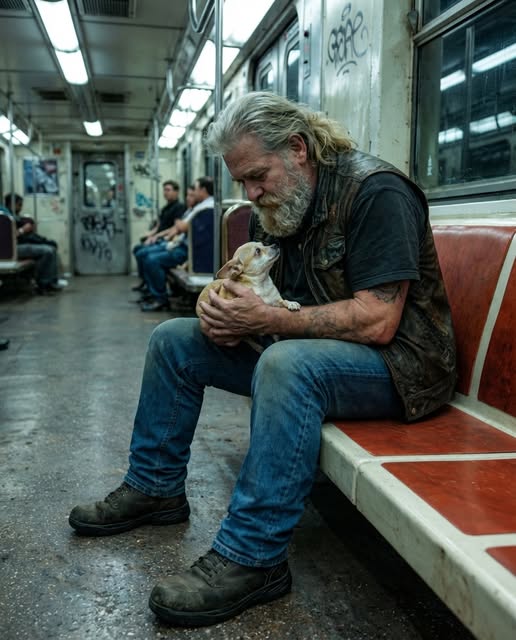
He looked out of place immediately. Worn leather vest covered in patches. Faded bandana. Boots that had seen decades of roads. His beard was gray and long, his face weathered like old leather.
The barista’s smile tightened when she saw him.
“Can I help you?” Her voice had that fake politeness that really means “why are you here?”
“Just a small black coffee, please.” His voice was quiet. Humble.
“That’ll be four seventy-five.”
The old man reached into his pocket and pulled out a handful of change. Quarters, dimes, nickels, pennies. He started counting them out on the counter, one by one, his arthritic fingers moving slowly.
That’s when the laughter started.
A group of four sat at the table nearest the counter. Two men in golf shirts, two women dripping with jewelry. They’d been loudly discussing their vacation homes and stock portfolios since I arrived.
“Oh my God,” one of the women whispered loudly. “Is he seriously paying in pennies?”
“Someone should tell him the homeless shelter is down the street,” one of the men snickered.
The old biker heard them. I saw his shoulders tense. But he kept counting.
“Four twenty-five… four thirty… four thirty-five…”
“This is painful to watch,” the other woman said. “Some people shouldn’t go out in public if they can’t afford it.”
The barista looked uncomfortable but said nothing.
“Four fifty… four sixty…”
One of the men stood up and walked toward the counter. He was maybe fifty, tan, wearing a polo shirt with some country club logo.
“Hey buddy, let me help you out.” He pulled out his wallet and made a big show of rifling through hundred dollar bills. “I’ve got plenty of money. Unlike some people.”
His friends burst out laughing.
The old biker stopped counting. He looked up at the man with eyes that held something I recognized. Something dangerous. But also something tired. Defeated.
“I can pay for my own coffee,” he said quietly.
“Clearly you can’t. What’s the matter? Social security check didn’t come this month?” More laughter from the table.
“Maybe he spent it all on that ridiculous costume,” one of the women added. “What are you supposed to be, a Hell’s Angel? Little old for that, aren’t you?”
I’d been recording since the man approached the counter. I don’t know why. Something told me this moment needed to be documented.
The old biker’s hands were shaking now. Not from weakness. From restraint.
“I’m just trying to buy a cup of coffee,” he said.
“Then buy it and get out. Some of us are trying to enjoy our morning without looking at… whatever you are.”
The barista finally spoke up. “Sir, if you can’t pay, I’m going to have to ask you to step aside.”
The old biker looked at her. Then at the rich people laughing. Then at the coins spread across the counter.
He started gathering them up. Putting them back in his pocket. His head was down. Shoulders slumped.
He was going to leave without his coffee.
That’s when I stood up.
“Stop.”
Everyone turned to look at me. I walked toward the counter, still recording.
“I’ll pay for his coffee,” I said to the barista. Then I turned to the group of rich people. “And you should be ashamed of yourselves.”
The country club man laughed. “Oh great, another bleeding heart. What, is this your dad? Your dealer?”
“Do you know who this man is?” I pointed at the old biker. “Do any of you have any idea who you’re laughing at?”
“Some broke old biker who can’t afford coffee,” one of the women said. “What’s to know?”
I looked at the old man’s vest. At the patches I’d recognized the moment he walked in.
“That patch on his chest? The one with the eagle and the rifle? That’s a Combat Infantryman Badge. It means he saw direct ground combat with enemy forces.”
The laughter stopped.
“That patch below it? Purple Heart. He was wounded in action. Bled for this country.”
The country club man’s smile faded slightly.
“The one on his shoulder? That’s the 101st Airborne Division. The Screaming Eagles. One of the most decorated units in American military history.”
I pointed to another patch.
“POW/MIA. You Never Forgotten. That means he either was a prisoner of war or he honors those who were. My guess, based on that patch next to it—the one that says ‘Hanoi Hilton Survivor’—is that he spent time in a Vietnamese prison camp.”
The café had gone completely silent.
I turned to the old biker. “Sir, am I reading your patches correctly?”
He looked at me for a long moment. Then nodded slowly.
“Five years, three months, and eleven days,” he said quietly. “That’s how long they held me. Bamboo cages. Beatings. Torture.” He paused. “I weighed 89 pounds when they released me. I was twenty-six years old and looked like I was sixty.”
I turned back to the rich people. Their faces had gone pale.
“This man was tortured for five years so people like you could sit in overpriced coffee shops and mock strangers.”
“We didn’t know—” one of the women started.
“Would it matter if he wasn’t a veteran?” I cut her off. “Would it be okay to humiliate him then? An old man counting coins to buy coffee? That’s who you choose to laugh at?”
Nobody answered.
“He’s not counting coins because he’s poor,” I continued. “He’s counting coins because that’s the money left over after he paid for his wife’s chemotherapy this month. Or his grandkid’s school supplies. Or his mortgage on a fixed income. You don’t know his story. You didn’t bother to find out.”
The country club man cleared his throat. “Look, we were just joking around—”
“You were being cruel. There’s a difference.”
I turned to the barista. “His coffee is on me. And I’d like to buy him breakfast too. Whatever he wants.”
She nodded quickly, clearly relieved to have something to do besides stand there awkwardly.
The old biker put his hand on my arm. “Son, you don’t have to do this.”
“I know I don’t have to. I want to.”
He studied my face. “You military?”
“My grandfather was. 82nd Airborne. Normandy.”
He smiled for the first time. “Good division. Damn good division.” He extended his hand. “Name’s Walter. Walter Hendricks.”
“James Mitchell. It’s an honor to meet you, sir.”
We shook hands. His grip was stronger than I expected.
“Would you like to join me for coffee, James? Since you’re buying and all.” There was a hint of humor in his voice.
“I’d like that very much.”
We sat at a table by the window. The barista brought Walter his black coffee and a full breakfast—eggs, bacon, toast, hash browns. She refused to let me pay.
“It’s on the house,” she said quietly. “I’m sorry I didn’t say something sooner.”
Walter waved his hand. “You’re young. It’s hard to stand up when everyone’s sitting down. I understand.”
The group of rich people left shortly after. They didn’t apologize. Didn’t look at us. Just gathered their things and slunk out like kicked dogs.
I stopped recording but kept my phone on the table.
“You got all that on video?” Walter asked.
“Yeah. I’m sorry, I should have asked—”
“Don’t be sorry. I’m glad you did.” He took a sip of his coffee. “Maybe it’ll teach someone something.”
“Can I ask you something, Walter?”
“Shoot.”
“Why didn’t you say anything? When they were mocking you? You could have told them who you are. What you did.”
Walter set down his coffee cup and looked out the window. His eyes were distant, seeing something far beyond the parking lot.
“Son, I spent five years in a cage being told I was worthless. Being beaten and starved and broken down to nothing. And you know what I learned?”
I shook my head.
“I learned that my value doesn’t depend on what other people think of me. Those people laughing at me—they can’t take anything from me that hasn’t already been taken. They can’t hurt me. They can only show me who they really are.”
He turned back to me.
“I don’t need to prove myself to strangers. I know what I did. I know what I survived. And I know that I’d rather be a broke old biker counting coins than a rich man with a bankrupt soul.”
We sat in silence for a moment. Then I asked the question I’d been wondering since he walked in.
“Walter, why were you counting coins? If you don’t mind me asking.”
He smiled. “You want the truth?”
“Please.”
“My grandson gave me his piggy bank last week. He’s seven years old. Heard me telling my daughter that money was tight this month. Medical bills.” He pulled out a handful of coins. “He handed me his whole savings and said ‘Grandpa, you helped me my whole life. Now I help you.’”
His eyes got wet.
“Thirty-seven dollars and forty-two cents. That’s what that little boy had saved up. And he gave it all to me.” He shook his head. “I couldn’t not use it. Couldn’t let his gift mean nothing. So I’ve been spending it a little at a time. Coffee here. Bread there. Making his sacrifice count for something.”
I had to look away. Had to stare at the ceiling and blink fast.
“Those rich people thought I was pathetic, counting coins like a beggar,” Walter continued. “But those coins are worth more than everything in their wallets. Because those coins are love. That’s what my grandson gave me. Love.”
I couldn’t speak. My throat was too tight.
“James, can I tell you something?”
I nodded.
“You standing up for me today—that meant something. Not because I needed defending. But because it showed me that there are still good people in this world. People who will speak up when it’s easier to stay quiet. My generation is dying off. We worry about what we’re leaving behind. Today you showed me that maybe things will be okay.”
“Walter, I didn’t do anything special. I just—”
“You just did what most people won’t. That’s special enough.”
We talked for two more hours. Walter told me about Vietnam. About the prison camp. About coming home to a country that spat on him and called him a baby killer. About finding brotherhood in motorcycle clubs when his own family couldn’t understand what he’d been through.
He told me about his wife, Margaret, who’d stood by him through fifty-three years of nightmares and flashbacks and therapy. About his daughter who checked on him every day. About his grandson who gave him a piggy bank full of love.
“I’ve had a good life,” he said. “Hard, but good. And I’ve learned that the people who judge you the fastest are usually the emptiest inside. Those folks at that table? They’re not happy. You can’t be happy and that cruel at the same time. Something’s broken in them.”
“You almost sound like you feel sorry for them.”
“I do. They’ll never know what it’s like to count coins from their grandson’s piggy bank and feel like a millionaire. They’ll never know that kind of love.” He finished his coffee. “That’s the real poverty, James. Not empty pockets. Empty hearts.”
When we finally got up to leave, Walter shook my hand again.
“You gonna do something with that video?”
“I don’t know. What do you want me to do?”
He thought for a moment. “Post it. Let people see. Not to shame those folks—they’ll have to live with themselves, and that’s punishment enough. But to remind people that you never know someone’s story just by looking at them.”
“You sure?”
“I’m sure. Maybe it’ll make one person think twice before they laugh at a stranger. That’d be enough for me.”
I posted the video that night. It went viral within two days. Fourteen million views. News stations picked it up. Walter became an internet sensation—the Vietnam POW hero who was mocked for counting coins.
The outpouring was overwhelming. People sent money, which Walter donated to veterans’ organizations. People sent letters thanking him for his service. A major motorcycle company gave him a brand new bike. His grandson’s elementary school invited him to speak to the students about courage and kindness.
The rich people from the coffee shop? They were identified by internet sleuths. Their employers saw the video. Their country clubs saw the video. Their families saw the video.
I don’t know what happened to them. I don’t care.
What I care about is what Walter said to me the last time we met.
“James, you know what the best part of all this is?”
“What’s that?”
“My grandson saw the video. Saw all those millions of people standing up for his grandpa. And he said to me, ‘See Grandpa? I told you my coins were special.’”
Walter wiped his eyes.
“He was right. Those coins were special. Because they led to you. And you led to all of this.” He gestured at the pile of letters on his kitchen table. “Funny how the universe works, isn’t it?”
Yeah. Funny how the universe works.
An old biker counting coins. A group of cruel strangers. A video that shouldn’t have mattered but did.
And somewhere in all of that, a reminder that everyone has a story. Everyone has value. Everyone deserves to buy a cup of coffee without being humiliated.
Walter passed away eight months later. Peacefully, in his sleep, with Margaret holding his hand.
His funeral was massive. Over five hundred motorcycles escorted him to the cemetery. Veterans from three different wars stood at attention. His grandson placed thirty-seven dollars and forty-two cents in coins on top of his casket.
“For coffee in heaven, Grandpa,” the little boy said.
I still have the video on my phone. I watch it sometimes when I need to remember why kindness matters. Why standing up matters. Why you should never, ever judge someone by how much money they have or what they look like.
Walter taught me that.
An old biker counting coins in a coffee shop.
The richest man I ever met.