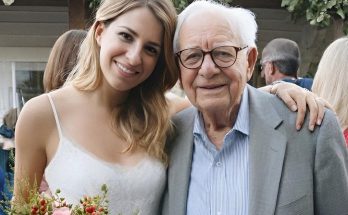
Due to financial difficulties, I had no choice but to marry a wealthy old man. But on the first night of our marriage, he shocked me by saying nothing would happen between us—he only wanted to watch me sleep.
The situation was so dire that the very thought of marrying an elderly rich man disgusted me. However, due to my father’s debts, the bank had seized our home, and we were left with nowhere to go. We were desperate.

A distant relative—an elderly man in his seventies, whose wife had passed away years ago—offered to help. He promised to pay off some of our debts, provide us with a home, and cover my father’s medical expenses. We were ready to bow to him in gratitude.
But this “generosity” came with a strange and revolting condition: I had to marry him. What could be more unbearable for a young girl? Yet, I reluctantly agreed—for the sake of my father, for the family—thinking that he was much older than me, would not live long, and at least we’d be safe.
The first night of our marriage, I was terrified. I sat at the edge of the bed, knees pressed to my chest, shaking uncontrollably. The thought of what might happen when the door opened made my soul tremble.
Then the door opened. He entered slowly, with heavy steps, a strange, lost look on his face. He held a chair in his hand. He placed the chair by the bedside, sat down, and said in a calm voice, as though it were completely normal:
“Nothing will happen between us tonight. You go to sleep.”
I stammered, “And you… will you sleep here?”
“No,” he replied. “I want to watch you sleep.”
It felt like blood had frozen in my veins. What did that mean? Was he crazy? Was he some kind of freak? But I was so exhausted, and I knew I had to appear normal in front of my father the next morning. So, I lay down without taking off my wedding dress.
When I woke up the next morning, he was gone.
The same thing happened the next night. He brought the chair, sat silently, watching me without blinking, as if waiting for me to fall asleep. The third night—nothing changed.
I began to believe my husband was insane, hiding some dark secret, and I couldn’t understand what he wanted.
On the fourth night, something happened that froze me with terror.
I had just fallen asleep when I suddenly felt movement next to me. Heavy breathing, a growling sound near my ear—I woke up startled. When I opened my eyes, he was right in front of me—so close I could smell his old perfume. But what terrified me even more was what he was doing…
I couldn’t scream. The voice was stuck in my throat. My husband was bent over me, his eyes focused on my eyelids as if he were counting my breaths. His fingers trembled, but they didn’t touch me. He was just… watching. For a moment, I felt as though he were listening to something—my heartbeat, or perhaps something from another world.
“What are you doing?” I whispered, my voice breaking.
He flinched, as though caught in the act, and quickly backed off. “Sorry,” he said, “I woke you.”
I sat up, the room suddenly cold. “You said… you would just sit in the chair.”
He lowered his gaze. “I didn’t lie. Today… Today was different.”
That night we sat in silence. I huddled in the far corner of the bed, and he sat in the chair, still and watchful. When the sun rose, he disappeared again. During the day, the house staff seemed afraid of him, but when they spoke to me, they bowed their heads, saying nothing. It was as if everyone in the house had made a silent agreement to remain quiet.
On the fourth day, I couldn’t take it anymore. “Why do you watch me sleep?” I asked.
He stood by the window, the mango trees outside swaying in the breeze. “Because if I don’t watch,” he said softly, “something very bad could happen.”
“Something bad… with me?” I asked.
“With both of us,” he answered.
His response was filled with more fear than truth. That night, I pretended to sleep. I kept my eyes shut, but I was wide awake. In the middle of the night, I felt it again—his presence. But this time, he didn’t come closer. He didn’t pull the chair up. He sat on the floor, as if standing guard.
“Are you afraid?” I asked suddenly.
He hesitated. “Yes.”
“Afraid of what?”
“Not of you,” he said, “but of your past.”
Gradually, the layers began to peel away. He explained that his wife had died in her sleep. Doctors said it was a heart attack, but he knew the truth was different. “She would wake up at night,” he told me, “with her eyes open but not seeing. It was as though someone else was controlling her.”
A chill ran through me. “And you?”
“I fell asleep,” he said. “When I woke up… it was too late.”
After that night, he became even more vigilant. The medicine cabinets were locked, the bells on the doors were silenced, and the windows latched. I began to feel as though I were living in a fortress.
“Do you think I will…” I asked one day.
He cut me off. “No. But fear has no logic.”
One evening, I went through some old files in his room—medical reports, notes, and a diary. I didn’t open it, but on the last page, a sentence caught my eye: “If he smiles while sleeping, the danger is over.”
I stopped breathing.
That night I had a dream—I was walking down a long corridor, and someone was calling my name from behind. I ran, but my legs felt heavy. I suddenly fell—and woke up.
He was there. “It’s okay,” he said. “You were smiling.”
“How do you know?”
“I saw,” he said. For the first time, I heard relief in his voice.
Days went by. The fear began to feel like a habit, and the habit gave way to a strange sense of security. I saw him change too. His hardness began to soften. He’d talk to me over books, listen to old songs, and sometimes—even laugh.
“You ever tell me the truth?” I asked one day. “Did you marry me just because of this fear?”
He stayed silent for a moment before answering, “I married you because I had to save someone… and someone told me that your dreams are clear.”
“Who?” I asked.
“A doctor,” he replied. “Who is no longer with us.”
The first jolt of truth came when one night I sleepwalked. I don’t remember, but in the morning, the servant told me I had been standing by the stairs. He had been holding me, drenched in sweat.
“See?” he said. “I wasn’t wrong.”
I was terrified—not just by him, but by something hidden within me. But there was also a new kind of confidence in that fear—he wouldn’t let me fall.
“Why don’t you sleep?” I asked.
“Because if I fall asleep,” he said, “history will repeat itself.”
One night, the power went out. In the dark, I reached out for his hand—for the first time. He didn’t pull away.
“What if I’m afraid?” I whispered. “What if?”
“I’ll keep watching,” he said. “Until morning.”
In that darkness, he revealed another secret. He was sick. Time was running out. “I didn’t want to leave you alone,” he said. “In this house… in this world.”
Tears welled in my eyes. “So you bought me?”
“No,” he said. “I entrusted you with my greatest fear.”
That night, nothing happened—and yet everything changed. A bridge was built between fear and trust.

The next morning, he said, “If you want, you can leave.”
I nodded. “Not yet.”
After that, the events intensified. The doctor came. Treatment began. New rules were set in place. And one day—the night never came.
I stayed awake. The bells were silent. The doors locked.
The next morning, the news came—he had been admitted to the hospital.
The sterile white walls of the hospital felt like a prison. The beeping of machines, the smell of medications, and the frantic footsteps only added to the anxiety. When I reached his room, he was unconscious, older, and more exhausted than ever.
The doctor called me out of the room.
“His condition is critical,” she said. “Both his heart and his mind are affected. The question is: who are you?”
I paused for a moment before answering. “I’m his wife.”
It was then that I realized—this wasn’t just about a piece of paper.
I sat in the same chair he had occupied for countless nights, watching me sleep. For the first time, the roles were reversed. Now I was the one watching him, counting his breaths.
“If you can hear me,” I said softly, “then know… I’m scared. Just like you were.”
He didn’t wake for three days. On the fourth day, his fingers twitched. His eyes opened.
“Were you sleeping?” was the first thing he asked.
Tears filled my eyes. “No,” I said. “Now it’s my turn to watch.”
He gave a weak smile. “The danger is over.”
“Do you still believe that?”
“Fear… it doesn’t leave easily,” he said.
While in the hospital, I learned the truth that changed everything. A nurse stopped me one day.
“You weren’t told everything,” she said.
She showed me old records. His first wife’s death was not an accident. She had fallen from the roof while sleepwalking. Before that—three times, she had survived. Every time, the same man had caught her.
“He stayed awake while she slept,” the nurse said. “People thought he was strange. But the truth is—he was her guard.”
My hands began to tremble.
“So… she married me…”
“To save you,” the nurse said. “And also to punish himself.”
When he returned home, he was no longer the same. He was quieter, more vulnerable. He didn’t sit in the chair anymore. He slept by the door, away from the bed.
“Now I don’t need to watch,” he said. “You’re safe.”
But I knew—he wasn’t okay.
One night, feverish and delirious, he muttered:
“Don’t go… watch… smile…”
I took his hand. “I’m here.”
He opened his eyes. For the first time, he saw me without fear.
“You must hate me,” he said.
“Maybe I would have left earlier,” I said, “but not anymore.”
The next shock came when I discovered the cause of my sleepwalking. The doctor explained that I had suffered childhood trauma, repressed. My husband had known it long before I did.
I stayed up late that night. For the first time, there was no fear—only regret.
“Why didn’t you tell me?”
He gazed out the window. “Because if I had, you would have run away.”
“And now?”
“It’s too late,” he said.
His condition worsened. One evening, he said, “If I leave…”
“Don’t say that,” I interrupted.
“Listen,” he insisted. “Sell the house. Take your father. Start a new life.”
“And you?”
He didn’t respond.
That night, as he slept, I sat in the chair again. Just as I had on that first night—watching him. Then I saw it—he was smiling.
I understood. The danger was no longer mine. He was finally at peace.
The next morning, he said to me:
“I’ve made my decision.”
“What is it?”
“I will no longer live in fear.”
He continued treatment. Surgery was scheduled. It was risky, and we waited for hours.
The doctor came out with a smile.
“He made it,” she said.
I cried. At that moment, I understood—this marriage was not a deal. It was the healing of two broken people.
But the story didn’t end there. The real test was yet to come—when the past would return for the final time.
When he came home from the surgery, he was no longer the man who had sat in that chair, watching me sleep. His body was frail, but for the first time, there was peace in his eyes. The house, too, had changed. The walls seemed to breathe a sigh of relief. The bells were gone, the windows left open, and the darkness no longer felt like an enemy.
But the past doesn’t let go so easily.
One night, I had the same dream again—a long corridor, a voice calling from behind, heavy footsteps. The only difference was that this time, I didn’t fall. I stopped. I looked back.
And I saw myself.
I screamed and sat up. He woke immediately.
“I saw something,” I whispered, trembling.
He nodded. “I knew. It had to happen today or tomorrow.”
He revealed the truth—the whole truth. After his first wife’s death, he cursed himself, punished himself, and made fear his religion. That fear led him to the doctors, to the records, and finally… to my dreams.
“I thought,” he said, “that if I stayed awake, death could be beaten.”
“And now?” I asked.
“Now I understand,” he said, looking at me, “that it’s not by staying awake—by standing together, that we win.”
The next night, what he had feared came to pass. I sleepwalked again. I walked toward the stairs. But this time, he wasn’t sitting in the chair. He was standing in front of me.
“Wait,” he said.
I stopped.
My eyes were open, but I wasn’t fully conscious.
“Are you afraid?” he asked.
I nodded.
“Look,” he said. “I’m afraid too.” And yet, I’m still standing.
He took my hand—firmly but gently.
And something broke. Inside me.
I fell—but not to the ground this time. In his arms.
After that night, I never sleepwalked again.
The doctors said it was the last clash of the mind—between fear and trust. And trust had won.
Months later, he asked me again:
“Do you want to be free?”
I smiled. “I already am.”
We sold the big house. My father’s treatment was completed. We moved to a small town—where no one knew us. There were no chairs, no guards. There was just one bed—and two people.
For the first time, we both slept at the same time.
Years later, when he passed away—in his quiet sleep—I sat beside him. I saw him. He was smiling.
This time, there was no fear.
I knew—the danger was truly over.
The lesson was simple, but costly:
Sometimes, the man who seems the strangest is the one who is protecting you the most.
And sometimes, you need to hold someone’s hand to face fear—not run away from it.
I found him in the deal.
But lost in love.