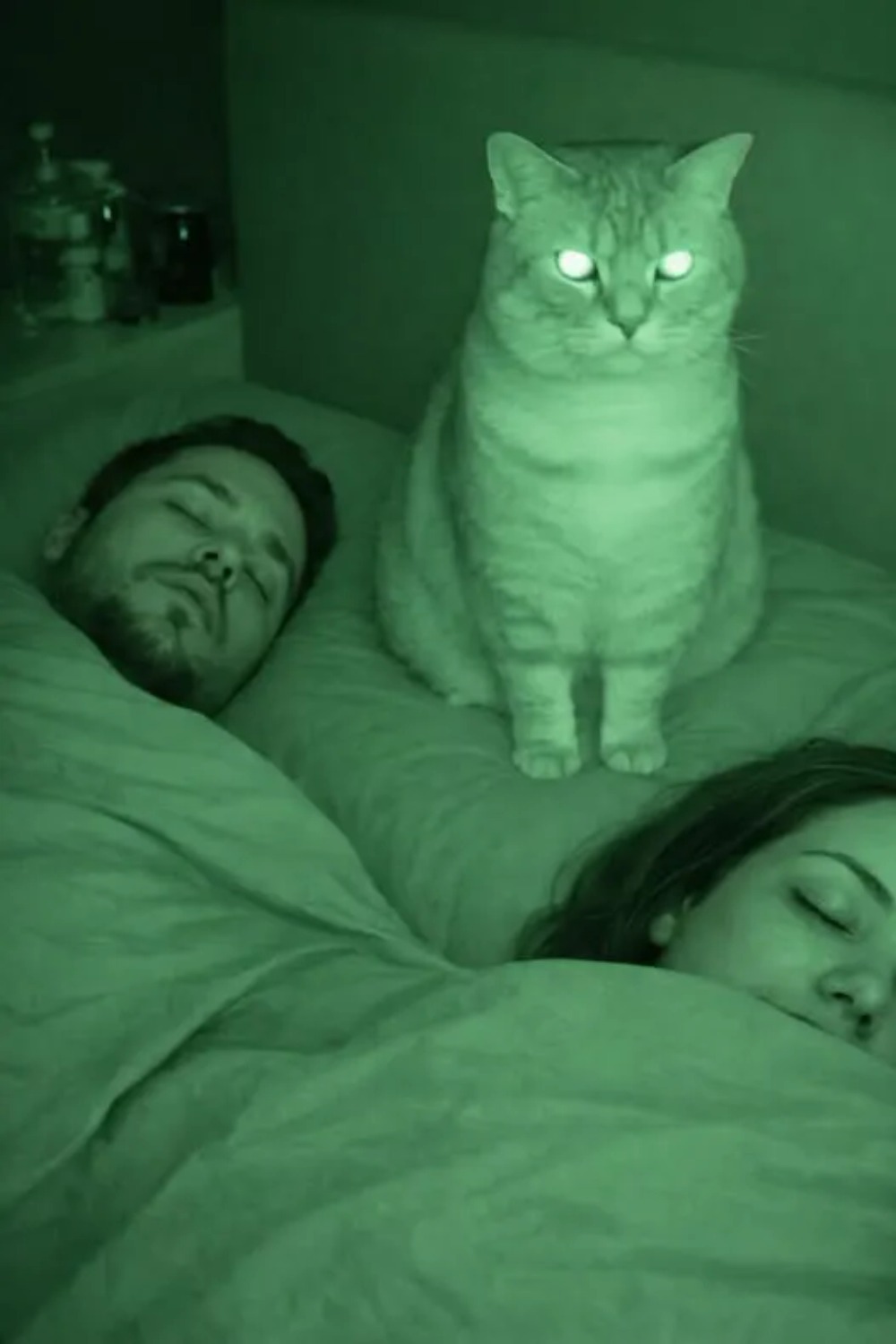
Domestic life is often defined by the quiet rhythms of our pets—the soft patter of paws on hardwood, the rhythmic purring at the foot of the bed, and the gentle companionship that requires no words. Our cat, Luna, had always been the embodiment of this tranquility. She was a poised, intelligent creature who seemed to value her sleep as much as we valued ours. For years, she had occupied a small, plush bed by the bedroom wall, a silent guardian who never stirred until the sun hit the floorboards. However, a subtle shift began to occur in the dead of night, transforming the sanctuary of our bedroom into a space of mounting unease.
It began as a prickle on the back of my neck, that primal instinct that tells you that you are no longer alone in your subconsciousness. I would drift into a deep sleep, only to be yanked back to the surface by the sensation of an intense, unblinking gaze. The first time it happened, I brushed it off as a half-dream. But the second and third times, I forced my eyes open. There, silhouetted against the pale moonlight filtering through the blinds, was Luna. She wasn’t curled in her bed; she was sitting upright on the edge of my pillow, her golden eyes wide and fixed on us with a frightening intensity. In the pitch black, she looked less like a domestic pet and more like a gargoyle carved from shadow.
During the daylight hours, Luna remained the cat we had always known. She was affectionate, she ate with her usual feline gusto, and she napped in her favorite sunbeam. But as soon as the lights went out, her demeanor shifted. She became a nocturnal sentinel, watching us with a focus that felt almost predatory. The frequency of these “staring sessions” increased until I found myself dreading the night. My imagination, fueled by late-night horror tropes, began to wander toward the supernatural. Was she sensing something in the house that we couldn’t see? Was she protecting us, or was she waiting for something?
Concerned for her well-being—and my own sanity—I took her to the veterinarian. I described the behavior: the sudden insomnia, the fixed staring, the eerie stillness. The vet performed a comprehensive exam, checked her vitals, and even looked for signs of neurological distress. “She’s perfectly healthy,” the doctor concluded with a shrug. “It could be stress, or perhaps she’s just bored. Cats are crepuscular, after all. Just keep an eye on her and see if you can identify a trigger.”
The advice was practical, but it presented a logistical challenge: how does one observe a cat’s behavior while one is unconscious? To solve the mystery, I purchased a high-definition night-vision camera and mounted it discretely on the dresser, angled to capture the entire expanse of our king-sized bed. That night, I went to sleep with a mixture of trepidation and curiosity, wondering if the lens would capture a ghost or merely a bored tabby.
The next morning, I sat at the kitchen table with my laptop, a cup of coffee in hand, and hit play on the recorded footage. At first, the video was uneventful—just the slow, rhythmic rising and falling of the blankets as my husband and I settled into sleep. But around 2:00 AM, the drama began. Luna rose from her bed with a slow, deliberate grace. She didn’t stretch or yawn; she moved with a specific mission. She hopped onto the mattress, treading lightly so as not to wake us, and took up her position.
I watched, frozen, as she sat inches from my husband’s face. For nearly forty-five minutes, she didn’t move a muscle. She simply stared at him, her head tilted slightly as if she were analyzing a complex mathematical equation. The footage was haunting; the night-vision gave her eyes a ghostly glow, and the silence of the room made her stillness feel heavy. Then, the mystery reached its climax.
My husband, a man known for his ability to rouse the dead with his snoring, let out a particularly loud, vibrating rumble. On the video, Luna didn’t flinch. Instead, she let out a tiny, irritated flick of her tail. She waited for the next snore. As soon as his breathing hitched and a second thunderous sound began to emerge, Luna acted. She reached out a single, velvet-furred paw and placed it firmly—and with surprising precision—directly over my husband’s open mouth.
She held it there, exerting just enough pressure to stifle the noise without cutting off his air. She looked like a librarian shushing a boisterous patron. My husband let out a muffled grunt in his sleep and rolled onto his side, the snoring silenced by the change in position. Luna remained in place for a few seconds, seemingly evaluating whether the “repair” was permanent. Once satisfied that the room was quiet again, she retracted her paw, hopped down from the bed, and returned to her own cushion, where she promptly curled up and fell into a deep, peaceful sleep.
I sat in the kitchen, the silence of the morning broken only by my own sudden, hysterical laughter. The “creepy” behavior wasn’t a sign of a haunting, nor was it a feline mid-life crisis. It was a tactical intervention. Our cat, a creature who clearly prized her REM cycle above all else, had grown tired of the acoustic assault of my husband’s sleep apnea. She wasn’t watching us out of malice or mystery; she was waiting for the exact moment the noise started so she could implement her custom-designed “silence protocol.”
The realization transformed the way we viewed our midnight sentinel. What I had perceived as a frightening intrusion was actually a form of feline engineering. Luna had identified a problem—the snoring—and experimented until she found a solution that worked. She had become the self-appointed peacekeeper of the master bedroom, ensuring that the environment remained conducive to her own rest, even if it meant risking a “reckless rescue” of her own sleep.
Now, we no longer feel a sense of dread when we see her shadow at the foot of the bed. In fact, my husband has started wearing nasal strips in an attempt to alleviate the burden on our four-legged enforcer. We’ve realized that the bond between humans and pets is often more complex and communicative than we give it credit for. Luna wasn’t just a passive observer of our lives; she was an active participant in our domestic harmony, albeit one with a very firm “hands-on” approach to conflict resolution.
In the end, the camera revealed a truth far more charming than the horror stories I had concocted. It reminded us that every “creepy” behavior often has a perfectly logical—if slightly eccentric—explanation when viewed through the eyes of a cat. Our bedroom is still being watched every night, but we sleep better knowing that the guardian on duty isn’t interested in our souls; she’s just interested in a little bit of peace and quiet.