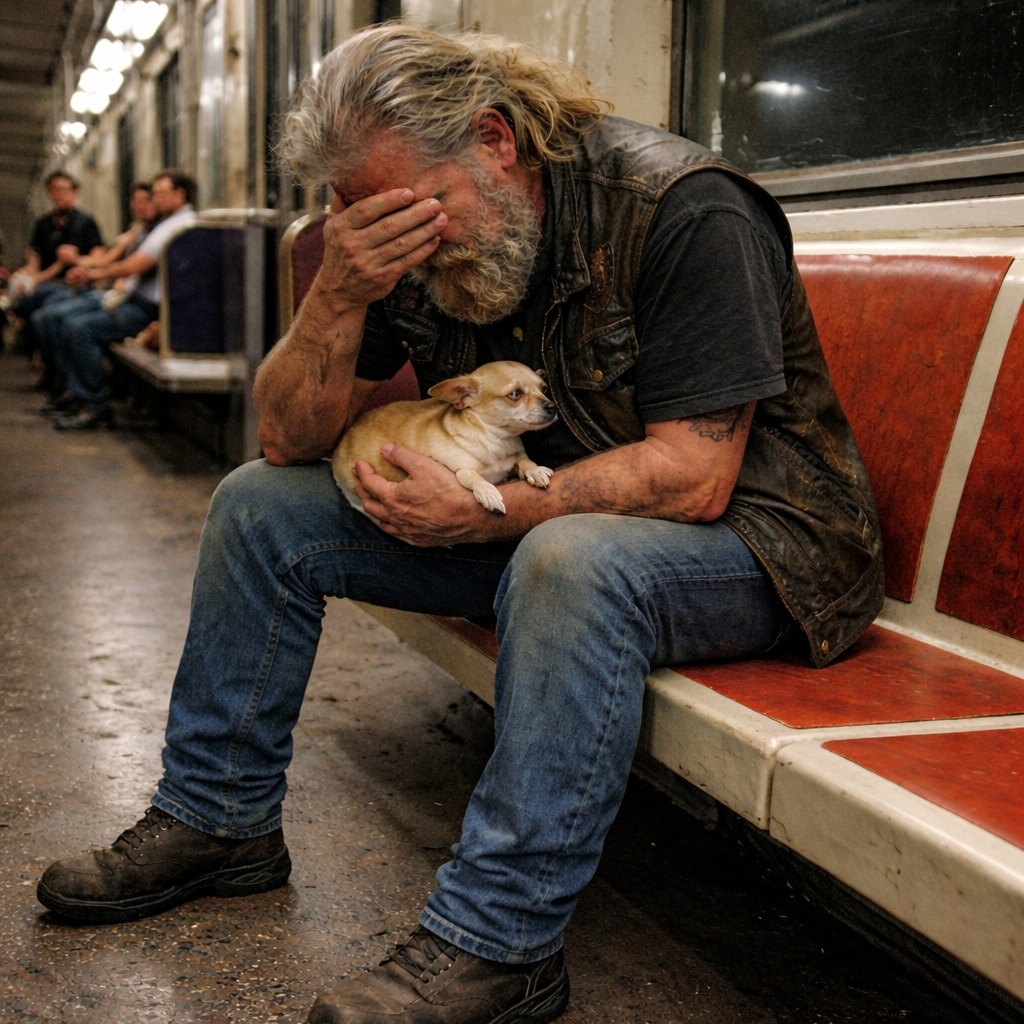
This biker was crying over a dying dog on the subway and everyone moved away except me. I watched as passengers grabbed their bags and shuffled to the other end of the car, whispering and staring at this massive man in leather who was sobbing like a child.
The dog was small. Some kind of terrier mix. Gray around the muzzle. Wrapped in a dirty blanket on the biker’s lap. Its breathing was shallow and ragged. Even from five seats away, I could tell it didn’t have long.
“Someone should call security,” the woman next to me muttered. “He shouldn’t have that animal on here. It’s unsanitary.”
I didn’t move. Couldn’t move. Because the way this man was holding that dog—like it was the most precious thing in the world—made my chest tight.
He was huge. Probably 6’4″, 280 pounds. Leather vest with patches. Tattoos covering both arms. A beard that reached his chest. The kind of man mothers pull their children away from.
And he was whispering to that dying dog like it was his baby.
“It’s okay, buddy. I’m here. I’m not going anywhere.”
The train rattled on. More people moved away. Soon it was just me on my side of the car and him on his, with that little dog between us.
I don’t know why I did it. Maybe because I’d just lost my own mother two months ago. Maybe because I knew what it looked like when someone was saying goodbye. Maybe because everyone else’s cruelty made me want to be kind.
I stood up and walked toward him.
He looked up when I sat down across from him. His eyes were red and swollen. Tears had soaked into his beard. He looked broken in a way I recognized.
“I’m sorry,” I said quietly. “Is your dog okay?”
He shook his head. “Cancer. The vet said he had maybe a few hours left. I was supposed to bring him in this morning to… to put him down. But I couldn’t do it. I couldn’t let him die on a cold metal table in a room that smelled like chemicals.”
His voice cracked.
“So I took him for one last ride. Subway to Coney Island. That’s where I found him eleven years ago. Figured that’s where he’d want to say goodbye.”
The dog’s tail moved slightly. Just a small twitch. Like he knew he was being talked about.
“What’s his name?” I asked.
“Sergeant. Because when I found him, he was standing guard over a litter of dead puppies under the boardwalk. Wouldn’t leave them. Even though he was starving. Even though he was covered in fleas and sores. He was protecting them.”
He stroked the dog’s head gently.
“Reminded me of the guys I served with. The ones who wouldn’t leave their brothers behind no matter what. So I called him Sergeant.”
“You’re a veteran?”
“Two tours in Iraq. Came back messed up. PTSD. Couldn’t hold a job. Lost my wife. Lost my house. Lost everything.” He paused. “Sergeant saved my life.”
I didn’t say anything. Just listened.
“I was living on the streets when I found him. Or I guess he found me. I’d been thinking about ending it. Had it all planned out. But then this little guy showed up, needing someone to take care of him. Needing me.”
He lifted the dog slightly, pressing his forehead against Sergeant’s small head.
“How do you kill yourself when something needs you to stay alive? How do you give up when someone’s depending on you?”
The train stopped. Doors opened. A few people got on, saw the scene, and quickly moved to another car.
“Eleven years,” the biker continued. “Eleven years he’s been my best friend. My only friend for a long time. When I was too broken to talk to humans, I talked to him. When I couldn’t sleep because of the nightmares, he’d lay on my chest and lick my face until I calmed down.”
His voice dropped to a whisper.
“He’s the reason I got clean. The reason I found my club. The reason I’m alive. And now he’s leaving me.”
I felt tears on my own cheeks.
“I’m sorry,” I said. “I’m so sorry.”
He looked at me then. Really looked at me. “You’re the only person who came over. Everyone else ran away like I was dangerous.”
“You don’t look dangerous to me. You look like someone saying goodbye to family.”
He nodded slowly. “That’s exactly what this is. He’s not just a dog. He’s my brother. My therapist. My guardian angel with four legs and bad breath.”
A laugh escaped through his tears. I laughed too.
Sergeant’s breathing changed. Got slower. More labored. The biker noticed immediately.
“No, buddy. Not yet. We’re almost there. Just a few more stops. Can you hold on for me? Can you see the ocean one more time?”
The dog’s eyes opened slightly. Looked up at his owner with the kind of pure love only dogs can give.
“That’s my boy. That’s my good boy.”
I should have gotten off at 34th Street. That was my stop. But I stayed. Couldn’t leave this man alone. Not during this.
“Tell me about him,” I said. “Tell me your favorite memory.”
The biker smiled through his tears.
“There’s this beach we used to go to. Before I had my bike, we’d take the train out early on Sunday mornings. Just the two of us. I’d let him off the leash and he’d run for hours. Chase seagulls he was never going to catch. Dig holes he was never going to finish. Just pure joy.”
He stroked Sergeant’s ears.
“I was so depressed back then. Couldn’t see the point of anything. But watching him be so happy, so free, it reminded me that life could be good. That there were still moments worth living for.”
“He taught you how to live again.”
“He taught me everything. Loyalty. Forgiveness. How to love without expecting anything in return.” He paused. “My ex-wife left because I was too broken. Said I was too much work. But Sergeant never cared that I was broken. He loved me anyway. Every single day. No matter what.”
The train emerged from the tunnel. Sunlight flooded the car. The biker turned Sergeant toward the window.
“Look, buddy. We’re almost there. Can you see the light? Can you feel the sun?”
Sergeant’s tail twitched again. Weak but there.
“That’s my boy. Just a little longer.”
An old woman got on at the next stop. She looked at the biker, at the dog, at me sitting across from him. Then she walked over and sat down next to me.
“Is he okay?” she asked quietly.
“His dog is dying. They’re going to Coney Island. Where they first met.”
The old woman’s eyes filled with tears. She reached into her purse and pulled out a small packet of tissues, handed them to the biker.
“Thank you, ma’am,” he said hoarsely.
“My husband had a dog like that,” she said. “Helped him through the war. Through our hardest years. I know what that bond means.”
More people got on at the next stop. A teenager with headphones. A mother with two kids. A businessman in a suit.
One by one, they noticed what was happening. The biker crying. The dying dog. The small group of strangers sitting with him.
And one by one, they sat down nearby. Not too close. But close enough to show they cared.
The teenager took off his headphones. The mother held her kids close and wiped her eyes. The businessman put away his phone.
Nobody said anything. We just sat there together, bearing witness to this man’s grief.
The biker noticed. Looked around at all of us.
“You don’t have to stay,” he said.
“We want to,” the old woman replied.
He broke down then. Sobbed openly while strangers surrounded him with silent support.
“I don’t know how to do this without him,” he admitted. “I don’t know who I am without him.”
“You’re the person he helped you become,” I said. “And that person is strong enough to survive this. He made sure of it.”
The train pulled into the Coney Island station. End of the line.
The biker stood up carefully, cradling Sergeant against his chest. We all stood too.
“I can’t thank you enough,” he said, looking at each of us. “You didn’t have to stay. But you did.”
“Let us walk with you,” the old woman said. “To the beach. If that’s okay.”
He nodded, too emotional to speak.
So we did. A strange procession of strangers following a crying biker off the subway and toward the ocean. The teenager helped hold doors open. The businessman carried the biker’s bag. The mother explained to her kids what was happening in gentle words.
“That man’s dog is very sick, babies. We’re helping him say goodbye.”
The kids didn’t ask any more questions. Just held their mother’s hands and walked with us.
The beach was nearly empty. It was a cold morning. Wind whipping off the water. Not a day anyone would choose for the beach.
But the biker walked straight to the shore. Knelt down in the sand. Held Sergeant up to see the ocean.
“Look, buddy. We made it. One last time.”
Sergeant’s eyes were barely open. But I swear he saw it. Saw the water he used to splash through. The sand he used to dig. The seagulls he used to chase.
The biker lowered him down, letting his paws touch the sand.
“You were the best boy. The best friend anyone could ask for. You saved my life. You gave me a reason to keep going.”
His voice broke completely.
“I don’t know how to let you go. But I know you’re tired. I know you’re hurting. So if you need to go, buddy, you can go. I’ll be okay. You taught me how to be okay.”
We stood in a semicircle behind them. The old woman was crying silently. The mother had her arms around her children. The teenager was recording on his phone, then thought better of it and put it away.
The businessman spoke up quietly. “I had a dog when I was a kid. She died when I was twelve. I never got another one because I couldn’t handle losing another.”
The old woman nodded. “My husband’s dog passed two weeks before he did. I think he was waiting for her on the other side.”
I thought about my mother. How I’d held her hand when she took her last breath. How the room had been cold and clinical and nothing like this beach.
“You’re giving him a beautiful goodbye,” I told the biker. “This is what love looks like.”
He didn’t respond. Just held Sergeant close and watched the waves.
We stood there for almost an hour. Strangers who’d become something more. United by a dying dog and a broken man who loved him.
Sergeant passed at 10
AM with the sound of waves in his ears and the sun on his face.
The biker knew immediately. Let out a sound that wasn’t quite human. A howl of grief that startled the seagulls into flight.
He clutched Sergeant’s body to his chest and rocked back and forth in the sand.
“He’s gone. Oh God, he’s gone.”
The old woman stepped forward and put her hand on his shoulder. Then the mother. Then me. Then the teenager. Then the businessman.
Six strangers holding a grieving biker on a cold beach while he said goodbye to the only family he had.
I don’t know how long we stayed like that. Time stopped meaning anything.
Eventually, the biker’s sobs slowed. He looked up at us with swollen eyes.
“I came here alone,” he said. “I was ready to bury him alone. I didn’t think anyone would care.”
“Everyone cares,” the old woman said. “We just forget sometimes.”
The businessman cleared his throat. “I run a funeral home. Third generation. I’d like to offer you our pet cremation services. No charge. Your dog deserves a proper service.”
The biker stared at him. “I can’t afford—”
“No charge. This one’s on me.” He handed the biker his card. “When you’re ready, call me. We’ll take care of Sergeant with dignity.”
The teenager spoke up. “My parents have a plot in Brooklyn where they buried our family pets. There’s space. If you want, Sergeant could rest there with other loved animals.”
The mother reached into her purse. “My kids want to give you something.” She handed over two small stuffed dogs. “They picked them out of their own toy boxes. They said maybe you could have these until you feel better.”
The biker took the stuffed animals with shaking hands.
“Why?” he asked. “Why are you all doing this? You don’t know me. You don’t know him.”
I knelt down in the sand next to him.
“Because this morning on that subway, everyone moved away from you except me. And I almost didn’t come over either. I almost stayed in my seat because you looked scary. Because I judged you before I knew you.”
I gestured at the others.
“I think everyone here has done that before. Judged someone without knowing their story. Walked past pain because it was easier.”
The old woman nodded. “I’ve done it a hundred times. Today I decided to stop.”
“Me too,” the businessman said.
“Me too,” the teenager added.
The mother just nodded, holding her kids close.
The biker looked down at Sergeant’s still body. “He would have liked you all. He never judged anyone. Loved everyone who was kind to him. Even the people who weren’t kind at first.”
“He sounds like he was a very good boy,” I said.
“The best.” He kissed Sergeant’s head one final time. “The absolute best.”
We helped him up. Walked back to the train station together. Exchanged numbers. Made plans to meet at the pet funeral home in two days.
Six strangers who’d found each other because of a dying dog on a subway.
I went to the funeral. So did the old woman and the businessman and the teenager and the mother with her two kids. The biker—his name was Thomas, I learned—had invited his motorcycle club too.
Twenty-three bikers in leather vests crying over a small terrier mix named Sergeant.
The businessman gave a beautiful eulogy. The teenager played a song on his guitar. The mother’s children placed the stuffed dogs in the casket.
I read a poem I’d found about dogs waiting at the Rainbow Bridge.
Thomas spoke last.
“Eleven years ago, I was ready to die. I had nothing left. No purpose. No hope. Then this little guy showed up, and suddenly I had a reason to live.”
He paused, wiping his eyes.
“People say dogs are just animals. Just pets. But Sergeant was more than that. He was my therapist when I couldn’t afford one. My family when I had none. My reason when I’d lost mine.”
He looked at all of us—his biker brothers and the strangers who’d become friends.
“He also brought me all of you. Even in dying, he was still saving me. Still teaching me. Still showing me that there are good people in the world if you just give them a chance.”
After the service, Thomas pulled me aside.
“I never got your name.”
“Michael.”
He extended his massive hand. “Thank you, Michael. For sitting down. For staying. For reminding me that not everyone runs away.”
“Thank you for letting me in. For letting all of us in.”
“That was all Sergeant.” He smiled sadly. “Even at the end, he was still bringing people together.”
I think about that day often. About how close I came to staying in my seat. About how wrong my first impression was. About a dying dog who taught a train full of strangers how to be human again.
Thomas and I are friends now. I’ve been to his motorcycle club. Met his brothers. Heard their stories. Learned that every single one of them has a story that would break your heart.
Last month, Thomas adopted a new dog. A rescue from the same shelter where Sergeant came from. Another terrier mix. Another old soul nobody wanted.
He named her Hope.
“Sergeant would have wanted me to save another one,” he told me. “Pay it forward. That’s what he taught me.”
I’m writing this because I want you to know something: the scariest-looking people are often carrying the heaviest pain. The ones everyone moves away from are usually the ones who need someone to move closer.
A biker crying over a dying dog on the subway.
That’s all he was. A man saying goodbye to his best friend.
And because one person sat down, because one person chose compassion over fear, six strangers found each other. Found community. Found proof that humanity isn’t dead.
Sergeant saved his owner’s life.
But in the end, he saved a little piece of all of us too.
That’s the power of love. That’s the power of showing up. That’s the power of a good dog.
Rest easy, Sergeant. You were the best boy.
And you taught us all how to be better humans.