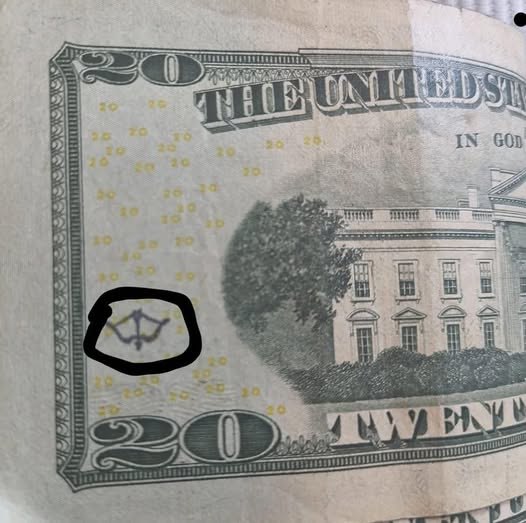
The United States dollar is more than just a piece of legal tender; it is a global traveler that carries the invisible weight of international trade and the physical scars of its journeys. Among the most intriguing features found on circulating currency are small, seemingly cryptic symbols—such as a bow and arrow, a geometric shape, or a tiny character—stamped in vibrant inks.
To the casual observer in a grocery store line, these might appear to be random graffiti or the result of a child’s stamp set. However, for those who understand the intricacies of global finance, these markings, known as “chop marks,” are a silent testament to a bill’s authenticity and its long voyage through the hands of international merchants.
A chop mark is not an official feature of the U.S. Bureau of Engraving and Printing. Instead, it is a private mark of verification added by individual money changers, banks, and traders, primarily outside of the United States. These symbols are rooted in a centuries-old tradition of commerce that predates paper money. In the era of the silver trade, merchants in East Asia would “chop” or punch a small mark into silver coins, such as the Spanish Eight Real or the American Trade Dollar, to verify the purity of the metal.1 If a merchant tested a coin and found it to be genuine, they would leave their unique stamp as a guarantee to the next person who received it. As the world transitioned from heavy silver to lightweight paper, the practice evolved, shifting from physical punches in metal to inked stamps on the margins of banknotes.
The appearance of a chop mark, such as the delicate outline of a bow and arrow, signifies that the bill has moved through a region where the U.S. dollar is used as a secondary or even primary currency. In many parts of Asia, Africa, and Latin America, the dollar is prized for its stability.2 Because these regions often lack the sophisticated electronic verification systems found in Western banks, trust becomes the primary currency. When a professional money changer in a bustling market in Hong Kong or a trading post in Lagos receives a hundred-dollar bill, they inspect it with expert eyes, checking the feel of the paper and the clarity of the ink. Once they are satisfied that the note is not a counterfeit, they apply their “chop.” This mark serves as a personal endorsement, telling the local community, “I have checked this money, and it is good.”
From a functional perspective, chop marks streamline the flow of cash. In high-volume trading environments, re-verifying every single note in a stack of thousands can be an arduous task. A bill that bears several distinct chop marks tells a story of successful transactions; it has passed through multiple professional hands, each time being validated. It reduces friction in the marketplace and builds a decentralized network of trust. Interestingly, these marks are almost always placed with precision. Money changers are careful not to obscure the serial numbers, the security threads, or the portrait of the figure on the bill. They understand that to deface the security features would be to render the bill worthless, so they tuck their symbols into the white spaces or the ornate borders of the design.
The variety of these symbols is staggering. Beyond the bow and arrow, one might find Chinese characters representing luck or prosperity, animal silhouettes like dolphins or eagles, or even simple alphanumeric codes. Each stamp is a unique signature belonging to a specific exchange house or a prominent trader. For a global economist, a single bill with five different chop marks is a data point—it is a map showing that this specific piece of paper may have traveled from a bank in New York to a merchant in Singapore, then perhaps to a textile trader in Jakarta, before finally finding its way back into a traveler’s wallet and returning to the United States.
There is often a lingering question regarding the legality of these marked bills. Under U.S. law, specifically 18 U.S.C. § 333, it is illegal to “mutilate, cut, deface, disfigure, or perforate” currency with the intent to render it unfit to be reissued.3 However, chop marks are generally viewed by the Treasury Department and the Federal Reserve as “incidental wear” rather than intentional defacement. Much like a bill that has been wrinkled in a pocket or had a small corner torn off, a chop-marked bill remains legal tender. Within the United States, these bills are usually accepted without issue by banks, though they may eventually be pulled from circulation and replaced with “clean” notes as they pass through the Federal Reserve’s sorting machines.
For the modern currency collector, or “numismatist,” chop marks add a layer of historical and cultural value that a pristine, uncirculated bill lacks. While some collectors prefer perfect notes, a growing community of enthusiasts specifically hunts for “world-traveled” dollars. To them, these marks are not blemishes but “passport stamps.” Each bow and arrow or starburst is a tangible link to a human connection—a moment where two people, perhaps speaking different languages and living thousands of miles from Washington D.C., agreed on the value and authenticity of a piece of American paper.
In an age where digital transactions and cryptocurrencies are becoming the norm, the persistence of the physical chop mark is a fascinating anomaly. It represents the “human element” of finance—the need for physical verification and the weight of a personal guarantee. It reminds us that money is, at its core, a social contract. The bow and arrow symbol appearing on a twenty-dollar bill in your pocket today might have been stamped in a small exchange booth in a different hemisphere six months ago. It is a reminder that the dollar is not just American; it is a global tool that facilitates the dreams and livelihoods of people across the planet.
When you next encounter a bill with a strange inked symbol, take a moment to look at it closely. You are holding a relic of the “Silk Road” style of commerce, modernized for the 21st century. That tiny bow and arrow is a signature of trust, a marker of a journey, and a small piece of global economic history that has survived the rigors of international trade to land, quite literally, in the palm of your hand. It is a testament to the enduring power of the dollar and the universal human need to verify, trust, and trade.