My name is Daniel Miller. From the outside, I’m the kind of man people use as proof that hard work pays off.
I built a tech consulting firm from nothing. I live in a glass-and-stone house outside Dallas. I drive cars I used to cut out of magazines. And I married Lauren Pierce—polished, stunning, and effortlessly impressive in every room she enters.
I also told myself I was a good son.
I brought my mother, Rosa Miller, from a tiny town in New Mexico so she could “live her golden years in comfort.” I gave her a room in my mansion, paid every bill, and believed that was what love looked like.
Money. Space. Safety.
I was wrong.
That day, my meeting in Houston ended early. I should’ve been annoyed by the extra drive. Instead, it felt like a gift—like life was giving me one rare, quiet evening.
I pulled into the garage, entered through the side door, and immediately noticed something strange.
The house wasn’t peaceful. It was… muted. Like it was holding its breath.
I set down my briefcase, loosened my tie, and took two steps into the hallway when I heard it.
A faint sound—soft, broken. Not a baby’s cry. Not a TV.
A tired whimper.
Then another sound.
Click. Click. Click.
Heels on tile.
Lauren’s voice floated toward me, crisp and sharp.

“Are you going to sit there whining all day, or are you actually going to clean it properly?”
My stomach dropped.
That tone—I’d heard it in arguments, in stressful moments, in the way she spoke to staff sometimes. But never like this. Not in my home. Not to my mother.
I moved toward the guest bathroom, heart hammering, and pushed the door open without knocking.
And my world tilted.
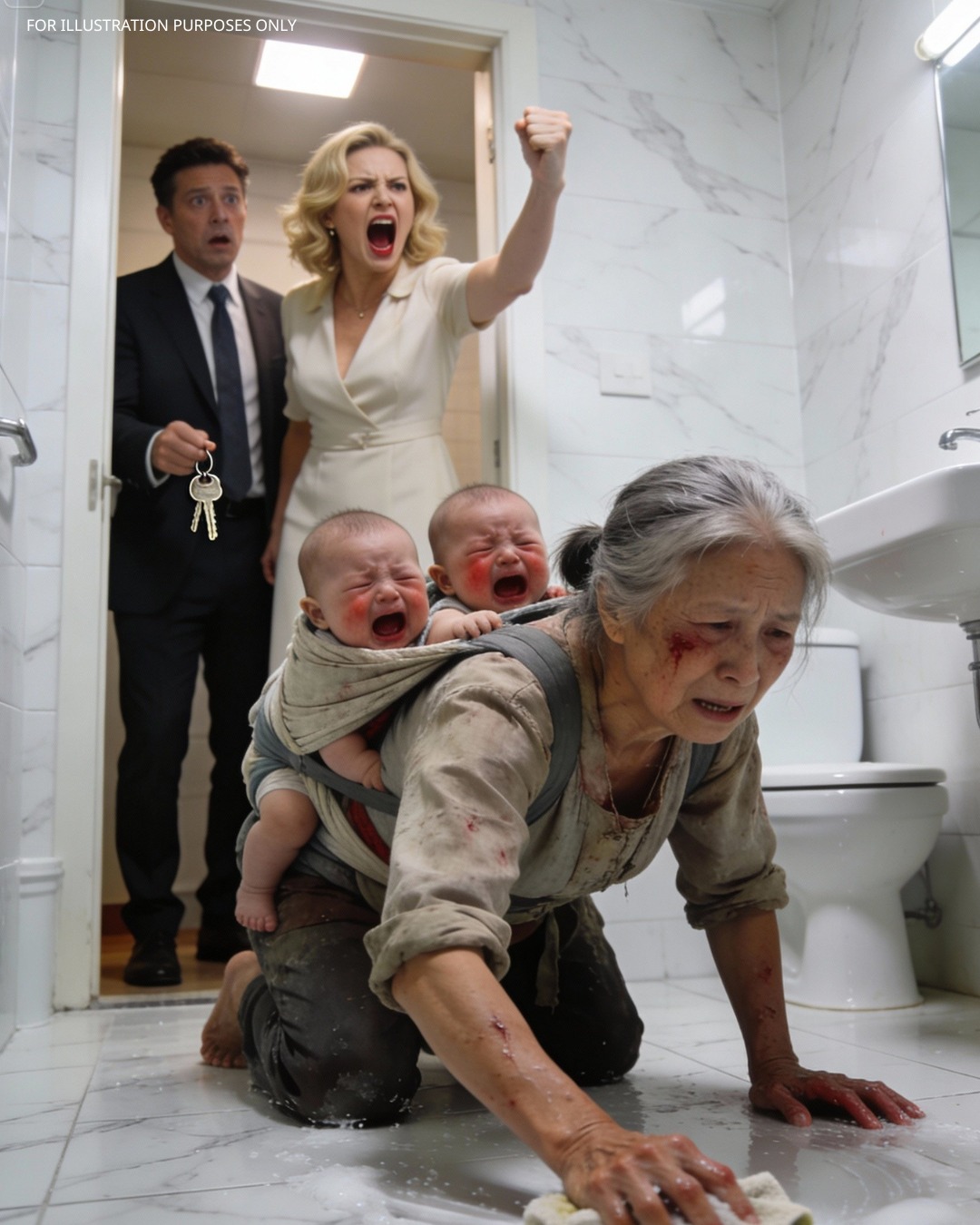
My mother was on her knees.
Not on a mat. Not on a towel. Her knees were pressed directly into the cold marble floor. Her shoulders trembled with strain, hands red and raw from scrubbing behind the toilet with a chemical-soaked sponge.
But that wasn’t what shattered me.
Strapped to her back—tight with an old, faded carrier—were my twin boys.
Noah and Caleb.
My sons squirmed against her small frame, their cheeks pressed to her shoulder. Their soft fussing rose and fell like tired waves. The weight of them bent her forward even more, forcing her down into the stone like gravity had doubled.
Sweat darkened her hairline. Her breathing came short and shallow. And then, in a voice so small it barely existed, she whispered toward the floor:
“Almost done, ma’am… my back just hurts a little.”
Ma’am.
She called my wife ma’am.
Lauren stood there in tailored perfection, arms folded, expression calm—like she was supervising a chore chart, not watching a nearly seventy-year-old woman crumble under pain with two babies tied to her back.
Lauren let out a light, dismissive laugh.
“Everyone hurts somewhere, Rosa,” she said. “The difference is whether you choose to be strong or choose to be a burden.”
I couldn’t breathe. The air felt thick—like the room itself was judging me.
“What… are you doing to my mother?”
My voice cracked through the bathroom like a slap. It echoed off the tile, the mirrors, the marble.
Everything froze.
Lauren’s face shifted—surprise first, then calculation. My mother flinched like she’d been struck.
And in that instant, I understood something horrible:
This wasn’t a misunderstanding.
This wasn’t the first time.
This was routine.
Lauren straightened, smoothing the front of her blouse as if she could iron the moment away.

“Daniel,” she said evenly, “you’re overreacting. Your mom offered to help. She says she likes contributing. She feels useful.”
My eyes went to my mother’s hands. The skin looked angry and split. There were faint blue marks on her forearms—too precise to be “clumsy.”
I knelt in front of her, ignoring Lauren completely.
“Mamá,” I whispered. “Look at me.”
It took effort for her to lift her eyes. They were glassy with exhaustion. The lines on her face weren’t just age—they were wear.
“I’m fine, mijo,” she whispered automatically. “I was just helping.”
Helping.
While on her knees. With my babies strapped to her spine.
I turned back to Lauren, my voice low and dangerous.
“You honestly think this is normal?”
Lauren rolled her eyes like I was being inconvenient.
“She grew up working,” she said. “She’s not fragile. And they’re her grandkids. She loves being with them.”
I looked back at my mother, steadying my voice with everything I had.
“Mom. Did you want to be scrubbing a bathroom floor on your knees today—yes or no?”
Her lips trembled. She stared down at the marble.
“I don’t want to cause problems for you,” she whispered.
That wasn’t peace.
That was fear pretending to be loyalty.
I stood and began unfastening the carrier straps, my hands shaking.
“No,” I said softly. “You’re done.”
My mother panicked, even then.
“Daniel, please—”
“Stop.” I lifted the twins into my arms, one at a time. “You’re not carrying pain for anyone anymore. Not in my house.”
Lauren let out a sharp, impatient sound.
“You’re acting like she’s helpless,” she snapped. “You’re exaggerating.”
I turned to her, my voice calm now—too calm.
“What you call ‘keeping her busy,’ I call humiliation.”
Lauren’s eyes hardened.
“You forget where she comes from,” she said coldly. “She’s used to cleaning. Serving. Following orders. I just reminded her of her place.”
Her place.
That phrase hit me like poison.
“My mother’s only place,” I said, “is wherever she’s treated with dignity.”
Then my mother whispered something so quietly I almost missed it.
“It’s not the first time.”
My chest went hollow.
I knelt again, took her hands in mine, and forced myself to stay steady.
“Tell me,” I said. “I need to know.”
Tears spilled down her cheeks—slow at first, then unstoppable.
“At first it was little things,” she admitted. “Dishes. Laundry. Watching the boys.”
She swallowed hard.
“Then she started ordering me. If I was slow, she said I was useless. If I made a mistake, she said people like me never do anything right. She told me I should be grateful she lets me live here.”
Lauren scoffed. “Discipline isn’t abuse.”
My mother flinched at the word discipline like it was a whip.
“There were worse things,” she whispered.
I didn’t blink. “Tell me.”
My mother’s voice broke.
“She said if I told you, you’d believe her over me. She said you’d think I was jealous… and you’d send me away. She said I’d never see the babies again.”
I felt something ancient and feral rise inside me.
I looked at Lauren.
“Did you shove her?”
Lauren’s mouth twisted. “She’s dramatic. She’s clumsy.”
My mother shut her eyes.
“Once,” she whispered. “I almost fell.”
That was it.
That was the moment the marriage I thought I had—clean, glamorous, stable—collapsed into dust.
I stood up.
“You’re leaving,” I said.
Lauren blinked, then laughed like I’d told a joke.
“Daniel, you don’t mean that.”
“I mean it,” I replied. “Right now.”
She stepped closer, lowering her voice the way she did when she wanted control back.
“You’re going to ruin your image,” she hissed. “Your perfect family. Over this?”
“If my ‘perfect family’ requires my mother to suffer in silence,” I said, “then it was never perfect. It was just well-decorated.”
Lauren’s eyes flashed. “And what about the babies? You think you can do this without me?”
I stared at her.
“I already have,” I said, and I didn’t mean the twins.
I meant everything.
Because the truth was, I had been doing life without real love for a long time—I just didn’t know it.
When the front doorbell rang, loud and firm, Lauren’s face shifted again—fear this time.
I opened the door to find a uniformed officer and a man in a suit holding a folder.
“Mr. Daniel Miller?” the man asked. “We received a formal report of elder mistreatment in this residence.”
Lauren’s voice snapped behind me.
“This is insane!”
The officer’s gaze moved past me—toward my mother’s bruised arms, her shaking hands, her exhausted face.
“Ma’am,” the officer said, calm and professional, “we need you to come with us while we sort this out.”
Lauren spun toward me as if I’d betrayed her.
“You did this?”
I didn’t answer. I didn’t have to.
Because the only betrayal that mattered had been happening for months—maybe longer—right under my roof.
When the door finally shut behind her, the house felt quieter than ever.
But for the first time, the quiet wasn’t hiding anything.
I walked back to my mother, placed my hand gently on her shoulder, and said the words I should’ve said from the beginning:
“You’re safe now. And I’m sorry it took me so long to see you.”
My mother leaned her head against me like she didn’t trust the moment yet.
“I prayed you would notice,” she whispered.
I held her tighter.
“I notice,” I said. “And I’m not looking away again.”
That night, we ate at the small kitchen table instead of the long dining table Lauren loved. Soup, bread, tea—simple food, real silence.
My mother rocked Noah while Caleb slept against my chest.
And in that ordinary moment, I finally understood something I should’ve learned years ago:
Success isn’t the house you buy.
It’s the people you protect inside it.