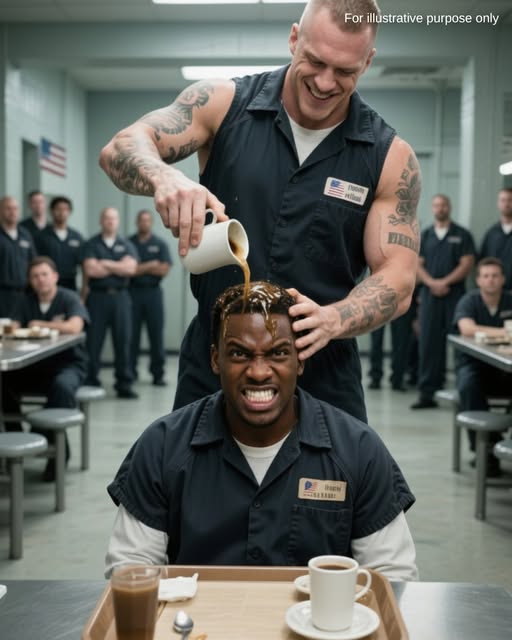
The cafeteria reeked of burnt coffee and sweat. It was the type of place where you quickly learn who holds the power. Trays clattered. Guards pretended to ignore what was happening. And in the corner sat Marcus, the man known as the king of cell block C. When the new inmate entered, the noise faded slightly. He was black, in his mid-30s, and calm in a way that didn’t fit in here.
No twitch, no fear, just steady eyes scanning the room as if he’d been here before. Marcus didn’t like that. He leaned back in his chair, grinning. Fresh meat, he muttered. Thinks he’s Bruce Lee. A few of his guys chuckled. The new guy said nothing. He simply picked up a tray and continued walking. Quiet and polite. Too polite for prison. That’s when Marcus decided to act.
He stood up, swaggered over, and accidentally knocked the tray out of the new guy’s hands. The sound echoed. Metal, food, silence. Everyone watched. Marcus grabbed a hot cup of coffee, raised it slowly like a showman, and poured it over the new inmate’s head. The cafeteria froze. The new guy didn’t yell, didn’t even flinch.
He simply exhaled once and looked up. That’s when Marcus realized he’d just made the biggest mistake of his life. Because seconds later, that quiet man was no longer standing still. And by the time the guards rushed in, King of Cell Block C was lying on the floor, crying, broken, begging, “Stay with me until the end.”

What the guards discovered later about that quiet inmate changed everything they thought they knew about him. Before we continue, don’t forget to like this video, hit subscribe, and comment where you’re watching from. Now, let’s get into it.
The concrete walls of Blackwater State Penitentiary had witnessed their share of broken men. After 23 years of housing the worst society had to offer, the place had become more than just a prison. It was an ecosystem, a brutal hierarchy where respect was earned through violence and weakness was punished without mercy. Marcus “Tank” Williams had ruled cell block C for four years. At 6’2″, he was pure intimidation wrapped in orange, with arms like tree trunks and a reputation that preceded him down every hallway.
His crew of loyal followers moved through the prison like they owned it, and in many ways, they did. Tank had built his empire the old-fashioned way: through blood and fear. He decided who ate in peace and who went hungry. He determined who got protection and who became a target. Even the guards had learned to turn a blind eye when Tank handled business. It kept order, and that made their jobs easier.
When David Chen walked through the steel doors that morning, the temperature in cell block C seemed to drop a few degrees. Not because anyone knew who he was, and not because his paperwork said anything threatening, but because something about the way he moved, the way he carried himself, felt different.
David’s intake processing had been routine. Another mid-30s offender caught up in the system. Assault charges from a bar fight gone too far. Three to five years. Eligible for parole in 18 months with good behavior. The intake officer barely glanced up from his paperwork as he processed the new arrival. Nothing unusual, nothing threatening, just another number filling another cell. But if that officer had looked closer, really looked, he might have noticed something different about David Chen. The way his feet were planted even while standing still. The way his breathing stayed calm despite being processed into one of the most violent prisons in the state. The way his eyes took in every detail of his surroundings without seeming to stare.
David had been a free man for 34 years. He’d owned a successful martial arts studio in downtown Portland, teaching taekwondo to everyone from nervous children to seasoned adults looking to get back in shape. He had lived a disciplined life built on respect, honor, and the ancient techniques passed down by his Korean master over two decades ago.
Now, he was prisoner number 847291, and the next three years of his life would be spent behind these concrete walls. His cell was controlled by Tank’s influence, just like everything else in cell block C. His cellmate was a nervous young man named Tommy Rodriguez, barely 22, who had been counting down the days until his own release for the past 8 months.
“You seem different,” Tommy whispered after the lights went out on David’s first night. “Most new guys come in scared, angry, or trying to act tough. You’re just calm.”
David set aside the worn paperback he had been reading and looked across the small cell. “Fear and anger cloud judgment,” he said quietly. “Clarity comes from stillness.”
Tommy didn’t fully understand, but something in David’s voice made him feel safer than he had in months. There was a weight to his words that spoke of experience beyond these walls. Knowledge that ran deeper than prison survival tactics.
The next morning brought David’s first trip to the cafeteria, and Tank was waiting. He had positioned himself and his crew near the serving line, ensuring that every inmate would have to walk past them. It was a power move, a reminder of the hierarchy that governed this place. Fresh meat needed to learn the rules quickly, and Tank was always eager to be the teacher.
David entered the cafeteria, carrying himself with the same quiet dignity he had since his arrival. He moved through the breakfast line methodically, his eyes scanning the room with practiced awareness—alert, not paranoid, not afraid—just aware, like someone who had spent decades teaching others how to defend themselves. The food was exactly what he expected: watery scrambled eggs that had been sitting under heat lamps too long, toast that had seen better days, coffee that looked like it had been brewed sometime last week. He took what was offered without complaint and looked for a place to sit.
Tank watched the new guy’s every movement, sizing him up like a predator evaluating its prey. This one was different from the usual fresh fish who stumbled through those doors. No nervous glances, no obvious fear, no false bravado, just a man getting breakfast like he’d done it a thousand times before. That calm confidence irritated Tank more than outright defiance would have. Defiance he could crush immediately. Fear he could exploit for weeks.
But this quiet dignity, this unshakable composure, felt like a challenge to everything Tank had built his reputation on.
“Well,” Tank’s voice boomed across the cafeteria, causing conversations to pause and heads to turn. “Look what we got here, boys. Fresh meat thinks he’s special.”
David continued walking toward an empty table, his tray steady in his hands, his expression unchanged.
He had dealt with bullies before, though not in quite this setting. The principle remained the same: show no fear, but avoid unnecessary confrontation. Tank stepped directly into David’s path, blocking the way to the tables. His crew flanked him on both sides, grins spreading across their faces as they anticipated the show they’d seen a dozen times before.
“I’m talking to you, boy,” Tank growled, his voice dropping menacingly. “When somebody speaks to you in here, you answer. That’s how respect works.”
David stopped walking and looked up at Tank calmly. The height difference was significant, but David’s posture remained relaxed, balanced. “I heard you,” he said simply. “I just don’t have anything to say.”
The response caught Tank off guard. Most new inmates either cowered in empty threats or tried to act tough. This man was doing neither. He was just standing there, completely unruffled.
“You don’t have anything to say?” Tank repeated, his voice growing louder and drawing more attention. “Maybe you don’t understand how things work around here. See, I run this block. That means everything that happens here goes through me, including where some nobody like you gets to sit.”
David remained still, his breathing slow and controlled. Years of meditation and disciplined training had taught him to find calm at the center of any storm. This was just another storm, no different from the countless sparring matches where opponents had tried to intimidate him before the real fight began.
“I understand,” David said quietly, his voice carrying. “You’re the man in charge. I’m just trying to eat my breakfast.”
Tank’s face flushed with anger. The new inmate’s calm was making him look weak in front of his crew, in front of the entire cafeteria. That couldn’t stand. In a place like this, perception was everything. And right now, the perception was that some nobody fresh fish wasn’t showing proper respect to the king.
Without warning, Tank shoved David hard in the chest. The force should have sent the smaller man stumbling backward, maybe even knocked him down, but David’s feet seemed rooted to the floor. He absorbed the impact with a slight shift in weight and remained standing exactly where he had been.
Tank blinked in surprise. He had put real force behind that shove—enough to move men twice David’s size—but this quiet inmate hadn’t budged an inch. His balance had barely been affected.
“Did you just—” Tank started to say, but David cut him off with a look that made the gang leader’s words die in his throat. For just a moment, David’s calm mask slipped slightly, and Tank caught a glimpse of something that made his blood run cold.
It was like looking into the eyes of a trained fighter pretending to be helpless. The depth of knowledge and capability that flashed through David’s gaze spoke of years of discipline, of techniques mastered through countless hours of practice. The moment stretched, tense and taut. Tank stared into David’s eyes and felt something he hadn’t experienced in years behind bars. Uncertainty.
David’s gaze held depths of training, discipline, and confidence. But Tank was the king of cell block C. Kings don’t back down from challenges, especially not from fresh fish who probably couldn’t last a week without protection.

“You think you’re tough, new guy?” Tank snarled, stepping closer, towering over David. “You think those calm little eyes can stand up to what I’ve got waiting for you?”
David’s response was barely above a whisper, but everyone in the immediate area heard it clearly. “I think you should let me eat my breakfast in peace.”
The cafeteria had gone completely silent. Every conversation had stopped. Even the guards at the far end of the room had noticed something was happening, though they weren’t moving to intervene yet. In their experience, these situations usually resolved quickly, with the new inmate learning his place. Tank’s crew was getting restless. They fed off their leader’s energy. And right now, that energy was building toward something explosive.
One of them, a wiry man named Snake, stepped forward eagerly. “Tank, you want me to teach this boy some manners?” Snake cracked his knuckles, eager to please his boss and put on a show for the growing crowd of spectators.
But Tank held up a hand to stop him. This was personal now. The new inmate’s unshakable calm was eating away at his authority with every second that passed. He needed to end this himself, decisively, brutally, to restore the fear that kept his empire intact.
“Nah,” Tank said, never taking his eyes off David. “I got this one personally.”
What happened next would be whispered about across three states for years to come. Tank drew back his massive right fist, putting all his weight behind a punch meant to shatter David’s jaw.
It was the kind of blow that had dropped men half Tank’s age—the kind that ended fights before they even started. David saw it coming from the moment Tank’s shoulder tensed. 22 years of taekwondo training had given him an instinctive understanding of body mechanics. The punch was powerful, but it was telegraphed—thrown with emotion, not technique, rage instead of precision.
Time slowed as David’s body moved with fluid grace. His left hand rose in a gentle arc, deflecting Tank’s punch just enough to send it harmlessly past his head. At the same time, his right foot pivoted, and his body turned like water flowing around a stone. Tank’s eyes went wide as his massive fist missed nothing but air. His momentum carried him forward, off-balance, exactly where David needed him.
In one smooth motion, David’s right leg swept upward in a perfect roundhouse kick, connecting with Tank’s temple with surgical precision. The sound echoed through the cafeteria like a gunshot. Tank’s eyes rolled back, and his massive frame collapsed to the concrete floor like a demolished building. The breakfast tray David had been holding clattered beside him, spilling its contents across the ground.
The silence in the cafeteria was deafening. Snake and the rest of Tank’s crew stood frozen, unable to process what they had just witnessed. Their invincible leader, the man who had ruled this block through fear and violence for four years, was unconscious on the floor in front of an inmate who looked like he belonged teaching kids at a community center.
David looked down at Tank’s motionless form, then slowly surveyed the room. Every eye in the cafeteria was locked on him, waiting to see what would happen next. The power structure that had governed cell block C for years had been shattered in just three seconds.
“I asked nicely,” David said, his voice still calm and controlled, carrying clearly through the stunned silence. “All I wanted was to eat my breakfast.”
Snake was the first to snap out of his shock. His face twisted with rage as he reached for the makeshift shank hidden in his waistband. “You just signed your death warrant, old man,” he hissed, lunging forward with the crude blade aimed at David’s ribs.
But David was already somewhere else.
He had shifted to the side with minimal movement, like smoke drifting on the breeze. Snake’s desperate thrust met nothing but empty air, and David’s elbow struck downward with devastating accuracy, connecting with the nerve cluster at Snake’s neck. Snake collapsed instantly, the shank sliding across the floor as his body went limp. Two down.
The rest of Tank’s crew backed away, their confidence vanishing like morning mist. The remaining members of Tank’s gang exchanged panicked looks. This wasn’t how these things were supposed to go. Fresh meat was supposed to cower, beg, submit. They weren’t supposed to move like shadows and strike like lightning.
A heavyset man named Brick stepped forward, his massive fists curling. He had been Tank’s enforcer for three years, known for breaking bones with his bare hands.
“I don’t care what kind of kung fu movie garbage you think you know,” he growled. “You’re about to learn what real prison fighting looks like.”
Brick charged forward like an angry bull, swinging wild haymakers meant to overwhelm through sheer brutality. David watched him approach with the same calm he had shown Tank, reading Brick’s movements like an open book. At the last possible moment, David dropped low and swept Brick’s legs with a spinning heel sweep.
Brick’s momentum worked against him as his feet left the ground. David’s palm struck upward, catching Brick under the chin with enough force to snap his head back violently. Brick hit the floor hard, his head bouncing off the concrete with a sickening thud. He groaned once and went still, joining Tank and Snake in unconsciousness.
The cafeteria erupted in chaos as inmates scrambled for exits. Some wanted to avoid being caught in whatever was coming next. Others were already planning how to use this information to their advantage. The guards finally started moving, but they were still 30 seconds away from reaching the center of the disturbance.
David straightened his jumpsuit and picked up a fresh tray from the serving line. The kitchen staff handed him his food with trembling hands, their eyes wide with a mixture of fear and awe. He nodded politely and walked calmly to an empty table, sitting down as if nothing had happened.
As David ate his scrambled eggs with methodical precision, the conversations around the cafeteria gradually picked up again. But they were different now—hushed, cautious, tinged with the kind of speculation that spreads through prison populations like wildfire. The power structure that had dominated cell block C for years was completely upended in less than two minutes.
When the guards finally arrived, they found Tank still unconscious, Snake groaning and trying to sit up, and Brick staring at the ceiling with blank, glassy eyes. David sat calmly at his table, finishing his breakfast as though the three men on the floor had nothing to do with him. Sergeant Rodriguez, the head of security for Cellblock C, surveyed the scene with practiced eyes.
He had been working at Blackwater for 15 years and had witnessed every kind of violence the place had to offer. But this was different. Three of the most dangerous inmates on the block were down, and the only person sitting peacefully in the middle of it all was a first-day inmate who looked like he belonged in a library. “What happened here?” Rodriguez demanded, glancing around the cafeteria for answers.
“Disagreement over seating arrangements?” David replied calmly, not looking up from his eggs. It got out of hand. Rodriguez took in the chaos, then glanced back at David, and then again at the three injured inmates being helped to their feet by the medical team that had just arrived. His experience told him there was more to the story, but prison politics were complicated.
Sometimes, it was better not to ask too many questions, especially when the answers could complicate things further. “Medical attention for the injured,” Rodriguez ordered his team. Then, pointing at David, he added, “And you. Solitary confinement. 48 hours.” David nodded. Acceptance. It was a small price to pay for sending a message that would reverberate through every cell block in the prison.
The quiet new inmate wasn’t just dangerous—he was untouchable. As guards escorted him away, David caught the eyes of inmates throughout the cafeteria, each wearing expressions he recognized. Some showed newfound respect. Others wore the kind of curiosity typically reserved for dangerous predators. A few had the calculating look of men wondering how they might use this development to their advantage. But it was the fear in their eyes that David noticed the most. The same fear that had once belonged exclusively to Tank and his crew had now transferred to him. He never wanted that kind of attention.
But in a place like Blackwater, sometimes survival required making choices that went against your nature. When David returned from solitary confinement two days later, Tommy Rodriguez was waiting in their cell. His face showed a mixture of relief and concern. “Man, I thought they might never let you out,” he said, helping David settle back onto his bunk. “The whole block’s been talking about what you did to Tank and his crew.”
“Is Tank still planning his revenge?” David asked, though he already suspected the answer. Tommy shook his head. “Tank’s in the infirmary with a concussion. Snake can barely move his right arm. And Brick… man, Brick’s been walking into walls since it happened. Word is, Tank’s calling in favors from other blocks, trying to put together something big.”
David nodded grimly. This was exactly what he feared. His self-defense had turned a simple bullying situation into something that could ignite a prison-wide conflict. Tank’s reputation was built on fear and dominance, and having that reputation shattered by a newcomer would demand a response that would restore the natural order, no matter how many people had to get hurt in the process.
“How many men is he gathering?” David asked quietly.
“20, maybe 30. All serious players with nothing to lose. Lifers, gang leaders from other blocks, guys who owe Tank favors. He’s promising them territory, commissary money, whatever it takes.”
David closed his eyes, trying to center himself. But for the first time since arriving at Blackwater, he felt the weight of genuine concern settling on his shoulders. Thirty armed and organized men, all coming for one middle-aged martial artist who just wanted to serve his time in peace. Even with all his training and experience, David knew that some battles couldn’t be won through skill alone. The question wasn’t whether he could survive what was coming.
It was how many innocent people would get hurt in the process—and whether standing his ground was worth the price others might have to pay. That evening, as word of the cafeteria incident spread through the prison, David sat quietly on his bunk, knowing tomorrow would bring the storm he had been trying to avoid. Whispers carried details of Tank’s growing alliance.
Names of dangerous men from all corners of the prison had been recruited for what was being called the biggest coordinated attack in Blackwater’s history. The math was simple and brutal. One man against 30. Even Bruce Lee would have struggled with those odds. And David wasn’t a movie star.
He was a middle-aged taekwondo instructor whose knees creaked when he got out of bed, and whose reflexes, though still sharp, weren’t what they had been 20 years ago. But there was something Tank and his new allies didn’t understand about David Chen. Something that went deeper than technique or physical ability.
During his two decades of teaching martial arts, David had learned that the most dangerous fights weren’t won by the strongest or fastest. They were won by the person who understood the battlefield better than anyone else. Prison was just another kind of battlefield with its own rules and rhythms, and David had spent every moment since his arrival studying those rules with the same intensity he had once applied to mastering forms and sparring techniques.
The next morning came with an electric tension that charged the air in cell block C. David rose before the wake-up call, as was his habit, and began his daily routine of stretching and meditation. The familiar movements centered his mind and prepared his body for whatever the day might bring.
Tommy stirred on the lower bunk, rubbing sleep from his eyes. “You’re up early again,” he observed, watching David move through a series of precise exercises. “The body remembers discipline even when the mind wants to rest,” David replied, completing his routine. “Today will require both.”
Word had already spread through the prison grapevine that Tank’s alliance was planning their move during breakfast. It was the perfect time for maximum impact with minimal guard interference. The cafeteria would be crowded, visibility would be limited, and by the time security responded, the message would be sent. As they walked toward the cafeteria, Tommy stayed close to David, his nervousness palpable.
“Man, maybe you should skip breakfast today. Stay in the cell. Let this whole thing blow over.” David shook his head calmly. “Running away doesn’t solve the problem. It just delays it. And delays give angry men time to plan worse things.”
The cafeteria felt different the moment they stepped inside. The usual morning chaos of conversations and clattering trays was replaced by an unnatural quiet. Inmates moved carefully, keeping their heads down, sensing that something explosive was about to unfold. Tank sat at his usual table, but today, he wasn’t alone. The faces around him told the story of every alliance he had forged over the past 48 hours.
Gang members from rival blocks who had set aside their differences for the promise of territory and respect. Lifers with nothing to lose and everything to prove. Men whose reputations were built on violence and maintained through fear. David took his tray and selected his food methodically, aware that every eye in the room was watching his every move.
He could feel the weight of anticipation pressing down like storm clouds before a hurricane. The question wasn’t whether violence would erupt, but when and how devastating it would be. David chose a table in the center of the cafeteria, not hiding in corners or seeking protection near the guards—right in the middle, where everyone could see him, where there was nowhere to run.
It was a calculated decision, one that spoke either of supreme confidence or complete resignation to his fate. The attack came without warning or ceremony. Tank’s signal was subtle, a slight nod of his head, but it unleashed chaos throughout the cafeteria. Men rose from tables across the room, moving with coordinated precision toward the quiet figure sitting calmly with his breakfast tray.
What happened next defied every expectation and shattered all assumptions about how prison fights were supposed to unfold. David didn’t panic. He didn’t scramble for weapons or call for help. Instead, he moved like water flowing around stones, his body shifting and turning with fluid precision that seemed to bend the laws of physics.
The first attacker came from his left, swinging a sock filled with batteries in a wide arc aimed at David’s skull. David leaned back just enough for the weapon to whistle past his face, then stepped forward and drove his palm into the man’s solar plexus with surgical accuracy. The attacker doubled over, gasping as the makeshift weapon clattered to the floor.
Two more rushed him from opposite sides, trying to overwhelm him with coordinated strikes. David dropped low, sweeping the legs of one, while his elbow found the ribs of the other. Both men crashed into each other and tumbled to the ground in a tangle of limbs and curses. The room erupted into pandemonium as more inmates joined the assault.
But David was no longer fighting individuals. He was fighting the entire mob, using their numbers against them, turning their aggression into a weapon that struck down their own allies. His movements were poetry written in violence, each technique flowing seamlessly into the next.
A spinning heel kick sent one man crashing into a table. An uppercut lifted another off his feet. A throw used an attacker’s momentum to send him flying into three of his companions. Decades of training had prepared him, not just for combat, but for this exact moment when skill would face overwhelming odds and emerge victorious through discipline, leverage, timing, and human mechanics.
The cafeteria had become a battlefield, but it was unlike any fight the inmates or guards had ever witnessed. There were no wild swings or desperate grappling, no screaming or cursing—just David moving through his attackers like a dancer performing a deadly choreography. Each movement was precise and purposeful.
Snake, who had recovered enough to join the revenge plot, came at David with a sharpened spoon aimed at his kidneys. David caught his wrist mid-thrust, twisted sharply, and used Snake’s own forward momentum to drive him face-first into the concrete floor. The improvised weapon skittered away as Snake lay motionless, blood pooling beneath his head.
Brick, still slow from his earlier concussion, tried to grab David from behind in a bear hug designed to crush his ribs. David dropped his weight, slipped out of the hold like smoke, and struck upward with his palm. The blow caught Brick under the chin with enough force to snap his head back violently. His eyes rolled up, and he collapsed onto an overturned table.
One by one, Tank’s carefully assembled army fell. Some were unconscious, others writhing in pain from precisely targeted strikes to pressure points and nerve clusters. A few retreated to the edges of the room, unwilling to face the quiet man who fought like a force of nature. Through it all, David’s breathing remained controlled, his movements economical.
He wasn’t fighting with anger or desperation. He was simply applying techniques he had practiced 10,000 times in dojos across Portland—adapted now for a battlefield he had never wanted to enter. Tank watched his grand alliance crumble with growing horror and disbelief. This wasn’t how it was supposed to happen. Thirty men against one should have been a slaughter.
Instead, it looked like a martial arts demonstration, with David as the instructor showing students exactly how technique could triumph over brute force. When the last of his allies either fell or fled, Tank found himself standing alone in the center of the destroyed cafeteria, facing the man who had just dismantled his entire power structure with surgical precision.
The king of cell block C, who had ruled through fear and violence for four years, suddenly looked small and vulnerable. David wiped a small amount of blood from his lip where one lucky punch had connected and looked at Tank with something that might have been pity. “This didn’t have to happen,” he said quietly, his voice carrying through the stunned silence. “All I ever wanted was to eat my meals in peace.”
Tank’s face twisted with rage and humiliation. His reputation, his power, his entire identity had been destroyed in front of everyone who mattered. The fear that had protected him was gone, transferred to the quiet man standing calmly amid the wreckage of his empire.
“You think this is over?” Tank snarled, pulling a crude knife from his waistband. “You think you can humiliate me in front of everyone and just walk away? I’d rather die than let some nobody fresh fish destroy everything I built.”
David sighed deeply, genuinely sad that it had come to this. “Then you’ve made your choice,” he said simply.
Tank charged forward with a desperate roar. The knife raised high above his head in a clumsy overhand strike fueled by desperation rather than skill. David stepped aside with minimal effort, caught Tank’s wrist in a lock that sent the weapon spinning away across the blood-slicked floor.
Tank’s arm bent at an unnatural angle as David maintained the lock, applying just enough pressure to make his point clear. “Yield,” David said quietly, giving Tank one final chance to end this with whatever dignity he had left. But Tank’s pride wouldn’t let him submit. Even with his arm trapped and his power broken, he tried to swing his free hand at David’s head.
It was a pathetic gesture, born of desperation and humiliation rather than any real hope of victory. David’s response was swift and final. His free hand struck Tank’s neck at a specific pressure point, cutting off the blood flow to his brain with surgical precision. Tank’s eyes went wide with panic as consciousness began to fade.
His body went limp as David gently lowered him to the floor. The cafeteria fell silent except for the groaning of injured men and the sound of approaching boots as guards finally arrived in force. David stood slowly, his orange jumpsuit torn and stained, but his posture still dignified, still calm.
Sergeant Rodriguez burst through the entrance with a full tactical team, expecting to find multiple fatalities and a riot in progress. Instead, he found something that would be talked about in law enforcement circles for years to come. One man standing peacefully in the center of a room filled with defeated attackers, none of whom appeared to have suffered permanent injury despite the obvious violence.
“What in God’s name happened here?” Rodriguez demanded, surveying the destruction with experienced but bewildered eyes. David straightened his torn shirt and looked around at the men scattered across the floor like broken toys. “30 against one,” he said simply. “It wasn’t a fair fight.”
Rodriguez stared at him for a long moment, trying to process what he was seeing. In 15 years of corrections work, he had never encountered anything like this. The mathematical impossibility of one inmate defeating 30 others without weapons or backup defied every assumption about how prison violence worked.
“Medical teams, get these men checked out,” Rodriguez ordered his staff. “And you.” He pointed at David. “Administrative segregation until we figure out exactly what we’re dealing with here.”
As guards moved to escort him away, David caught the eyes of inmates throughout the cafeteria watching him with expressions he had never wanted to see. The fear, the awe, and the calculating looks of men wondering how they could use his reputation for their own purposes.
Tommy Rodriguez appeared at his side as they walked toward the exit, his face pale with shock. “Man, I can’t believe what I just saw. 30 guys and you took them all down without even breathing hard. What are you, some kind of secret weapon?”
David was quiet for a moment, considering how to answer. “I’m a teacher,” he said finally. “I’ve always been a teacher.”
“Today, I just had to teach a very hard lesson about the difference between violence and discipline.”
The administrative segregation unit was quieter than solitary confinement, designed for inmates who needed protection rather than punishment. David’s cell was larger, with a small window that let in natural light and a shelf where he could keep books.
But even in isolation, word of the cafeteria incident spread like wildfire. Guards whispered about it during shift changes. Inmates passed the story through the communication networks that connected every cell block. The details grew in the telling, becoming legend before they became history.
Within 24 hours, David Chen was no longer just another inmate serving time for assault charges. He had become something else entirely: a myth, a cautionary tale. The quiet man who had single-handedly dismantled Blackwater State’s most powerful gang had entered the most notorious penitentiary in the country without breaking a sweat.
Prison officials found themselves dealing with something unprecedented. They had an inmate who was simultaneously the most dangerous and the most peaceful person in their facility. David followed every rule, caused no trouble, and asked for nothing except to be left alone. Yet, he had just demonstrated combat capabilities that bordered on superhuman.
The warden, Margaret Sullivan, reviewed David’s file for the third time in as many days, searching for clues about the man who had turned the prison upside down. The prison paperwork told a simple story: Small business owner, no prior convictions, assault charges stemming from a bar fight that escalated beyond reasonable force.
But the details of that bar fight, when read carefully, painted a different picture. Seven men had attacked David outside a Portland nightclub. All seven had ended up hospitalized. David had claimed self-defense, and security footage had supported his story. The district attorney had reduced the charges rather than face the embarrassment of prosecuting a man who had been clearly outnumbered and defending himself.
Now, Sullivan understood why David had seemed so calm during intake. This wasn’t his first time facing impossible odds. It was just the first time he had faced them in her prison.
The question that kept her awake at night was simple but troubling. What do you do with a man who can single-handedly defeat 30 attackers but has no interest in ruling anything or anyone? How do you maintain order in a facility where the most dangerous inmate is also the most disciplined?
The answer would reshape how Blackwater State Penitentiary operated for years to come. But that’s a story for another day, because David Chen’s legend was just beginning to grow.
Three weeks passed in administrative segregation before Warden Sullivan made her decision. David would return to general population, but under conditions that had never been implemented at Blackwater before. He would have a single cell. His movements would be monitored, but not restricted. And most importantly, he would be allowed to teach.
“Teach what?” David had asked during their meeting, genuinely surprised by the proposal.
“Whatever you think these men need to learn,” Sullivan replied, sliding a proposal across her desk. “Anger management, conflict resolution, self-discipline. Call it what you want, but I’ve got 800 inmates in this facility, and after what happened in that cafeteria, half of them are terrified, and the other half are planning how to challenge you. Neither scenario ends well.”
David read through the proposal carefully. The program would be voluntary. Classes would be held in the library three times a week, no more than 12 participants at a time. Guards would be present but positioned at a distance to avoid intimidating students.
“Why?” David asked, setting the papers down. “Why take this risk?”
Sullivan leaned back in her chair, studying the man across from her desk. In 25 years of corrections work, she had never encountered an inmate quite like David Chen. Dangerous beyond measure, yet completely without malice. Capable of devastating violence, yet seeking only peace.
“Because what you did in that cafeteria wasn’t just about fighting,” she said finally. “It was about control, discipline. You took 30 men who wanted to hurt you and neutralized them without causing permanent damage. That’s not the behavior of a typical violent offender.”
David considered her words carefully. Teaching had been his life before this place. The idea of returning to instruction, even in such an unusual setting, appealed to him more than he cared to admit.
“There will be rules,” Sullivan continued. “No physical contact between you and students, no demonstration of fighting techniques. This isn’t about creating an army of martial artists. It’s about teaching discipline and self-control to men who have very little of either.”
The first class drew an eclectic mix of inmates. Some came out of genuine curiosity about the man who had become a legend. Others attended hoping to learn secrets that might help them survive in Blackwater’s harsh environment. A few arrived with barely concealed hostility, still loyal to Tank’s fallen regime and looking for weakness they could exploit.
David entered the library that first afternoon to find 12 men sitting in a rough language circle, their bodies radiating everything from nervous anticipation to outright suspicion.
He had changed since the cafeteria incident—not physically, but something in his demeanor had shifted. The quiet confidence remained, but it was tempered now with a deeper understanding of the responsibility that came with his reputation.
“My name is David Chen,” he began, taking a seat among them rather than standing in a position of authority. “I’m here because Warden Sullivan thinks I might have something useful to share with you. I’m not entirely sure she’s right, but I’m willing to try if you are.”
A young Latino inmate named Carlos raised his hand tentatively. “Are you going to teach us how to fight like you did? Because, man, what you did to Tank’s crew, that was like something out of a movie.”
David shook his head gently.

What happened in the cafeteria was necessary, but it wasn’t good. Violence should always be the last resort, never the first. What I want to teach you is how to avoid reaching that point in the first place. Jerome, an older black inmate, scoffed from across the circle. Easy to say when you can take down 30 guys without breaking a sweat.