I didn’t step into that grocery store expecting anything extraordinary. I certainly didn’t think a spontaneous decision — one small act done on instinct — would slowly untangle the life I believed was already set, and replace it with something gentler, fuller, and entirely unexpected.
At the time, I was simply trying to survive the week.
Two days before payday, with just twenty-seven dollars left in my account and my toddler balanced on my hip, I stood in line whispering silent negotiations to the universe.
Please — just let us get through checkout peacefully. No meltdowns. No surprises.
Of course, Owen had ideas of his own.
He wriggled in my arms with impressive determination, stretching toward the candy display like a man on a mission. Sour worms, specifically. Always the sour worms.
“No, sweetheart,” I murmured, hoisting him higher. “Not today.”
He stared up at me with exaggerated innocence — wide brown eyes, lip pushed forward in dramatic protest.
“But they’re sour worms, Mommy.”
It had been that kind of evening — the kind where exhaustion seeps into your bones and anxiety buzzes under your skin. My back ached. My thoughts raced. If circumstances were different, I might’ve let him choose whatever he wanted. But reality had other rules: forty-eight hours until my paycheck arrived, and a debit card that had already protested loudly at the gas station earlier that day.
I gave him the look. He laughed and withdrew his hand.
“Next time,” I said, unsure whether the promise was more for him or for me.

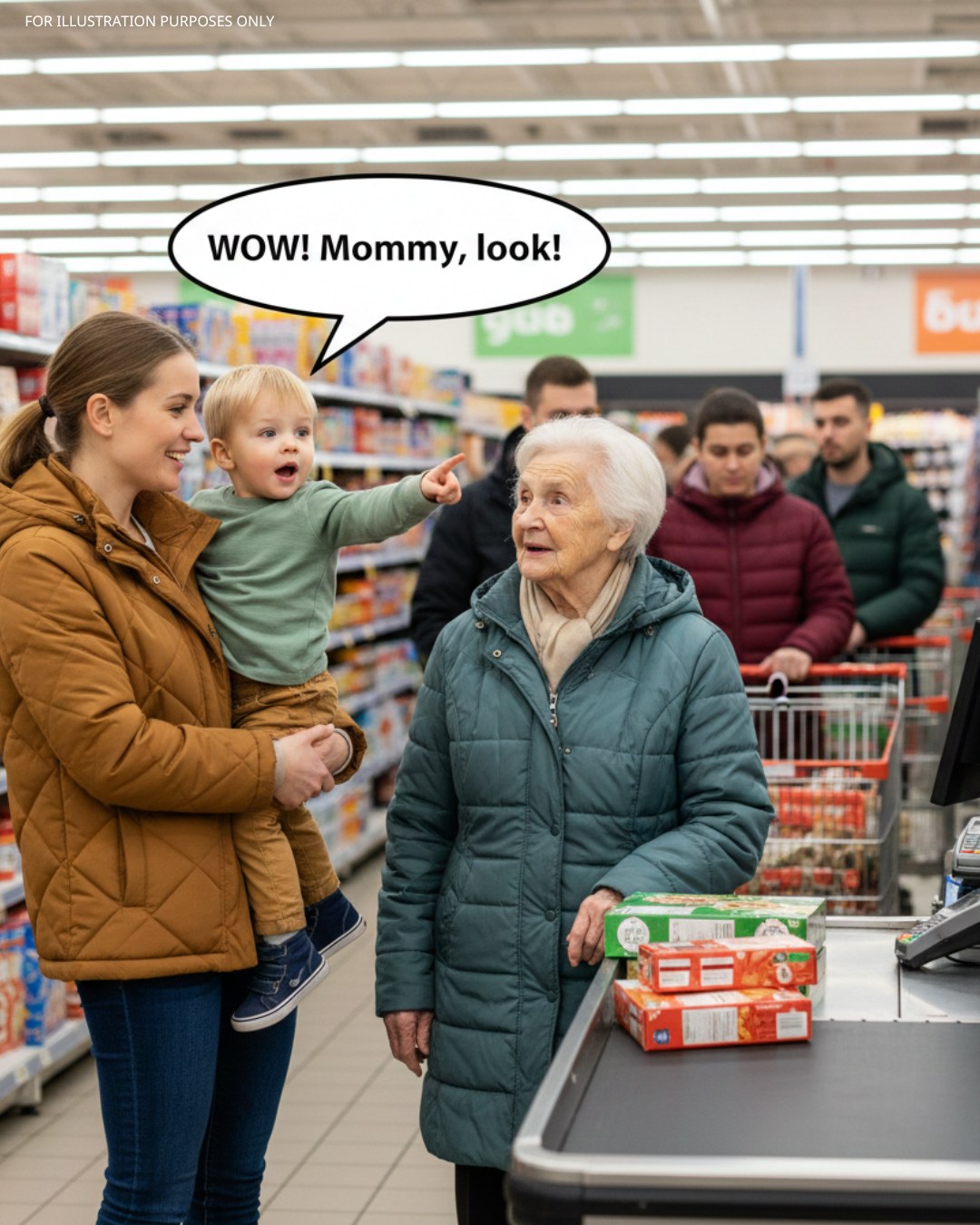
Standing ahead of us was an elderly woman, likely in her late seventies. Her silver hair was gently pinned back, loose strands framing a face etched with life. She wore a soft green cardigan, worn thin at the elbows — the kind of clothing that tells quiet stories of years passed.
Her cart held only necessities: bread, milk, canned soup, potatoes, and a small apple pie lightly dusted with sugar. The kind my grandmother used to make in the fall.
As the cashier scanned each item, the woman mouthed numbers under her breath. Her hands tightened around her purse.
Then the total appeared.
She paused.
Just briefly — but long enough for the mood in the line to shift.
She inserted her card.
Beep.
Declined.
“Oh dear,” she whispered. “I must’ve entered the wrong number.”
She tried again.
Declined.
Someone behind me sighed sharply.
“For heaven’s sake,” a man muttered.
Another voice snapped, far louder than necessary.
“If you can’t afford groceries, why are you even here?”
The woman’s face flushed. Her shoulders pulled inward.
“I’ll put the pie back,” she said softly. “It’s not needed.”
Something inside me twisted.
That pie — that small sweetness — was likely the one indulgence she’d allowed herself. For Owen and me, it was the occasional dessert cup. Survival teaches you how precious those tiny comforts are.
Before I thought it through, the words left my mouth.
“It’s okay,” I said. “I’ve got it.”
She turned toward me, startled. Her eyes shone — tired eyes that had seen too many moments like this.
“You don’t need to do that,” she insisted gently.
“I’d like to,” I said, already reaching for my card.
The cashier processed the payment without comment.
The woman looked at me as though I’d handed her something far more valuable than groceries.
“Thank you,” she whispered. “I don’t know how to explain what this means.”
“Please,” I said. “Just take it.”
Owen lifted his small hand and waved enthusiastically.
“Bye-bye, Grandma! Have a good day!”
She laughed softly through tears as she waved back.
“You too, sweetheart.”
She left holding the pie close to her chest, and within seconds, the line resumed — indifferent, impatient, already moving on.
Two days later, we returned to the same store.
Owen tugged at my hand as we walked in.
“Mommy! Chocolate milk?”
“Only if it’s on sale,” I replied. “Red sticker, remember?”
He suddenly froze.
“Mommy — look!”
Near the entrance, taped beside a cluttered bulletin board, was a cardboard sign. On it was a printed still from the store’s security camera.
My face. Owen grinning beside me.
Above it, handwritten in thick marker:

“Please call me. You helped my mother, and we want to thank you.”
I felt exposed. A private, instinctive moment — now public.
I went straight to customer service. The store manager apologized and removed it immediately.
That night, after Owen fell asleep clutching his cup of chocolate milk, I stared at the phone number.
Eventually, I called.
The voice on the other end was warm — relieved.
“She hasn’t stopped talking about you,” the man said. “Would you meet us? She’d really like to thank you properly.”
Against my instincts… I agreed.
We met at a cozy coffee shop the next afternoon.
The elderly woman greeted me with a hug as if we were already family. Beside her stood her son, John — kind-eyed, soft-spoken, familiar in a way I couldn’t quite explain.
“My card had expired,” she admitted quietly. “But it wasn’t just that. What hurt was feeling invisible.”
“You weren’t,” I said. “And you never should be.”
She smiled, then said gently, “I’d like to open a savings account for Owen. For his future.”
I tried to refuse. She insisted — not as charity, but gratitude.
And something inside me finally loosened.
Coffee led to conversations. Conversations became dinners. Dinners became memories.
John and I discovered shared wounds, quiet understanding, and something steady growing between us. Owen adored him — instinctively, as children do.
A year later, under an oak tree in her backyard, we were married.
Three months after that, John adopted Owen.
Every night, Owen still asks about that grocery store visit.
And every time, I remember how one small act — one apple pie, one moment of compassion — reshaped our lives.
Not loudly.
Not suddenly.
But completely.
Note: This story is a work of fiction inspired by real-life moments. Names, details, and events have been altered. Any resemblance is coincidental. Images used are for illustrative purposes only.