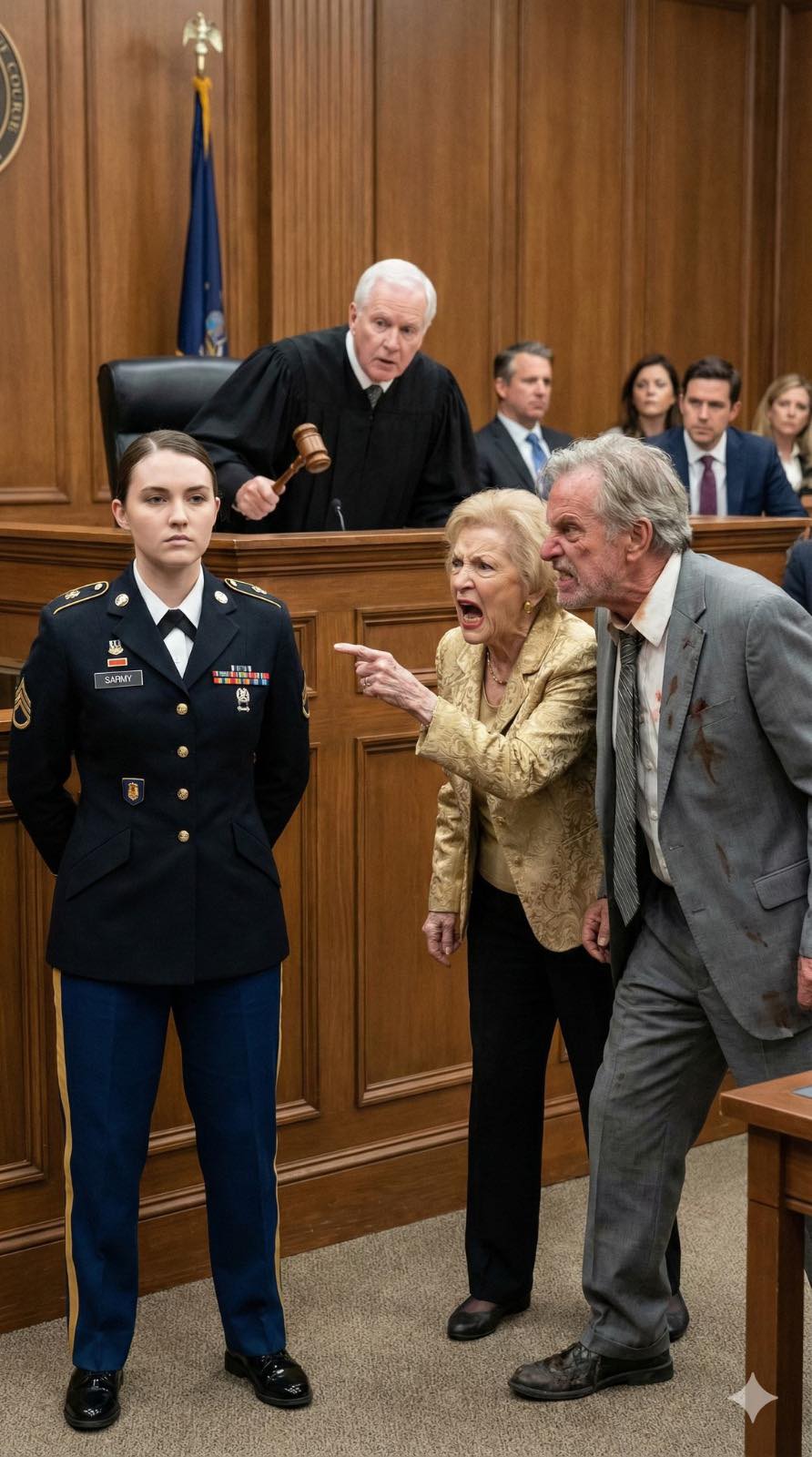
They thought the will was just money, just numbers on a page to be clawed back with lies and expensive suits. They never understood it was a fuse. Her grandfather had spent fifteen years wiring every secret, every bribe, every bruise on her childhood into a single, devastating detonation.
When the judge recognized her, the past stopped being a private nightmare and became evidence, and the courtroom turned into a reckoning no one could quietly buy.
As the handcuffs clicked around their wrists, she finally saw them clearly: not monsters, not gods, just small, greedy people cornered by the truth they’d sold so many times before. The check in her hand felt colder than the rain at the grave, but it wasn’t an ending.
It was a weapon she could refuse to use like them. Leaving the cemetery, she understood: the real inheritance was the power to break the cycle—and kick down doors for children still waiting in the dark.
PART 2 : Inheritance Judge’s Dark Secret
The city smelled of rain and exhaust as she stepped back into the streets, but it no longer felt oppressive. Every corner seemed to whisper the secrets she had unearthed, yet instead of fear, she felt clarity. Years of whispered threats and cold silences had sharpened her instincts; now, they guided her like a compass she had never trusted before. She realized the courtroom victory was a hinge—what swung open next would be entirely her choice.
Her first calls were quiet, careful, reaching out to people who had once seemed untouchable. Some answered with suspicion, others with relief. She wasn’t here to punish them—at least, not exactly—but to build something sturdier than revenge. Each conversation was a small, strategic act: a test of loyalty, a mapping of who could be allies in a world that had tried to train her to distrust everyone.
Nights were the hardest. In the solitude of her apartment, the memories that had been dormant under her grandfather’s careful orchestration sometimes clawed their way back. Faces, voices, shadows of abuse—all replayed like films in black and white. But this time, she did not collapse beneath them. She cataloged them, filed them away, and used the pain to craft new strategies: programs, foundations, safe spaces. She was no longer a survivor; she was a planner, an architect of prevention.
By the second week, the city had started to notice her presence. The media whispered about the young woman who had taken down a family empire and refused the fortune that came with it. She watched the coverage with a detached amusement. The real story wasn’t about wealth or justice; it was about agency—the quiet, invisible force that allowed someone to take their suffering and turn it into a ladder for others.
PART 3 : Inheritance Judge’s Dark Secret
The foundation she built was modest at first: a small office in a converted warehouse, a handful of staff who believed in action over applause. But even in those cramped rooms, the energy was electric. Every call from a child in danger, every report of corruption, every small victory was like a spark lighting a larger fire. The work was relentless, exhausting, and sometimes heartbreaking, yet she welcomed it—it felt purposeful in a way that money or revenge never could.
Not everyone appreciated her methods. Old allies of her grandfather tried subtle intimidation; some whispered threats, others made veiled offers of cooperation. She met each with the same quiet strength that had carried her through the courtroom. Fear and manipulation held no sway over someone who had already seen the machinery behind them. Instead, she listened, cataloged, and used the knowledge to reinforce her defenses. The empire of lies had crumbled; now, the real work was protective, constructive, and unstoppable.
Her nights grew shorter, her dreams more vivid. In the corners of her mind, the ghosts of the past sometimes lingered, but they no longer dictated her actions. She learned to speak for them in meetings, in reports, in strategies: the children who had no voice became her compass. She realized that her grandfather’s true gift wasn’t the will, or the trap, or even the courtroom reckoning—it was showing her how to transform pain into power.
Then, one late afternoon, as the city was drenched in an amber sunset, she received a letter without return address. The envelope was thick, heavy, and the handwriting familiar enough to make her pulse quicken. Inside was a note, simple and chilling: “You’ve started something. Don’t let them stop you.” She smiled. That was the confirmation she didn’t need: the cycle could be broken, and she had already begun.