Based on your new source transcript, here is the polished long-form narrative in exactly 3 continuous parts.
Life had a way of beating a person down until even their own boots felt like enemies. Edy Brooks knew that better than most.
By the time the winter of 1873 rolled over Widow’s Peak, she had already been living alone for 3 hard years, and each season had taken something from her. First Samuel, her husband, who had died and left her with 40 rough acres of mountain land in the Colorado Territory and a cabin too full of memory to ever feel empty, no matter how much silence lived in it. Then her health, worn thinner by work and grief. Then the easy strength she used to carry in her body before widowhood and loneliness taught her how heavy a life could become when only 1 pair of hands remained to manage it.
The mountain suited her because it asked little in the way of conversation. The nearest neighbor lived 6 miles downhill. The town itself was farther still. Gossip could reach her, of course, but only as an echo, thinned by distance and pine trees and the hard good work of survival. Up there, she could split wood, mend dresses, tend a small stubborn garden, and let her grief sit beside her without needing to explain it to anyone.
That February evening, the wind tore at every loose board on the cabin as if it meant to take the whole place down by force. Edy was at the kitchen table, mending a torn dress by lamplight, when the knock came.
At first it was so faint she nearly missed it beneath the storm.
She held the needle still in midair.
Nobody came calling on Widow’s Peak in weather like that. Nobody with sense, at least. Mountain men sometimes passed through. Drifters too. A widow alone on 40 acres of isolated land learned quickly not to assume every voice at the door belonged to someone decent. Samuel had taught her to shoot before he taught her to bake bread, and after his death she had more than once had reason to be grateful for that ترتیب of lessons.
The knock came again, a little louder this time, though weaker too, like whoever stood out there was being held upright by almost nothing.
Her hand went to the Winchester hanging above the door.
“Who’s there?” she called.
A voice answered, nearly carried away by the wind.
“Please, ma’am. I’m hurt.”
Everything in her said trap.
Bandits could be clever when hunger or greed sharpened them. A wounded boy at the door might be the lure that got a woman to open it wide enough for worse things to come through.
But something about the voice caught her off guard. It did not sound practiced. It sounded worn thin with cold, politeness, and the last of whatever strength a body could spend before giving up.
She cracked the door open just enough to see.
The sight nearly knocked the breath from her.
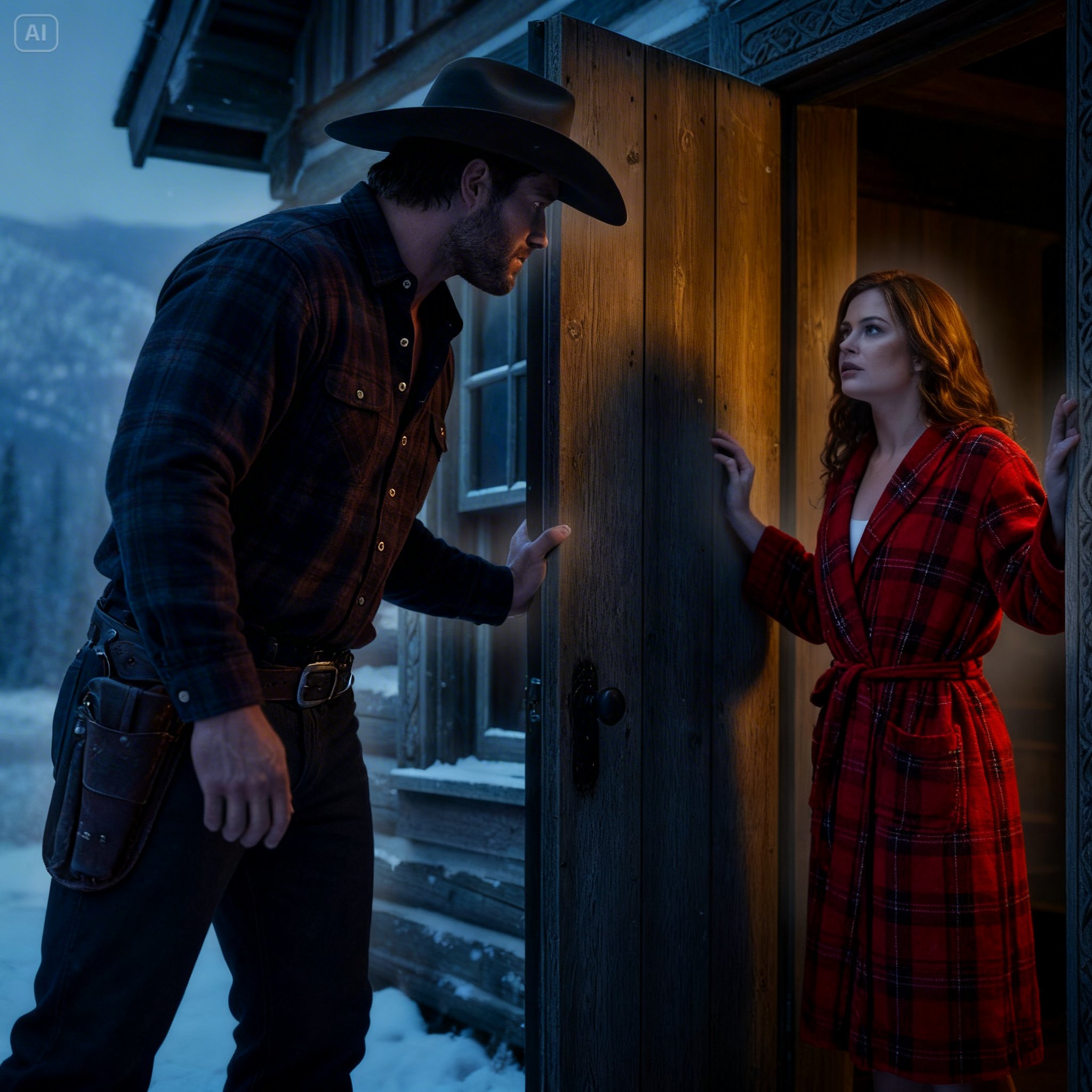
A young man—no, hardly more than a boy—was slumped against the doorframe. Snow clung to his hair and shoulders as if the storm had already started claiming him. Even half folded by weakness, he was enormous. Taller than any man she had ever seen this close, with shoulders broad enough to block half the doorway and hands so large they looked clumsy only until one realized how carefully they were gripping the frame to keep from falling.
“Please,” he whispered again, his lips blue with cold. “I just need bread.”
That was the sentence that undid her.
Not help me, not save me, not anything dramatic enough to feel manipulative. Just bread, spoken like he’d already cut his need down to the smallest possible piece to make it easier for her to give.
She opened the door.
“Get inside before you freeze to death.”
He stumbled over the threshold and collapsed straight onto her braided rug. Up close, she could see that he was maybe 17 or 18 at most, with dark hair matted to his forehead by ice and a long shallow gash near his temple where dried blood had stiffened in the cold. His clothes told the story of several brutal days of travel. Torn coat. Worn boots. Wet through almost to the bone.
“My name’s Harlon,” he managed. “Harlon Tate. My folks… they died of the fever down in Trinidad. Been walking for days.”
Edy stared at him for a long second in the lamplight. No trick. No threat. No slyness. Only exhaustion and loss and that awful hollow look people sometimes got when grief and starvation worked together hard enough.
“I’m Edy Brooks,” she said, kneeling beside him. “And you’re about to die if we don’t get you warm.”
She got him into the chair by the stove with effort. Even weakened, he was so large that helping him felt like trying to guide a felled tree upright. His hands shook too hard to hold the coffee cup properly, so she wrapped his fingers around it and guided it to his lips herself.
“Drink slow,” she warned. “Your stomach’s probably empty as a church on Monday.”
His eyes—brown, tired, and strangely gentle for a body built like that—lifted to hers over the steam.
“Yes, ma’am. Been 3 days since I had anything but snow to eat.”
She ladled stew into a bowl and set it in front of him with a thick slice of bread still warm from that morning’s baking. He tried to eat like a civilized man, slow and careful, but she could see the desperation beneath the manners in the way his hand tightened on the spoon.
“Where you headed, Harlon Tate?”
“Nowhere particular, ma’am. Just away from Trinidad. Too many memories there.”
She understood that better than she wanted to.
“Well,” she said, “you can sleep in my barn tonight. Good hay in there. Warmer than outside.”
Even as she offered it, she heard how it sounded. Half kindness, half distance. She was still practical enough not to invite a strange young man into the deeper parts of her life all in one evening.
“Thank you, ma’am. I’ll work for my keep if you’ll have me. I’m good with my hands.”
That, she believed immediately.
He had the look of someone shaped by labor. But there was something else too. A gentleness in the way he handled the cup, in the way he waited before taking a second bite, in the way he looked at her without ever presuming upon the mercy she had shown.
One night, she thought.
Then we’ll see.
One night became 2. Then a week. Then a month.
Harlon worked like a man with nowhere else to belong and just enough pride left to want his place earned. He repaired the sagging fence posts. Chopped enough wood to get her halfway to summer. Fixed the leak in the barn roof she had been patching badly for 2 winters. His hands, for all their size, moved with surprising care. He could set a nail straight, mend harness leather, and lift a newborn calf with the same deliberate softness.
What changed everything, though, was not the work.
It was the evenings.
After supper, Edy would sew or mend by the fire while Harlon carved little animals from scraps of pine with a pocket knife worn smooth by use. Bears. Eagles. A rabbit. A horse that looked so much like Samuel’s old gelding she had to set it down after a moment because her eyes burned too sharply to keep looking at it.
“Samuel would have liked you,” she said one evening before she could stop herself.
Harlon’s knife stilled.
“Do Not Mind My Size, I Will Be Very Gentle,” The Giant Cowboy Assured the Struggling Widow