The wind on the high Wyoming plains did not whistle. It screamed.
It raced over the frozen ground like a living thing, fierce enough to peel skin raw and cold enough to bury a man if he let it catch him in the open too long. Winter in that country was not a season people endured so much as a judgment they survived one day at a time. The mountains watched. The snow waited. The land took every measure of weakness and answered it without mercy.
Wes Carver knew how to move through that kind of world.
He was built for it in the blunt, unadorned way the frontier sometimes shaped men when it did not kill them first. Tall. Broad through the shoulders. Long coat crusted with blown snow. A scar ran from the corner of his eye to the edge of his jaw, turning one side of his face harder than the other even when he said nothing. Most people in town thought he looked dangerous. They were not entirely wrong. He had lived too much, buried too much, and chosen solitude too completely to be mistaken for easy company.
That afternoon he was pushing his mule through a storm with 2 deer slung over the animal’s back and no expectation beyond getting home before dark. The cabin he’d built with his own hands lay deep in a fold of the mountain where no road passed unless a person already knew it was there. That was the point. Wes had not taken to Widow’s Peak because it was convenient. He lived there because loneliness asked fewer questions than people did.
He nearly passed the wagon.
At first it was just another shape in the white blur, half sunk into frozen mud, wheels twisted wrong, canvas shredded by wind. Trouble. Dead horses maybe. Or drifters. Or some trap laid by men who understood that pity could pull a body closer than greed ever could.
Wes was not a fool.
He kept walking.
Then something under the wagon axle moved, just enough to catch his eye.
A flash of color. A body.
He stopped.
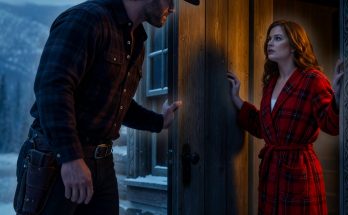
Snow crusted her hair. Her bare feet were blue with cold and cut open from rock and ice. Her dress had been ripped into little more than hanging rags, exposing bruises mottled dark along her ribs and jaw. Her red hair, clogged with dirt and thawed blood, stuck in damp coils to her neck. She looked less like a woman than a scrap of wreckage the storm had not yet finished swallowing.
Any smart man would have left her there.
Wes crouched beside her instead.
Her breath came so faintly he had to lower his hand near her mouth to feel it. Not dead. Not yet. Beneath the dirt and torn cloth he saw more of the bruises. Old ones and fresh ones. Not accident bruises. Not the random violence of a fall. Someone had been working on this girl for a long time.
Then he saw the brand at her shoulder.
A small dark mark shaped like a miner’s pick.
He had seen cattle marked that way. Never a woman.
That made the choice for him.
He lifted her carefully, startled by how little she weighed. A woman should not be that light, not if the world had been even half decent to her. He laid her across the mule, tied her securely so she would not slide off, and turned toward the trees without a backward glance.
By the time he reached the cabin, his gloves were stiff with cold and her skin had gone nearly white where it wasn’t bruised. Inside, he laid her on his own cot, built the fire high, and set water to boiling. He cut away the frozen shreds of her dress with the same knife he used to skin deer, only slower, taking care not to expose more than necessity required. He cleaned the cuts in her feet, the gash at her shoulder, the split skin over her knuckles. He wrapped her in 1 of his shirts and covered her with a heavy bearskin. Then he sat in the chair by the hearth with his knife in hand and watched her breathe.
Hours later, she woke with a gasp sharp enough to make even the fire seem to hush.
Her eyes flew open wild and unfocused. She sat up too quickly. The bearskin slid to her lap. She clutched the wool shirt closed with both hands and stared at him as though expecting the next breath to cost her dearly.
“Where am I?” she whispered.
“My cabin,” Wes said. “You’re safe from the storm.”
She did not believe him. He could see that immediately. Fear moved through her body in small visible currents—her shoulders, her hands, the way her eyes kept flicking to the door and then back to him.
“Don’t touch me,” she said.
“I won’t.”
He nudged a cup of hot broth across the floor toward her with the toe of his boot and sat back down. He did not move closer. Did not explain himself. Did not ask questions he had no right to ask.
She watched him for a long time before taking the cup.
For days, that was how it went.
She ate because hunger made refusal impossible. He changed the bandages on her feet and shoulder because infection would have killed her quicker than the cold. He spoke only when necessary. Yes. No. Rest. Eat. His silence unsettled her more than threats might have, because she seemed to know what to do with cruelty and none at all with restraint.
The cabin held only the 2 of them, the stove, the fire, the table, the narrow bed, and the endless sound of wind outside. It was no place for secrets, and yet both of them carried enough to fill the room.
When the fever left her and she could finally stand without swaying, she began moving through the cabin restlessly. She swept the floor. Straightened the blankets. Wiped down the table. Anything to make herself useful. Anything to push back against the awful uncertainty of why she was there and what he expected.
Wes watched her as he mended traps, cleaned his rifle, or sat with a knife and a block of pine in his hands, carving little creatures that emerged one by one from the wood. A hawk. A rabbit. A small goat. He had gentleness in his hands, and that made him harder to understand than a cruel man would have been.
One night, while he shaped a snowshoe strap by the fire, she asked, “Why did you bring me here?”
He did not look up at first.
“You would have died.”
“Men don’t help for nothing.”
That made him raise his eyes.
They held on each other for a long second before he answered.
“I don’t want anything from you.”
Her jaw tightened. Anger came easier than confusion.
“What are you hiding from?” she demanded. “Why live out here like some badger in a hole?”
He stood, and the room seemed to shrink around him.
“I’m Too Big For You,” He Warned — But She Straddled The Cowboy And Whispered, “Try Me Tonight