I’m a hospice nurse and this biker sits with every single patient who dies alone. For 3 years I thought he was Death himself. Showing up in his leather vest and gray beard whenever someone was about to pass. Never missing. Never late. Always there in the final hours.
The first time I saw him, I almost called security. Room 412. Margaret Chen. Ninety-one years old. No family. No visitors in six months. She had hours left and I was preparing to sit with her myself because nobody should die alone.
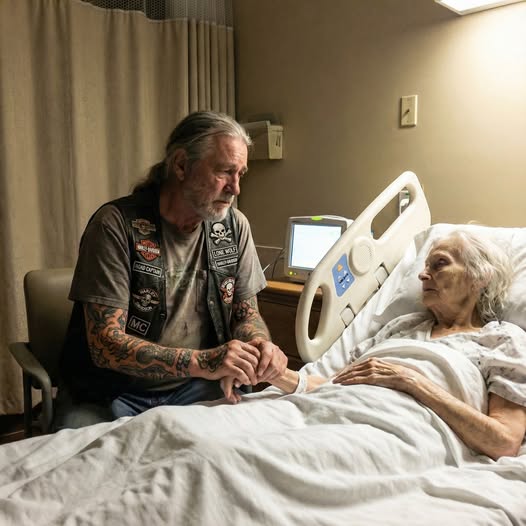
Then he walked in. 6’3″. Leather vest covered in patches. Tattoos up both arms. Boots that echoed down the hallway. He nodded at me, pulled a chair next to Margaret’s bed, and took her frail hand in his massive one.
“Who are you?” I demanded. “Family only beyond this point.”
He looked at me with the saddest eyes I’ve ever seen. “She doesn’t have family. That’s why I’m here.”
“How do you know she doesn’t have family? How do you even know she’s here?”
He didn’t answer. Just turned back to Margaret and started talking to her softly. Telling her it was okay to let go. Telling her she wasn’t alone. Telling her she mattered.
Margaret died forty-seven minutes later. Peaceful. Holding a stranger’s hand.
The biker stood up, kissed her forehead, and walked out without a word.
I reported it to my supervisor. She just smiled sadly. “That’s Thomas. He’s been coming here longer than I have. Nobody knows how he finds out about the patients. Nobody knows why he does it. But he’s never missed one.”
“Never missed one what?”
“A lonely death. Every single patient who’s about to die alone, Thomas shows up. Every single time.”
I became obsessed with understanding him. Started keeping notes. Over the next three years, I watched Thomas appear for sixty-three patients. Sixty-three people who had nobody.
Sixty-three people who would have died staring at ceiling tiles with only the beeping of machines for company.
He sat with Vietnam veterans abandoned by their families. With elderly women whose children lived across the country and couldn’t be bothered to fly in. With homeless men we’d taken in from the streets. With a nineteen-year-old girl whose parents had disowned her for being gay.
Every single one. Thomas was there.
He never spoke to staff. Never signed in at the front desk. Never explained himself. He’d just appear, sit, hold their hand, and stay until they passed.
Some patients were conscious. They’d talk to him. Tell him their life stories. Their regrets. Their secrets. Thomas listened to every word. Nodded. Cried with them. Told them they mattered.
Other patients were already unconscious. Didn’t matter to Thomas. He’d sit there anyway. Talk to them anyway. Hold their hand anyway.
“They can still hear,” he told me once. The only time he’d spoken to me since that first night. “Even when they can’t respond. They know someone’s there. They know they’re not alone.”
I tried to research him. Asked around. Nobody knew his last name. Nobody knew where he lived. Nobody knew anything except that he rode a motorcycle and he showed up when people were dying alone.
One night I followed him out to the parking lot. Watched him climb on his Harley. Watched him sit there for ten minutes without starting the engine. Watched his shoulders shake.
He was sobbing.
I walked over slowly. “Thomas?”
He looked up. His face was wet. His eyes were red. “Sorry. I just need a minute.”
“You don’t have to apologize.” I sat on the curb next to his bike. “Can I ask you something?”
He nodded.
“Why do you do this? Three years I’ve watched you. Sixty-three patients. You show up for every single one. Why?”
Thomas was quiet for a long time. Then he reached into his vest and pulled out a photograph. Handed it to me.
It was a woman. Beautiful. Maybe sixty years old. Smiling at the camera.
“My mother,” Thomas said. “Eleanor. She died in a hospice facility in 2007. Alone.”
My heart sank.
“I was on a cross-country ride. Took me three days to get back. She died fourteen hours before I arrived.” His voice cracked. “The nurses told me she kept asking for me. Kept looking at the door. Kept waiting for her son to show up.”
“Thomas, I’m so sorry.”
“She died alone. Staring at that door. Waiting for me.” He wiped his face. “I was her only family. And I wasn’t there. I was riding through Nevada while my mother died alone asking where her son was.”
I didn’t know what to say. There was nothing to say.
“After her funeral, I couldn’t sleep. Couldn’t eat. Couldn’t function. All I could think about was her lying there alone. Wondering why I didn’t come. Wondering if I even cared.”
He took the photograph back. Stared at it.
“One night I was at a bar. Drunk. Thinking about driving my bike off a bridge. A guy next to me started talking. Told me his wife was dying at the hospice across town. Said he couldn’t bring himself to go. Couldn’t watch her die.”
“I don’t know what came over me. I sobered up, rode to that hospice, and sat with her. Complete stranger. Held her hand for six hours until she passed. Her husband never showed up.”
Thomas looked at me. “When she died, something happened. I felt peace for the first time since my mother passed. Like maybe I couldn’t save my mom from dying alone, but I could save someone else’s mom. Someone else’s wife. Someone else’s grandmother.”
“So you just started showing up?”
“I talked to hospice workers. Nurses. Social workers. Asked them to let me know when someone was dying alone. Word spread. Now I get calls from six different facilities.”
“You’ve been doing this for sixteen years?”
Thomas nodded. “Four hundred and twelve people. I’ve sat with four hundred and twelve people while they died. Exposed to every disease. Every smell. Every bodily function. Held hands that were cold and stiff. Listened to death rattles that haunted my dreams. Watched the light leave four hundred and twelve pairs of eyes.”
“And you keep coming back.”
“I’ll keep coming back until I die. Because every single one of those people deserved what my mother deserved. Someone there. Someone holding their hand. Someone telling them they mattered.”
I was crying now. Couldn’t help it.
“The staff here thinks I’m creepy,” Thomas said with a sad smile. “I know they talk about me. Wonder if I’m some kind of death fetishist. Some weirdo who gets off on watching people die.”
“I used to think you were Death himself,” I admitted. “Showing up right before people passed. Like you knew.”
“I do know. That’s the hardest part. The nurses call me when someone’s close. I drop everything. Ride here as fast as I can. Sometimes I make it. Sometimes I don’t.”
“What happens when you don’t make it?”
Thomas’s face crumpled. “That’s the worst. When I walk in and they’re already gone. When I know they died alone because I wasn’t fast enough. Those are the nights I can’t sleep.”
He started his motorcycle. The engine rumbled to life.
“Thomas, wait.” I stood up. “What you’re doing… it matters. More than you know. Those sixty-three patients I watched you with? They all died peaceful. Every single one. That’s not a coincidence.”
He nodded but didn’t look at me.
“Your mother would be proud of you.”
That broke him. He killed the engine and put his face in his hands. Sobbed like a child.
I stood there awkwardly, not sure what to do. Finally I put my hand on his shoulder. “You’ve been carrying this alone for sixteen years. You don’t have to.”
“Who else is going to do it?” he asked. “Who else is going to show up for the people nobody wants?”
“Let me help. Let me tell the other nurses. Let us support you.”
Thomas shook his head. “I don’t want recognition. Don’t want praise. I just want to be there. That’s all. Just be there.”
He started his bike again. “I’ll see you next time, nurse. Hopefully not too soon.”
He rode away into the darkness. I stood in that parking lot crying for twenty minutes.
The next lonely death was two weeks later. Harold Martinez. Seventy-eight. Estranged from his children after a bitter divorce thirty years ago. Dementia had taken most of his memories, but he still cried out for his kids sometimes.
Thomas was there. Sat with Harold for nine hours. Held his hand. Told him his children loved him even if they couldn’t be there. Told him he was a good father. Told him he was forgiven for whatever he thought he’d done wrong.
Harold died peaceful. Smiling. Holding Thomas’s hand.
After, I brought Thomas coffee in the hallway. He took it gratefully.
“How do you do it?” I asked. “How do you keep giving pieces of yourself to strangers?”
“They’re not strangers by the end,” Thomas said. “By the end, I know their whole lives. Their regrets. Their proudest moments. Their secrets. I probably know more about these people than their own families do.”
“Doesn’t that hurt? Knowing them and then losing them?”
“Every single time.” He sipped his coffee. “But the alternative is them dying unknown. Dying forgotten. Dying thinking nobody cared. That hurts worse.”
I started sitting with Thomas sometimes. When my shift allowed. Watching him work. Learning from him.
He had a gift. A way of making people feel safe. Feel valued. Feel loved in their final moments. He’d hold their hands and tell them stories. Ask them questions. Laugh with them. Cry with them.
One patient, a former teacher named Dorothy, spent her last hours telling Thomas about every student she’d ever taught. Hundreds of names. Hundreds of stories. Thomas listened to every single one.
“You were a wonderful teacher,” he told her as she faded. “All those children you helped. All those lives you changed. You mattered, Dorothy. You mattered so much.”
She smiled and closed her eyes. Never opened them again.
Another patient, a veteran named James, was angry. Bitter. Cursed at Thomas when he first arrived. “Who the hell are you? Get out of my room!”
Thomas didn’t leave. Just sat there. Took the abuse. Waited.
Eventually James broke down. Started talking about Vietnam. About the friends he’d lost. About the guilt he’d carried for fifty years. About why his family had abandoned him.
“I wasn’t a good man,” James said. “I did things over there. Things I can’t forgive myself for.”
Thomas held his hand. “You were a soldier. You did what you had to do. And you’ve carried that weight alone for fifty years. It’s time to put it down, brother. It’s time to rest.”
James cried. First time in decades, he told Thomas. First time since 1971.
He died that night. Peaceful. Forgiven.
The most devastating one was a nineteen-year-old girl named Lily. Cancer. Her parents had disowned her two years earlier when she came out as gay. She’d been alone ever since.
Thomas sat with her for three days. Barely slept. Barely ate. Just sat there holding her hand.
“My parents hate me,” Lily whispered. “They think I’m going to hell.”
“You’re not going to hell,” Thomas said firmly. “You’re going somewhere beautiful. Somewhere you’ll be loved exactly as you are.”
“How do you know?”
“Because I’ve sat with four hundred people while they died. And every single one of them went somewhere peaceful. I saw it in their faces. The fear left. The pain left. And something beautiful took its place.”
Lily squeezed his hand. “Will you stay until the end?”
“I’m not going anywhere, sweetheart. I promise.”
She died on the third day. Thomas was holding her hand. Telling her she was loved. Telling her she mattered. Telling her she was perfect exactly as she was.
After Lily, I found Thomas in the parking lot again. Crying on his motorcycle.
“She was nineteen,” he said. “Nineteen years old. Died thinking her parents hated her. Died alone because she loved the wrong person.”
“She wasn’t alone,” I reminded him. “You were there.”
“It’s not enough. It’s never enough.” He looked at me with broken eyes. “I can’t replace their families. Can’t give them what they really want. All I can do is show up and hope it helps.”
“It helps, Thomas. Trust me. It helps more than you know.”
He’s still coming. Four years now since that first night with Margaret Chen. The staff knows him now. Respects him. Calls him when someone’s close.
Last month, Thomas had a heart attack. Seventy-one years old. Decades of stress and grief finally caught up with him.
I visited him in the cardiac unit. He was hooked up to monitors, looking small in the hospital bed. First time I’d ever seen him look small.
“You need to rest,” I told him. “Take care of yourself.”
“Can’t,” he said. “Mrs. Patterson in room 203. Ninety-four. No family. Maybe a day left.”
“Thomas, you just had a heart attack.”
“She’s dying alone.” He started pulling at his IV. “I have to go.”
Three nurses held him down. Sedated him. He fought the whole time.
Mrs. Patterson died that night. Alone.
Thomas found out the next morning. I’ve never seen a man so destroyed. He blamed himself. Said he’d failed her. Said he’d broken his promise.
“You were in the hospital,” I told him. “You almost died yourself.”
“Doesn’t matter. I should have been there. She died alone because of me.”
He checked himself out against medical advice that afternoon. Rode his motorcycle home. Was back at the hospice the next day.
“You’re going to kill yourself,” I told him.
“Then I’ll die doing something that matters.”
I couldn’t argue with that.
Thomas is seventy-two now. His heart is weak. His body is failing. But he still shows up. Still sits with the dying. Still holds their hands and tells them they matter.
I asked him once what he wants when his time comes.
“I want someone there,” he said simply. “I don’t want to die like my mother. Alone. Waiting for someone who never came.”
I made him a promise that day. When Thomas’s time comes, he won’t be alone. I’ll be there. The other nurses will be there. The patients he’s saved from lonely deaths—their families will be there.
Because a man who’s sat with over five hundred dying strangers deserves to have someone sit with him.
That’s what I’ve learned from Thomas. Death isn’t the tragedy. Dying alone is the tragedy. Dying thinking nobody cares. Dying believing you don’t matter.
Thomas has spent sixteen years making sure that doesn’t happen. Sixteen years of showing up. Sixteen years of holding hands. Sixteen years of telling strangers they’re loved.
He’s not Death. He’s the opposite of Death. He’s the man who makes sure Death doesn’t win completely. Who makes sure every person, no matter how forgotten, leaves this world knowing they mattered to someone.
I’m a hospice nurse. I’ve seen a lot of death. But I’ve never seen anything like Thomas.
And I hope I never stop seeing him walk through those doors. Leather vest. Gray beard. Sad eyes. Ready to hold another stranger’s hand.
Ready to make sure nobody dies alone.