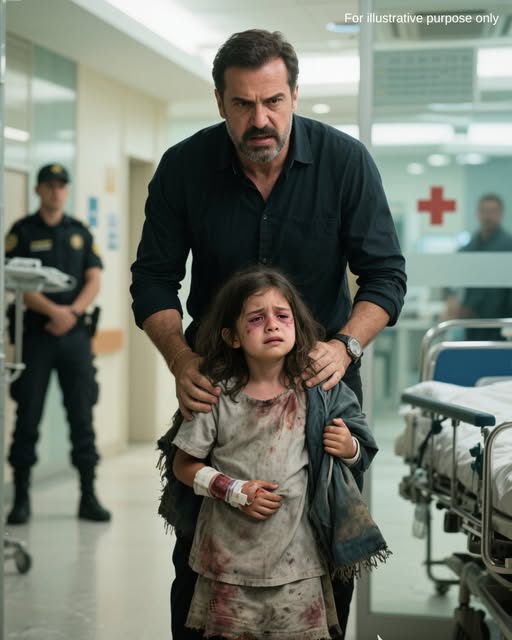
Lia was eight years old and carried the weight of someone who had suffered for lifetimes. That evening, she stumbled into the lobby of a private hospital where the marble gleamed as if untouched by time, and soft music drifted through the air like expensive perfume. Her bare feet left dark marks on the pristine floor, and the stark contrast between the broken child and the untouched luxury made some onlookers look away quickly, as though misery were contagious.

Her stomach burned intensely. It wasn’t just any pain; it felt like a claw tightening around her insides with each step, forcing her to bend over and clutch her abdomen, trying to hold herself together. Her lips trembled, yet she gathered enough strength to move toward the reception desk. She thought of hospitals as places where life mattered more than wealth, than appearance, than smell.
Behind the counter, a young receptionist named Cintia, with a practiced smile and icy eyes, watched Lia approach. Recently hired, she had big ambitions and was eager to rise quickly, cautious of anything that might mar her first week. For Cintia, the lobby was a stage, and the hospital had to appear exclusive, spotless, perfect. The little girl with her tangled hair and tear-streaked face was an unwelcome blemish on that image.
“Please…” Lia whispered, placing her dirty hands on the cold marble. “Help me. It hurts so much.”
The silence hung heavily in the air. Two security guards near the entrance stood taller, focusing on the receptionist’s cue, not the girl’s whimper. Cintia regarded those hands as if they were litter on a pristine tablecloth. Her face tightened.
“We don’t treat beggars here,” she said, loud enough for all to hear. “This is a hospital for decent people. Leave at once.”
The words hit Lia like a slammed door. Her shoulders drooped, her eyes filled with a fear no child should ever have to know. Yet, she didn’t move. A painful truth stronger than shame anchored her: she had nowhere else to go.
“I have nowhere to go,” she stammered, her voice shaking as another wave of pain made her bite her lip. “Just a doctor… please.”
Cintia picked up the phone as though calling for a package pick-up. The guards started toward the counter. All around them, well-dressed visitors pretended to check their phones, glance at their watches, or read magazines. It wasn’t that they didn’t see; it was that they had learned not to get involved.
Across the room, a man in his fifties sat quietly on a cream-colored leather sofa, observing. He wore simple clothes—beige pants, a cotton shirt, and worn shoes. He seemed like just another visitor. No one would guess he was the hospital’s owner, the man behind the contracts and the financial statements. His name was Artur Monteiro, and for years, he had felt like a ghost in his own empire.
Artur had built his wealth through discipline, vision, and an almost ruthless ability to read numbers. But there was a wound in his life that no amount of money could heal. Years ago, in a different hospital, he had watched his daughter Lúcia’s pale face and had come to understand how trivial money was compared to the fragility of the human heart. Since then, he bought hospitals, not to expand his wealth, but as silent monuments to fill the emptiness he couldn’t define.
That evening, he had come to observe—not the reports, but the people. Because he always believed something that wasn’t in the charts: the true worth of a hospital is seen in how it treats those who arrive with nothing.
And now, the test before him was called Lia.
The guards reached the girl. The younger one extended his hand, full of practiced harshness. The older guard, Jonas, hesitated for a moment. There was weariness in his eyes and something more—perhaps a flicker of humanity. Maybe because he had a granddaughter of Lia’s age. Maybe because that cry sounded less like a whim and more like a cry for survival.
“Let’s go,” ordered the young guard. “No fuss.”
Lia clung to the edge of the counter as though it were a lifeline. Her nails scraped the marble, and her sobs turned into thin cries that pierced through the music. No one moved. No one said “stop.” The entire hospital seemed to hold its breath.

Artur clenched his fists. His blood boiled, but there was an ancient chill creeping up his spine. This scene wasn’t new; it was a repeat with a different face. For a brief moment, he saw Lúcia in that dirty face. And it tore him apart.
The guards pulled Lia away, dragging her toward the glass doors where hope had entered. She fought them weakly, more out of desperation than strength. Then the pain won. Her legs gave way, and her screams turned into a moan. Her eyes glazed over, as though the ceiling had become an unreachable sky.
And she fell.
Not like someone who surrendered, but like someone who could no longer stand.
Her small body lay limp in the guards’ arms, on the cold marble, surrounded by stares that didn’t know where to look. The silence that followed was more brutal than the screams. Cintia frowned, not bothered by the gravity of the situation, but by the disruption to the façade.
“Get her out of here,” she muttered. “Before the customers see this.”
At that moment, Artur stood. He didn’t do it hastily, but with the determination of someone whose mask of observation had shattered, revealing the father—the one still burdened by a broken promise.
He crossed the lobby with long strides. The guards glanced at him and, for a moment, hesitated. Artur stopped in front of Lia, looking closely at her: feverish skin, ragged breathing, fragile and in pain.
“Give her to me,” he ordered, his voice quiet but commanding.
Jonas, the senior guard, instinctively obeyed. There was something in Artur’s eyes that couldn’t be learned in training: the urgency to save.
Artur took Lia gently in his arms, as though she were a fragile flame. She was light and warm; her head rested against his arm without resistance. He held her close and moved toward the emergency room.
“Hey!” shouted Cintia, running after him. “You can’t just barge in like that! There’s a procedure!”
Artur didn’t stop. He knew the hospital intimately; he had studied it before purchasing it. He knew where the hallways, the doors, and the emergency rooms were. Every second counted.
Cintia raised her voice even more, drawing the attention of other staff members—a nurse, an administrative worker, a large man who tried to block Artur’s path with a conciliatory gesture.
“Sir, calm down,” the nurse said. “You need to go through admissions. We can’t treat you without a registration.”
Artur paused just long enough for everyone to see what he was holding.
“This girl is unconscious,” he said calmly. “She doesn’t need a form. She needs a doctor. Now.”
Cintia caught up, her rage apparent.
“And who’s going to pay?” she spat. “This isn’t charity. We require collateral. A deposit. Initial capital.”
The word “capital” sounded obscene in that moment. Artur felt pity for her—so tied to status that she couldn’t tell the difference between a life and a bill.
“I will pay,” he said firmly. “Everything.”
Cintia scoffed, looking him up and down as though he didn’t belong.
“Do you know how much a night in the ICU costs? We need a card, documents, proof of insurance…”
Artur took a deep breath. His wealth was vast, but that night, dressed as an ordinary man, his fortune seemed invisible. He wanted to shout that money wasn’t the issue. But it wasn’t just the money. It was the culture, the sickness of a system he had allowed to fester.
An office worker with glasses—Mr. Guimarães—appeared nervously. Cintia asked for the administrative director. The name alone caused the staff to tense up: Dr. Valadares, notorious for his rigidity and obsession with “image.”
Valadares arrived, impeccably dressed, his gaze cold, his walk like that of someone who sees himself as a judge.
“What’s happening?” he asked.
Cintia explained quickly, casting Artur as an intruder and Lia as a problem. Valadares listened and then turned to Artur with a tone that could freeze water.
“Either you provide proof of payment immediately, or we’ll call the police. And hand over the girl. We’ll send her to a public hospital, where she belongs.”
The word “police” hit the hallway like a hammer. Artur understood that there was no room for argument. With men like that, compassion was a language they didn’t understand. They only understood one thing: measurable power.
Artur settled Lia in his left arm. He took out a simple smartphone with a slightly cracked screen. Cintia smirked, convinced he was calling for help.
“Mr. Guimarães,” Artur said, “I need the hospital’s main account details.”
Guimarães, taken aback, reluctantly gave the information. Artur opened his digital wallet, typed quickly, converted funds, and wrote down a number that didn’t seem real.
He confirmed.
Then, looking up, he said, “Check the account.”
Guimarães checked his tablet. His eyes widened. He tried to swallow, but the words wouldn’t come.
“Dr. Valadares…” he whispered.
Valadares hurried over, irritated. He looked at the screen, his face drained of color. Cintia peered over and saw the unthinkable: an immediate deposit of two million dollars.
It wasn’t a promise. It wasn’t words. It was money—already in the bank.
The hallway fell silent. Power had shifted without a shout, without a fight. Just with an impossible number.
Artur turned to the emergency room door, where two doctors were already waiting.
“Now,” he said, “they’re going to save her.”

A stretcher appeared. A nurse rushed over. The bureaucracy evaporated like smoke. Artur gently placed Lia on the stretcher, adjusting her head with a protective touch that seemed like a promise.
When the doors closed, Artur stood alone in the hallway, listening to the echo of his own breath—and to the ghosts that haunted him.
Years ago, in a similar hallway, he had promised Lúcia everything would be alright. It hadn’t been. That defeat haunted him like a shadow.
“Who… who are you?” Valadares asked, now trembling with respect.
Artur looked at him coldly.
“Does it matter?” he replied. “The only thing that matters is behind that door.”
Minutes later, an older doctor came out, his face serious.
“We’ve stabilized her for now,” he reported. “But it’s serious. She needs surgery. The next few hours are critical. Be prepared.”
“Prepared for the worst” struck Artur like a blow to the chest. He leaned against the wall, feeling helpless. Money was useless now. Only hope remained, fragile but stubborn.
“Do whatever needs to be done,” he said. “Use all resources. The cost doesn’t matter.”
Hours passed. Artur paced back and forth, unable to sit still. Valadares tried to discuss technology, investments, prestige. Artur ignored him. He wasn’t there for reputation; he was there for a life.
Helena, the social worker, arrived with a compassionate expression. Artur asked who the girl was and where she came from. Jonas approached and, in a low voice, confessed something that chilled him: it wasn’t the first time the reception desk had “filtered” the poor. Weeks earlier, a poorly dressed old man had been sent away to a public hospital ten blocks away, even though he was struggling to breathe. No one knew what had happened after that.
The surgery lasted nearly three hours. Dr. Afonso emerged, his mask hanging off and exhaustion in his eyes.
“It was complicated,” he said. “The infection was advanced. But we made it. She’s alive.”
Artur exhaled in relief. His legs wobbled—not from fear, but from gratitude. He asked to see her and, after insisting, was allowed a brief visit in the ICU.
Lia looked smaller among the tubes and monitors, but her face was peaceful, clearer than before. Artur stood still, his hand hovering over her, afraid to break that fragile calm. The small mole above her left eyebrow struck him like a cruel coincidence: Lúcia had one just like it.
Helena came in, handing him Lia’s story: Lia Soares. Just turned eight. Her parents had died in a car crash three months ago. No close family. She was placed in a temporary shelter, then ran away six weeks ago. No one had really searched for her. She had become invisible.
Artur closed his eyes. Invisible. That word explained the lobby, the silence of the customers, Cintia’s cruelty, and the polished professionalism. Invisible—until pain became impossible to ignore.
Valadares appeared, announcing that Cintia had been fired, trying to resolve it as if it were an isolated incident. Helena, resolute, contradicted him: this wasn’t just one bad apple, it was the entire tree. There was an unspoken policy to discourage patients with humble appearances—even in the emergency room.
Artur stood, his calm chilling.
“Explain to me,” he said to Valadares, “how your ‘patient profile optimization’ works.”
Valadares stammered excuses about sustainability and ROI. Artur interrupted him, his voice low but filled with authority.
“I invested in this hospital,” he said, “and my return isn’t measured in dollars. It’s measured in lives saved and dignity preserved. You’ve turned a sanctuary into a counter where lives are traded.”
He pulled out his phone and called his advisor.
“I’m Artur Monteiro. Activate the board. Emergency meeting in one hour. Prepare for the immediate dismissal of Dr. Valadares.”
The name hit like a bomb. Artur Monteiro—the reclusive millionaire, the owner. Valadares crumbled. The employees looked at Artur with a mix of fear and admiration. But Artur felt no triumph. He felt exhausted. Firing people wouldn’t undo the harm done to those rejected before.
That same night, Artur, with Helena and Dr. Afonso, decided on something not found in any business plan: the creation of the Lúcia Monteiro Fund to cover any pediatric emergency, no questions asked, no bureaucracy. He reformed the admissions process so that reception would no longer be a barrier but a welcoming gateway, with staff trained to see vulnerability before insurance. He changed the metrics: less billing, more humanity.
Two days later, Lia woke up, confused and scared. The first thing she saw was the man who had carried her, dressed simply, standing beside her with a tired but genuine smile.
Her recovery was slow—not just physically, but emotionally. Helena helped her mourn her parents, helping her process the loss the streets had never allowed her to face. Artur appeared every day: with stories, with ice cream, with patience. He didn’t act like a distant benefactor; he acted like someone who had finally realized what had been missing in his life.
One afternoon, while coloring in a book, Lia asked, her voice sincere:
“Are you going to take me back to the shelter?”
Artur put down his pencil and looked at her for a long time. The answer had been forming inside him since the moment he carried her.
“No,” he said, his voice a little shaky. “I’m not going to send you back. I was thinking… maybe… you’d like to come live with me.”
Lia’s eyes widened as if she had been offered the world.
“With you? But why?”
Artur gently took her small hand in his.
“Because I think we’re both a little lonely,” he whispered. “And maybe… we could keep each other company.”
Three weeks later, Artur walked into the same lobby, but this time, he wasn’t hiding. Yes, he wore a suit, but his gaze was the same: one of someone searching for the human pulse of things. Lia walked beside him, wearing a light dress, new shoes, and her hair braided. She surveyed the space with curiosity, not fear.
The marble still gleamed, the music still played, but something had changed: the coldness was gone. There was now a lower reception desk, comfortable chairs, and a discreet plaque stating that every girl in the emergency room would be treated immediately, free of charge, thanks to the Lúcia Monteiro Fund.
Artur knelt beside Lia in front of the plaque.
“Do you see that name?” he said. “Lúcia was my daughter.”
It was the first time he had said it like that, without hiding his pain. Lia touched the engraved letters with her fingertips. She didn’t understand the finances, the systems, but she understood the heart behind the gesture.
“She would have been special… like you,” Artur whispered.
Lia hugged him tightly around the neck, as though trying to make sure it wasn’t a dream.
“I would have liked to meet her too,” he whispered.
Helena arrived with the final adoption papers. Artur held them for a moment before signing, aware of something that surprised him: his greatest investment, his true legacy, wouldn’t be a building or a balance sheet. It would be a promise kept. An open door. A shared life.
When they left the hospital, they didn’t leave to escape. They left to start anew. And in the lobby, the echo of that cruel phrase that had nearly killed a little girl was buried forever—replaced by a simple, powerful certainty that no luxury can buy, but all humanity needs: no one should be invisible when they ask for help.