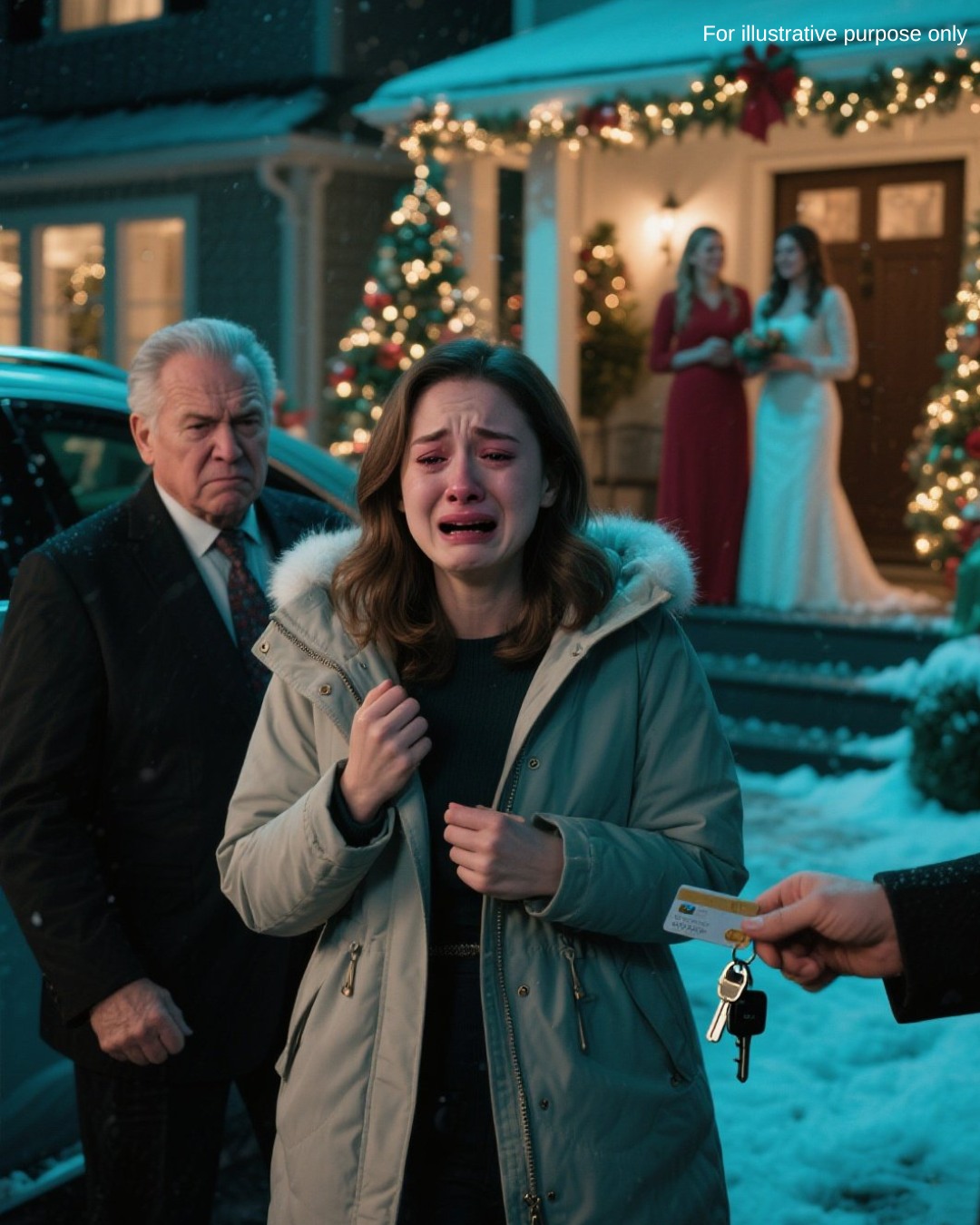
My parents handed my sister $55 million in front of 200 guests, then took my car keys and shut down my credit card. I stepped into the night with one suitcase and nowhere left to go. But…

The iron gate feels colder than it should on Christmas Eve. I stand in the freezing rain, fingers curled around the bars the way a child presses against a candy shop window. Only there’s nothing sweet on the other side. Just the house that was supposed to be home, glowing with warm golden light from every window of the Greenwich estate, while my breath clouds the December air.
I reach for the door handle of my Subaru. Ten years old. A dent on the passenger side from the night I clipped a mailbox during a snowstorm.
But I paid for it? I stammer, my fingers brushing the metal. Every payment. For five years.
Preston’s hand darts through the bars and snatches the keys before I can grab them. Paid through the corporate leasing structure using pre-tax bonuses. His tone is flat, clinical. The same voice he uses when terminating employees. Technically, you transferred the title to the holding company three years ago for tax efficiency. Remember? You don’t work for us anymore. You don’t get the perks.
He turns away. Just turns and walks back toward the house, my keys jingling in his palm like spare change. The sound fades as he climbs the steps, leaving me gripping my small suitcase, watching him vanish without a backward glance.
I should leave. I know I should. But some pathetic part of me keeps waiting for him to turn around.
An hour ago, I walked through those gates thinking I’d sleep in my old bedroom tonight. Thinking maybe Christmas morning would feel normal—or at least familiar. I’d lost my PR job three days before the holiday when the company merged and my entire department was carved away like fat from a roast. The severance would cover two months’ rent somewhere, maybe three if I stretched it, but I needed time to figure out where that somewhere was.
I thought I had time. Instead, I walked straight into Kinsley’s engagement party. Crystal chandeliers. A string quartet. Two hundred guests in cocktail attire watching my baby sister flash her ring beneath soft, romantic lighting while I stood there in work clothes, still damp from the subway.
Preston tapped his champagne glass for silence right there in the foyer. He announced that the family trust—all fifty-five million dollars—had been transferred entirely to Kinsley. Not divided. Not delayed. Transferred. Final. Miranda has demonstrated a consistent pattern of professional failure, he said, his voice echoing across the marble floors. This family rewards success, not mediocrity.
I begged. God, I hate remembering that part, but I begged. I asked if I could stay just a few weeks, through the holidays, until I found another job. I promised to stay out of the way. To help. To be invisible.
Genevieve set her wine glass down with a sharp click. You’re a burden, Miranda. We’re not running a charity for failed adults. You need to leave. Tonight.
The party went silent. Two hundred people watching me stand there with my purse still on my shoulder and my face burning. I slipped out the side door. Grabbed the suitcase I’d packed that morning—the one I thought I’d unpack into my childhood dresser. Then I walked to the front gate like an obedient daughter, because some habits die hard.
That’s where I am now. Shaking. My wool coat soaked through at the shoulders where the rain finds every weak seam. Cold trickles down my spine in slow streams. And standing there in the dark, something finally clicks. This is my fatal flaw. Right here. I’m still waiting for them.
Five minutes pass. Maybe ten. I lose track when my phone battery dies in my pocket, drained by the cold. Inside the house, the lights go out one by one. First the ballroom. Then the dining room. Then the upstairs bedrooms, blinking off like stars at dawn. My mother’s room is last. I imagine her drawing the curtains, smoothing the duvet, climbing into bed without a single thought for her daughter standing outside in freezing rain.
My finger hovers over the intercom. I could buzz. Ask for a blanket. A cab. Anything. But the image of my father’s voice crackling through the speaker, the satisfaction in it when he says no, twists my stomach.
So I grip the suitcase handle instead. The metal is so cold it burns. I feel it through my gloves, through my skin, straight into the bone. Still, I hold on. I turn away from the gate. Away from the house. Away from every Christmas morning, every summer barbecue, every graduation photo that ever happened behind those walls.
Portchester is three miles east. I know because I used to drive past it on my way to the train station—back when I had a car, back when I had a job, back when I had a family. I start walking into the dark. The freezing rain turns the road into a black mirror. My suitcase wheels snag on every crack in the pavement.
Behind me, the estate disappears around a bend, and I don’t look back. Not once. Because if I do, I might stand at that gate forever, waiting for someone who will never come.
Portchester is only three miles from Greenwich, but it feels like crossing into another country. My feet go numb somewhere around mile two. The rain needles my face, and every step sends pain shooting through my ankles where my flats have rubbed the skin raw. The suitcase wheels keep catching on ice, forcing me to drag it like dead weight.
Just after midnight, I pass a Motel 6. The neon sign flickers red and white, promising vacancy, and I think maybe this is where things turn. I still have the emergency credit card in my wallet. The one Preston gave me years ago—for real emergencies only. Being locked out of your family home on Christmas Eve in sub-freezing rain seems to qualify.
The night clerk looks half-asleep behind bulletproof glass. He slides the card reader through the slot without looking up. The machine processes for what feels like an hour. Then it beeps.
Declined.
Try again? My voice cracks. He swipes it twice more. Same result. Says here the card was reported stolen. He checks his screen, then looks at me, suspicion creeping into his expression. About twenty minutes ago.
Twenty minutes. Right after Preston took my keys. Right after he went back inside and shut the door. My father reported fraud while I was still walking through the rain.
I leave without saying anything else. What would I say? The clerk is already reaching for his phone, probably debating whether to call the police about the soaked woman using a stolen card.
The bus stop at the edge of town is the only shelter I can find. Three scratched plexiglass walls and a metal bench. I collapse onto it, the cold seeping through my wet coat straight into my bones. My teeth chatter so hard I taste blood where I’ve bitten my cheek.
That’s when I hear the whimper.
A dog. Maybe forty pounds. Tied to the post with frayed rope. Its fur is matted and soaked, shaking harder than I am. Someone abandoned it here—tied it up and walked away. Just like my family left me at the gate.

I dig through my purse and find half a stale sandwich from two days ago. Turkey and Swiss on wheat, wrapped in wax paper. I crouch and break it into pieces, holding them out. The dog takes them gently, its tail thumping once against the concrete.
We match, I whisper, both of us thrown away on Christmas Eve.
I share the whole sandwich, bite for bite. When we’re done, the dog presses against my leg. I wrap an arm around it, stealing what little warmth we can give each other.
That’s when I notice the woman.
She’s sitting at the far end of the bench, tucked into the shadows. I hadn’t seen her before, but now her shape comes into focus. Elderly—maybe seventy. Wearing a thin house dress and soaked bedroom slippers that don’t belong outdoors. Gray hair hangs in stringy strands around her face.
Cold night, she says. Her voice rattles like loose coins in a tin. The worst. I tug my coat tighter, but it’s pointless. The wool is completely soaked.
Nice coat. She’s shivering violently. Warm?
It was warm. Three hours ago, it was warm. I look at her slippers. At the dress clinging to her frail body. At the blue creeping along the edges of her lips. I stand and shrug off my coat. It’s the last thing I own of any value. My final barrier against hypothermia.
Here.
I drape it over her shoulders. She stares at me like I’ve just handed her a fortune.
You’ll freeze.
You’ll freeze faster.
I sit back down in just my blouse and slacks, and the cold hits like a punch. Wind cuts through the wet fabric, and I shake so hard my vision blurs. But watching the woman pull the coat tight, seeing color return to her face, makes the cold feel a little less like dying.
Ten minutes pass. Maybe fifteen. I start slipping into that dangerous, heavy drowsiness when headlights slice through the rain.
Black SUVs. Three of them, moving together like a motorcade. They stop with military precision, and a man in a dark suit steps out under an umbrella.
Miss Morris? His accent is Irish, clipped. I’m Declan O’Connor. Miss Vance would like a word.
The elderly woman stands. She isn’t shaking anymore. She slips my coat off—and beneath it, she’s wearing a perfectly dry cashmere sweater. The wet slippers are gone, replaced by leather boots that seem to appear out of nowhere.
Adelaide Vance.
She extends her hand as if we’re meeting at a country club instead of a bus stop where I just gave away my last possession. You passed.
No.
My mind can’t catch up. Passed what?
The test, she says, nodding toward Declan, who guides me toward the middle SUV. I have a habit of finding people who choose freezing over watching someone else suffer. She pauses beside the door, her gaze drifting toward the empty road back to Greenwich. My security team has been tracking your father’s movements all night. We knew he’d thrown you out. I needed to see whether you’d break—or survive. Sitting on that bench was unpleasant, but necessary to observe your true character up close.
The SUV’s heated interior feels like paradise. Someone drapes a blanket over my shoulders, and Adelaide settles into the seat across from me, now unmistakably the billionaire she apparently is.
Declan hands me a folder. Your credit report, Ms. Morris.
My hands tremble as I open it. Inside is my signature on a loan guarantee. $500,000 to Morris Holdings, LLC. Dated three days ago.
I never signed this.
No, Adelaide says. Your father forged it. He needed a personal guarantor for a commercial loan that was already sinking. He used you as the scapegoat before cutting you loose.
Each word lands like a separate blow. Not just disinherited. Criminally exposed. My father didn’t merely abandon me—he weaponized me.
Something shifts in my chest. Not grief. Clarity. Cold and sharp as December wind.
You’re not just homeless, Adelaide continues. You’re staring down $500,000 in fraudulent debt that could haunt you for decades. Preston Morris isn’t cruel, dear. He’s a criminal who profited off his daughter.
She leans in. I’m offering you $215,000 a year to train under me. Nine months of hell. But when you’re done, you’ll have the skills and resources to survive what he did to you.
I should feel desperate. Thankful. Overwhelmed. Instead, I feel calculating. I need power. I need money. Not to escape what Preston did—but to turn it back on him.
When do I start?
Adelaide smiles. Right now.
The first boardroom humiliation comes in February. I’m standing at the head of a marble conference table in downtown Manhattan, presenting Adelaide’s mixed-income housing proposal for the South Bronx, when a developer in a gray suit cuts me off mid-sentence.
Who did you say you were again?
My throat tightens. Six months ago, I could own a room. Now I stumble over my introduction, hands shaking as I clutch the presentation remote.
Miranda Morris, executive director of—
Right, right. The trust fund kid.
He leans back, arms crossed. Adelaide, with all due respect, this is a waste of our time. Send someone who actually understands construction.
Adelaide doesn’t intervene. She simply gestures toward the door. I gather my papers, cheeks burning, while twelve people watch me leave like a child dismissed from the adult table.
In the descending elevator, she finally speaks. How did that feel?
Humiliating.
Good.
She presses the lobby button. Now you understand what’s at stake when you walk into the next one unprepared.
The following morning, she hands me a stack of textbooks on forensic accounting and construction management. The pile reaches my chin. You have three months to master the fundamentals, she says. After that, you’ll shadow Declan on site inspections.
March through May disappear in a blur of load-bearing formulas and zoning codes. My apartment turns into a cave of highlighted pages and stale coffee. I teach myself to read blueprints at 4 a.m., the only quiet hour before Adelaide’s car arrives at six.
The site inspections are worse. On my first day at the Port Chester construction site—the same town where Adelaide found me freezing at a bus stop nine months earlier—Declan hands me a hard hat and steel-toed boots. Keep up, he says, and steps into the mud without looking back.
I learn that construction sites reek of diesel and wet concrete. That contractors don’t soften their language for women in pencil skirts. That my Yale degree is meaningless when I can’t distinguish rebar from conduit.
By June, my hands no longer resemble someone who once had weekly manicures. Calluses form slowly, earned from rain-soaked clipboards and endless scaffold stairs under summer sun.
In July, Adelaide assigns me Project Beacon. Her affordable housing initiative: 20 units for single mothers transitioning out of shelters. The budget is razor-thin. The timeline is brutal. The site is a forgotten Port Chester lot that floods every time it rains.
Fix it? Adelaide says, then leaves me ankle-deep in water with a drainage nightmare and three contractors who won’t return my calls.
I fix it. Not because I’m gifted, but because failure would prove Preston right. August is spent learning pump systems and French drains. I negotiate with suppliers who try to overcharge me until they realize I’ve done the math. I earn my crew’s respect by arriving before them every morning and leaving after they do, my rubber boots coated in the same mud as theirs.
By September, we’re ahead of schedule. Foundation poured. Framing complete. I stand in what will someday be a kitchen and feel something unfamiliar. Pride, maybe—or relief that I haven’t failed yet.
That’s when Kinsley finds me.

I’m inspecting the electrical rough-in on a Thursday afternoon when I hear heels clicking on plywood. She navigates the site like it’s a minefield, phone already raised and recording.
Miranda? That artificial sweetness creeps into her voice, the one she uses before drawing blood. Oh my god, is that really you?
I’m in muddy jeans and a flannel. My hair’s pulled into a ponytail that hasn’t seen a salon in nine months. Clay cakes my boots no matter how hard I scrub.
She circles me with her camera. This is so sad. My sister used to work in PR, and now she’s literally digging ditches. She zooms in on my boots. The Morris legacy, everyone. How embarrassing.
I should retaliate. Defend myself. But the old instinct—honed through years of her casual cruelty—kicks in, and I stand silent while she gets her footage.
She posts it before leaving the site. By the time I reach my truck, my phone is exploding. Two hundred shares in Greenwich circles alone. The comments hit like blows.
She really fell from grace. Imagine losing everything and ending up here. This is what happens when you disappoint your family.
I sit in the driver’s seat, mud smeared across the floor mats, shame crawling up my neck. This is exactly what Preston predicted—that I’d fail, that I’d humiliate the name, that I was always disposable.
My phone rings. Adelaide. I saw the post, she says. I’m sorry. I’ll figure out how to—
Come to my office. Now.
I drive to Manhattan expecting to be fired. Instead, Adelaide sits at her desk with Declan, both studying Kinsley’s Instagram on a laptop.
This is actually perfect, Adelaide says.
I must look confused because Declan smirks. You’re a PR executive, Miranda. So do PR.
They’re right. I spent five years shaping narratives for corporate clients. I know how stories move. More importantly, I know how to expose Kinsley for exactly who she is.
That evening, I film a response video. Not in my apartment with soft lighting, but back at the construction site. Standing in the same mud where Kinsley cornered me. My boots are still filthy. My flannel still wrinkled. My voice steady.
My sister is right. I’m not in PR anymore. I’m building affordable housing for single mothers. Twenty families who need a safe place to raise their children.
I turn the camera to the framed structure behind me. This is Project Beacon. If you think helping people is embarrassing, then yes, I’m deeply embarrassed. But if you think building something that matters is worth your time, we’re accepting donations.
I post it at 11 p.m.
By morning, everything has shifted. The comments pour in—different now. Kinsley is labeled elitist. Shallow. Out of touch. Someone posts a side-by-side of her designer handbags and my mud-caked boots with the caption, Guess which Morris sister is actually working?
The Project Beacon donation page crashes. We raise $40,000 in three days.
Adelaide finds me on site the following Monday. You see it now, don’t you?
See what?
That her opinion only matters if you let it.
She’s right. For the first time since Christmas Eve, I realize I’m no longer waiting for my family’s approval. I have Adelaide. Declan. A crew that respects me because I earned it. Twenty future tenants whose children will grow up in homes I helped build.
Kinsley’s post was meant to ruin me. Instead, it proved how far I’d already come.
That afternoon, as I finish my inspection, Declan pulls me aside near the construction trailer. His face is grim. We need to talk about your father.
He hands me his tablet. On the screen is a grainy security photo from a Manhattan restaurant—Preston seated across from Julian Thorne. I recognize him from the Financial News, though his company name seems to change with every article. Quantum Energy Tech is the current one.
Thorne’s fund is under federal investigation, Declan says quietly. Your father’s trying to erase his debts with a miracle investment.
I study the photo. Preston leans forward, eager, desperate—the same look he wore when he snatched my keys through the gate, entitled to take whatever he needs to save himself.
I hand the tablet back. Something cold settles in my chest. Not anger. Just clarity.
How long until it collapses?
Six months. Maybe less.
I nod slowly, watching the crew pack up as the sun sinks behind the buildings. Then we have time to prepare.
Declan studies me. You’re not going to warn him.
No. I’m going to watch.
That day in Adelaide’s office, Declan slides a manila folder across her mahogany desk like a dealer laying down cards. Smooth. Controlled. I’ve learned his tells. When he moves like that, he’s angry.
Quantum Energy Tech, he says. Your father’s been meeting Julian Thorne twice a week for a month.
Inside: glossy prospectuses. Solar panels that likely exist only in a designer’s imagination. Returns so generous they’d make Bernie Madoff blush.
It’s a Ponzi scheme, Adelaide says calmly. FBI’s been building a case for eight months. Declan taps a paragraph. They’re waiting for more deposits. Maybe two months before they move.
I scan the minimum investment requirement. $500,000. Exactly what Preston owes on the loan he forged in my name—plus interest. Too perfect to be coincidence.
I close the folder. He thinks this is his escape.
We could warn him, Adelaide says, without conviction.
If we do, he’ll know we’re watching. He’ll panic. Maybe even try to bury me deeper in his mess.
I walk to the window. Below, crews frame the final Project Beacon building—real housing, real impact.
He needs to commit completely.
So we do nothing? Declan asks.
We create the conditions for him to destroy himself. I turn back. He just needs the right push.
The lawsuit arrives three days later.
I’m reviewing permits when my phone buzzes. A process server catches me in the parking lot, hands over the papers with an apologetic shrug. I read them as cement dust settles on my boots.
Morris Holdings, LLC v. Miranda Morris. Violation of non-disclosure agreement. Damages sought: $100,000.
The NDA dates back six years—standard boilerplate from when Preston made me a junior analyst. Filing papers. Making coffee. Eighteen months before he decided I wasn’t executive material.
The lawsuit is harassment. Spite in legal form. But it’s also desperation. Preston needs liquid cash for Thorne. The mansion is leveraged. Banks won’t touch him. This isn’t justice—it’s extraction.
I drive straight to Adelaide’s estate. She reads the complaint twice. This is extortion, she says. Desperation pretending to be power.
I sit across from her, steady. He needs $100,000 to close his investment. Mansion equity gets him to $400,000. This fills the gap.
You want to settle?
Immediately. Full amount.
Declan looks up. That makes you look weak.
Good. Let him believe that.
Understanding flickers across Adelaide’s face. She smiles slightly—the look of a chess player spotting checkmate six moves out.
You’re handing him the rope.
Exactly enough rope.
I pull out my phone and draft an email to my lawyer. He thinks I’m paying because I’m afraid. Because I know my place. What I’m really doing is making sure he has no excuse not to gamble everything.
The settlement conference takes place in a gray office that smells like old carpet and desperation. Preston arrives with Genevieve and their lawyer—a weary man who already regrets the retainer. They’re dressed for war. Preston in his power suit. Genevieve in pearls that once cost more than my rent ever did.