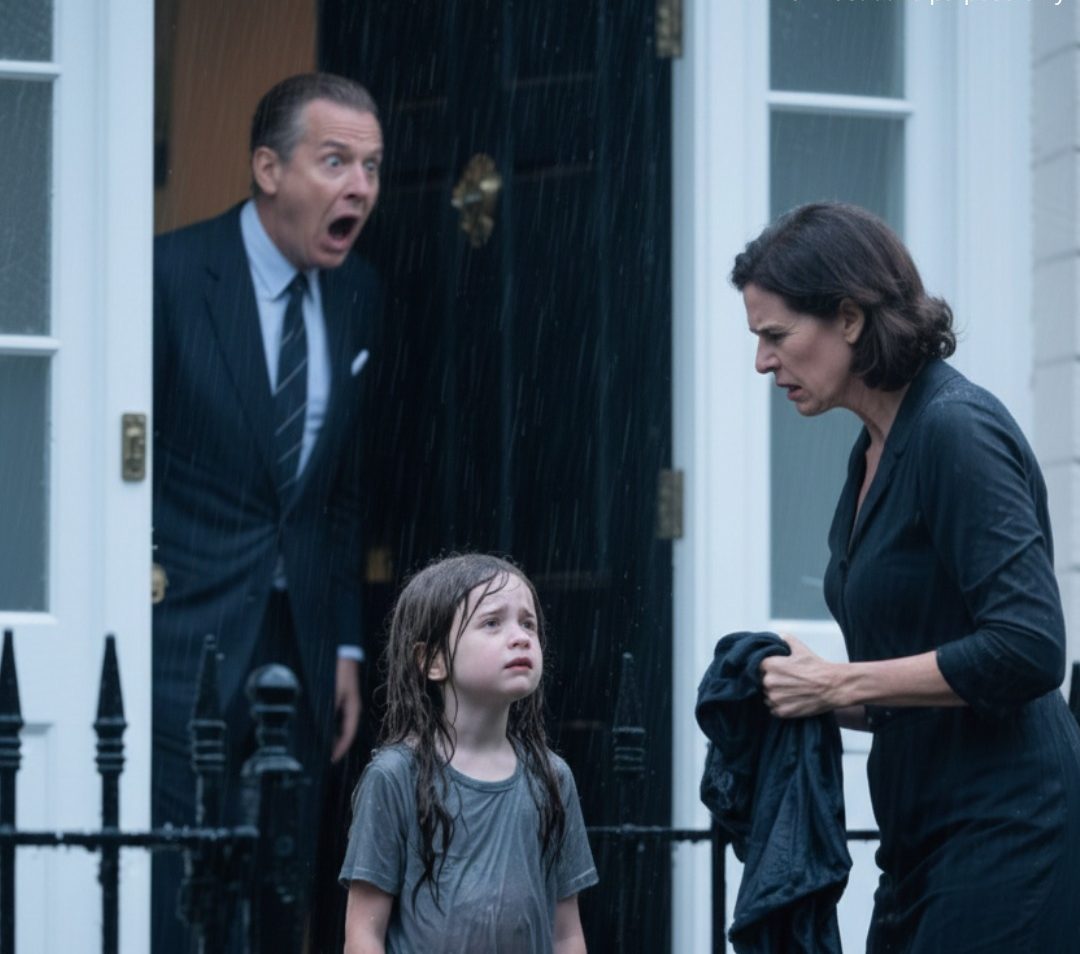
You hear your daughter’s voice on the voicemail as if it’s rising from the bottom of a deep well—thin, cracking, each word trembling the way her teeth likely are.
“Dad… please… hurry and come home. I’m really cold… and Raquel won’t let me change…”

Outside the ballroom, the air still carries expensive cologne and warm champagne. Applause with your name on it echoes faintly behind closed doors.
You’re wearing a perfectly tailored suit worth more than most people’s rent, gripping a contract meant to define your year.
Yet your entire body turns to ice, as if winter has been poured straight down your spine.
You stare at your phone—five voicemails in forty minutes—and realize you chose professionalism at the worst possible moment.
Rain streaks down the hotel windows, not cinematic or dramatic, but the kind that seeps into bones and lingers.
You hit play again, because your mind refuses to accept what your heart already understands.
You don’t excuse yourself to the investors.
You don’t bother sending a smoothing text.
You pivot and move, your body acting before your thoughts catch up.
Your assistant calls your name, but it hits you like sound against glass.
You cut through the lobby at a near sprint, ignoring stares and the receptionist’s polished smile.
The valet reaches for your keys with calm efficiency—meant for composed clients, not a father whose world has just split open.
You grab them with clumsy fingers and slam the door harder than necessary.
Once you pull onto the rain-soaked street, the city turns hostile—headlights smeared into streaks, horns blaring like accusations, wipers barely keeping pace.
You tell yourself you’re overreacting.
The same lie you’ve leaned on for months.
Then you remember how she said, “I’m really cold.”
And the lie collapses.
That honesty doesn’t absolve you, but it cracks the door to change.
You leave the hospital with your daughter stable yet fragile, her eyes darting at sudden sounds.
She grips your hand as if you might vanish.
And you realize she’s been rehearsing that fear for a long time.
You take her somewhere new—not the mansion with its leather couch and unspoken threats.
You stay awake all night watching her breathe, fully aware of what you almost lost.
In the morning, you sit beside her bed and gently ask what Raquel said when you weren’t there.
Your daughter hesitates, as if truth needs permission.
Then she whispers.
Raquel called her stupid.
Clumsy.
A burden.
She warned that you’d send her away if she complained.
That you traveled because you were tired of being her dad.
Each word drives in like a nail.
You feel them because you recognize your role.
You didn’t speak those lies—
but you were absent enough for them to sound true.
You tell your daughter none of it is real.
You make her look at you while you say it.
You cry in front of her, because you want her to learn that love doesn’t hide behind pride.
The second voicemail lands like a punch to the chest.
“Dad… she finally let me inside… but she won’t let me take off my wet clothes.”
Your daughter tries to sound brave, like she’s describing something too small to matter.
She mentions the couch.
Being forced to sit there dripping, while the house stays warm around her like a cruel joke.
You picture it with painful clarity.
Your clean-lined living room.
Leather furniture.
Overpriced art.
And a soaked child folding into herself.

The third message is worse.
Her voice is slower now, as if the cold is stealing her words.
“My lips feel weird… my teeth hurt… she said if I move it’ll be worse.”
You know what that means.
And you hate that you know it—
because you learned it as someone who might need the knowledge someday,
not someone who was supposed to prevent it.
The fourth message dissolves into raw crying.
Ragged breaths.
Apology after apology.
Like she thinks safety must be earned.
The fifth message is the one that makes you press the accelerator
as if you could outrun time.
“My teacher said hypothermia can make you sleepy…
and you can fall asleep and not wake up.”
Your eight-year-old says it calmly,
like she’s repeating a rule someone taught her to survive.
She’s afraid to sleep.
Which means she’s been sitting there, soaked, for hours—
fighting her own body.
You call your wife.
Once.
Twice.
Three times.
Only ringing silence.
You leave a voicemail that doesn’t sound like you.
Too calm.
Too controlled.
Too dangerous.
You tell her you’re fifteen minutes away
and she’d better have the best explanation of her life.
The words “consequences will be severe” come out smooth, almost polite.
That frightens you more than shouting ever could.

As you drive, memory catches up.
Your first wife’s death.
The hollow space it left.
How quickly you remarried,
because loneliness felt like failure.
You told yourself your daughter needed a mother figure.
You told yourself you needed someone who could “hold down the home.”
Now the home feels like the most dangerous place she’s ever known.
Rain pounds the windshield like fingernails.
Streetlights blur.
Every red light feels personal,
like the universe testing whether you deserve to arrive in time.
Your jaw aches from clenching.
You imagine her small shoulders shaking.
Her wet uniform heavy like punishment.
Her eyes drooping with exhaustion.
You imagine your wife upstairs—
dry, warm,
convincing herself this is “parenting.”
Something shifts.
Not just rage.
Clarity.
You see how you’ve outsourced love
like a task on a calendar.
Presence treated as a luxury you’d buy later—
after the next deal,
the next trip,
the next success.
The realization turns your stomach.
You can’t negotiate your way out of what happens
when a child learns help arrives late.
You take a turn too sharply.
The tires slip—just for a second.
Enough to remind you
control has always been an illusion.
You pull into your gated home
and park like you’re abandoning the car.
You don’t fix your tie.
You don’t check your reflection.
Rain soaks your suit within seconds.
You don’t care.
Your key scrapes the lock—
your hands are shaking.
The door swings open hard enough to hit the wall.
You shout your daughter’s name.
Your voice echoes off stone and glass.
The house is too quiet.
The kind that means people are asleep—
or pretending.
You move fast toward the living room.
Heart hammering.
And then you see her.
Curled small on the leather couch,
like an animal conserving warmth.
Clothes plastered to her body.
Water pooled beneath her like evidence.
Her hair sticks to her cheeks.
Her skin looks wrong.
Her lips are edged in blue.
Your stomach drops.
You’ve seen hypothermia photos online.
You never imagined seeing them
in your own home.
You kneel and touch her face.
The cold shocks you.
Ice cold—not just cool.
Your fingers recoil instinctively.
You hate that your body flinches
from what she endured.
She opens her eyes halfway.
“Dad.”
She says it like she’s not sure you’re real.
You tell her you’re here—
again and again—
as if repetition could fix time.
Her uniform is so soaked it has weight.
When you lift her,
water seeps into your shirt,
your jacket,
your expensive life.
You don’t care.
And that’s how you know something has changed.
You ask where Raquel is.
Your daughter barely whispers,
“In her room… she said not to bother her.”
That sentence hits harder than the cold.
It isn’t just cruelty.
It’s certainty.
Raquel was sure you wouldn’t arrive in time.
And you realize—
she’s been right before tonight.
You carry your daughter upstairs,
each step a prayer you didn’t know you still believed in.
In the bathroom,
you run the tub warm—
not hot.
Your mind ticks through emergency steps.
You gently peel away the wet fabric.
It clings to her skin like punishment tape.
She makes a small sound of pain.
You swallow rage
until it tastes metallic.
You see bruised-looking patches
on her fingers
and toes.
You force yourself not to panic.
Panic doesn’t help children.

You wrap her briefly in a towel,
then guide her into the warm water.
You speak softly,
the way your first wife once did
when your daughter was sick.
She winces.
Says it burns.
You explain
her body is waking up.
You hold her hand above the water
so she isn’t alone in the pain.
Then you call emergency services.
You say it out loud:
“My child has hypothermia
from prolonged exposure.”
Saying it makes it real.
Real makes you furious.
The dispatcher asks questions
in a professional tone
that suddenly feels like judgment.
You answer honestly.
Past the point of protecting reputations.
You say your wife left her outside in the rain as punishment.
Then refused to let her change for hours.
There’s a pause.
A system waking up.
The dispatcher’s voice lowers.
“Sir, that constitutes
child abuse and neglect.
I’m notifying child protective services.”
You don’t argue.
You don’t plead.
“Do what you have to do—
just get help here.”
Your daughter’s eyelids droop.
You urge her to stay awake.
Look at you.
Squeeze your fingers.
Her hand feels too weak.
You hate that she knows
the word hypothermia
at eight years old.
You hate that she had to beg you
to come home
like a stranger
she wasn’t sure would arrive.
You leave the bathroom
for one minute.
Just one.
Because the other emergency
is in your bedroom.
Raquel is exactly where your daughter said.
In bed.
Dry.
Warm.
Scrolling
like nothing is wrong.
The lamp casts a peaceful glow.
The normalcy feels obscene.
You yank the earbuds from her ears.
She snaps up—
angry.
Like you disturbed her comfort.
She starts to speak.
You cut her off.
“She’s hypothermic.”
The word hangs heavy.
Raquel blinks
like it’s just drama.
She shrugs.
“She was just wet.”
Something breaks inside you.
Clean.
Final.
You tell her an ambulance is coming.
Child services
have been notified.
For the first time,
her confidence falters.
Color drains from her face.
Then she says
what abusers always say:
“I was teaching her responsibility.”
You step closer.
Your voice stays low.
Low is more frightening
than yelling.
You ask
what responsibility an eight-year-old learns
from losing body heat
until she turns blue.
Raquel pivots to victimhood.
You’re overreacting.
You’re making a scene.
You’re undermining her.
But you see it clearly now.
She isn’t afraid for your daughter.
She’s afraid of consequences.
She says she didn’t know
it would get “that serious.”
The casual tone
strips the mask away.
This wasn’t a mistake.
It was a pattern.
She wanted your daughter scared.
Obedient.
Small.
Fear was easier than love.
Control easier than care.
You tell her:
She will never be alone
with your child again.
No negotiation.
No softening.
Panic flashes in her eyes.
“You can’t do this—
we’re married.”
You answer simply:
“I’m her father.”
Sirens draw closer.
Judgment climbing the driveway.
Paramedics move fast.
Calm.
Practiced.
They check your daughter’s temperature.
They exchange a look
you don’t like.
Her core temp is low enough
to need monitoring.
Your stomach drops again.
Your daughter panics at the stretcher.
She clings to you
with wet fingers.
You promise you’re going with her.
And this time,
you mean it.
Wrapped in thermal blankets,
she looks impossibly small.
Swallowed by fabric.
You realize
she’s lived like that emotionally too.
Wrapped in fear.
Trying not to take up space.
At the hospital,
doctors speak carefully.
It still cuts.
They tell you she’s lucky
you arrived when you did.
And luck
isn’t a parenting strategy.
They ask what happened.
You tell it
without excuses.
Each sentence
feels like confession.
A social worker arrives.
Folder in hand.
Her gaze is firm—
not cruel.
She asks you to recount everything.
The hardest part
is how easy it becomes
once you stop lying to yourself.
You tell her about the voicemails.
The rain.
The couch.
The refusal to change clothes.
The threat:
“If you move it’ll be worse.”
Then comes the question
you dreaded.
“Has there been other punishment?”
Your throat tightens.
Memories flash.
Your daughter going quiet
when Raquel enters.
Flinching at sharp tones.
“Lessons”
that looked like humiliation.
Endless chores.
Toys taken indefinitely.
Meals withheld
“until she learns.”
You admit
what you knew.
And what you ignored.
The social worker doesn’t shame you.
She writes.
Her job is protecting a child—
not comforting an adult.
She asks if your daughter
is afraid of your wife.
You say yes.
Then she asks
why you allowed it.
And you answer,
with words that taste like ash:
“Because I wanted to believe
my life was stable.”
In the weeks that follow, you do things you once thought were “small” and “domestic,” as if they weren’t the foundation of safety.
You learn how to make soup without ordering it. You learn how to braid hair badly and laugh about it instead of feeling embarrassed.
You set alarms not for meetings, but for pick-up times, for therapy appointments, for the simple instruction: be home.
Your daughter starts seeing a child psychologist who talks about trauma in a way that makes you feel both guilty and grateful.
The therapist explains that abuse isn’t only bruises—it’s fear, isolation, the slow shrinking of a child’s self-worth.
She tells you your daughter needs consistency, and that consistency is the part of love you can’t outsource.
You request reduced travel and delegate more. For the first time, your success feels measured by the quiet in your daughter’s shoulders.
Legal consequences move in parallel—reports, evidence, recordings, weather data, medical notes.
Raquel tries to minimize, tries to spin, tries to frame it as a “misunderstanding.”
But the body doesn’t misunderstand hypothermia.
And a judge doesn’t misunderstand a child’s voice on voicemail.
When Raquel realizes she can’t charm her way out, she turns on you instead.
She claims you’re overreacting because you feel guilty, that you’re using her as a scapegoat.
She suggests you’re being manipulated by your daughter—and that suggestion shows you how dangerous she really is.
You stop arguing with her, because arguments give her a stage.
You communicate through attorneys, document everything, and follow every protective order like it’s oxygen.
The first time you tell your daughter she will never have to see Raquel again, she doesn’t cheer.
She simply exhales.
It’s the saddest sound you’ve ever heard, because it means she’s been holding her breath for months.
You begin noticing how fear still lives in her—how she apologizes for spilling water, asks permission to use the bathroom, freezes if you sound stressed.
Each time, you stop, kneel, and remind her she is safe.
You don’t say it once; you say it again and again, because safety is built through repetition.
Slowly, your daughter begins to believe you.
One evening, months later, rain taps the windows.
Your daughter glances up, then quickly back down, like she expects punishment to fall from the ceiling.
You pause what you’re doing and sit beside her.
You tell her the rain is just rain, and no one will ever make her sit in it again.
She studies your face the way children do when they’re deciding whether adults are real or just loud.
Then she asks, quietly, why Raquel was so mean if she hadn’t done anything wrong.
You swallow the urge to demonize, because you don’t want your daughter carrying hate like a second backpack.
You tell her some people are broken and choose control instead of healing, and broken adults don’t get to make children pay for their pain.
You make sure she hears the most important sentence:
“None of it was your fault.”
Your daughter blinks fast, then nods, like she’s trying to lock the words somewhere safe.
She asks if you’ll ever marry again.
You answer honestly—you don’t know.
But if you ever do, you tell her, her comfort will decide everything, because she is your priority, not your image.
She leans into you and holds on.
You let her—because you finally understand that love is proven in staying.
On the first anniversary of that night, you take her to a quiet café and let her order the biggest hot chocolate on the menu.
You sit across from her and watch her hands—no longer raw, no longer trembling, no longer bracing for impact.
She talks about school, a friend, a book she likes, and you realize she has returned to the world of ordinary childhood.
The therapist told you healing isn’t linear, and you’ve seen that truth on the nights she wakes up crying, convinced she’s “in trouble.”
But you’ve also seen progress—in her laughter, her willingness to ask for help, in the way she says “Dad” like it’s safe.
You apologize again, not dramatically, but steadily, and you tell her you will always answer when she calls.
She nods and says she believes you.
That simple sentence feels bigger than any deal you’ve ever signed.
Outside, rain begins to fall again, soft and persistent.
She watches it for a moment, then looks at you and smiles—without fear.
And you understand the lesson that finally cost you something real:
the only wealth that matters is who you choose to protect, every single day.
That night, back home, your daughter falls asleep easily—no bargaining, no panic, no whispered “don’t leave.”
You sit at the edge of her bed a little longer, listening to her breathing, letting the quiet settle in your chest.
You think about the version of yourself who ignored his phone because he didn’t want to look unprofessional.
You think about how close you came to receiving a call no father survives.
Your hands shake—not from cold, but from memory.
Blue lips. A soaked uniform.
You let the fear teach you instead of haunt you.
You vow never to confuse providing money with providing safety again.
You turn off the light, leave the door cracked the way she likes it, and listen as rain taps the roof—harmless now, just weather.
For the first time in a long time, the house feels right.
Not a mansion. Not a showroom. Not a stage.
Just a shelter.
You set your phone face-up on the counter and leave the ringer on.
Because you finally understand what your daughter tried to tell you in five voicemails:
Being present isn’t a bonus.
It’s the job.