For years, I was convinced I knew my daughter.
Not just her habits or her schedule—but her soul. I believed I understood the quiet rhythms of her heart, the way only a parent thinks they can.
After my divorce, it had been just the two of us in our modest Massachusetts home. No shouting. No chaos. Just calm mornings, shared dinners, and evenings wrapped in silence. My thirteen-year-old daughter, Lily, was everything a single mother could hope for—polite, responsible, disciplined. She did well in school. She followed rules. She never caused trouble.
I told myself I was lucky.
I didn’t know how wrong I was.
A Comment That Refused to Fade
It began with a remark so casual it almost slipped past me.
One Thursday morning, as I locked my door and headed to work, my elderly neighbor Mrs. Greene waved me over. She was the kind of woman who noticed everything—the mail, the trash, the comings and goings of the street.
“Olivia,” she said gently, lowering her voice, “has Lily been coming home early from school again?”
I stopped cold.
“Again?” I asked. “No… she’s at school all day.”
Mrs. Greene hesitated, eyes searching my face. “I’ve seen her. During school hours. And she’s not always alone.”
I forced a smile, dismissed it as confusion, and drove away.
But the word again followed me all day.
The Mother’s Instinct We Try to Silence
Lily had been quieter lately. Eating less. Sleeping more. Carrying a tiredness that sleep never cured. I had blamed hormones. Stress. Adolescence.
That night, she smiled when I asked about school. Said everything was “fine.” When I mentioned Mrs. Greene’s comment, she laughed—but just a second too late.
“I’m always at school, Mom.”
Her eyes didn’t smile with her mouth.
That night, I didn’t sleep.
By two a.m., I knew something was wrong.
A Choice That Broke My Heart
The next morning, I kissed Lily goodbye and waited.
Fifteen minutes later, I returned home, parked down the street, and slipped inside. The house was silent.
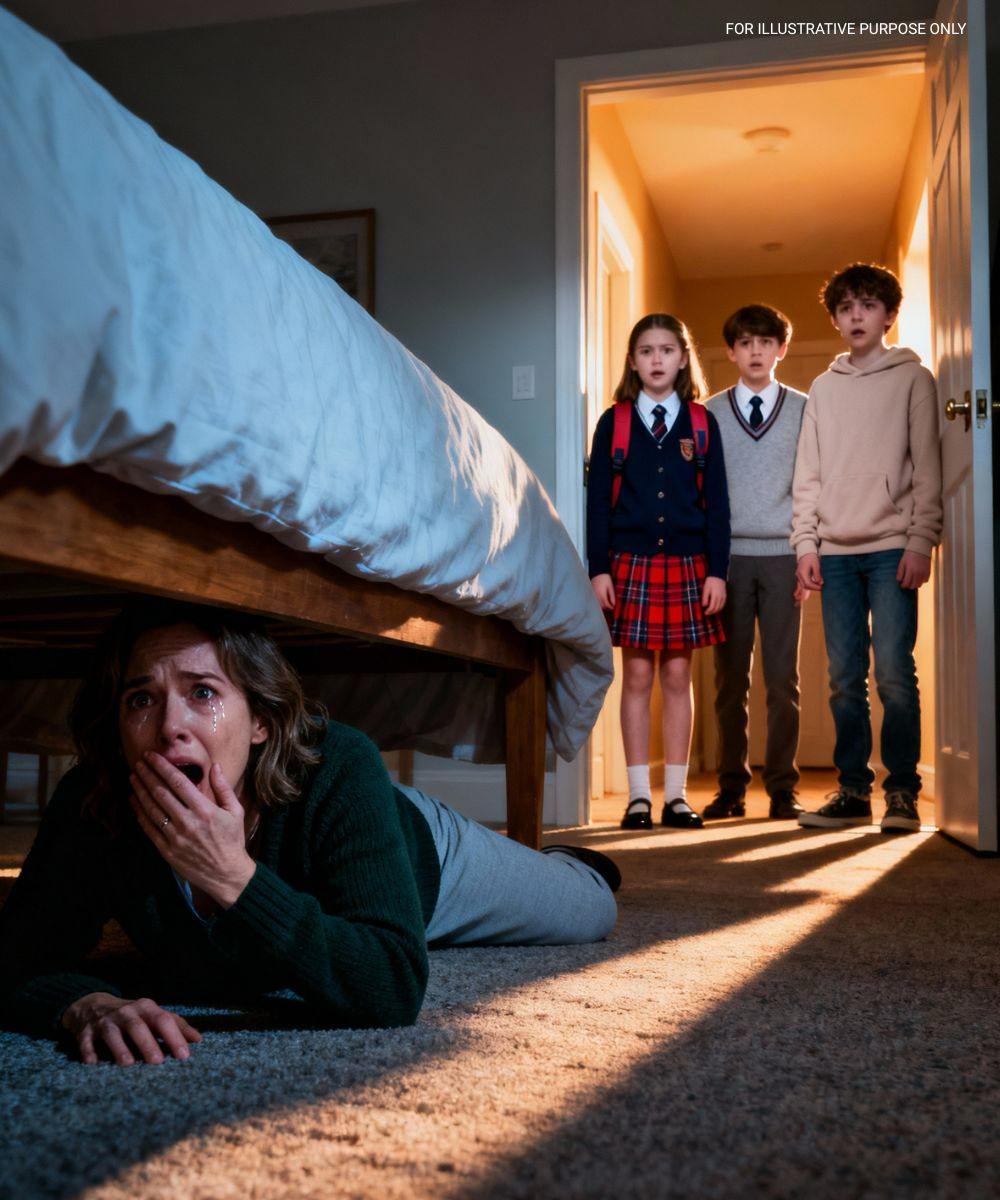
My heart thundered as I crept upstairs and slid beneath her bed.
And I waited.
At nine o’clock, nothing.
At nine twenty, doubt crept in.
Then the front door opened.
Soft footsteps. Careful ones. More than one.
Children.
I heard Lily whisper, “Quiet.”
My breath caught.
The Truth Beneath the Floor
I listened as voices filled the house.
A boy murmured, “My dad was angry again this morning.”
A girl whispered through tears, “They pushed me yesterday.”
Another voice trembled, “They took my lunch. Everyone laughed.”
These weren’t rebellious kids.
They were broken ones.
“You’re safe here,” Lily said softly. “Mom works late.”
Someone asked, “Shouldn’t you tell her?”
There was a long pause.
“I can’t,” Lily whispered. “She already fought so hard for me once. I don’t want her to hurt again.”
I covered my mouth to stop myself from crying.
When Silence Becomes Complicity
The children spoke of teachers who looked away. Of warnings ignored. Of pain buried to survive.
That’s when I stepped out.
The room froze.
Lily collapsed into my arms, sobbing. “I just wanted to protect you.”
I held her tighter than I ever had before.
“You don’t have to be strong alone,” I told her. “That’s my job.”
What Happens When Parents Finally Listen
That afternoon, parents filled our living room. Stories poured out. Proof surfaced. Truth demanded action.
Change followed.
Slowly. Painfully.
But it came.
Months later, Lily smiled again.
One night, she whispered, “Real strength isn’t hiding pain.”
She was right.
It’s sharing it.
And facing it—together.