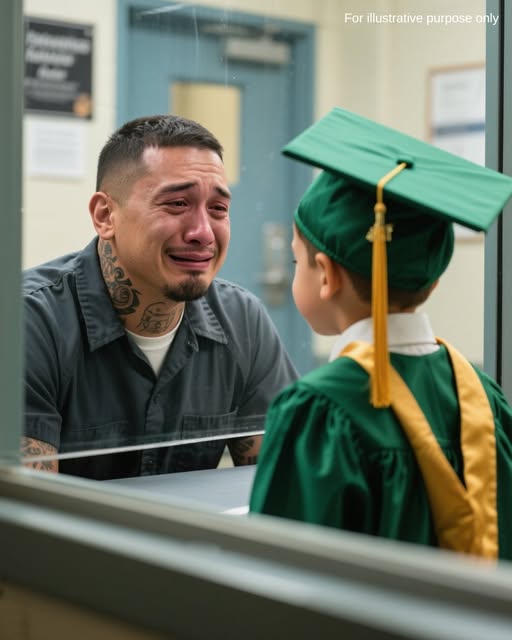
The empty seat at the graduation ceremony broke the little boy’s heart.
But the 6-year-old refused to celebrate until he shared his big moment with the one person who couldn’t be there.

Gabriel had been serving time for the last three years. His past was written all over his face in ink—swirling tattoos that told stories of mistakes, losses, and survival. To the guards and other inmates, he was just another number in the system. But to his son, Mateo, he was just “Dad.”
For months, Gabriel had been dreading this week. It was Mateo’s kindergarten graduation. In the weeks leading up to it, during their phone calls, Mateo would chatter endlessly about the songs they were learning, the tiny hand-decorated caps his classmates had made, and the bright blue gown he couldn’t wait to wear. Sometimes Gabriel would pretend he wasn’t crying into the phone, hiding his tears behind the receiver.
He had to swallow the lump in his throat, imagining the ceremony he couldn’t attend—the applause he couldn’t give, the hugs he couldn’t share. He felt like he had failed the one person who mattered most.
The ceremony was yesterday. Gabriel spent the day staring at the concrete wall, tracing the lines and cracks with his eyes, imagining Mateo’s little feet tapping across the stage. He could almost hear the teachers calling out names, the proud smiles of parents he couldn’t see.
But today was visiting day. Gabriel walked into the booth, expecting a normal visit, a routine exchange of hellos and updates.
When he looked up, his knees nearly buckled.
Standing on the other side of the reinforced glass wasn’t a boy in street clothes. Mateo was standing there in his full blue cap and gown, clutching his rolled-up diploma. His tiny shoulders were stiff with pride, and a smudge of chocolate from breakfast still lingered on his cheek.
His mother said he had refused to take the outfit off for twenty-four hours. “I have to show Daddy first,” he had insisted. “He has to see I graduated.”
Mateo held the paper up to the partition, beaming a smile that could light up even the dingiest corner of the prison. “Look, Daddy! I did it!”

Gabriel, a man who hadn’t cried in years, felt something crack inside him. He pressed his tattooed hand against the cold glass, trying to get as close as the law allowed. Mateo immediately pressed his tiny hand against his father’s, the warmth from the other side reaching him in a way that no bars or walls could block.
He noticed a small, handmade medal hanging from Mateo’s neck, painted with stars and glitter. Mateo had whispered over the phone for weeks about how he wanted Daddy to see it first. “I made it for you, Daddy. So you remember me when you’re gone,” Mateo had said.
In that visiting booth, the prison walls disappeared. Gabriel wasn’t an inmate with a record; he was a father, bursting with pride, laughter, and love. He whispered words he hadn’t dared say in months, “I’m so proud of you, buddy.”
He wiped his eyes, his fingers tracing the outline of Mateo’s on the glass. And right there, he made a vow. He promised that by the time Mateo graduated high school, there wouldn’t be any glass between them—only hugs, laughter, and the freedom to share every moment together.