I had just grabbed my keys from the kitchen counter when I called out, “Mira, don’t forget your jacket.”
My four-year-old daughter’s muffled reply floated out from her bedroom closet. “I don’t need it, Daddy!” she hollered, her voice slightly warped by whatever mountain of toys she was buried under.
I sighed, but a smile tugged at my mouth. Even at her age, Mira was determined, stubborn, and fiercely independent. Being her father was the greatest joy of my life—but raising her on my own hadn’t been easy. Her mother, Elena, had left before Mira’s first birthday. One night she said she felt “trapped,” and by morning she was gone, leaving behind a note and a baby who still cried through the night.
Those first months nearly broke me. Mira woke constantly, screaming for reasons I didn’t yet understand. I tried everything—rocking, humming, bouncing—only for her to erupt again the moment I tried to lay her down. I learned to sleep sitting up with her on my chest. I learned how to make bottles half-asleep. Slowly, painfully, we found our rhythm.
Eventually, we became a team. Just us against the world.
Things began changing a few months ago, when I met Tessa.
It happened on a rainy Wednesday morning. I had ducked into my usual coffee shop, ordering my predictable black coffee, no sugar, no cream. I was exhausted, rain-soaked, and already running late for work. Behind me stood a woman with chestnut hair and a teal scarf wrapped around her neck.
“You look like that coffee needs… reinforcements,” she joked lightly.
I turned around, caught off guard, and couldn’t help laughing. “Is it that obvious?”
“Oh, definitely,” she said, her smile warm and unforced. “Rough morning?”
“That’s obvious, too?” I asked.
“Painfully.”
Somehow that opened a conversation that lasted nearly half an hour—about weather, work, childhood disasters, and the horror of stepping on Legos barefoot. She was easy to talk to in a way I hadn’t experienced in years.
When we left the café, we exchanged numbers. A week later, we went on our first date. Two weeks after that, she asked if she could meet Mira.
I hesitated—introducing someone to my daughter was a big step—but Tessa felt genuine. Kind. Steady. So I agreed.
The first time they met, Mira only peered at her from behind my leg. By the third time, she was offering Tessa stickers. By the fifth, she asked if Tessa could read her a bedtime story. Anyone who knew Mira understood that this was monumental. My daughter didn’t warm up to just anyone—not even most relatives.
Tonight was the first time Mira and I would visit Tessa’s home. All day, Mira had talked about it nonstop: I hope she has sparkly lights, I hope she has a big couch, I hope her house smells like cookies. I told her we’d see.
When we pulled up, Mira gasped so loudly I nearly jumped. “Daddy! Look! She has fairy lights!”
Tessa’s apartment balcony was wrapped in soft gold bulbs that twinkled against the cool evening. I grinned. “Looks like you got your wish.”
Before I even knocked, the door swung open. “Hey, you two!” Tessa said, stepping aside to usher us in. “Come in, it’s freezing.”
Mira darted inside as if she had always lived there. The apartment radiated warmth. Soft yellow lighting, a plush sunflower-colored couch, shelves lined with books and old cameras, a row of succulents basking under a warm lamp. A small artificial tree still sat in the corner, decorated with silver ribbons—Christmas long packed away everywhere else except here.
“This place is amazing!” Mira cried, spinning theatrically.
Tessa laughed. “Thank you. Hey, do you like video games, Mira? I found an old console in my room. Want to try it while your dad helps me in the kitchen?”
Mira’s eyes grew huge. “Can I, Daddy?”
“Sure,” I said. Tessa held out her hand, and Mira took it without hesitation.
As the two disappeared down the hallway, I stepped into the kitchen. The scent of garlic, rosemary, and roasted potatoes filled the air. Tessa was pulling a tray of vegetables from the oven when she glanced back at me.
“Any embarrassing childhood stories you want to warn me about before I meet the extended family?” she teased.
“Oh, if we ever get to that point, I’ll give you a whole book.”
She smirked. “Your turn to share, then.”
“Nah,” I said, grabbing two plates from the counter. “You start.”
She grinned mischievously. “Okay, fine. When I was seven, I tried to ‘help’ my mom repaint the living room. I poured an entire bottle of glitter on the walls because I thought it would make the house magical.”
I burst out laughing. “Let me guess—she didn’t think it was magical.”
“Oh, she thought some things,” Tessa said dryly. “But magical was not one of them.”
As I laughed, I imagined Mira doing the same one day, and it made my chest warm.
But the warmth vanished the moment Mira appeared in the doorway.
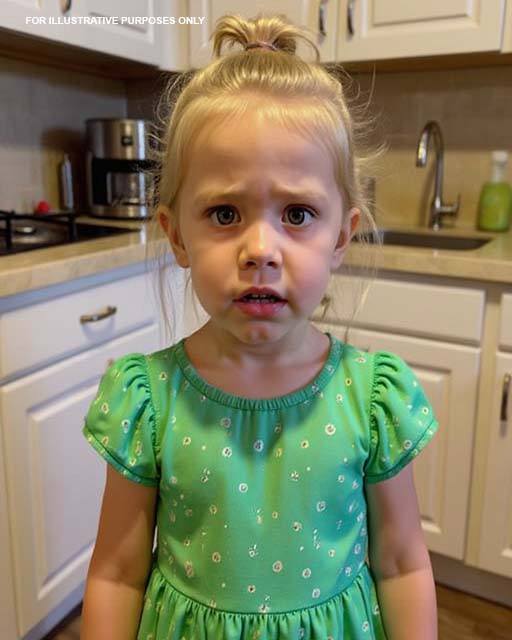
She stood frozen, tiny shoulders shaking, eyes wide—terrified. Real, visceral fear.
“Mira?” I lowered the plate and dropped to one knee. “Sweetheart, what’s wrong?”
Her gaze flicked down the hall, then back at me. She swallowed hard. “Daddy… I need to talk to you. Alone.”
My stomach tightened. “Of course.” I stepped with her toward the front door, crouching in front of her. “What happened?”
Her eyes filled with tears. “She’s bad, Daddy.”
My heart stopped. “Tessa?”
Mira nodded frantically. “I saw something. In her closet.” Her voice dropped to a trembling whisper. “There are heads in there. Real heads.”
For a moment, I thought I misheard. “Heads?”
She tugged at my sleeve desperately. “People heads! They were staring at me. Daddy, I want to go home. Please. Please.”
Her panic hit me like a blow. Mira didn’t lie. She didn’t exaggerate. She didn’t even pretend things for attention. Her fear was real, raw, shaking through her tiny body.
I scooped her up instantly. “Okay. We’re leaving.”
I grabbed our things as she clung to my shirt, burying her face in my neck.
Tessa turned from the kitchen, confused. “Everything okay?”
“Mira’s not feeling well,” I said quickly. “I think we need to head home.”
“Oh no,” she said, frowning. “Is she sick?”
“She will be fine. I’ll call you later.” And before she could question me further, I gently hurried Mira out the door.
The entire drive to my mother’s house, Mira sat curled in her seat, knees drawn to her chest, trembling.
I kept glancing at her in the rearview mirror. “Sweetheart,” I said softly, “are you sure about what you saw?”
Her chin wobbled. “I know what I saw. They were real.” Tears spilt down her cheeks.
By the time I parked at my mom’s house, my mind was a hurricane of confusion and dread. I carried Mira inside. My mother sat on the couch, knitting, her expression instantly concerned.
“What’s wrong?” she asked.
“Mira had a scare,” I said, trying to keep my voice steady. “I need to check something at Tessa’s place. I won’t be long.”
Mom narrowed her eyes. “You’re white as a sheet. What happened?”
“Just a misunderstanding, I think,” I lied, gently setting Mira down. “Watch her for me. Please.”
Mom nodded, though worry furrowed her brow.
When I got back into the car, my hands were shaking. Mira’s words replayed in my head: There are heads in her closet. I didn’t believe that, of course—not literally—but something had terrified her, and I needed to know what it was.
Back at Tessa’s apartment, she opened the door, looking startled. “You’re back already. Is everything—”
“Can I… play that old console you mentioned?” I said abruptly.
Her eyebrows lifted. “Uh… sure. Of course. It’s in my room.”
I walked down the hallway, pulse pounding so loudly I could hear it in my ears. When I reached her room, I swallowed hard, approached the closet, and slowly slid open the door.
And there they were.
Four heads stared directly at me.
But they weren’t human.
One was a grotesque clown mask, its grin twisted unnaturally wide. Another was a pale, ghostly face with hollow black eyes. A third was wrapped in crimson cloth like some eerie doll. The last was an alien—green skin, bulging eyes.
My heart slammed against my ribs.
I stepped closer. Reached out. Touched the clown’s face.
Rubber.
Masks.
I let out a long, shaky breath and closed my eyes. It was all pretend. Horror-mask cosplay props, probably from her college theatre days, she’d mentioned.
When I opened my eyes, guilt poured in like ice water.
I had run out with my daughter. Accused Tessa silently in my mind. Returned and searched her private space without permission. All because my daughter, terrified beyond reason, had misinterpreted Halloween masks.
I closed the closet quietly and walked back to the kitchen.
“Hey,” Tessa said softly, offering me a mug of coffee. “You sure you’re okay?”
I exhaled, rubbing my forehead. “I need to tell you something.”
Her posture stiffened. “This sounds serious.”
“It’s about Mira. She was… terrified earlier. She said she saw heads in your closet.”
Tessa blinked. “Heads?”
“I know how it sounds. But she’s four, and when she’s scared, she believes everything she sees. I didn’t know what else to do, so I came back to check.”
Tessa’s mouth fell open. “You looked in my closet?”
“Yes, and I’m sorry. I shouldn’t have. But she was shaking, Tessa. She thought she was in danger.”
Tessa stared at me for a moment—then burst into laughter. Not mocking, but incredulous. “She thought my masks were real?”
I didn’t laugh. “She was terrified.”
Tessa’s laughter softened into a sympathetic sigh. “Oh, poor kid.” She pressed a hand to her chest. “I didn’t even think about how scary they might look to a child.”
“She still thinks they’re real,” I said helplessly. “She wouldn’t even look toward your hallway.”
Tessa’s eyes brightened with an idea. “Then we need to show her they aren’t real.”
The next morning, Tessa arrived at my mom’s house carrying a colourful tote bag. Mira peeked at her from behind the couch, wary.
Tessa knelt on the rug. “Hi, Mira,” she said gently. “I brought something to show you.”
Mira gripped my pant leg but nodded cautiously.
Tessa pulled out one of the masks—a silly one this time, with wobbly googly eyes and a lopsided smile. She put it on dramatically. “See? It’s just me.”
Mira gasped softly but didn’t run.
Tessa lifted the mask. “Not real. Just rubber. You can feel it if you want.”
Mira hesitated. Slowly, she reached out and poked the mask. Then squeezed it. Her eyes widened. “It’s squishy.”
“Exactly.” Tessa smiled. “Want to try it on?”
Mira hesitated only a moment before slipping it on. It dwarfed her head, and she stumbled around giggling. Tessa pretended to faint dramatically. “Oh no! The squishy-faced creature has come to life!”
Mira shrieked with laughter.
Hearing that sound—light, free, unafraid—released the tension I’d been holding for almost twenty-four hours.
From that day forward, Mira adored Tessa. The fear vanished completely, replaced by fascination. Whenever we visited, she insisted on trying on the masks, parading around like a miniature monster.
Months passed. Seasons shifted. What once felt tentative blossomed into something steady and warm. Tessa didn’t just tolerate Mira—she loved her, wholly and without reservation. She learned Mira’s favourite pancake shape, remembered her stuffed animals’ names, and never forgot that bedtime required precisely three kisses: one on each cheek and one on the forehead.
One bright spring afternoon, all three of us walked through the park. Mira tugged at Tessa’s hand. “Can we go to the swings, Mommy Tessa?”
Tessa froze slightly, startled but smiling. She looked at me, unsure how I’d react.
I felt emotion swell in my chest, deep and full. “Go on,” I said softly.
Tessa squeezed Mira’s hand gently. “Of course we can, sweet girl.”
As I watched them run ahead—my daughter’s laughter floating on the breeze, Tessa keeping pace beside her—I realised how close we had become, how easily Tessa had woven herself into our small world.
A moment that could have destroyed everything had instead brought us closer. It taught me to listen—to my daughter, to my instincts, and to the people I was learning to trust.
Sometimes, the scariest moments lead to the strongest bonds.
And sometimes, all it takes is a bit of honesty, patience, and laughter to make the world feel safe again.