At 6:37 AM, Andrés Herrera locked his apartment door with the same uneasy hands that had kept him awake all night. His nerves were shot, his eyes swollen, and inside his cheap briefcase sat the only thing keeping his life from collapsing: a USB drive containing a video that could clear his name. He had less than an hour to get to the downtown courthouse. One mistake, one delay, and he was done.
His battered white sedan coughed to life after three attempts, the engine shaking like it wanted to give up on him the same way the world had. He crossed himself out of habit and pulled into the morning traffic, navigating through the rush-hour gridlock with the desperation of a man running out of time.
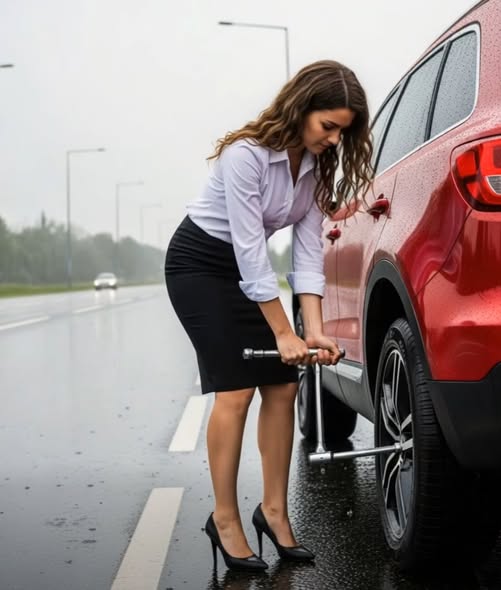
On a side road near the industrial district, he saw her: a woman standing beside a gray sedan, trunk open, spare tire on the ground. She looked furious and helpless at the same time, waving at her powerless phone as if yelling at it would bring back the signal. Andrés’s foot hit the brake before his brain caught up. Late or not, the instinct to help was stronger than the fear riding him.
He rolled down his window. “Do you need help?”
She turned. Dark hair pulled back, professional clothes, cool eyes masking frustration. She looked like someone who ran things—someone used to control, not a flat tire at sunrise. “Yes, please. I’m late for something important.”
A familiar line. Andrés parked, got his jack and tools, and got to work. She watched him closely, silent and alert, as if memorizing him.
“You in a hurry too?” she asked.
“Very,” he said without looking up.
“New job for me,” she said. “Terrible first day.”
“Maybe the day improves,” Andrés muttered, tightening the last lug nut.
Ten minutes later, the tire was fixed. She asked for his name. He told her. She thanked him with a sincerity that caught him off guard, then drove off into traffic. Andrés didn’t notice that the USB drive in his briefcase had slipped into the passenger seat of her car.
He reached the courthouse at 7:42, sweating through his shirt. The Fifth Civil Court loomed like a threat. Inside Courtroom 2B, he saw the people who had been tearing his life apart for weeks: attorney Salgado, smug as always, and Paula Aguilar, the supervisor who’d sworn he stole a company laptop containing confidential data.
Then he saw the judge.
The same woman from the roadside.
She froze for half a second when their eyes met. Not shock—recognition.
The clerk called his name. He stepped forward, heart pounding. The judge composed herself instantly, her tone sharp and professional as she started the session. Salgado delivered his usual performance, accusing Andrés of theft, manipulation, and misconduct. Paula sat beside him, chin high, eyes cold.
“Mr. Herrera,” the judge said, “how do you plead?”
“I’m innocent,” he answered. “And I have video proof that Paula is the one who took the laptop. The evidence is on a USB drive.”
He opened his briefcase.
Nothing.
His stomach dropped. He tore through the pockets, files, cords—nothing. His proof had vanished. Salgado smirked. Paula crossed her arms.
The judge leaned forward. “Mr. Herrera, without evidence, your claim has no weight.”
He tried to speak, but she held up a hand. “This court will recess. Find your evidence.”
He left the courtroom shaken. The hallway blurred as he walked, replaying the morning step by step, until it hit him like a punch.
The flat tire. Her car. His briefcase sitting open on her passenger seat.
He sprinted through the courthouse, begged security to let him into the judges’ parking area, and convinced a guard he’d left something critical in a judge’s car. They led him to a gray Mazda. His pulse roared. He opened the passenger door and reached under the seat. His fingers touched plastic.
The USB drive.
Back in the courtroom, he handed it to the technician. The security footage played on the screen: Paula entering the office after hours, empty-handed. Minutes later, leaving with a large bag. Timestamp perfectly matching the night the equipment disappeared.
Silence.
Salgado sputtered objections. The judge shut him down instantly.
“We will authenticate this video,” she said. “This hearing is not over.”
The session adjourned. Andrés finally breathed.
When he left the courthouse, Salgado cornered him outside with Paula in tow. Salgado carried a manila envelope.
“Twenty thousand pesos,” he said softly. “Tomorrow you plead guilty to a lesser charge. No jail. Case closed.”
Paula added, “Take it. You’ve already lost your job. Don’t lose your future too.”
Andrés looked defeated. Then he whispered, “Fine. I accept.”
What they didn’t know: the small device in his jacket pocket had recorded every word.
He spent the night listening to the recording repeatedly, his exhaustion hardening into resolve. By morning, he was ready.
In court, Salgado proudly announced that Andrés had agreed to plead guilty. The judge frowned. Andrés stepped forward.
“Your Honor, before any plea, I have one more piece of evidence.”
Salgado panicked.
The judge allowed it.
The audio played.
Every sentence. Every bribe. Every threat.
The courtroom froze.
When it ended, the judge’s face went cold as stone. “Attorney Salgado, Ms. Aguilar—your attempted bribery and obstruction of justice are criminal offenses. Officers, arrest them.”
The room erupted as guards moved in. Paula didn’t resist. Salgado shouted until he was dragged out in handcuffs.
Then the judge turned to Andrés.
“This court exonerates you completely. You’ll receive formal apology and compensation.”
Andrés let out a breath he’d been holding for months.
As the courtroom emptied, the judge approached him quietly.
“You dropped your USB drive in my car,” she said. “If you hadn’t helped me this morning… none of this would have come to light.”
“That tire saved my life,” he said.
“Sometimes fate works like that,” she replied.
Six months later, Andrés found work again and finally left the nightmare behind. The settlement helped him start fresh. The judge—Elena Morales—finished a demanding case out of town, and on a quiet Friday afternoon, she walked into the small café near the courthouse where she’d seen him once before.
Andrés was there, reading, coffee half-full.
She approached with a small smile. “Is this seat taken?”
He looked up, surprised but warm. “Not anymore.”
Sometimes a flat tire changes everything—your day, your fate, your whole damn life.